-
-

Header Image
-
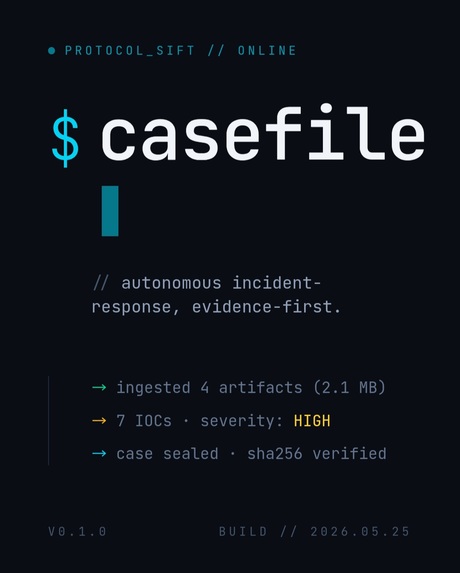
UI Branding

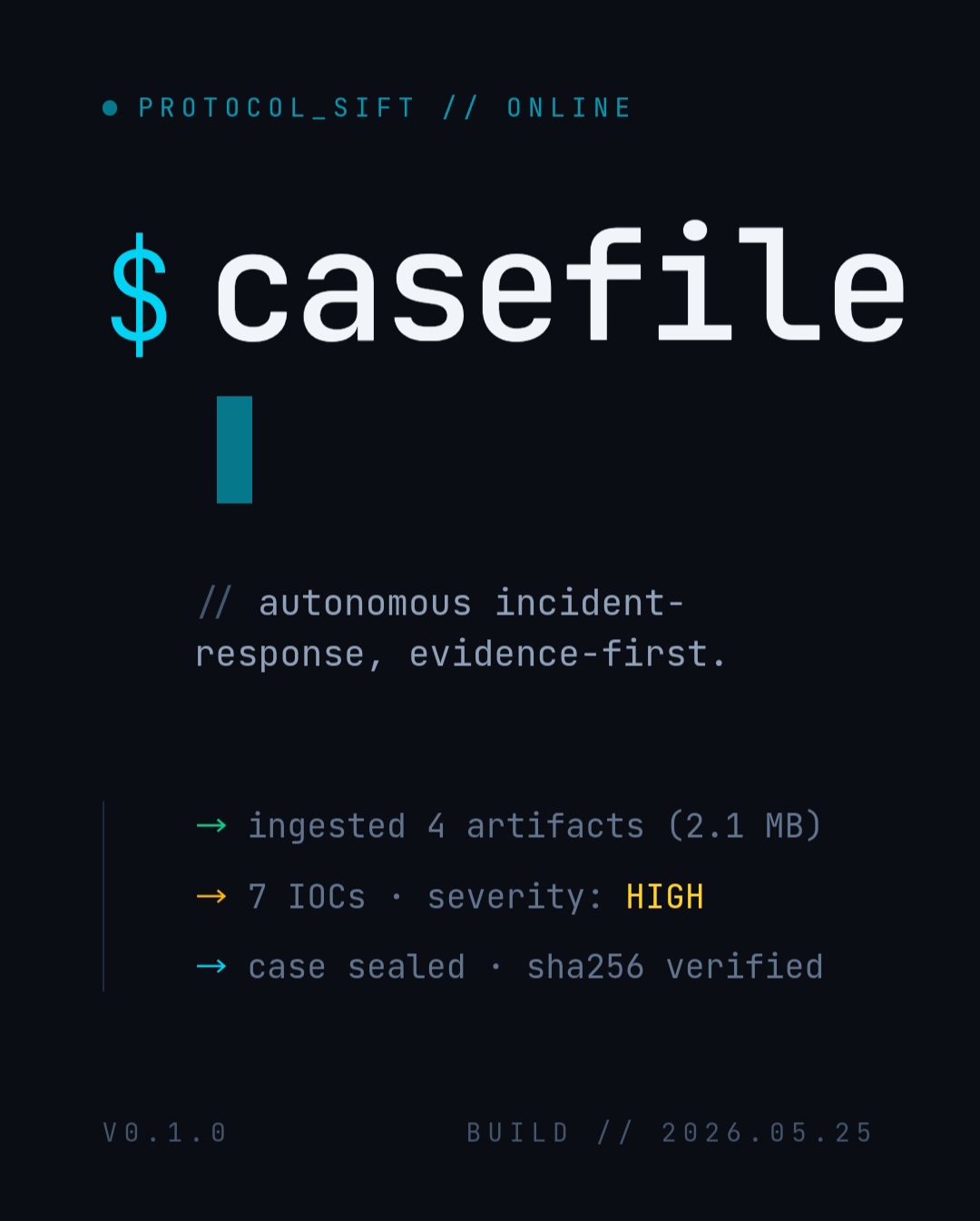
Inspiration
Two real problems push in opposite directions, and Casefile is built to address both at once.
Senior analysts cannot scale. The bottleneck in any blue team is the number of incidents a senior analyst can triage per day. Junior analysts learn by watching, but the watching is piecemeal — they see the final report, never the chain of reasoning that produced it. The learning curve is years long and largely tacit.
LLM agents in security cannot be trusted on their own. A model that writes confident-sounding IR conclusions without proof is worse than no agent at all, because it pollutes the case record with hallucinated indicators a human then has to disprove. The hackathon brief asked for an agent whose conclusions are verifiable, not just plausible.
Casefile is useful for the first problem only because it is trustworthy for the second.
What it does
A human uploads evidence — logs, network captures, packet captures, disk images, host-context notes — into a case folder. Casefile then investigates end-to-end on its own:
- forms hypotheses and picks forensic tools to test them;
- runs those tools over the verified evidence bytes;
- records each step as a structured finding (phase, rationale, what it expected, what it found, what to do next);
- self-corrects when threat-intel or a later tool contradicts an earlier hypothesis;
- produces a final incident report with severity, IOCs, a chronological timeline, recommendations, a numeric confidence score, and a verifiable chain of custody.
Everything streams to the browser live over Server-Sent Events, so a junior analyst can watch a senior-style reasoning loop unfold one tool call at a time. A "Chain of Custody" view shows every tool call with the SHA-256 of the exact bytes it read, so any conclusion can be re-derived from the persisted record.
Seven hand-authored sample cases ship in the UI as one-click loads,
spanning credential attack, endpoint malware, DNS exfiltration, disk
forensics, C2 beaconing over PCAP, ransomware-in-progress, and an
insider data-theft scenario where the correct call is a policy
judgment grounded strictly in the evidence. See
dataset.md.
Who it is for
- Junior analysts, who watch the rationale/expectation/result of each tool call instead of just the final verdict.
- SOC managers, who get an auto-triaged first pass with a confidence score and severity they can use to route work.
- Tabletop exercises, where Casefile can act as a synthetic responder against a scripted scenario.
How I built it
Casefile is a pnpm monorepo with TypeScript project references. The whole thing is one Postgres-backed Express 5 service plus a React + Vite UI, organized into three layers.
1. The agent loop (lib/sift-agent/). The architectural pattern is
a Direct Agent Extension: a single agent built directly on the model's
native tool-calling. The loop drives OpenAI gpt-5.4 (through the
Replit AI Integrations proxy — no API key in app code) with a system
prompt that defines a four-beat investigation cycle (triage → deep
analysis → synthesis → self-correction), an enumerated tool table, and
one non-negotiable rule: never claim a fact about evidence without a
tool-verified observation to back it up. Every reasoning step, tool
call, and tool result streams back to the browser over SSE.
2. The forensic tool suite (lib/sift-tools/). Eight pure
functions: a log parser, an IOC extractor (with Unicode-aware homoglyph
detection), an entropy scanner, a timeline builder, a network analyzer,
a PCAP analyzer, a disk-image analyzer (a pure-Node MBR/GPT parser that
hashes and reads decoded bytes), and mcpFetcher — the one tool that
touches the network. This is a self-built, SIFT-style toolkit; it is
not the SANS SIFT Workstation, and "SIFT" here is an homage rather than
a dependency.
These tools are not called directly by the agent. They are wrapped by a
custom MCP (Model Context Protocol) server (lib/sift-mcp/, built on
the official @modelcontextprotocol/sdk) that registers each one as a
typed, schema-validated MCP tool. The agent executes every forensic tool
by issuing an MCP tools/call, and a stdio entrypoint exposes the
identical tool surface to any external MCP client. This is the
hackathon's Custom MCP Server pattern: the agent speaks MCP to reach
its tools, and the MCP server registers only the typed forensic
functions — there is no execute_shell or other generic primitive on
that surface.
The MCP client speaks over two transports. By default it uses the
SDK's InMemoryTransport to an in-process server wrapping Casefile's own
simulated, SIFT-style tools — pure TypeScript, reproducible, what the
demo runs on. When SIFT_MCP_URL (and optional SIFT_MCP_TOKEN) is set,
the same client connects over Streamable-HTTP to a remote SANS SIFT
Workstation the user hosts on their own VM, running real DFIR tools
(Volatility 3, The Sleuth Kit, YARA, ...). In remote mode the agent also
discovers the Workstation's tools/list and exposes any capability it
does not already wrap, so the real tools are genuinely callable rather
than renamed local stand-ins. The remote path is verified inside Replit
against a local mock that serves the same contract; a reference VM server
to drop onto a SIFT box ships in lib/sift-mcp/reference/. For built-in
tools, evidence-integrity verification still runs agent-side before the
MCP call in either transport; for remote-only discovered tools (which act
on evidence held by the Workstation) that guarantee shifts to the VM, and
every execution log records which endpoint served the call. Evidence
reaches a tool by a documented contract (lib/sift-mcp/src/evidence.ts):
small text/JSON is sent inline with its sha256, while large binary
evidence is passed by reference ({ path, sha256 }) that the server
resolves under its evidence root and re-verifies before running — failing
closed on a missing file or hash mismatch.
3. The persistence + integrity layer (lib/db/). This is the part
that makes the agent trustworthy. Postgres triggers make evidence
immutable, every artifact read is hash-verified at runtime, and every
tool call and finding is persisted with cryptographic provenance.
The REST contract is an OpenAPI spec (lib/api-spec/openapi.yaml) from
which the Zod schemas and React Query hooks are generated with Orval, so
the client and server never drift.
The trust model, concretely
Casefile separates architectural guardrails (enforced by code/DB/runtime
— the agent cannot bypass them) from prompt-based guardrails
(instructions a misaligned model could ignore). The full breakdown,
including what happens when the agent tries to bypass each one, is in
architecture.md. The short version:
- Storage immutability.
BEFOREtriggers oncase_artifactsreject any UPDATE that touches evidence content or its hash, and any direct DELETE that is not a cascade from the case. A compromised agent process has no path to tamper with its own inputs — the database refuses. - Read-time verification. Every artifact read goes through
loadVerifiedArtifact(), which re-hashes the bytes and compares to the upload-time hash. A mismatch raises aSPOLIATIONevent and halts the investigation. The verified hash and a hash of the tool's output are written toexecution_logs, so the chain-of-custody view replays exactly what the agent saw. - No arbitrary egress.
fetch_urldoes not accept a URL. The model supplies an endpoint name and an IOC value; the URL is built server-side from a fixed template, the IOC is validated by kind, andmcpFetcherapplies three SSRF layers plus a timeout/size cap. - Reasoning provenance. Every conclusion is an
analysis_stepsrow with a five-field schema, and the final report commits to a numeric confidence (0.00–1.00) and a 5-level severity enum. The agent cannot hedge.
Self-correction
The fourth beat of the cycle is the most important for trustworthiness.
When two pieces of evidence disagree — say, an IOC is flagged locally but
fetch_url to public threat-intel returns benign — the agent is
instructed to write a self_correction finding rather than pick the
convenient answer. In the bundled PowerShell case, the agent's initial
hypothesis rates the incident high, threat-intel comes back clean for the
C2 IP, and the agent tempers its confidence instead of flipping its
conclusion, because the local attack chain (encoded command + WINWORD
parent + Run-key persistence + DLL drop) still stands. The downgrade is
the right answer, and it is visible to the human in the UI.
Challenges I ran into
- Making integrity enforced, not advisory. An application-layer
immutability check is one stray code path away from being bypassed. We
moved the guarantee into Postgres
BEFOREtriggers so it holds regardless of what the application (or the agent) tries. - Stopping the agent from constructing its own URLs. An early version
let the model pass a full URL to the fetch tool — a textbook SSRF
surface. We re-architected
fetch_urlso the model only names an endpoint and supplies an IOC, and the server owns URL construction. - Binary evidence. Disk images forced the hashing and IOC paths to
operate over decoded bytes (base64 on the wire, hashed after decode)
so a stored
sha256Hashmatches whatsha256sumprints on the original file. - Homoglyph IOCs. The Cyrillic-lookalike sender domain in the
PowerShell case originally truncated in the extractor; the domain regex
was rewritten with Unicode property classes and a
suspiciousDomainssignal for ASCII/non-ASCII label mixing. - Schema ergonomics. The model liked to pass
nullfor optional tool fields; the Zod schemas were switched to.nullish()so those shapes flow through instead of costing a recovery iteration.
What I learned
- Trust is an architecture problem, not a prompt problem. The controls that actually held under test were the ones the model could not route around. Prompt rules shape behavior; they do not guarantee it. Naming that distinction explicitly changed how we built every feature.
- Structured reasoning beats freeform "thoughts." Forcing every conclusion into a five-field schema made the agent auditable and made the training-mode UI possible — you can count and inspect every revision.
- Reproducibility is a design constraint. Keeping the tools pure and local means a judge can re-run a tool on the same bytes and get identical output, which is what a forensic finding requires.
What's next
- A larger, adversarial benchmark (30+ cases, including planted distractors and "this is a false positive / insufficient evidence" cases) with a machine-checkable ground-truth schema so the harness can self-score instead of relying on human review.
- A dev-mode auth path for the accuracy harness so all seven cases re-run
unattended (the harness currently sits behind the same auth gate as the
production API — see
accuracy-report.md). - Optional human-in-the-loop checkpoints before high-severity finalize.
Built with
- Language / runtime: TypeScript 5.9, Node.js 24
- AI: OpenAI gpt-5.4 via the Replit AI Integrations proxy
- Backend: Express 5, Server-Sent Events
- Database: PostgreSQL, Drizzle ORM, SQL triggers
- Validation / contract: Zod (
zod/v4), OpenAPI, Orval codegen - Frontend: React, Vite, wouter, TanStack Query
- Auth: Replit Auth (OIDC)
- Tooling / infra: pnpm workspaces, esbuild, Replit (AI Integrations, Auth, Deployments)
- Forensics: a self-built, SIFT-style forensic toolkit (log/IOC/ entropy/timeline/network/PCAP/disk-image analysis) — not the SANS SIFT Workstation
Honesty notes for judges: Casefile does speak the Model Context Protocol — the forensic tools are wrapped by a custom MCP server (
lib/sift-mcp) that the agent calls over an MCP client. By default that client uses an in-process transport to Casefile's own simulated SIFT-style tools; setSIFT_MCP_URLand it connects over Streamable-HTTP to a real SANS SIFT Workstation you host, discovering and calling that VM's real DFIR tools. The remote path is verified inside Replit against a local mock serving the same contract — it has not been exercised against an external VM from here, and provisioning the VM is the user's responsibility. The separately-namedmcpFetchertool andmcp_endpointartifact kind are older internal labels unrelated to that MCP layer. The forensic suite is original code inspired by SIFT, not the SANS SIFT Workstation or "Protocol SIFT".
What this is not
- Not an EDR or SIEM. It does not collect telemetry — a human collects and uploads the evidence.
- Not a replacement for a senior analyst. It is a faster, more patient first-pass triage that produces audit-trail artifacts a senior can use.
- It does not write back to production systems. No containment action, no firewall rule, no AD lockout. It recommends; a human acts.
Built With
- drizzle-orm
- express.js
- javascript
- node.js
- openai
- orval
- pnpm
- postgresql
- react
- replit
- tanstack-react-query
- typescript
- vite
- zod

Log in or sign up for Devpost to join the conversation.