Case Assessment Lab (CAL)
Inspiration
⸻
What it does
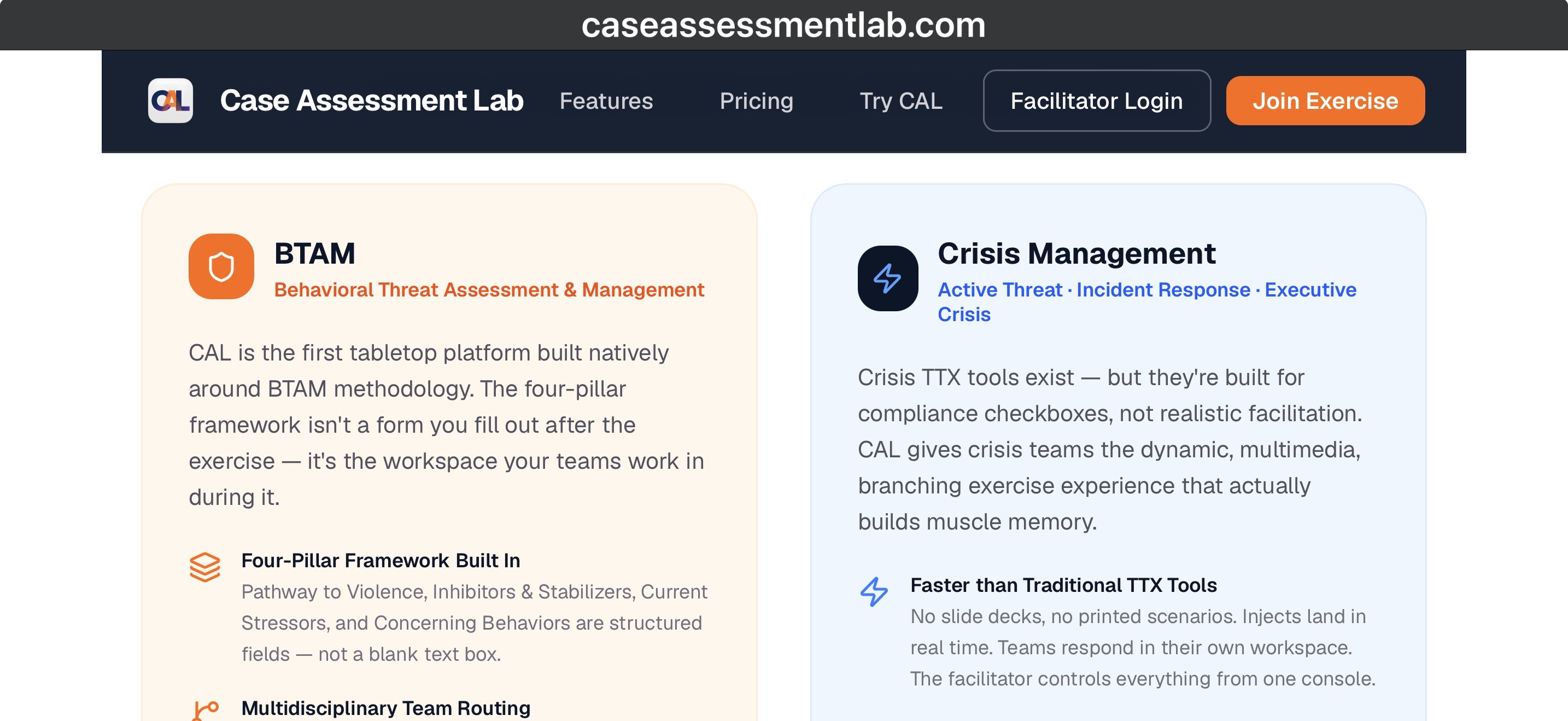
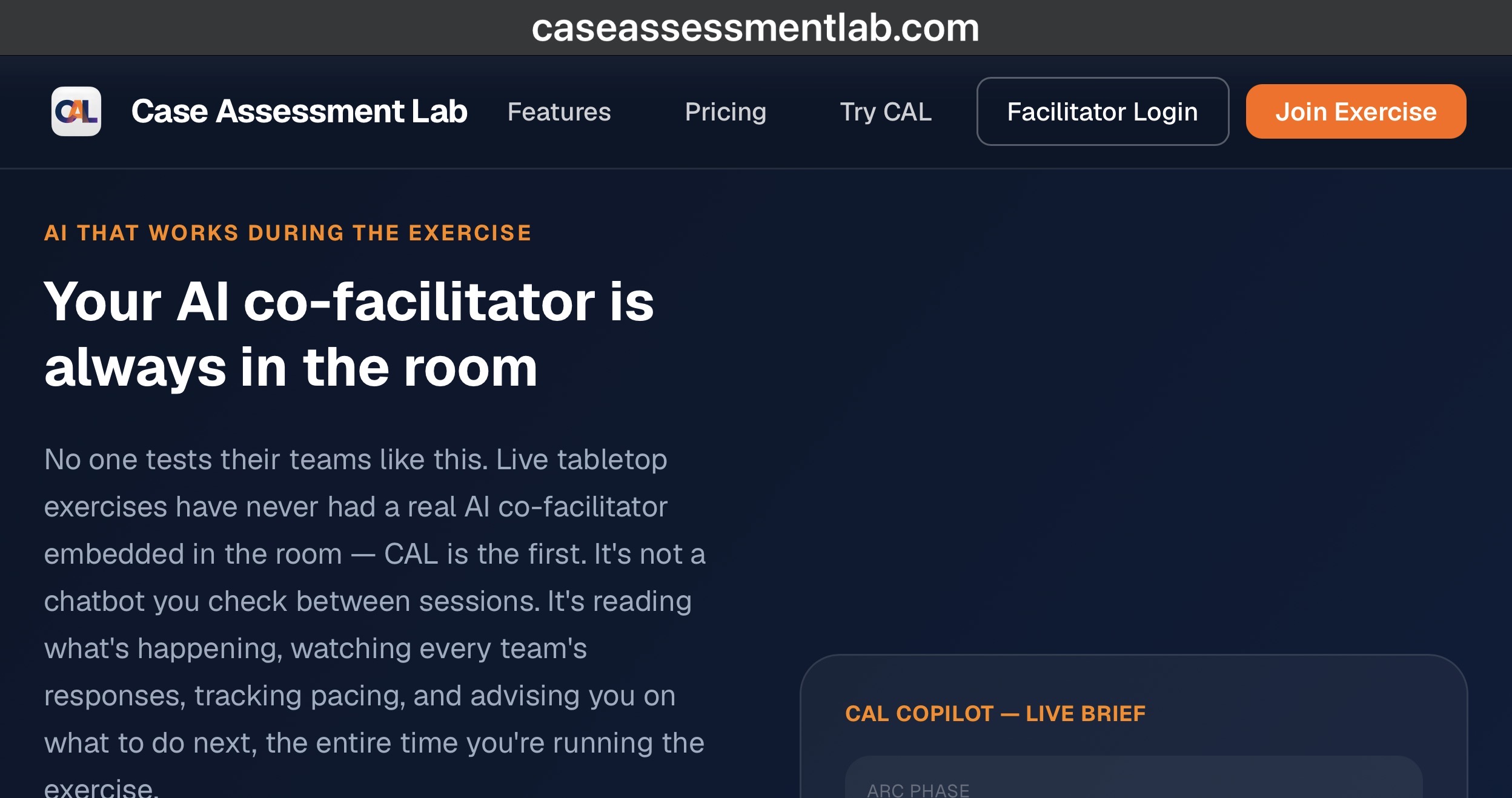
Case Assessment Lab is an AI-assisted case analysis platform designed for behavioral threat assessment and crisis management professionals.
Users upload case materials such as:
- Interview transcripts
- Incident reports
- Emails and text messages
- HR documentation
- Law enforcement reports
- Social media content
- Supporting documents
CAL uses OpenAI models to:
- Generate structured case summaries.
- Build timelines from multiple sources.
- Identify relevant behavioral indicators.
- Highlight evidence gaps.
- Suggest additional investigative questions.
- Draft transparent, editable assessment reports.
Rather than assigning a risk score or making decisions, CAL supports Structured Professional Judgment (SPJ). Every output remains reviewable and editable, with the human practitioner responsible for all final conclusions and recommendations.
⸻
How we built it
CAL combines OpenAI’s reasoning models with a retrieval-augmented workflow designed specifically for behavioral threat assessment.
The platform includes:
- OpenAI models for document understanding, reasoning, summarization, and report generation.
- Retrieval-Augmented Generation (RAG) grounded in trusted behavioral threat assessment literature and professional guidance.
- Vector search to retrieve relevant evidence from our knowledge base.
- Structured prompts aligned with established BTAM workflows.
- Human-in-the-loop review before reports are finalized.
- Automated PDF report generation for documentation and case management.
The result is an AI assistant that helps professionals work faster while maintaining transparency, traceability, and accountability.
⸻
Challenges we ran into
Behavioral threat assessment is a high-consequence domain where unsupported conclusions can have serious consequences.
Some of our biggest challenges included:
- Reducing hallucinations through retrieval-grounded responses.
- Preserving evidence attribution throughout the analysis.
- Creating prompts that encourage evidence-based reasoning instead of speculation.
- Designing outputs that explain why conclusions were reached.
- Building safeguards that reinforce human oversight instead of automation bias.
One of our core design decisions was not to build predictive risk scoring. Instead, CAL focuses on helping practitioners organize evidence, document reasoning, and support multidisciplinary decision-making.
⸻
Accomplishments that we’re proud of
During this project we successfully built a working prototype that demonstrates how generative AI can support behavioral threat assessment without replacing professional judgment.
We’re especially proud that CAL can:
- Analyze large collections of unstructured case documents.
- Produce consistent, well-organized case summaries.
- Generate professional-quality draft assessment reports.
- Surface information gaps that investigators may wish to address.
- Keep every AI-generated recommendation transparent and editable.
- Demonstrate a practical, responsible use of AI in violence prevention.
Most importantly, we built a tool that practitioners can trust because it keeps them firmly in control of every decision.
⸻
What we learned
The biggest lesson was that professionals don’t want AI making decisions—they want AI helping them think.
Users consistently valued:
- Better organization over full automation.
- Transparent reasoning over black-box outputs.
- Editable reports over fixed recommendations.
- AI that reduces repetitive work while preserving professional judgment.
We also learned that retrieval-grounded AI dramatically improves user confidence by connecting generated content back to trusted evidence and source material.
⸻
What’s next for Case Assessment Lab
This hackathon prototype is the foundation for a broader platform supporting behavioral threat assessment, workplace violence prevention, schools, healthcare organizations, government agencies, and corporate security teams.
Next steps include:
- Multi-user collaborative case review.
- Longitudinal case tracking.
- Expanded evidence libraries and professional guidance.
- Additional Structured Professional Judgment frameworks.
- Enhanced privacy and governance controls.
- AI-assisted mitigation planning and documentation.
- Integration with organizational workflows and reporting systems.
Our long-term vision is to build an AI platform that helps crisis teams make better-informed decisions, improves documentation quality, strengthens collaboration, and gives professionals more time to intervene before violence occurs.
Built With
- aiagents
- crisismanagement
- gpt-5
- knowlegeretrieval
- mongodb
- natural-language-processing
- next.js
- openaiapi
- rag
- react
- responsibleai
- typescript
- vectordatabase
- vercel
- violenceprevention

Log in or sign up for Devpost to join the conversation.