Inspiration
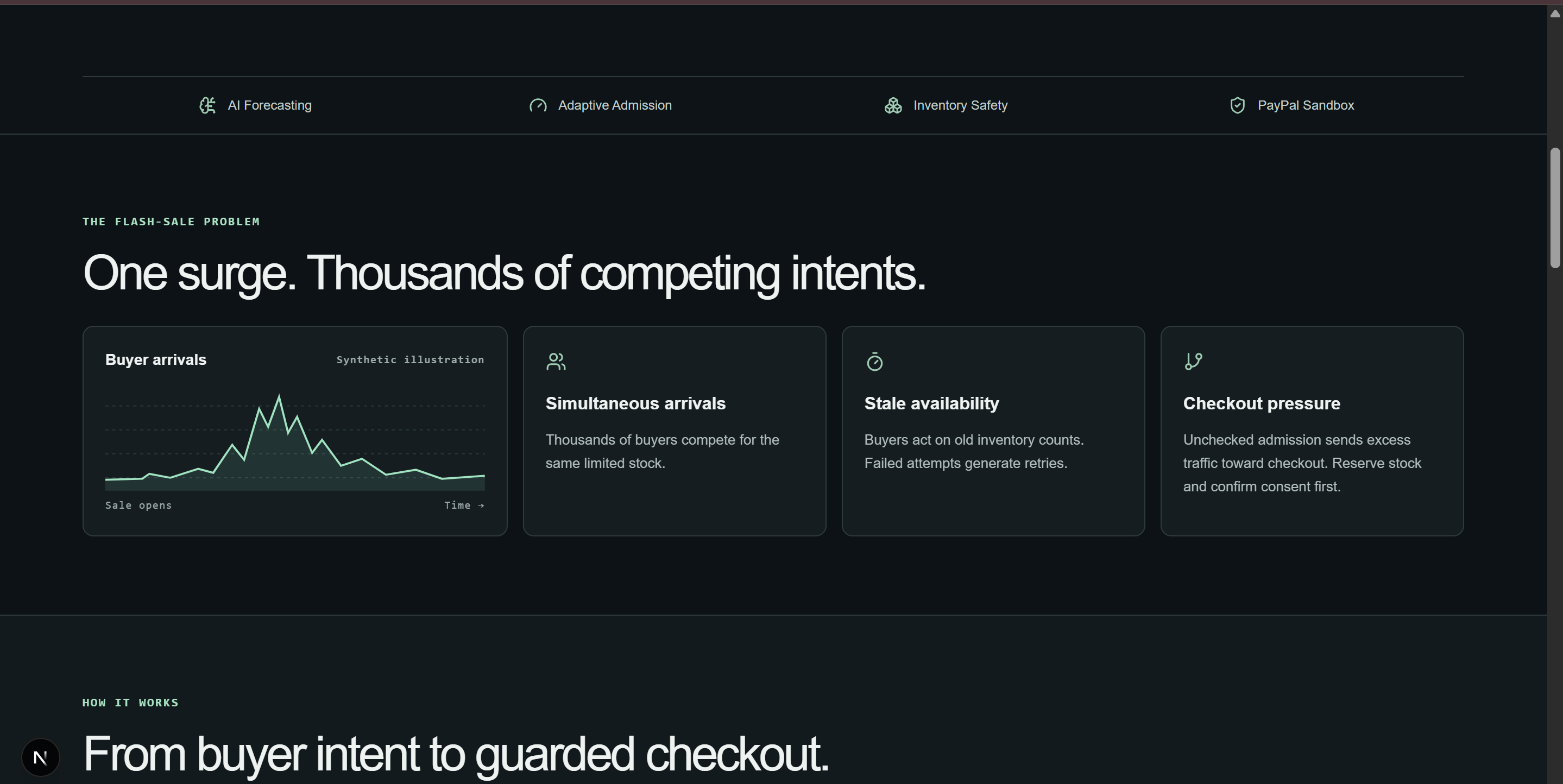
Flash sales are among the most demanding moments in digital commerce. Thousands of customers can arrive within seconds, competing for limited inventory while checkout infrastructure faces sudden spikes in traffic.
The problem isn't simply that demand is high. It's that traditional checkout systems can waste resources processing purchase attempts that cannot succeed. Customers encounter failed checkouts, repeated retries, and long waiting times, while merchants risk unnecessary infrastructure pressure and a poor shopping experience.
We asked ourselves:
What if an e-commerce platform could anticipate congestion, coordinate inventory, and control checkout traffic before failures occur?
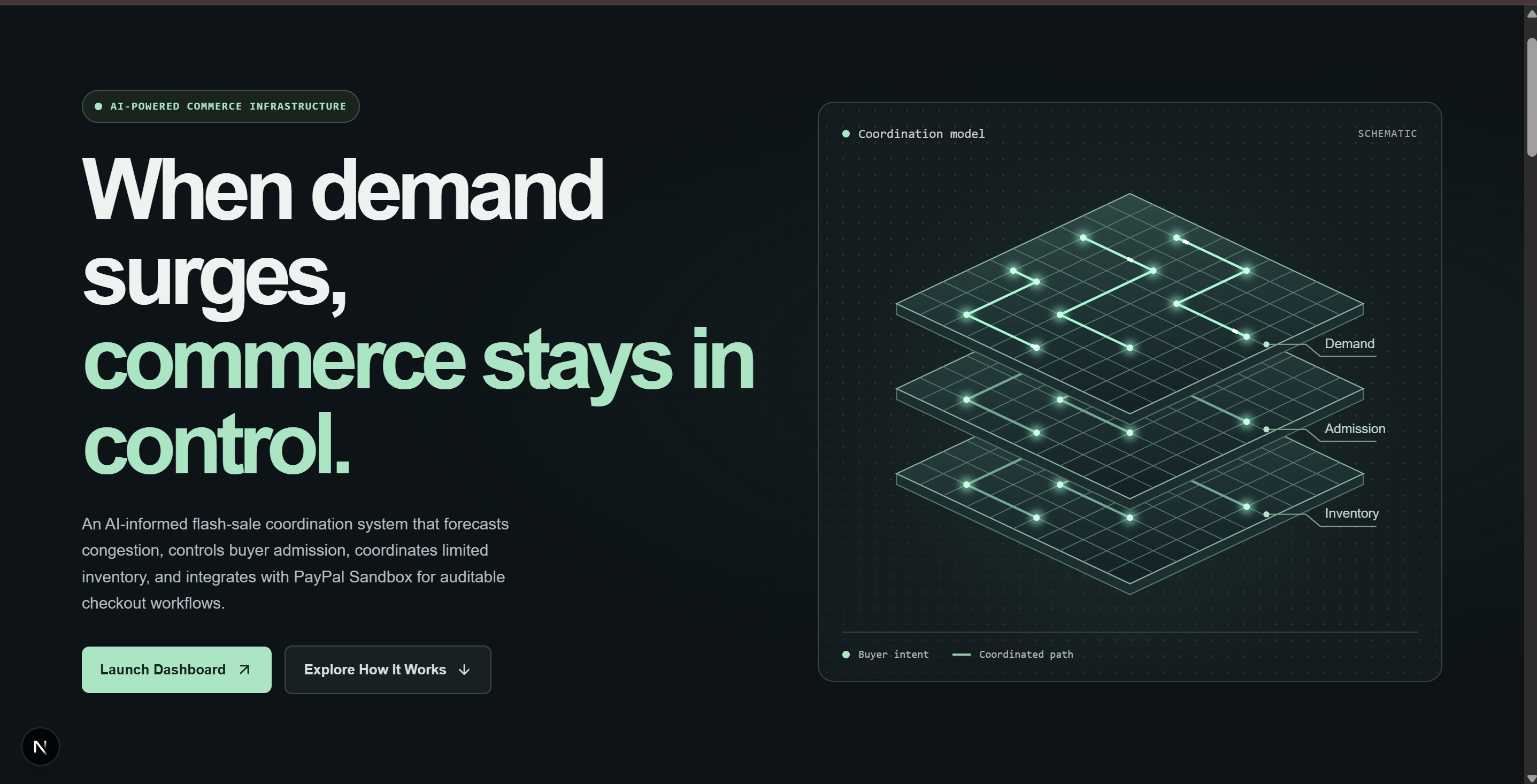
That question inspired CascadeOS, an AI-powered commerce orchestration platform that combines predictive congestion management, adaptive admission control, inventory coordination, and PayPal Sandbox payments.
Rather than treating checkout failures as isolated problems, CascadeOS approaches the entire purchase journey as a coordinated system.
What it does
CascadeOS helps commerce platforms manage high-demand shopping events more intelligently.
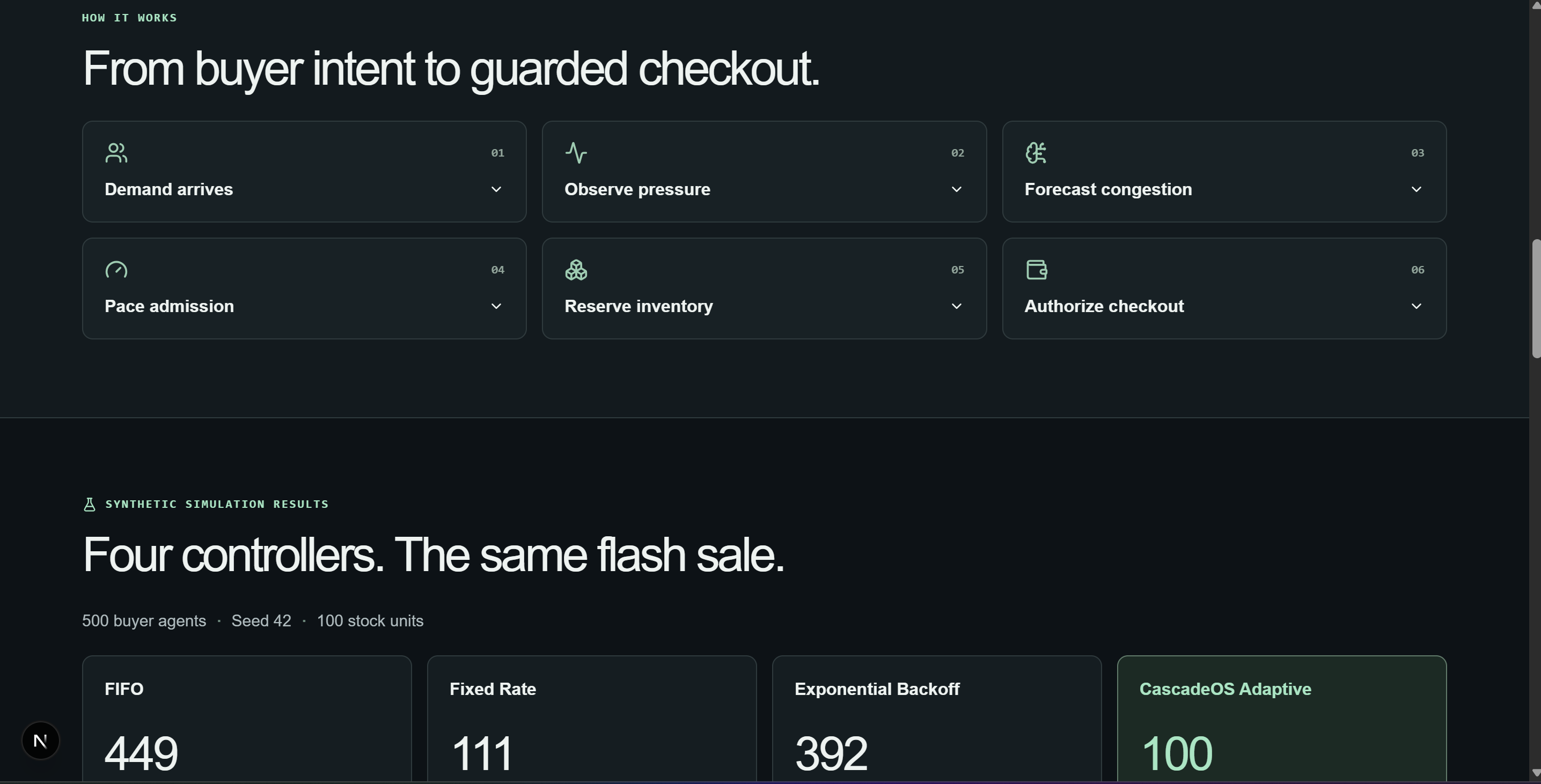
It combines six major capabilities:
1. AI-powered congestion forecasting
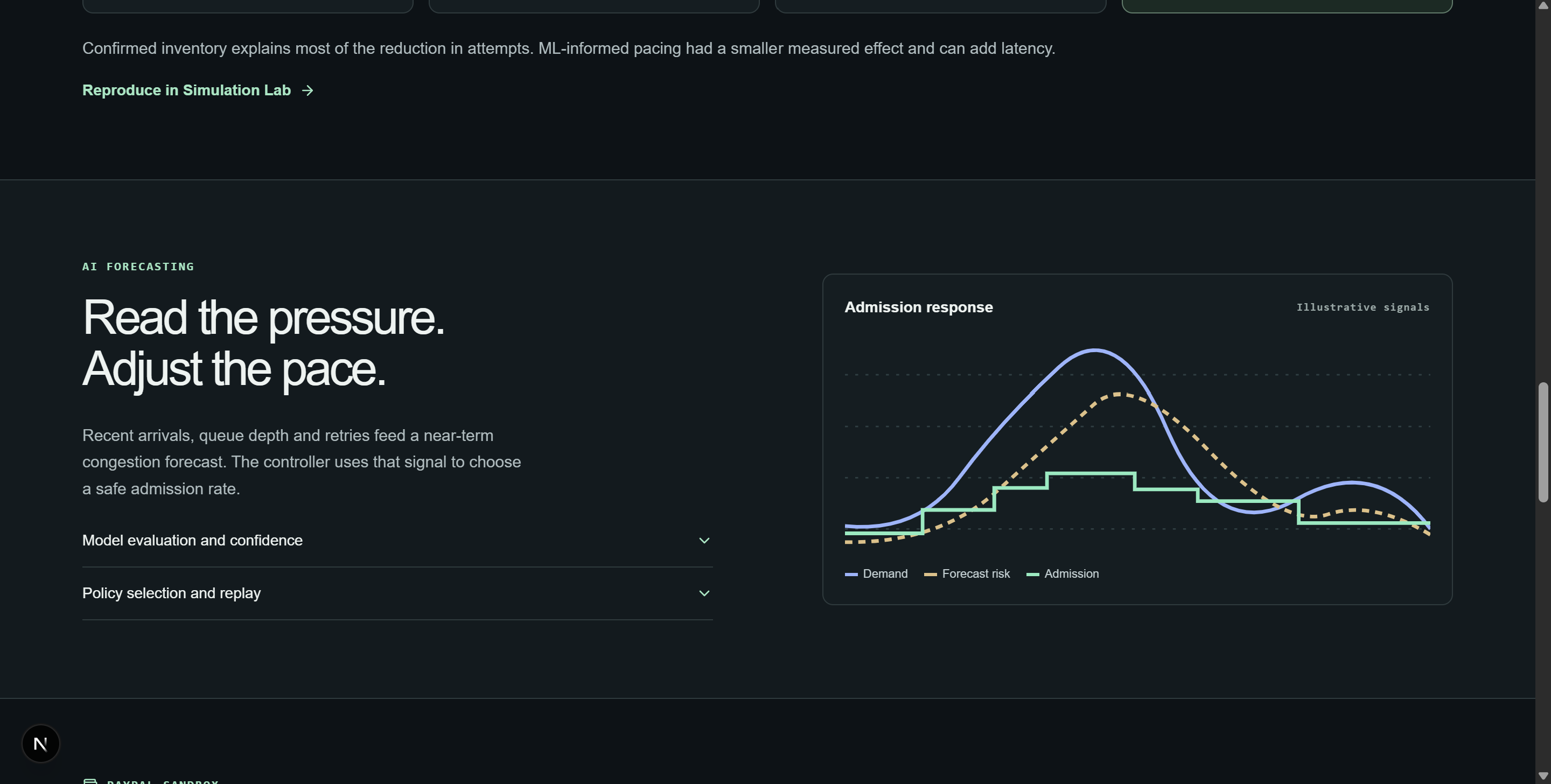
CascadeOS analyzes temporal demand signals, queue pressure, available inventory, and recent system activity to estimate short-term congestion risk. Its forecasting system supports model evaluation, calibrated predictions, and replayable decisions.
2. Adaptive admission control
Instead of allowing every customer to reach checkout simultaneously, CascadeOS uses observed conditions and predictive signals to adjust admission pacing.
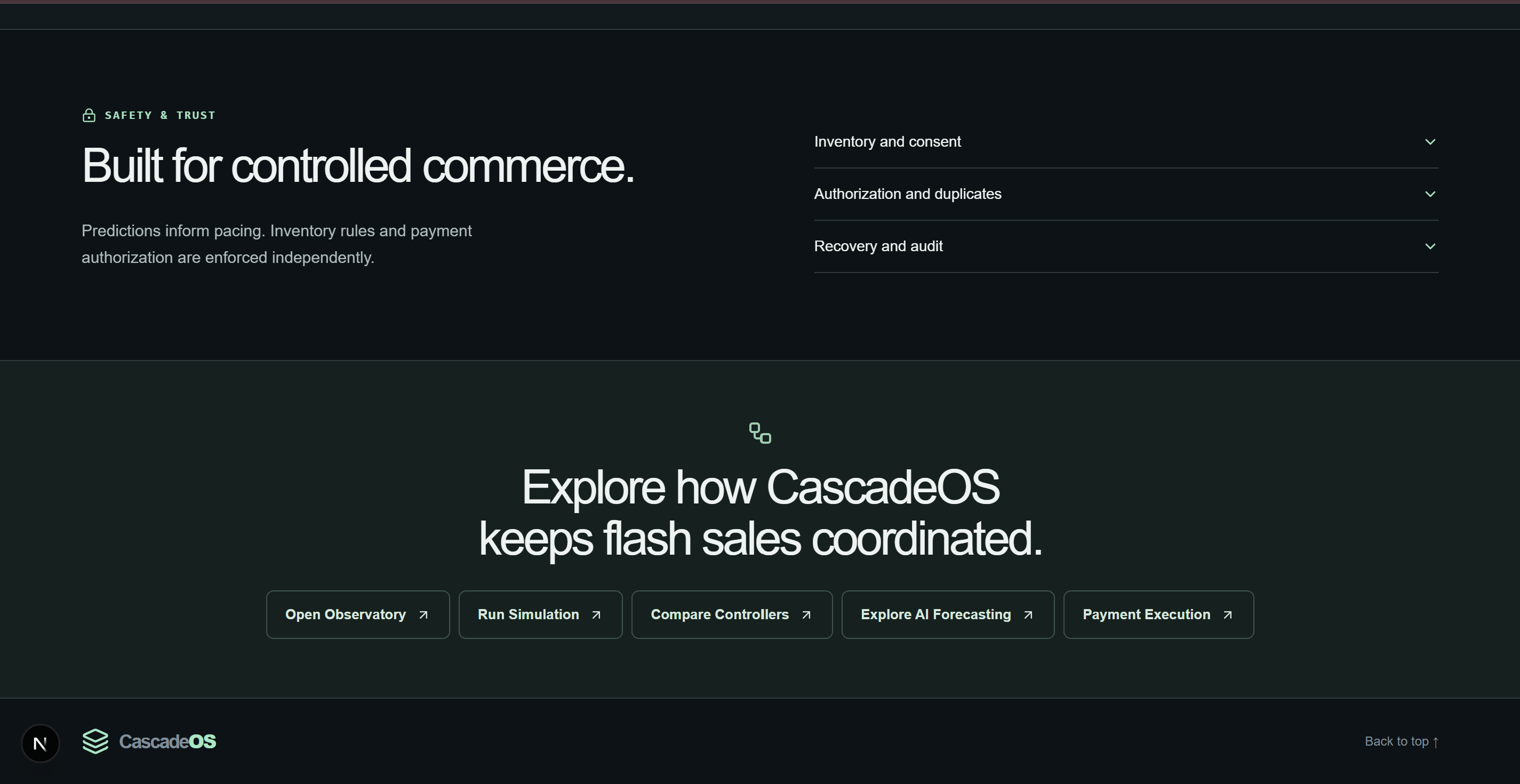
The AI informs which safe pacing strategy to use. It cannot bypass inventory limits or authorize payments.
3. Confirmed inventory coordination
CascadeOS coordinates purchase admissions using confirmed merchant inventory, reducing unnecessary checkout attempts against unavailable stock.
It enforces inventory limits and prevents simulated overselling and duplicate purchases.
4. Deterministic Simulation Lab
Our Simulation Lab creates reproducible flash-sale scenarios with independent buying agents, finite merchant inventory, configurable arrival patterns, and replayable event histories.
We benchmark four strategies:
- FIFO
- Fixed-rate admission
- Exponential backoff
- CascadeOS Adaptive
5. Interactive observability and decision analysis
The dashboard visualizes demand pressure, queue conditions, cumulative purchases, inventory conflicts, controller performance, and forecasting interventions.
Users can compare strategies, inspect adaptive decisions, and explore the evidence behind a controller's choices.
6. PayPal Sandbox integration
CascadeOS integrates with PayPal's Orders API to support controlled checkout operations with buyer approval, merchant authentication, durable SQLite payment records, idempotency protections, and provider reconciliation.
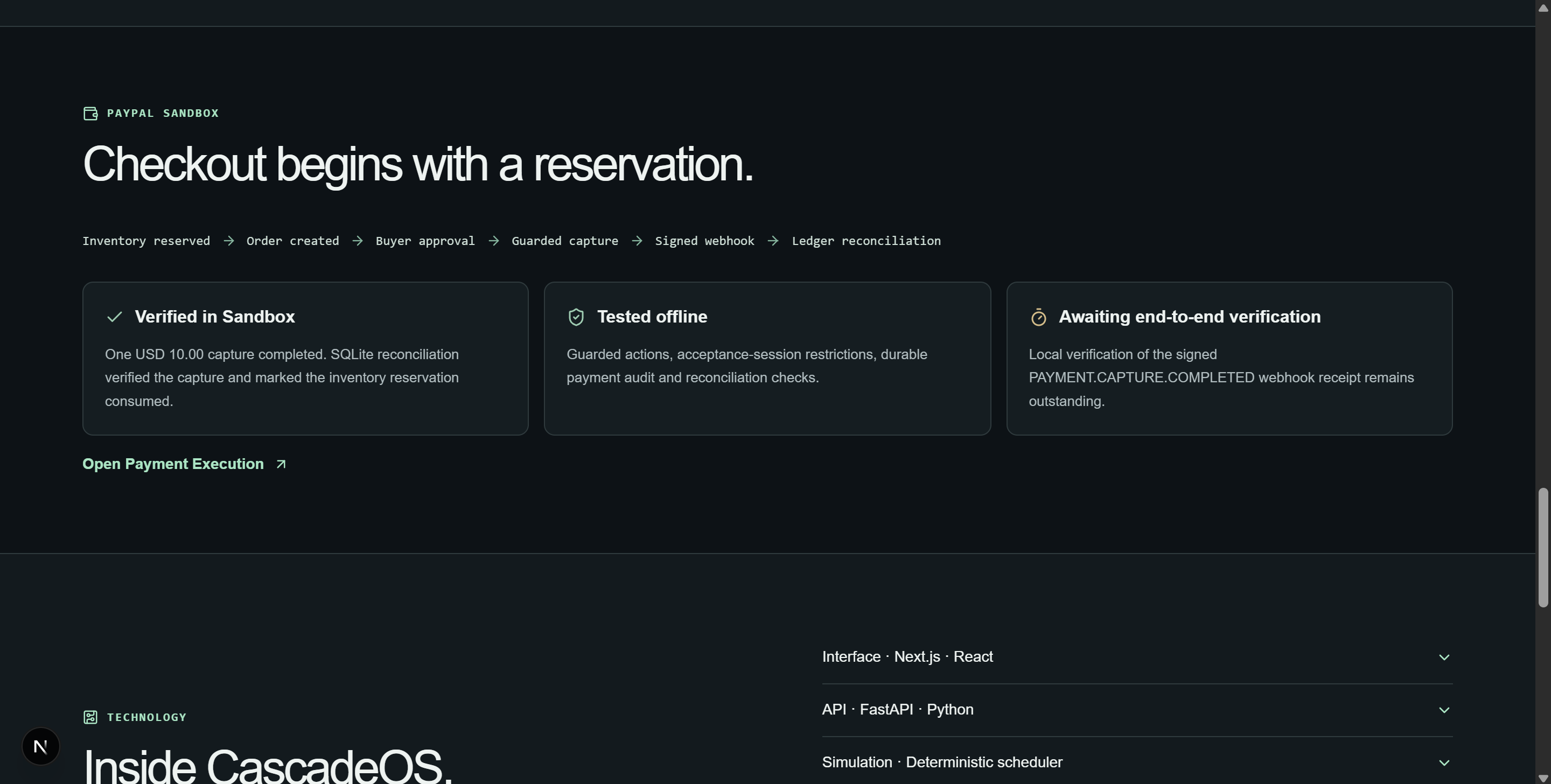
We successfully completed and verified one USD 10.00 PayPal Sandbox capture, followed by reconciliation between PayPal and our SQLite ledger. The corresponding inventory reservation was consumed correctly.
The signed order-approval webhook was verified. Local verification of the capture-completion webhook remains outstanding.
Our benchmark results
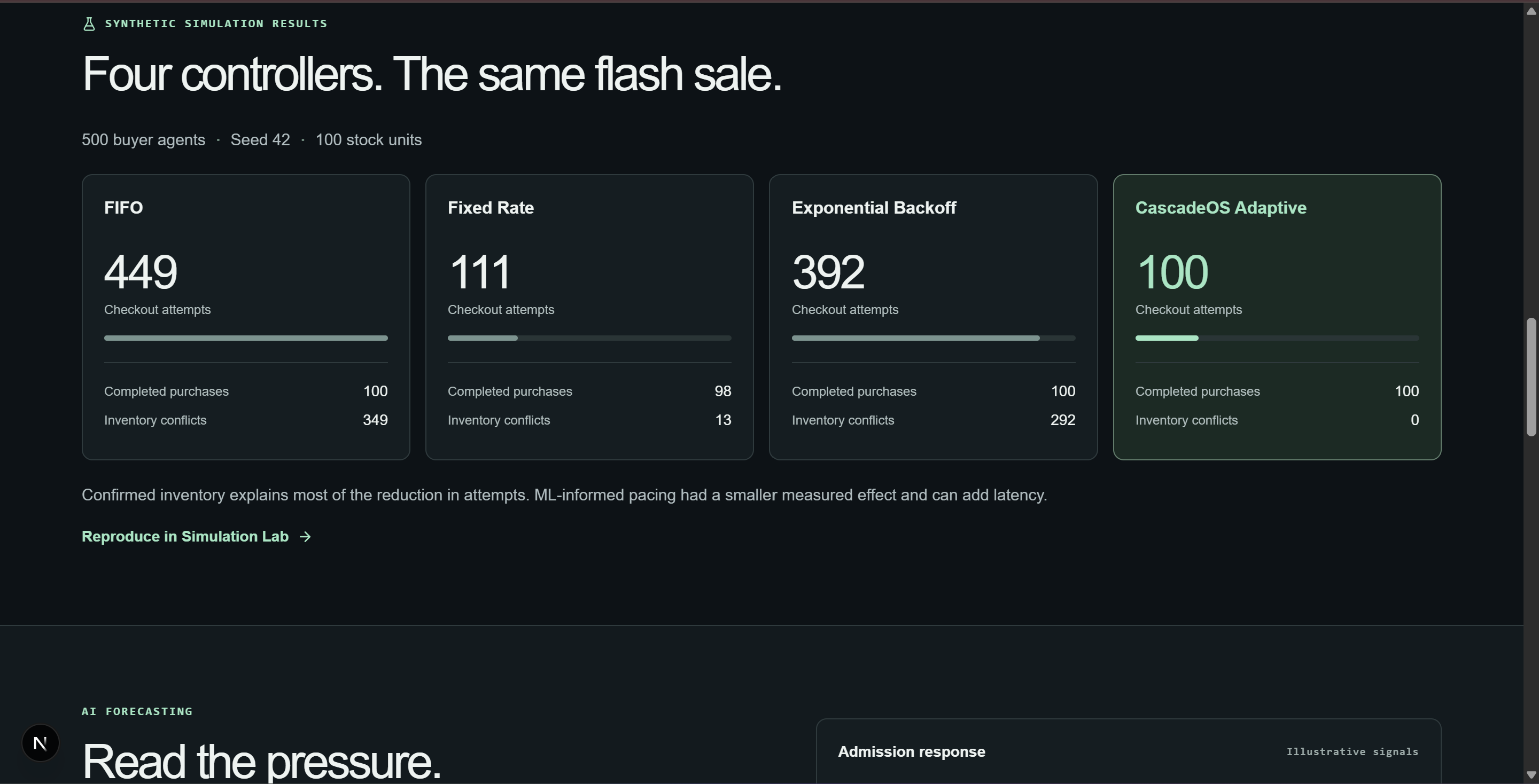
In a reproducible synthetic flash-sale scenario, 500 buyers compete for 100 available inventory units across two merchants.
| Metric | FIFO | CascadeOS Adaptive |
|---|---|---|
| Buying agents | 500 | 500 |
| Valid completed purchases | 100 | 100 |
| Checkout attempts | 449 | 100 |
| Inventory conflicts | 349 | 0 |
| Retry checkout attempts | 57 | 0 |
| Overselling | 0 | 0 |
CascadeOS achieved approximately 77.7% fewer checkout attempts than FIFO while completing all 100 available purchases.
These results come from a deterministic synthetic simulation, not production PayPal traffic. Confirmed inventory coordination explains a substantial portion of the improvement; the additional benefit of ML-based pacing varies by scenario.
How we built it
We developed CascadeOS as a full-stack application with independent simulation, forecasting, control, and payment components.
Frontend
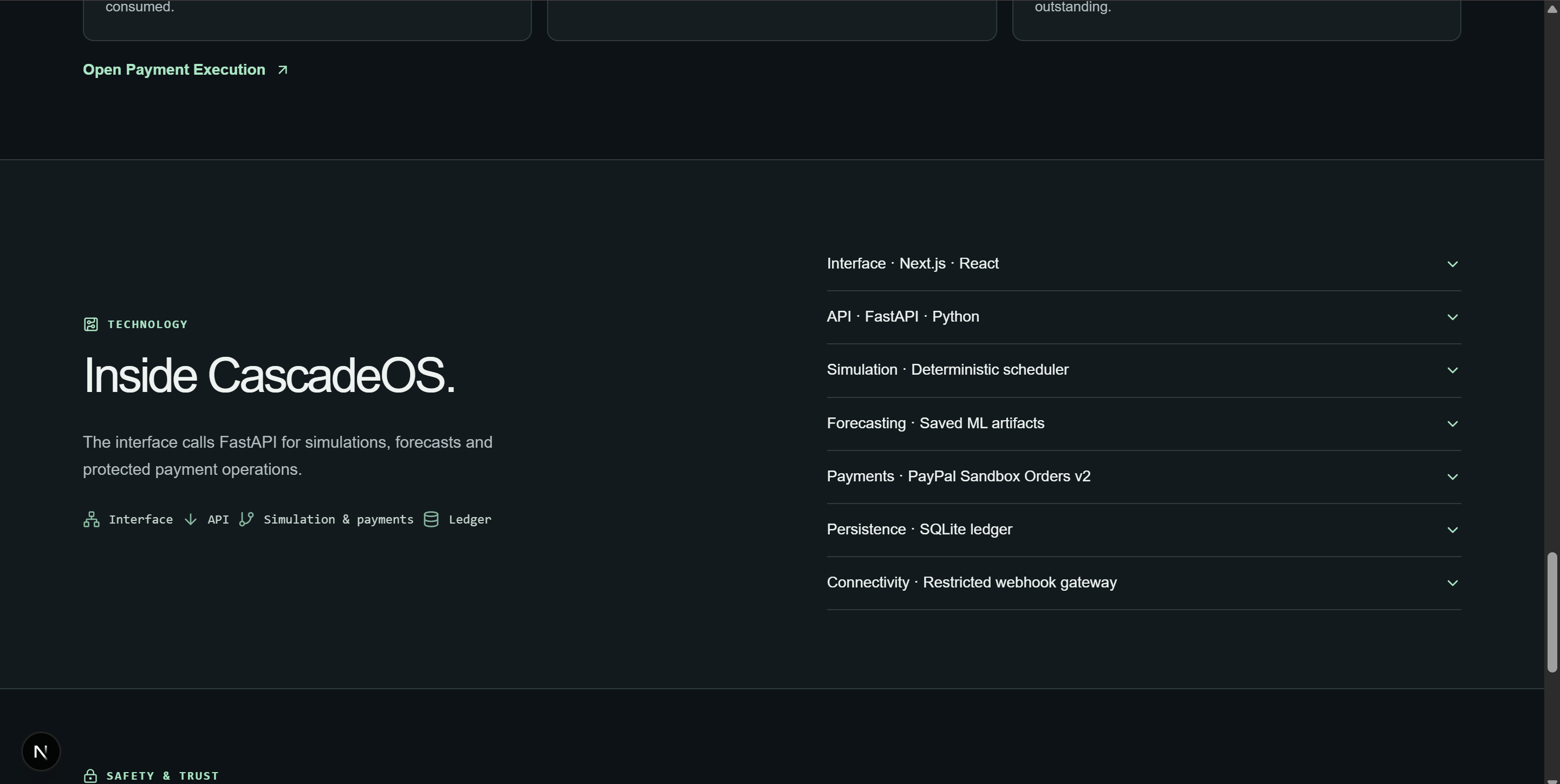
We used Next.js, React, TypeScript, and Tailwind CSS to build a responsive dashboard with a dark visual identity.
The frontend includes a product landing page, Observatory, Simulation Lab, controller comparison, Stability Engine, forecasting views, and Payment Execution dashboard.
Backend
We used Python, FastAPI, and Pydantic to implement the REST APIs, validation, simulation orchestration, safety controls, and payment services.
Simulation engine
We built deterministic simulations with independent buying agents, reproducible random seeds, inventory reservations, retries, stale observations, queue policies, and replayable event histories.
This allows us to evaluate different strategies under comparable demand conditions.
Machine learning
Our forecasting pipeline uses temporal demand features and calibrated predictive models to estimate near-term congestion.
The adaptive controller uses these forecasts alongside safety constraints and observed system state to inform admission decisions.
We designed the forecasting pipeline to support offline evaluation, deterministic replay, and controlled model loading.
PayPal payments
We integrated PayPal Sandbox Orders v2 for order creation, buyer approval, payment capture, and provider reconciliation.
A SQLite ledger tracks payment identities, reservation states, order and capture references, idempotency keys, and audit events.
Webhook verification, authenticated operator actions, bounded acceptance sessions, and duplicate-capture protections form additional security layers.
Payment execution remains disabled by default.
Testing and verification
We used automated Python tests, frontend browser tests, linting, type checking, and GitHub Actions.
Our tests cover simulation determinism, inventory safety, controller comparison, forecasting, payment authorization, idempotency, timeout recovery, and reconciliation.
The project is available on GitHub:
https://github.com/rastogisuyash2609-cmd/CascadeOS
Challenges we ran into
1. Creating a fair controller comparison
Comparing admission strategies is more complicated than comparing final purchase counts.
We needed identical demand conditions, consistent external failure schedules, and carefully defined metrics so that the resulting differences could be interpreted responsibly.
2. Separating machine-learning effects from coordination benefits
One important finding was that inventory coordination produced a substantial share of the improvements.
ML forecasting could influence pacing decisions, but it did not automatically improve every metric. We retained this distinction rather than overstating the model's contribution.
3. Preventing duplicate payments
Payment operations introduce different challenges from simulations, particularly when a provider request succeeds but the local application experiences a timeout.
We implemented durable transaction records, idempotency controls, and provider reconciliation to recover without blindly repeating a capture request.
4. Integrating PayPal Sandbox across different account regions
Our initial checkout attempts encountered currency-acceptance restrictions when using an Indian Sandbox buyer with an Indian Sandbox merchant.
We subsequently tested with a US Sandbox Personal buyer and the configured Indian Sandbox Business merchant, successfully completing the transaction.
5. Handling an uncertain capture
During the successful Sandbox transaction, CascadeOS initially recorded the capture as uncertain because its reconciliation logic treated two equivalent monetary representations differently.
We corrected the amount validation, preserved the original transaction identities, and successfully reconciled the already completed PayPal capture without submitting another payment.
6. Webhook delivery and temporary infrastructure
Testing signed PayPal webhooks against a local backend required an HTTPS-accessible webhook gateway. We used a restricted gateway and Cloudflare Tunnel to expose only the webhook endpoint.
The order-approval webhook was successfully verified. Final capture-completion webhook verification remains an area for further testing.
Accomplishments that we're proud of
We turned an AI commerce concept into a working, testable full-stack system.
Our most significant accomplishments include:
- Building a deterministic flash-sale simulator with 500 independent buying agents.
- Comparing four coordination strategies under reproducible conditions.
- Reducing synthetic checkout attempts from 449 to 100 while maintaining 100 completed purchases.
- Eliminating inventory conflicts in the CascadeOS Adaptive benchmark scenario.
- Developing a calibrated ML forecasting pipeline with explainable adaptive pacing decisions.
- Building a responsive interactive dashboard with replayable simulation evidence.
- Integrating PayPal Sandbox with authenticated, idempotent payment operations.
- Successfully verifying a real Sandbox order and one completed USD 10.00 capture.
- Reconciling the completed capture with SQLite and consuming the corresponding inventory reservation without retrying the payment.
- Making our implementation publicly available with source code and documentation.
We're particularly proud that our experiments helped us understand which improvements came from coordination and which were attributable to AI-informed decisions.
What we learned
Building CascadeOS taught us that reliable commerce depends on much more than payment-processing speed.
We learned how to design deterministic simulations, compare scheduling strategies, create temporal ML features, evaluate calibrated predictions, and enforce inventory invariants under concurrent demand.
We also gained practical experience with PayPal's Orders API, sandbox account configurations, buyer approval, webhook security, idempotency, durable ledgers, and recovering from uncertain provider operations.
Perhaps the most important lesson was that AI is most valuable when it operates inside strong engineering and safety constraints.
Predictive systems can improve operational decisions, but correctness must come from robust inventory, authorization, and payment controls.
What's next for CascadeOS
Our long-term vision is to develop CascadeOS into a deployable orchestration layer for high-demand commerce platforms.
The next steps include:
1. Complete webhook acceptance verification
Verify the signed PayPal PAYMENT.CAPTURE.COMPLETED event against the reconciled Sandbox capture and confirm the corresponding audit record.
2. Production-grade deployment
Deploy the frontend, backend, persistent data store, and webhook gateway with managed infrastructure, secure configuration, monitoring, and operational recovery.
3. Broader commerce integrations
Explore integrations with additional commerce platforms, inventory services, and payment workflows.
4. More advanced congestion forecasting
Evaluate forecasting models across larger workloads, seasonal patterns, different merchant configurations, and real operational traffic where available.
5. Stronger fairness and customer-experience metrics
Extend our evaluations to include admission fairness, conversion, user wait times, and merchant-level service quality.
6. Real-world pilots
Test CascadeOS under controlled pilot conditions, comparing it with existing queueing and admission systems using real operational measurements.
Our ultimate goal is to make high-demand commerce more predictable and resilient by coordinating demand, inventory, and checkout as one intelligent system.
CascadeOS — Predict congestion. Coordinate commerce. Protect every purchase.
Built With
- cloudflare
- fastapi
- github-actions
- javascript
- machine-learning
- next.js
- numpy
- paypal
- paypal-sandbox
- playwright
- pydantic
- pytest
- python
- react
- rest-api
- scikit-learn
- sqlalchemy
- sqlite
- tailwind-css
- typescript
