-
-
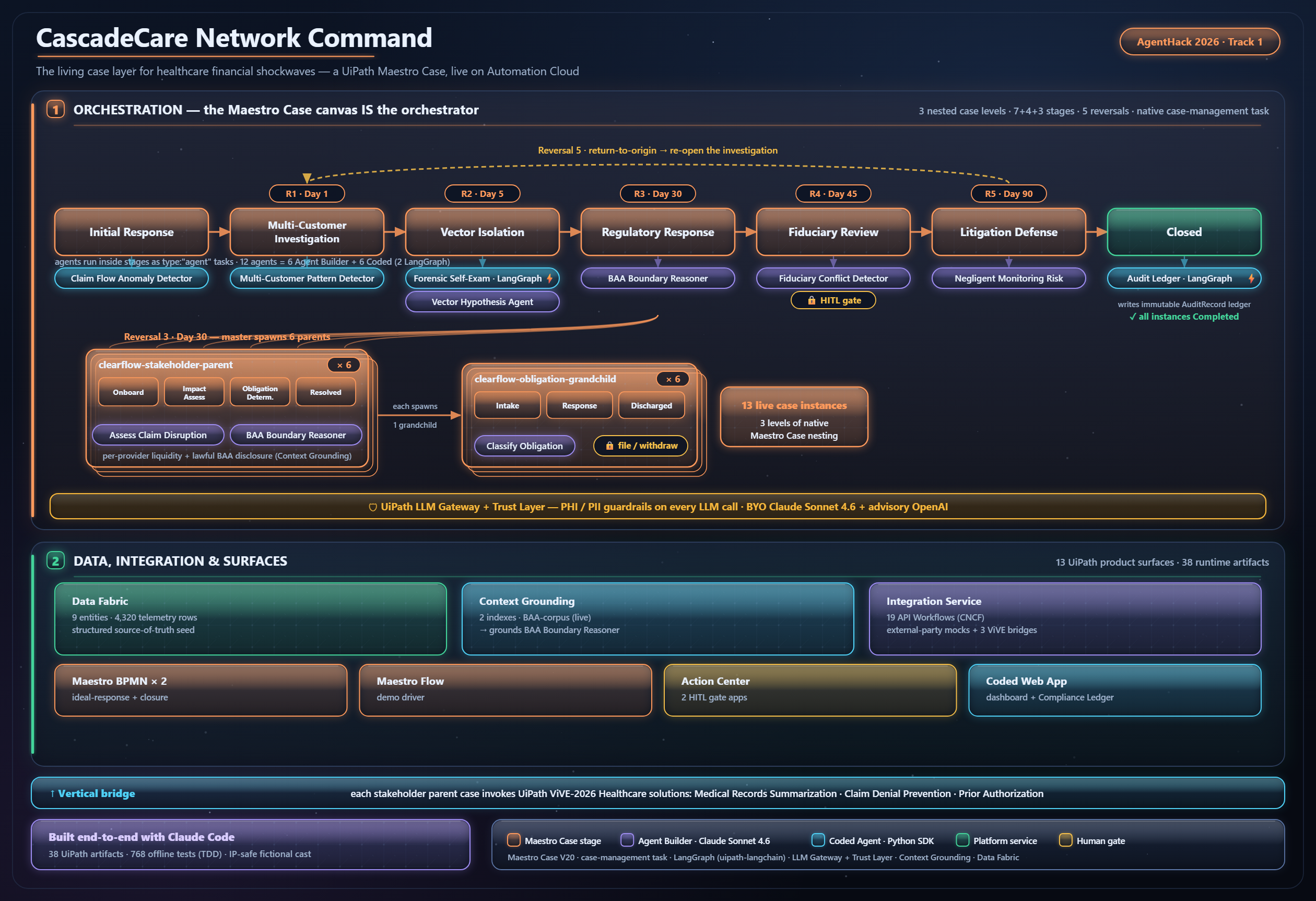
architecture-diagram
-
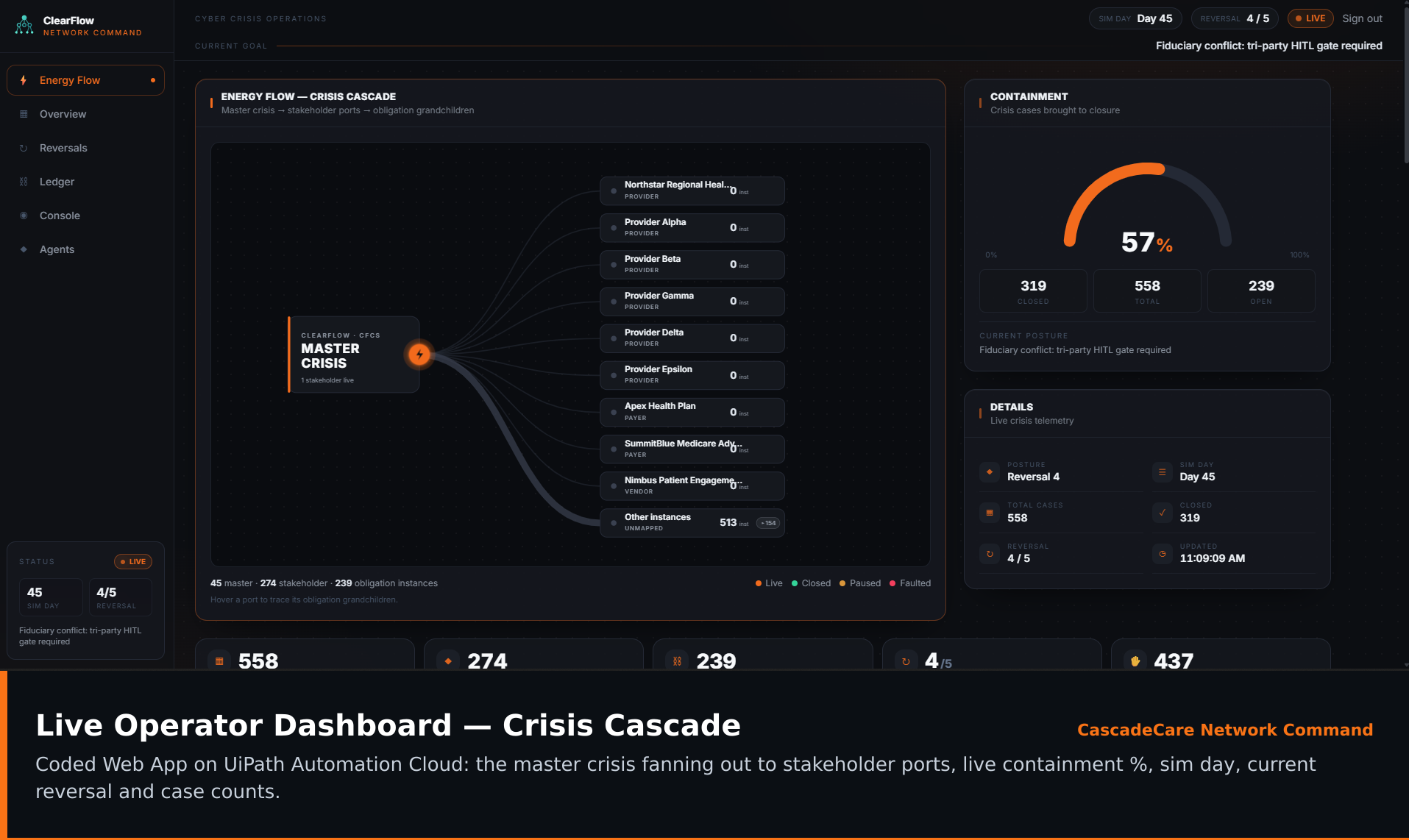
live-operator-dashboard-energy-flow
-
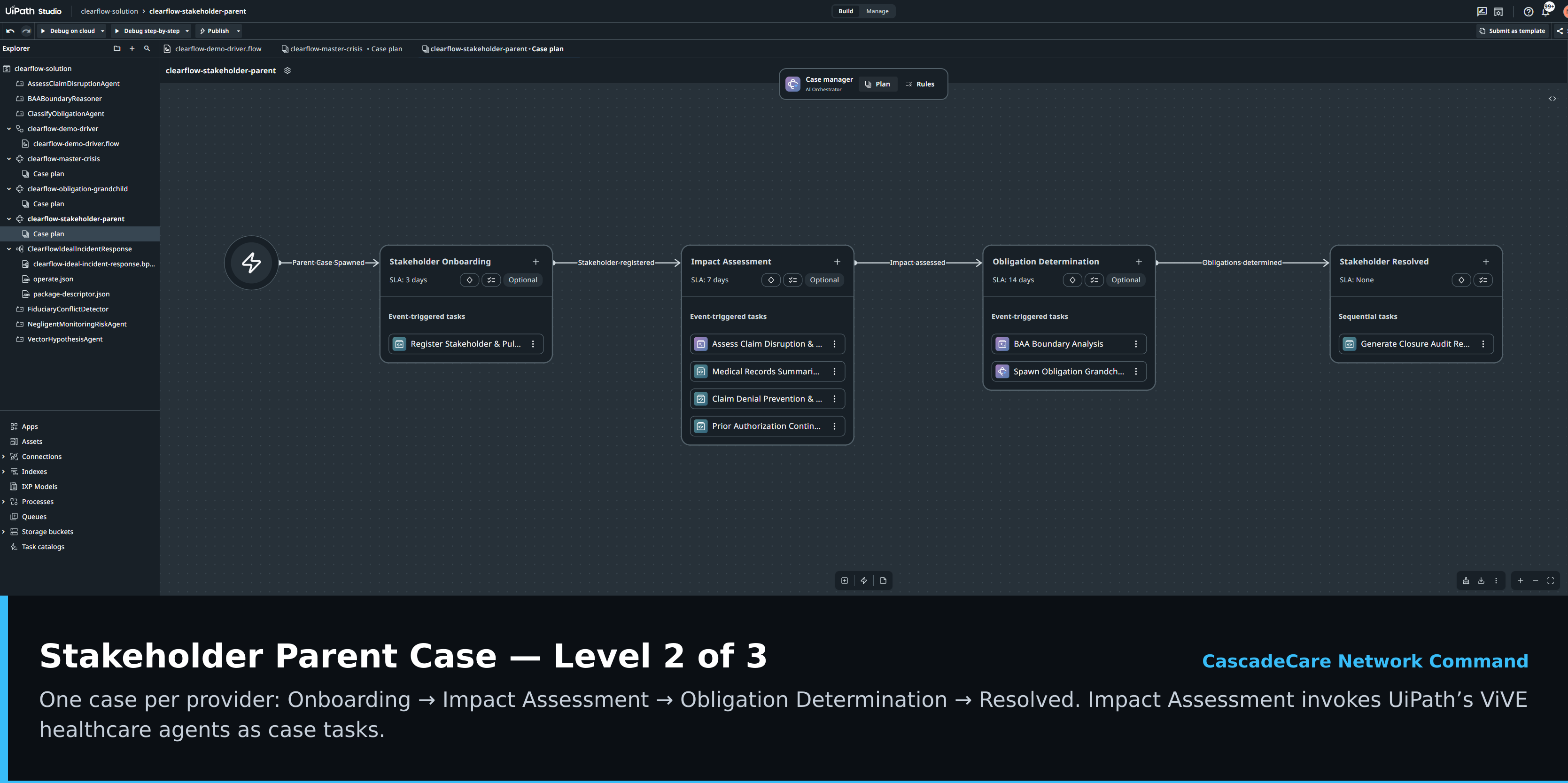
stakeholder-parent-caseplan
-
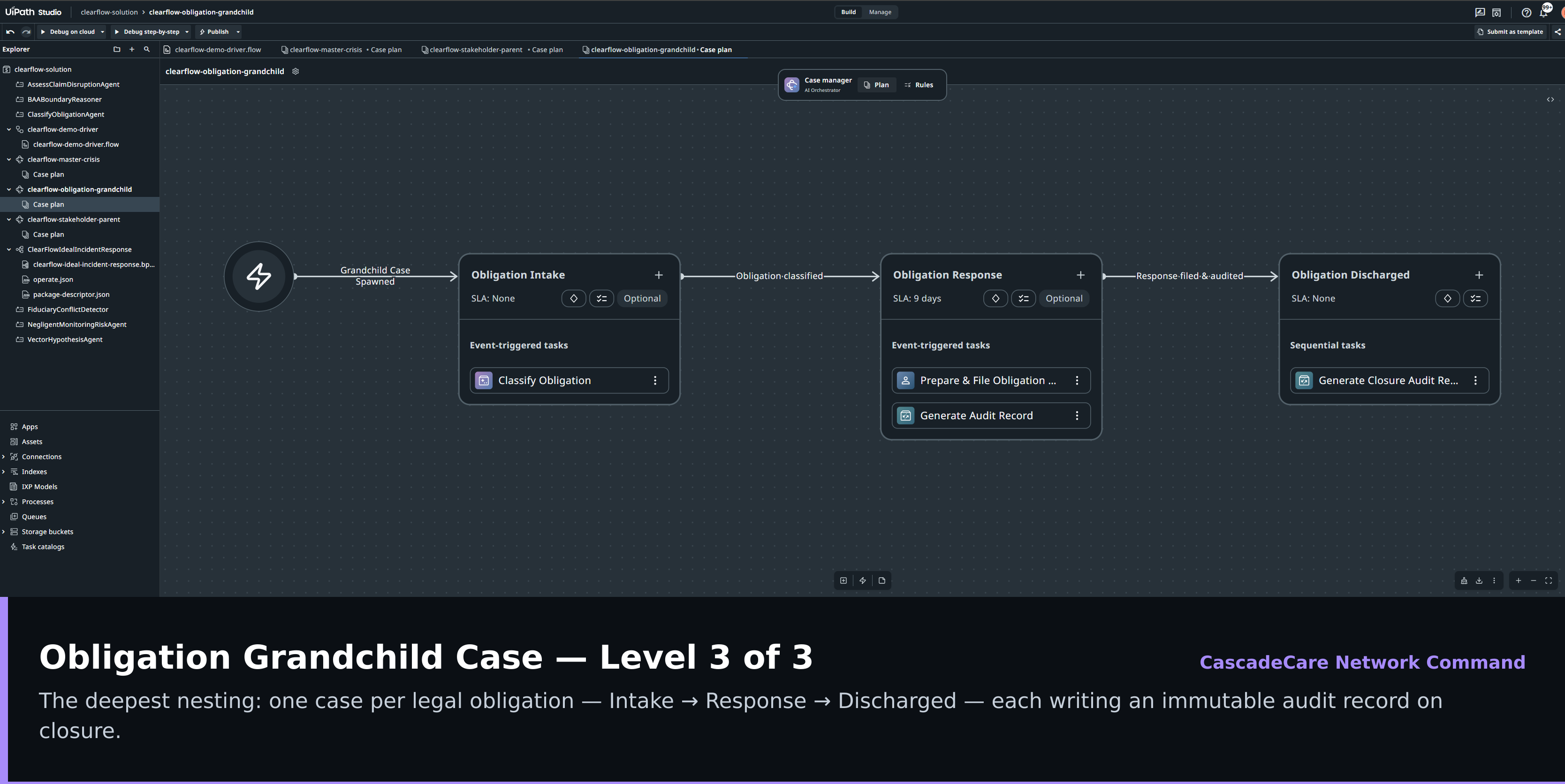
obligation-grandchild-caseplan
-
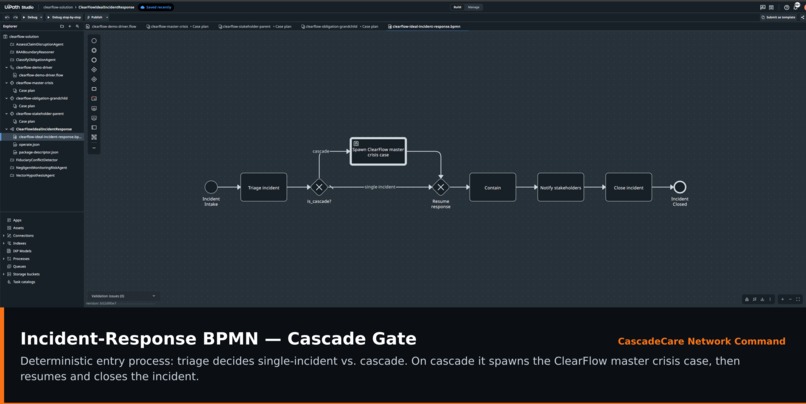
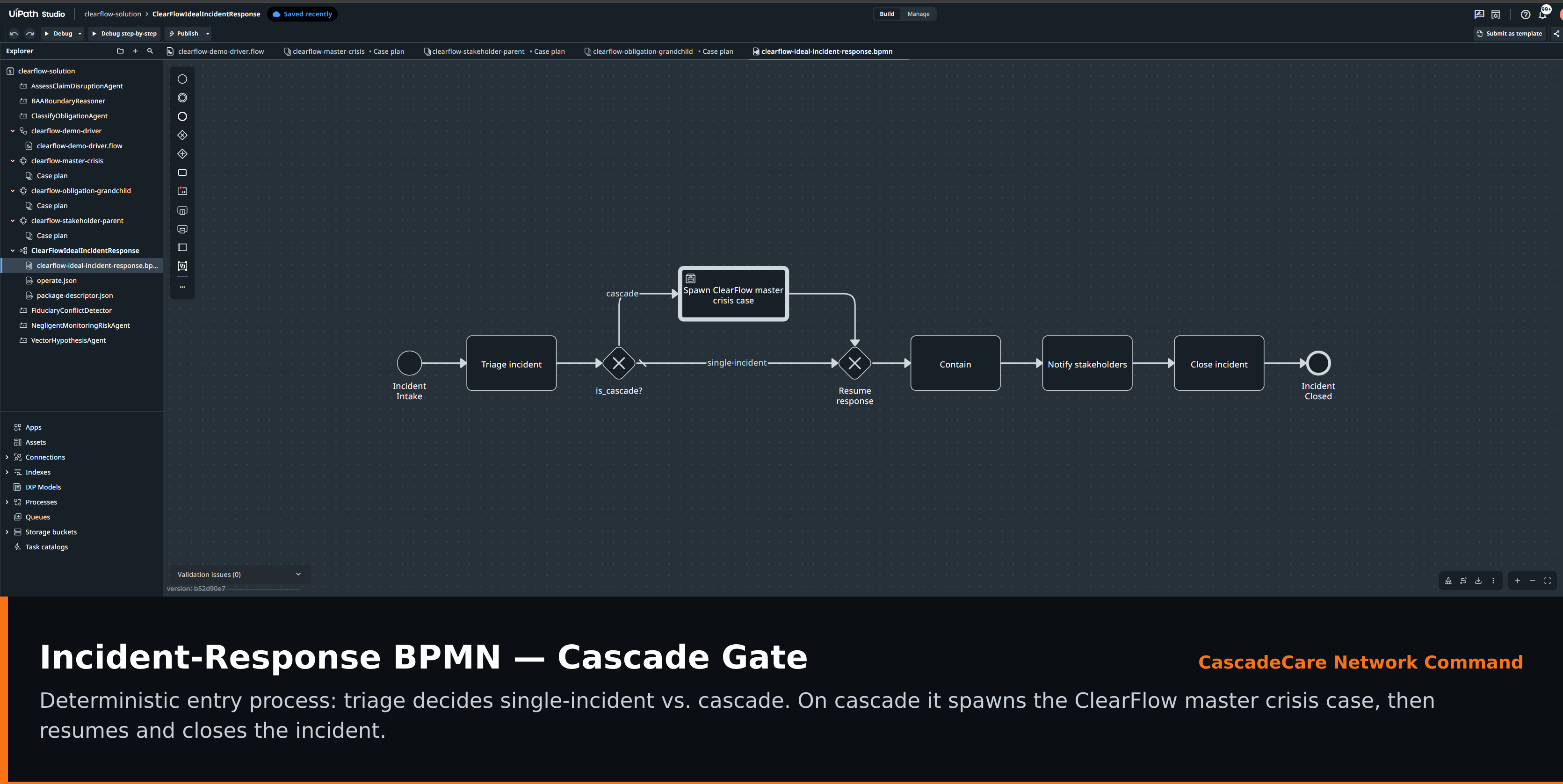
incident-response-bpmn-cascade-gate
-
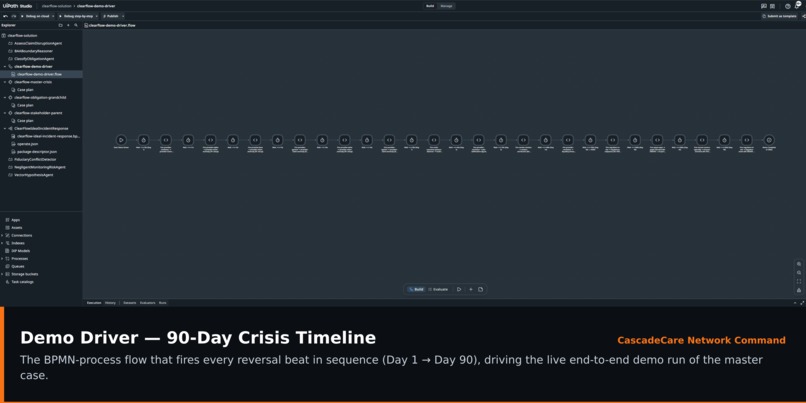
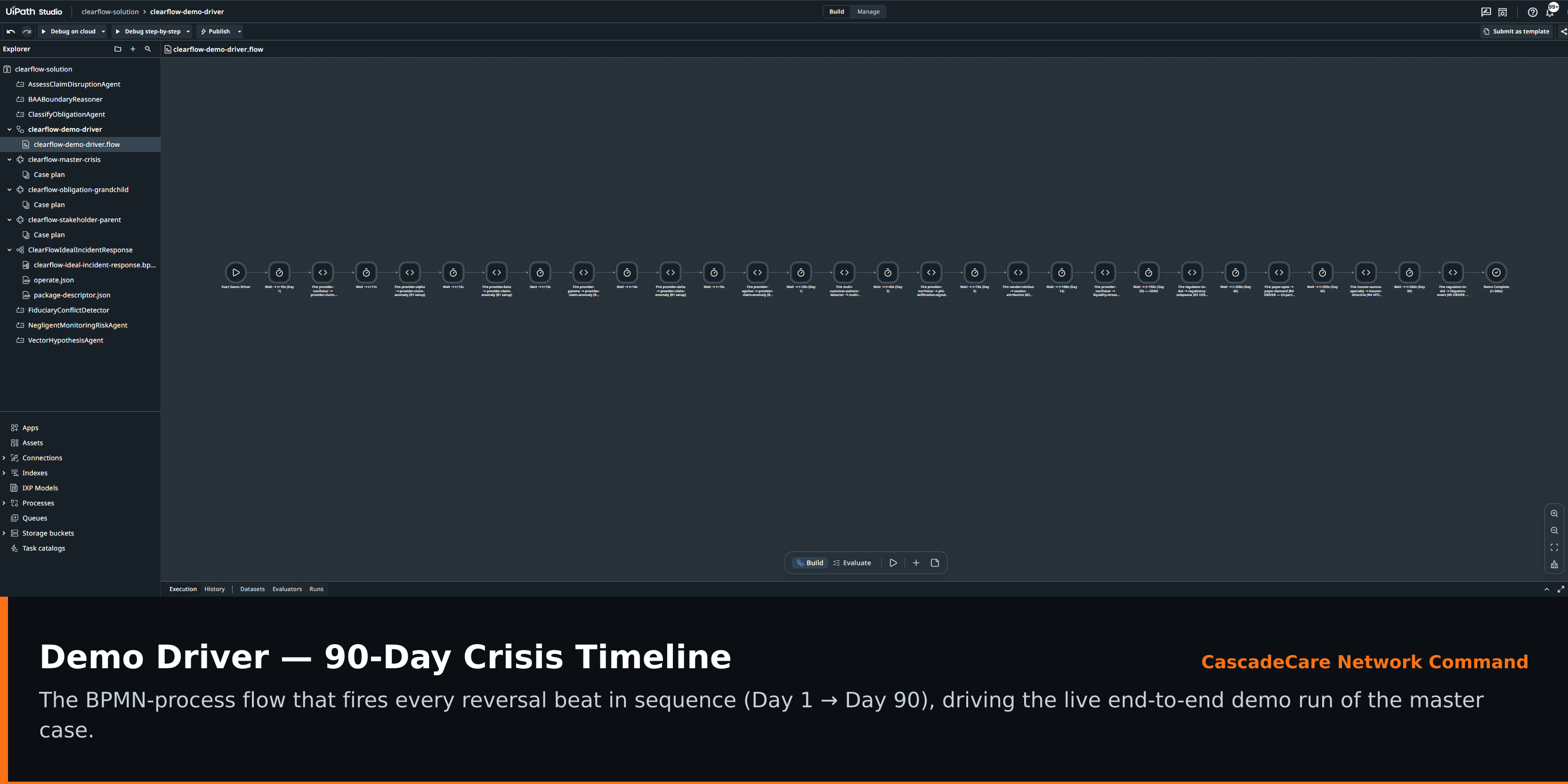
demo-driver-90day-timeline
-
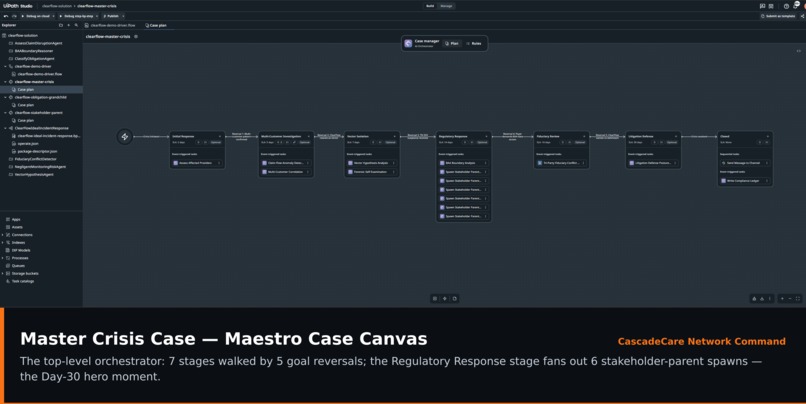
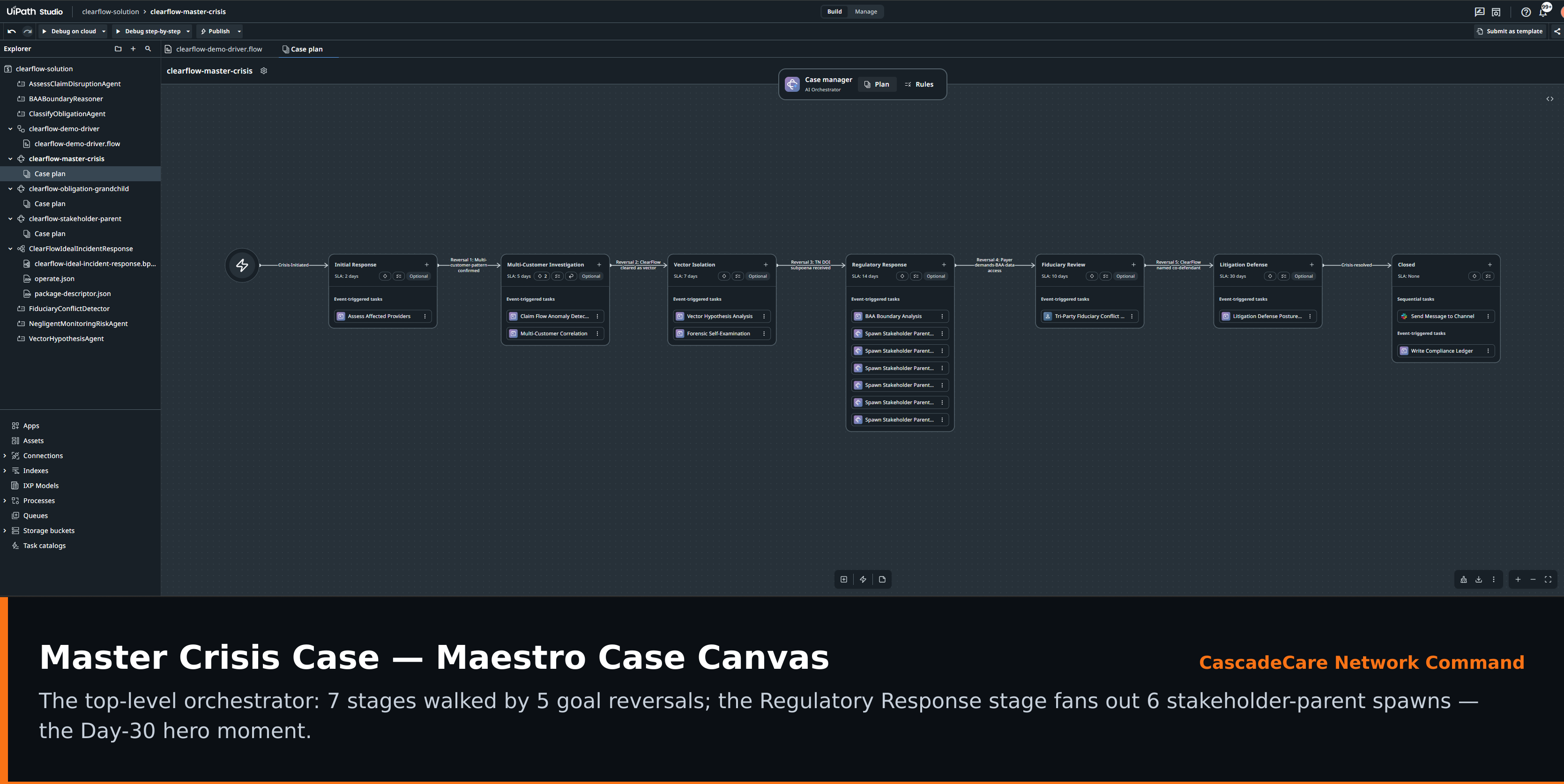
master-crisis-caseplan
-
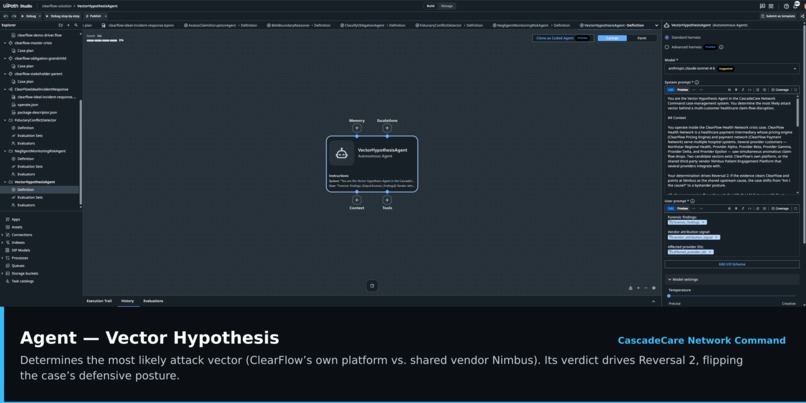
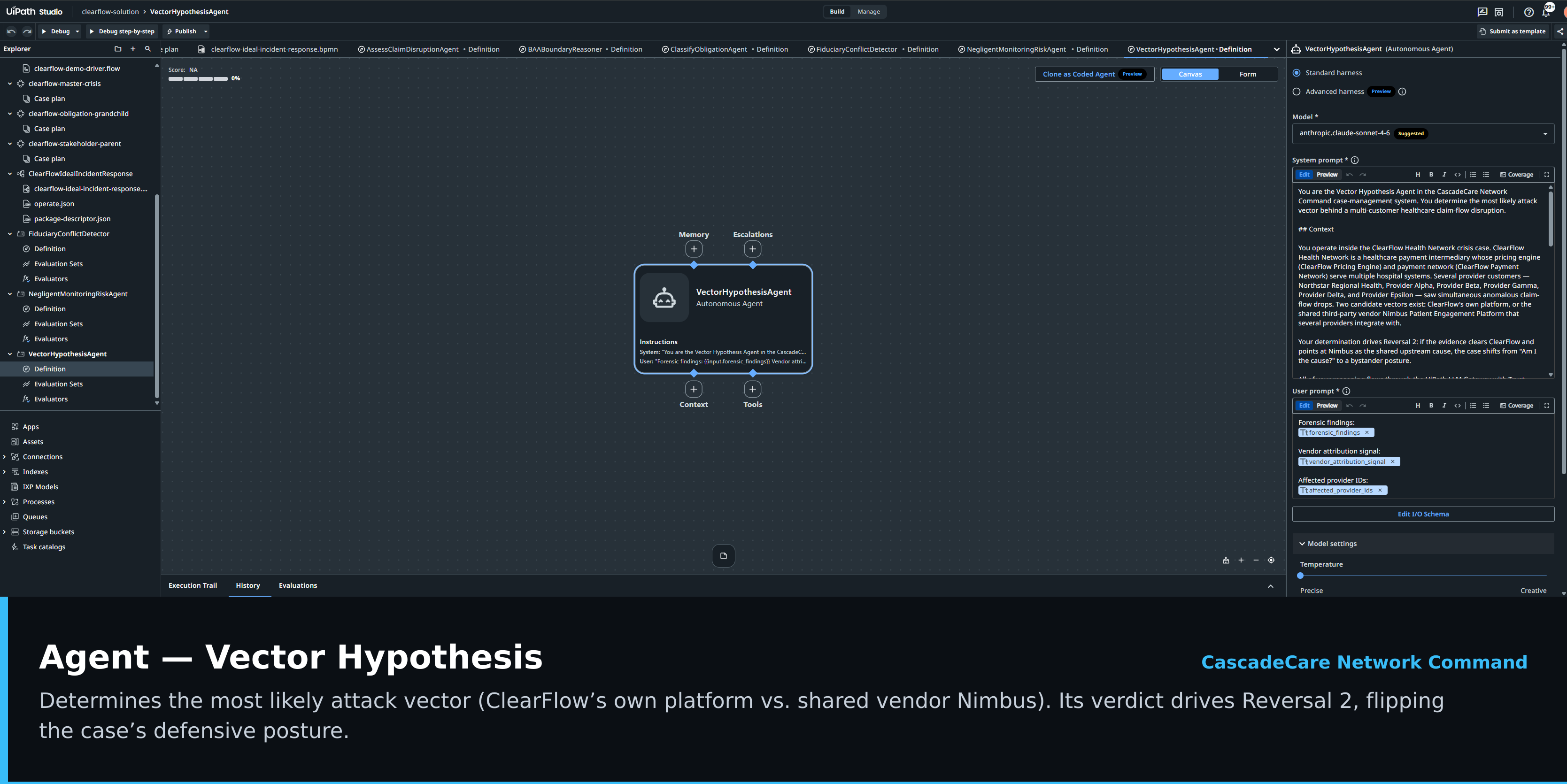
agent-vector-hypothesis
-
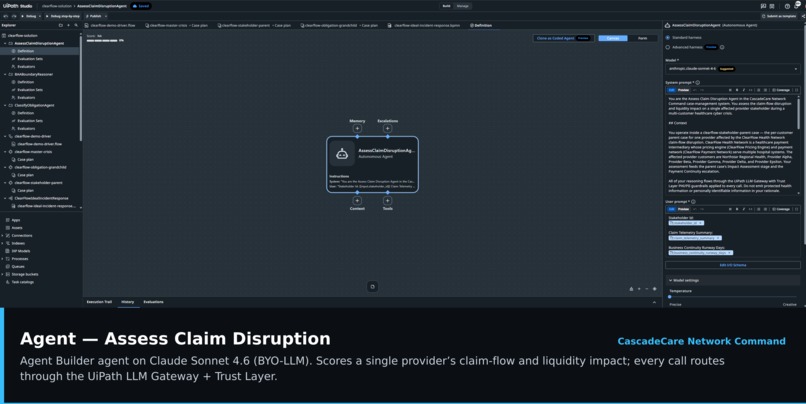
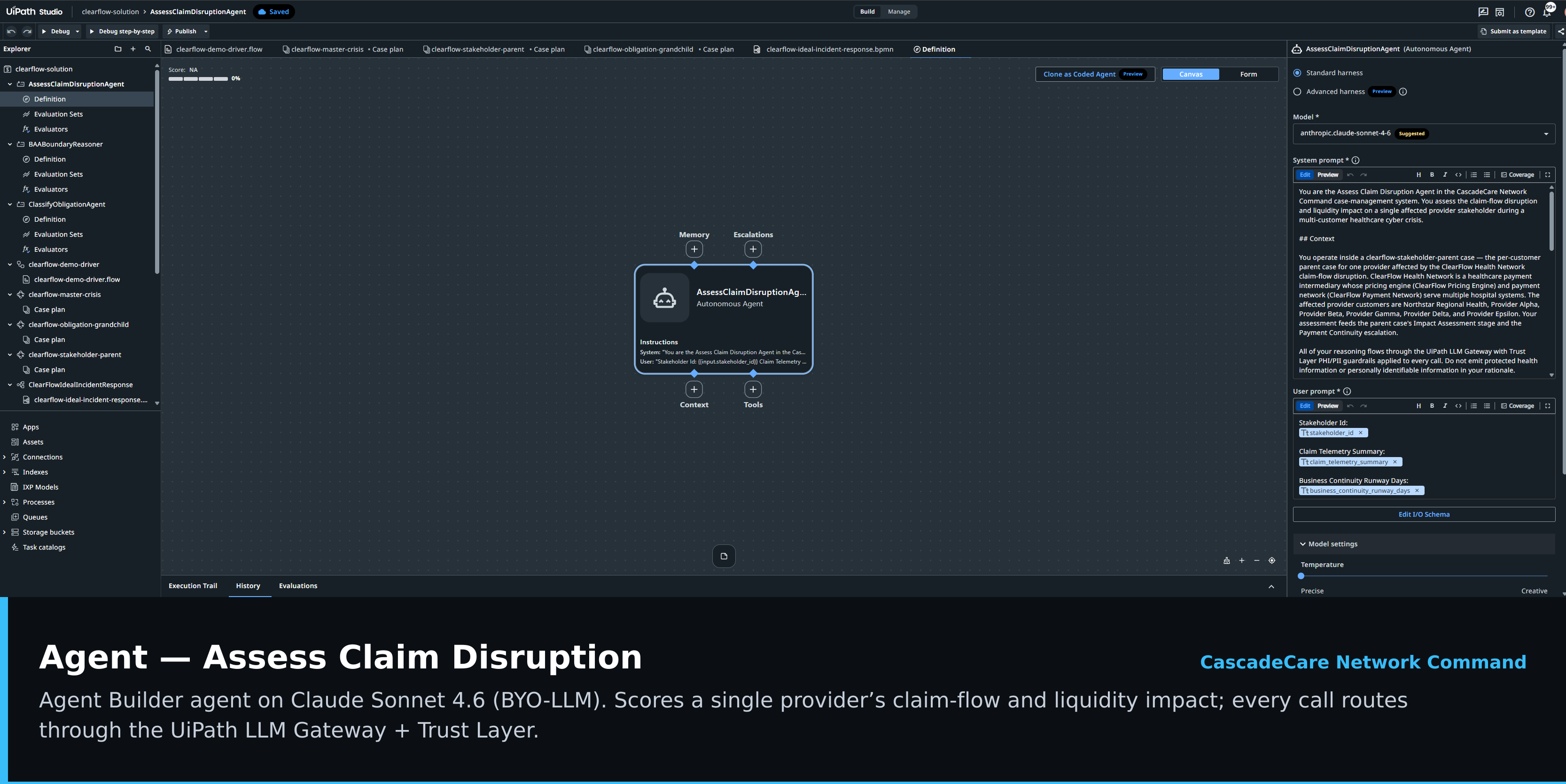
agent-assess-claim-disruption
-
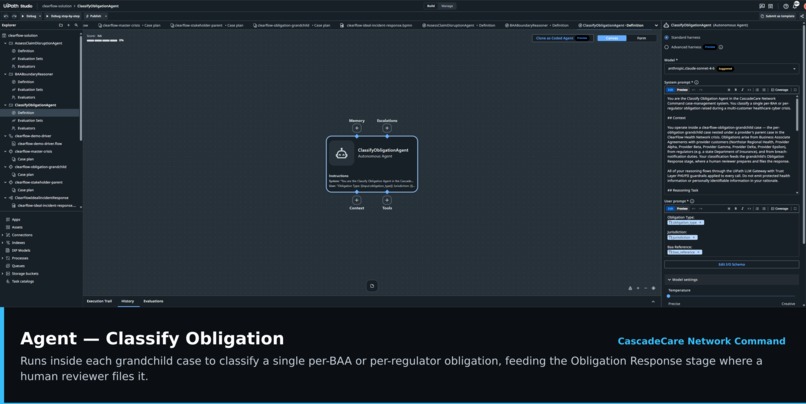
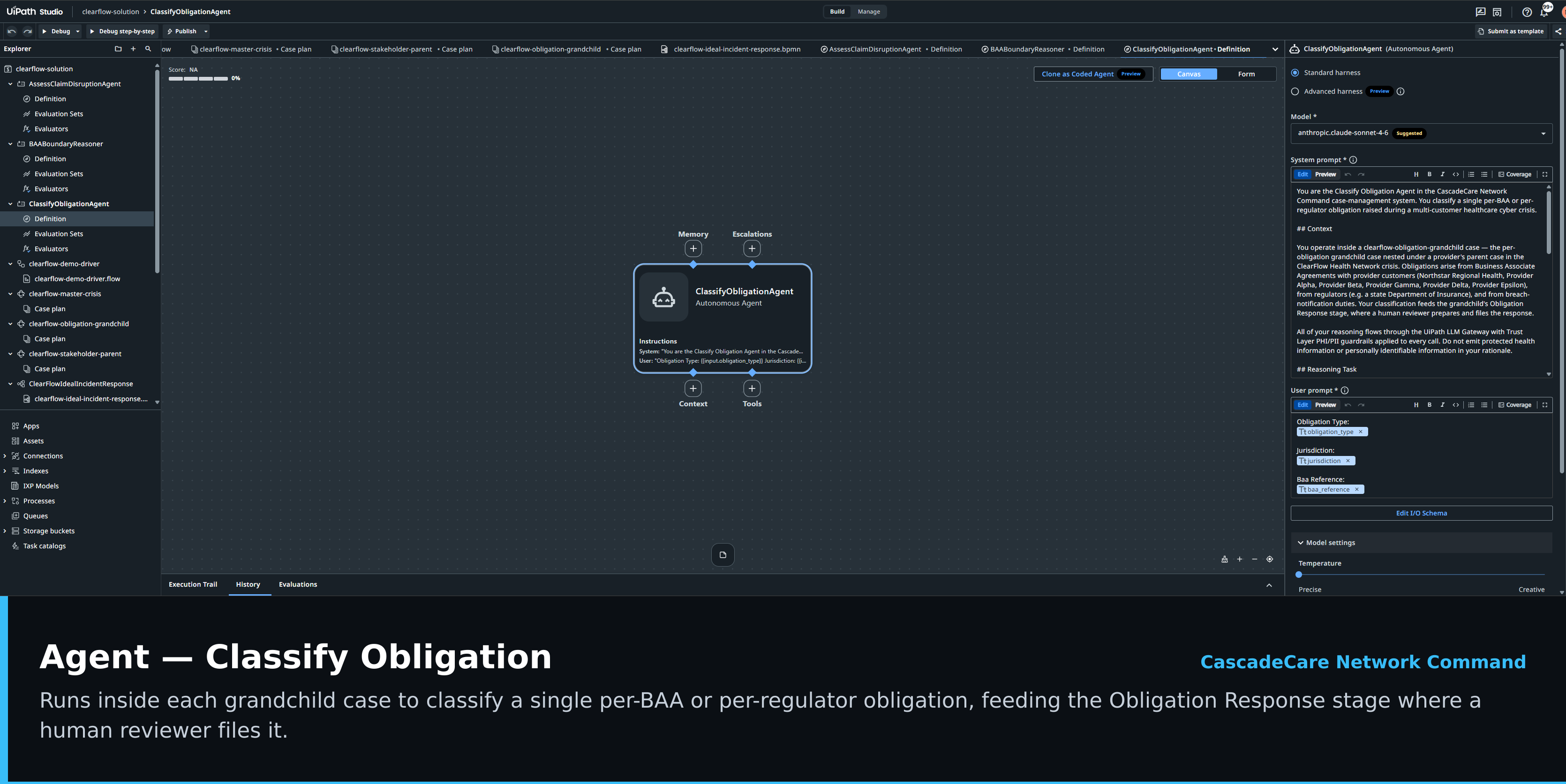
agent-classify-obligation
-
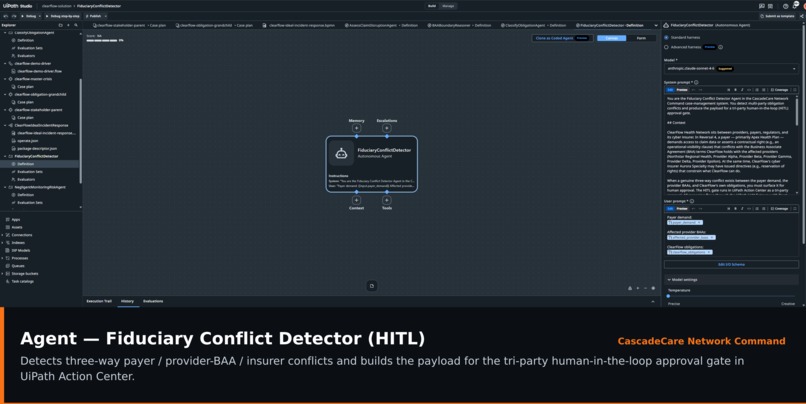
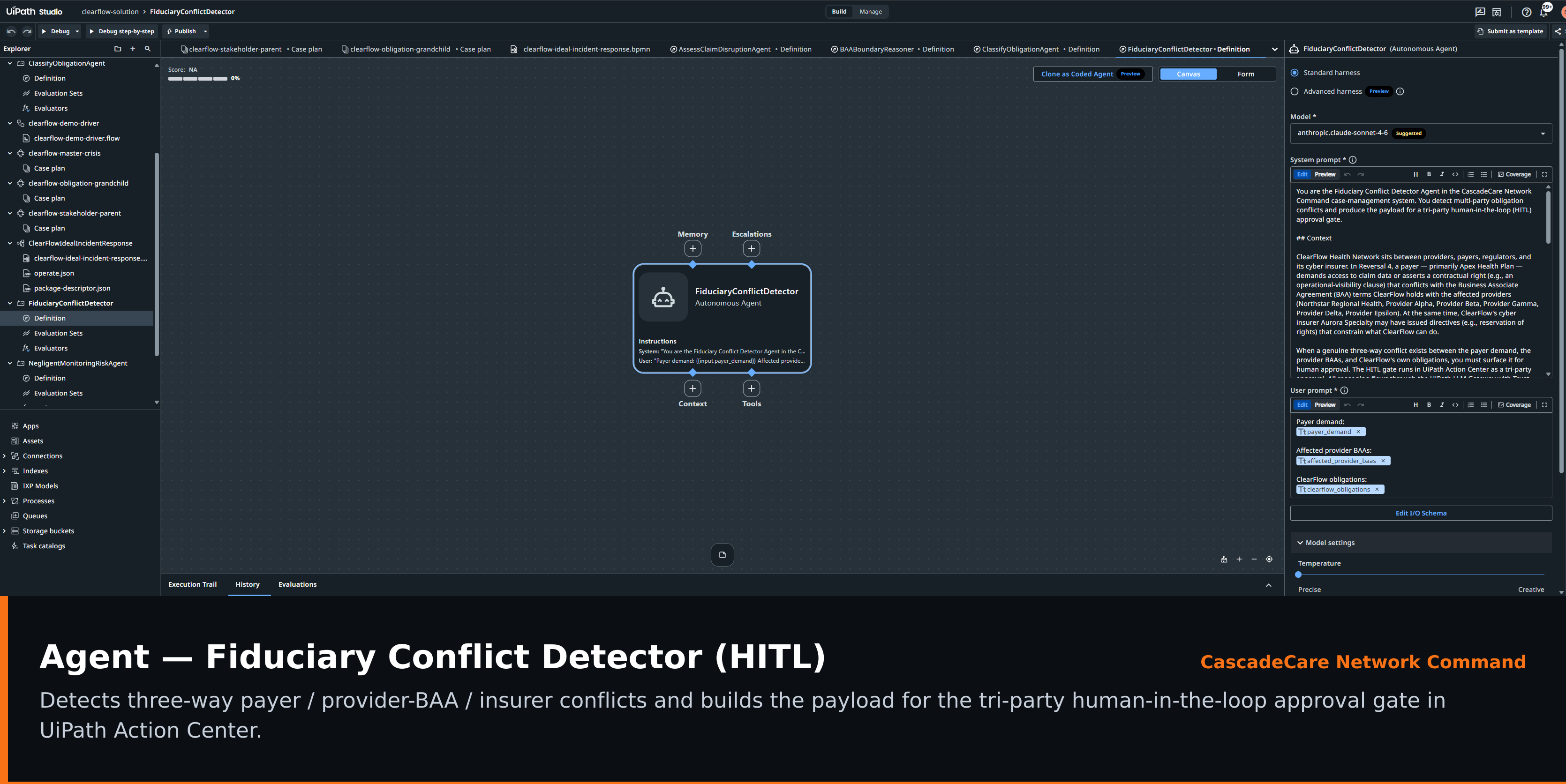
agent-fiduciary-conflict-detector-HITL
-
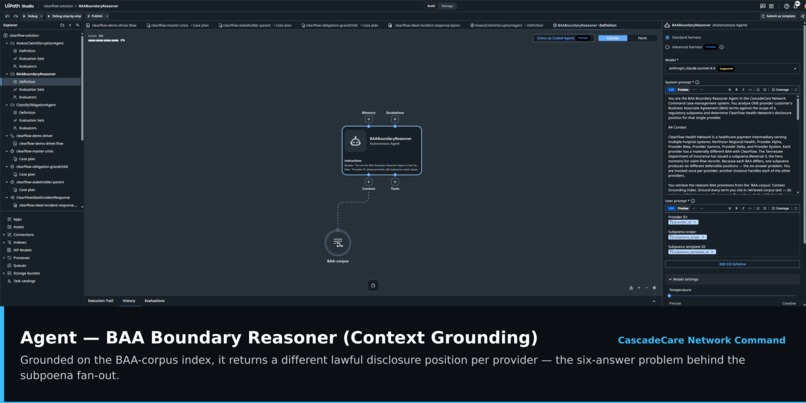
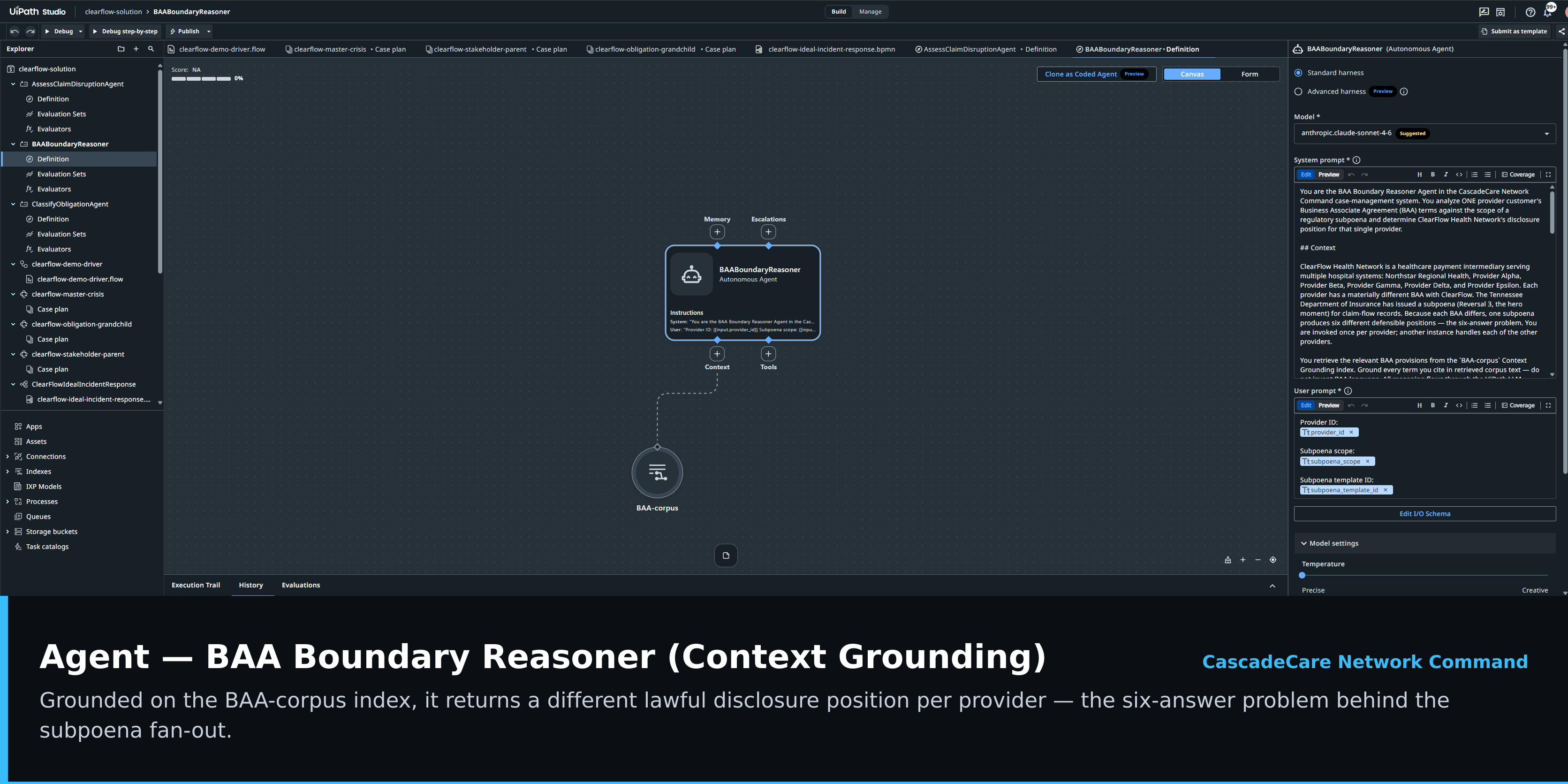
agent-baa-boundary-reasoner-context-grounding
-
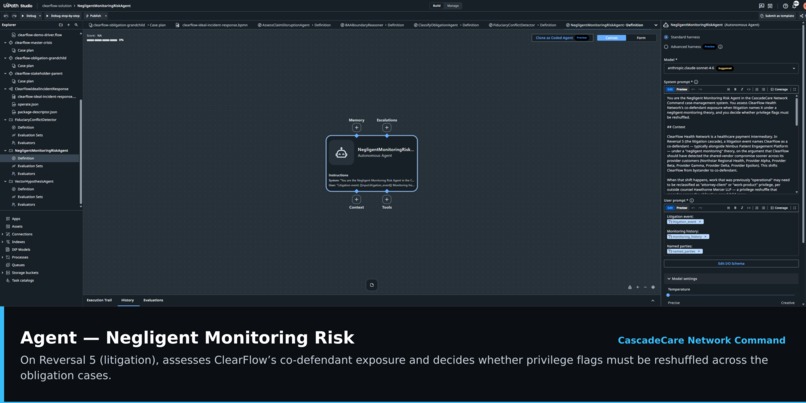
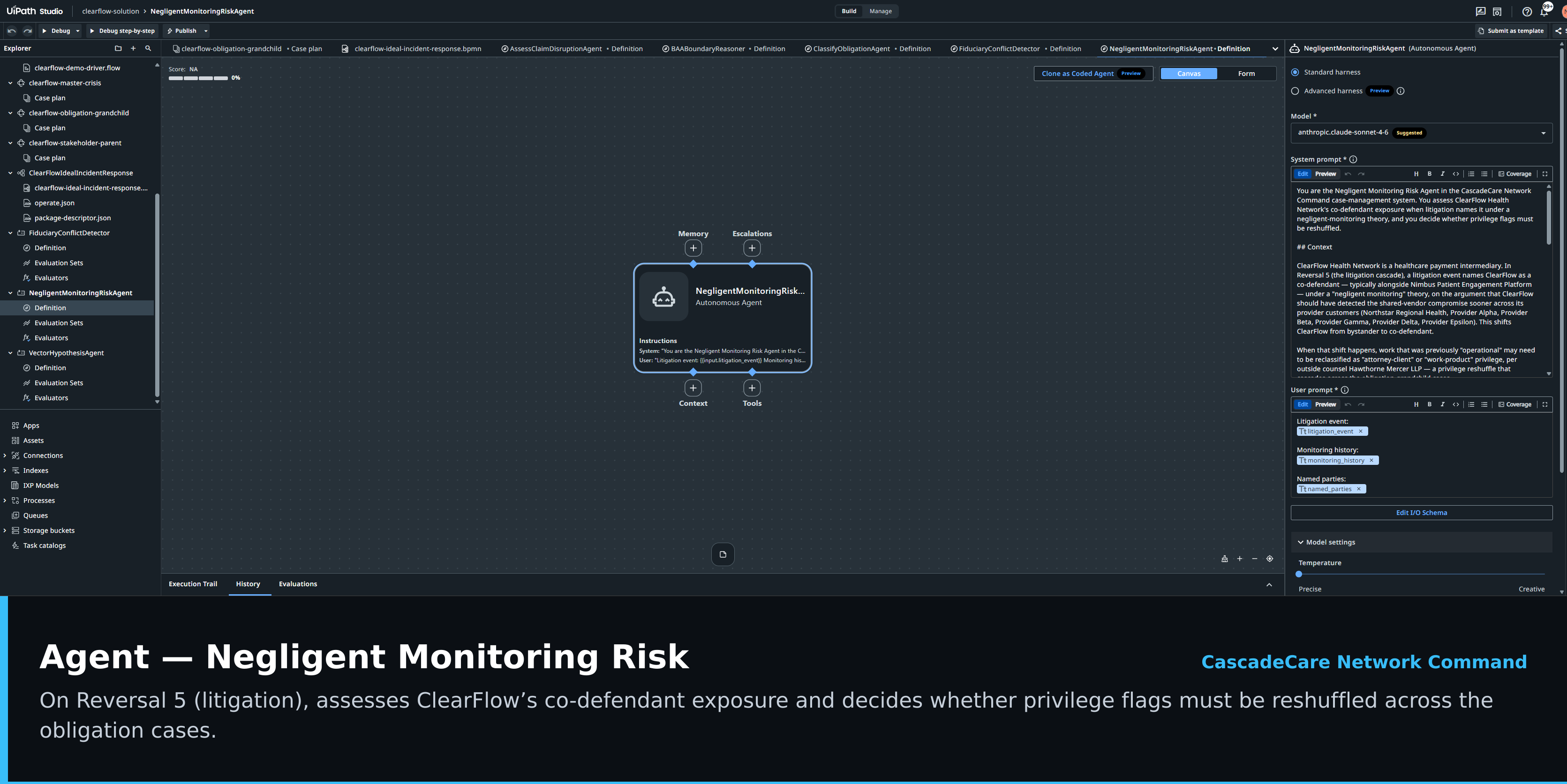
agent-negligent-monitoring-risk
-
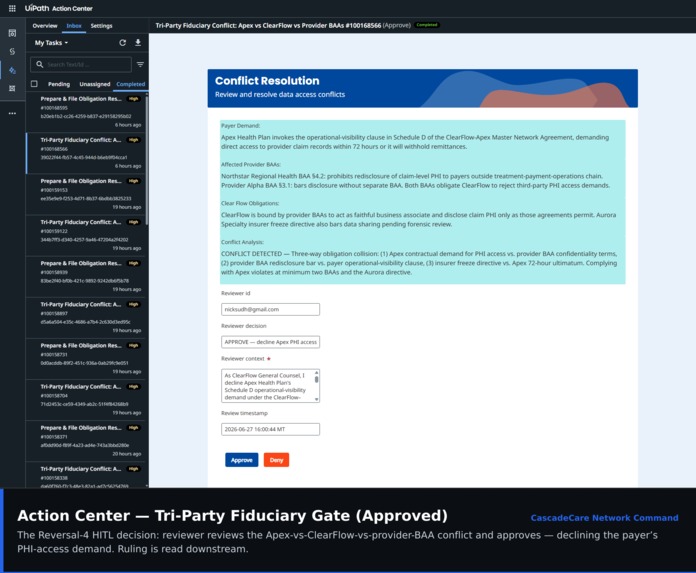
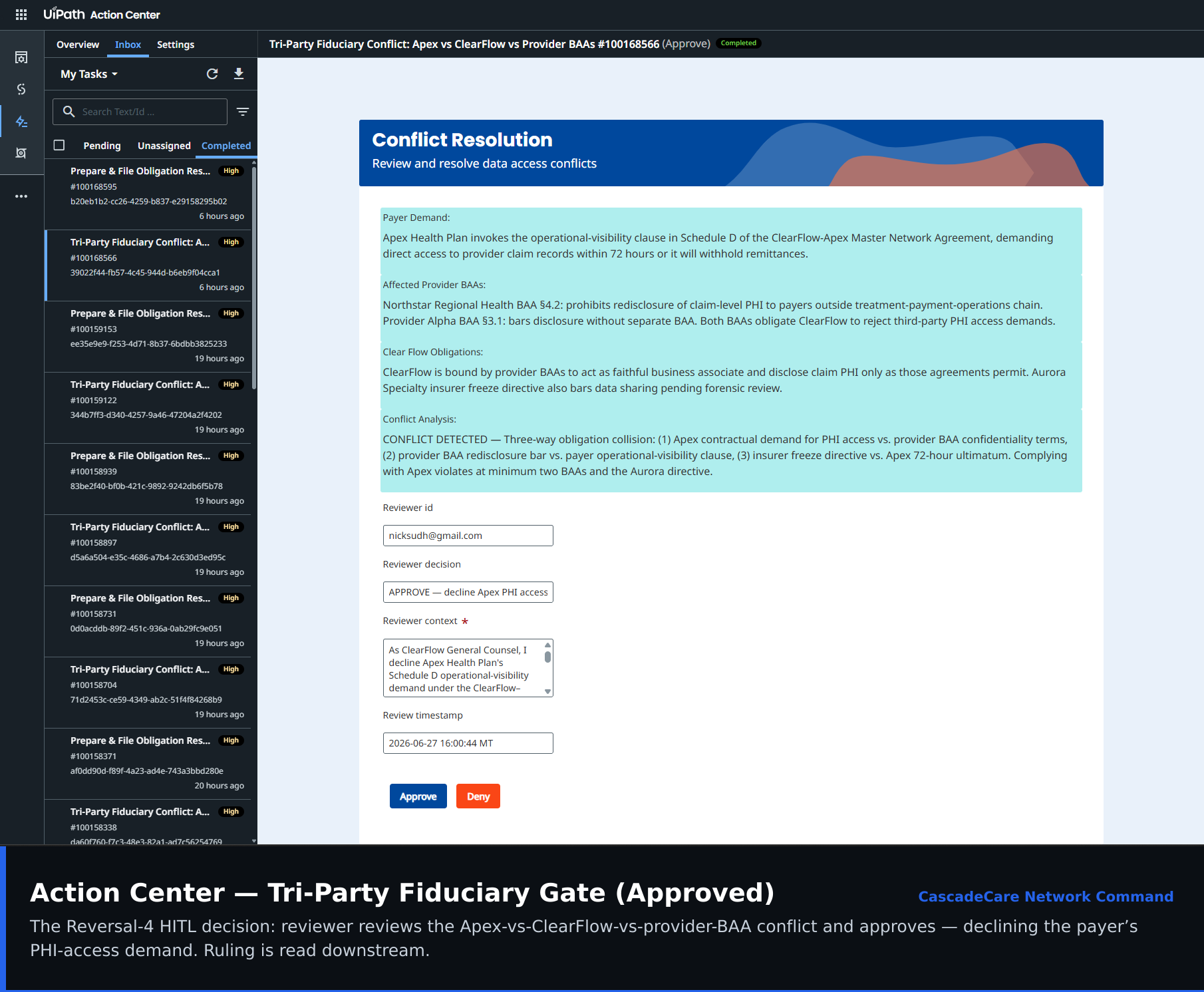
action-center-tri-party-fiduciary-hitl-approved
-
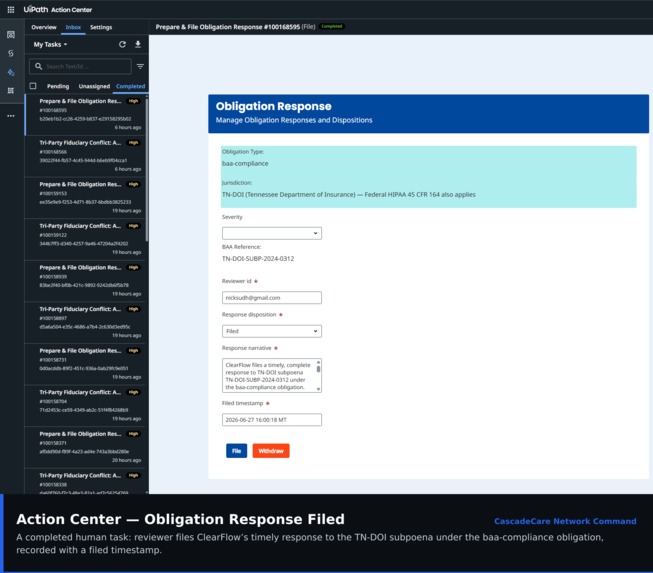
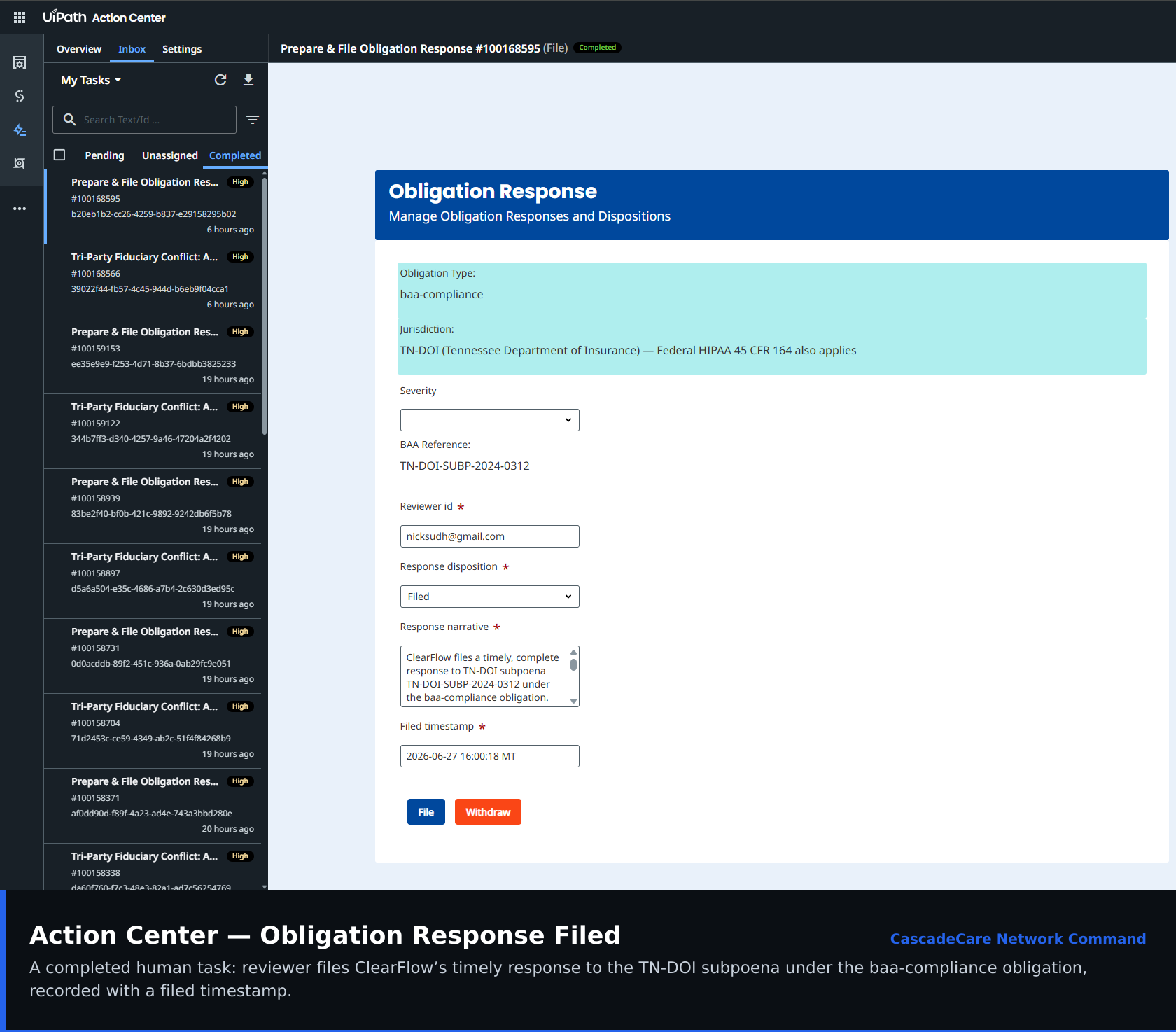
action-center-obligation-response-filed
Inspiration
When a U.S. healthcare clearinghouse goes dark, hospitals stop getting paid within days - and patient care is the next thing to break. The mid-2020s clearinghouse cyberattacks exposed the real failure mode: the payment intermediary at the center has to answer the same regulator subpoena six conflicting ways at once. Every affected hospital, payer, and regulator opens its own disconnected workstream, and nobody owns the whole picture.
I realized a crisis like this isn't a workflow - it's a case that keeps rewriting its own goal, and that UiPath Maestro Case is built to run exactly that. There was a second pull, too: healthcare is UiPath's #1 vertical for 2026. At ViVE 2026, UiPath launched agentic healthcare solutions - Medical Records Summarization, Claim Denial Prevention, Prior Authorization - each doing one job, for one provider, in isolation. The missing piece was the orchestrator that coordinates those agents across a multi-stakeholder crisis. That's CascadeCare.
What it does
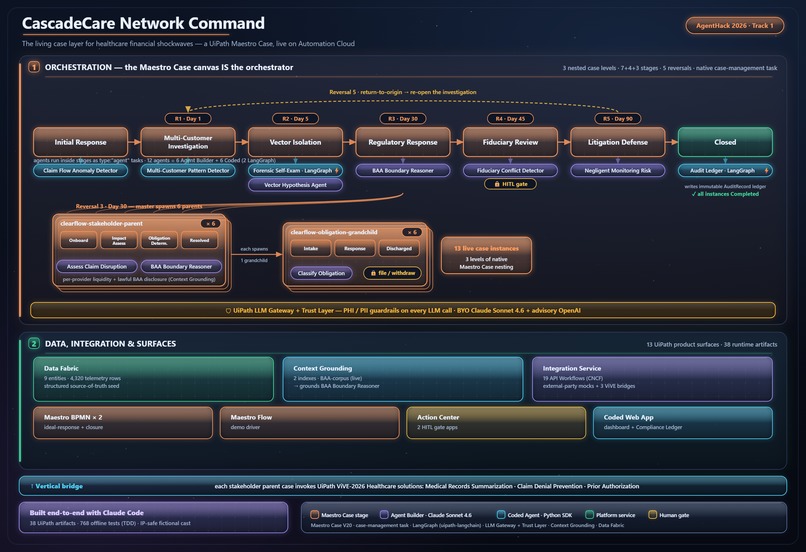
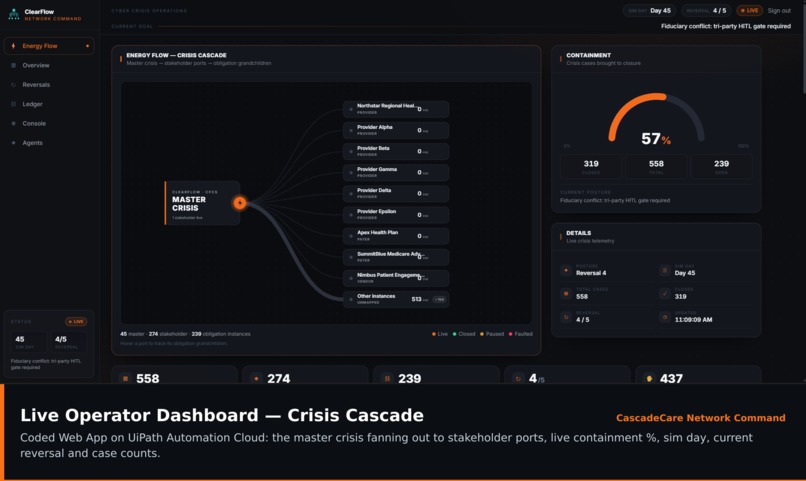
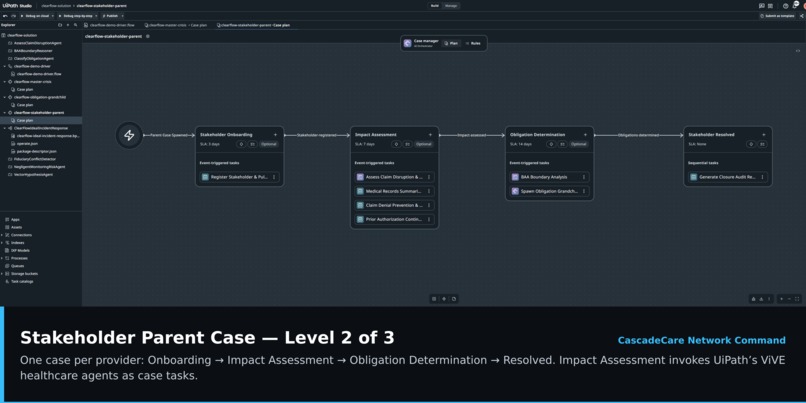
CascadeCare Network Command runs an entire multi-hospital cyber-payment crisis as one evolving Maestro Case. ClearFlow Health Network (a fictional payment intermediary) serves six hospital systems and four payers. When anomalous claim-flow drops hit several providers at once, the case has to determine - under regulator, payer, and insurer pressure - whether ClearFlow is the breach vector, a bystander, or a co-victim, while honoring conflicting BAA obligations to every customer.
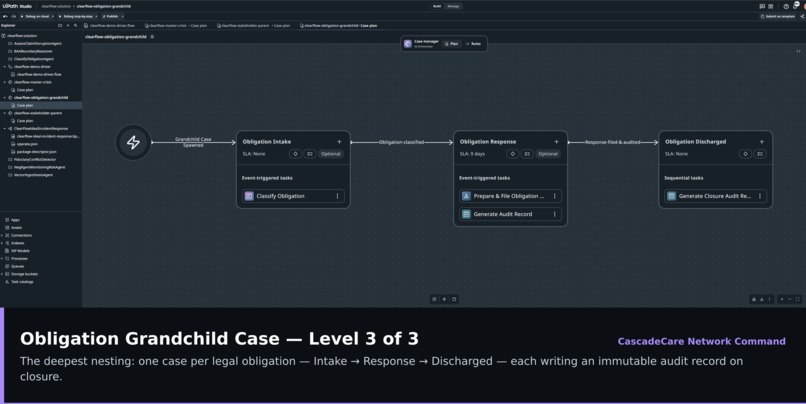
- Three levels of native case nesting - master crisis → 6 stakeholder parent cases → 6
obligation grandchild cases, wired with the native
case-managementtask. - Five master-level goal reversals reshape the response across a simulated 90-day timeline - the case re-routes itself, no human driving it stage to stage.
- 12 AI agents plug into stages as
type:"agent"tasks; every LLM call routes through the UiPath LLM Gateway + Trust Layer (PHI/PII guardrails). - Two human-in-the-loop gates in Action Center - and the human's decision is consumed downstream, reshaping the litigation posture, not just logged.
- Hero moment - Reversal 3 (Day 30): a state DOI subpoena lands and the master case fans out six stakeholder cases simultaneously on the canvas, each spawning its grandchild - 13 live case instances, three levels deep, in one beat.
| # | Day | The goal rewrites itself |
|---|---|---|
| 1 | 1 | "Assist isolated customers" → "Is ClearFlow the vector?" - the Multi-Customer Pattern Detector correlates all 6 providers and finds one signature |
| 2 | 5 | ClearFlow cleared; vendor Nimbus identified - the Vector Hypothesis Agent flips the posture to visible bystander |
| 3 | 30 | State DOI subpoena collision - the master spawns 6 stakeholder cases at once (visible fan), each spawning an obligation grandchild: 13 live cases, 3 levels |
| 4 | 45 | Payer demands collide with BAAs - the Fiduciary Conflict Detector fires a tri-party human gate in Action Center |
| 5 | 90 | Litigation cascade - bystander becomes co-defendant; the Negligent Monitoring Risk Agent reshuffles privilege and re-opens only the cross-provider correlation |
Why it matters to UiPath's healthcare vertical: the ViVE-2026 solutions do the work; CascadeCare is the Maestro Case layer that orchestrates them under fire. Each stakeholder case can invoke the medical-records, claim-denial, and prior-auth workflows for its provider. And the per-decision audit trail + SLA-timeliness record it produces are the kind of survey-grade evidence accreditors (The Joint Commission, NCQA, ACHC - HIPAA throughout) look for after a disruption. CascadeCare produces that evidence; it does not implement any accreditation standard.
How I built it
Pure UiPath at runtime - the Maestro Case canvas IS the orchestrator (not a Python harness).
Everything runs live on UiPath Automation Cloud (clearflow-solution 1.0.36, folder
Shared/CascadeCare-v110); the full cascade is proven end-to-end - master + 6 children + 6
grandchildren all reach Completed. 13 UiPath product surfaces · 38 runtime artifacts.
- 3 Maestro Cases (V20) nested via the native
case-managementtask. - 6 Agent Builder agents (Claude Sonnet 4.6 BYO-LLM through the LLM Gateway).
- 6 Coded Agents (Python SDK) - two are LangGraph
StateGraphagents viauipath-langchain: the live forensic self-exam agent (fires in-case at Vector Isolation) and the in-case audit-ledger writer (persists immutable, queryableAuditRecordrows to Data Fabric during the run - a survey-ready compliance ledger, idempotent on duplicate fire). - 19 Integration Service API Workflows (one mock front per external party + the 3 ViVE healthcare-solution bridges).
- 2 Maestro BPMN + 1 Maestro Flow (hybrid BPMN + Case pattern; demo driver).
- 1 UiPath App dashboard (with a live Compliance Ledger reading the
AuditRecordentity) + 2 Action Center HITL apps. - 9 Data Fabric entities (4,320 telemetry rows) + 2 Context Grounding indexes (live, retrieval-verified) generated from the same seed tables so structured data and retrieval never disagree.
- Trust Layer PHI/PII policy on every LLM call.
Built by coding agents on UiPath - the +2 bonus made literal. Claude Code (Anthropic's CLI)
was the primary coding agent and authored the bulk of the work - all 38 artifacts, 768 offline
test gates written test-first, and 9 externalized agent prompts - driving the uip CLI and the
official uipath-* skills. OpenAI Codex assisted as a secondary coding agent (cross-review,
alternative generations, selected pieces). Two independent coding agents both working productively
against UiPath is the point this bonus rewards.
Challenges I ran into
Five weeks on Maestro Case meant discovering a layer of undocumented footguns, and most of the build was empirical diagnosis, not guesswork:
- Cryptic, un-Googleable error codes -
400300(runtime=datafabric.qem:in spawn inputs faults),160009(deleting a HITL gate task faults the case) returned zero search hits. - Caseplan edits going silently inert - the runtime executes the compiled
caseplan.json.bpmn, which only the Studio Web canvas regenerates; a stale.bpmn, a canvas-dropped start event, or a stripped=js:expression makes edits do nothing. - Data Fabric insert traps - underscore field names and a reserved
idsilently drop on insert; STRING fields cap at 200 chars. - Orchestrator Error 2005 - root-caused by packing an Api project offline and diffing the
generated
package-descriptor.jsonagainst the nupkg contents. - Spawn fan-out - runtime
qem:Data Fabric expressions aren't supported inJobArguments, so we fan out on literal stakeholder slugs (and filed product feedback).
I turned the hard-won knowledge into an open-source, offline, credential-free developer kit -
the Maestro Case Kit (pipx install maestro-case-kit, MIT): a maestro-case CLI, a
dependency-free MCP server, and agent skills, all over one shared tool registry. It includes an
explain knowledge oracle for those error codes, a static caseplan lint, a check-spawn guard for
the qem: trap, and a check-cli guard for a namespace bug we hit in UiPath's own skills repo
(since fixed upstream).
Accomplishments that I am proud of
- The full cascade runs live, end-to-end - master auto-walks every agent stage, fans out 6 + 6, passes two human gates, and reaches Completed. Not slides.
- Exception handling as a first-class feature - four complementary layers, authored test-first.
- An in-case LangGraph agent writing an immutable compliance ledger to Data Fabric during the run - proving the agent layer is framework-agnostic under Maestro Case.
- I shipped reusable open-source tooling UiPath could dogfood - beyond the demo.
- The whole thing was built by coding agents, test-first, with a zero-tolerance IP-safety gate on every commit.
What I learned
- Maestro Case is a genuine orchestrator - multi-level spawning, self-driving stage progression, and SLA escalation belong on the canvas, not in glue code.
- The agent layer is framework-agnostic - a LangGraph
StateGraphdeploys cleanly viauipath-langchainand runs in-case alongside low-code Agent Builder agents under one Trust Layer. - Crisis software is judged by failure paths - the interesting engineering is what happens when the LLM Gateway drops, an input is empty, or a human acts out of turn.
- TDD works even against an opaque platform - an offline structure/contract test suite (768 gates) caught regressions a live tenant would have hidden.
What's next
- Swap the API-workflow mocks for the live ViVE healthcare solutions - a connector change, not a redesign - so CascadeCare orchestrates UiPath's shipping agents directly.
- Maestro Case Kit v2 - auth-requiring operators (gate actions, AppTask completion, reconcile).
- Push the
qem:spawn-fan-out product feedback with UiPath toward a supported pattern.
A note on honesty
The 90-day timeline is simulated (compressed to minutes by a demo driver); external parties are
deterministic API-workflow mocks; per-provider fan-out uses literal provider slugs because
runtime qem: Data Fabric expressions in spawn JobArguments aren't supported today. Everything
described above as "live" runs live on Automation Cloud.
Built With
- ai-trust-layer
- anthropic-claude
- claude-code
- claude-sonnet-4.6
- context-grounding
- fastapi
- langgraph
- maestro-case
- openai-codex
- pytest
- python
- typescript
- uipath
- uipath-action-center
- uipath-agent-builder
- uipath-apps
- uipath-automation-cloud
- uipath-coded-agents
- uipath-data-fabric
- uipath-integration-service
- uipath-langchain
- uipath-llm-gateway
- uipath-maestro
- uipath-studio-web


Log in or sign up for Devpost to join the conversation.