-
-

-
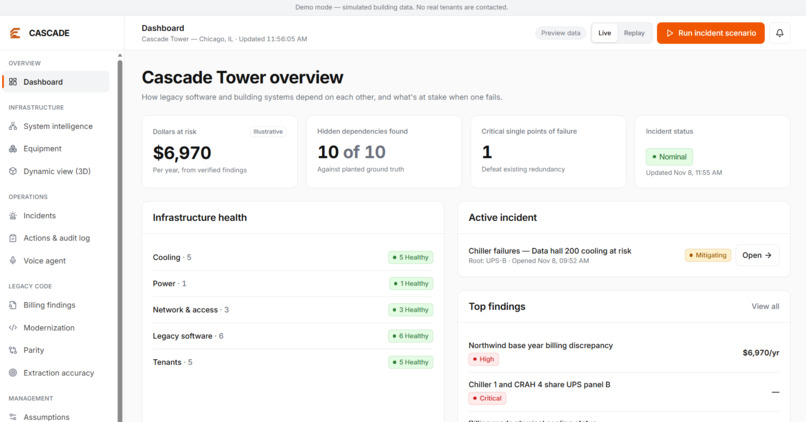
dashboard
-
-
-
-
-
-
-
-
-
-
-
-

Cascade
Inspiration
A data center can have two power feeds and still have a single point of failure. If both feeds connect to the same upstream equipment, one shutdown can take out both.
We researched what critical facilities managers do each day: coordinating maintenance, reviewing equipment records, preparing shift handoffs, and keeping customers informed. The information behind those decisions is usually spread across circuit rosters, equipment registers, maintenance exports, monitoring records, and contracts.
We wanted to connect those records so managers could answer one question with confidence: "If we take this component offline, what happens next?"
That became Cascade.
What It Does
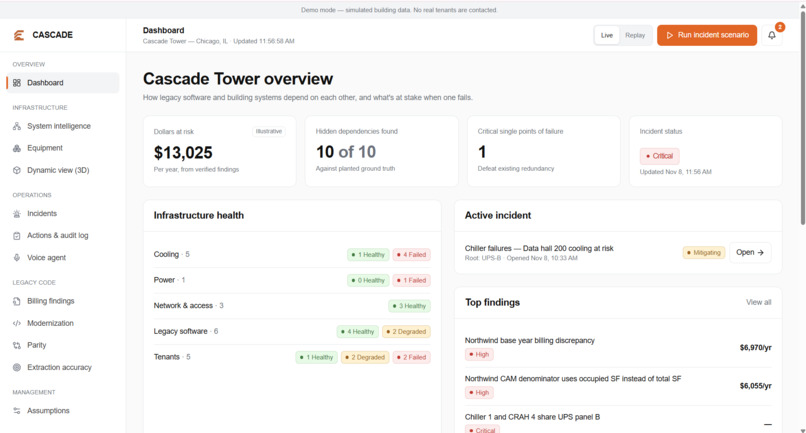
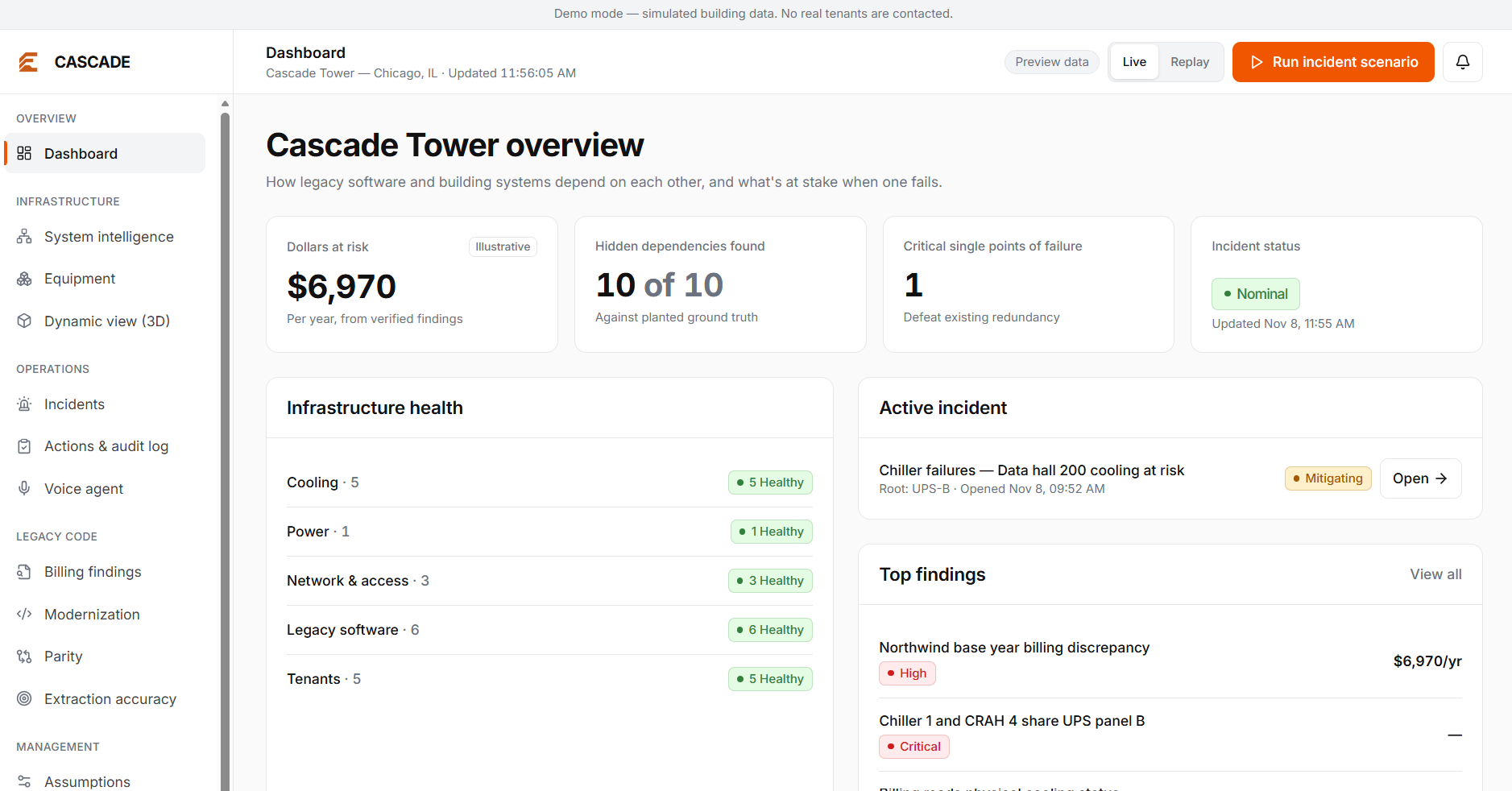
Cascade builds a data center's power and cooling dependency model from the documents operators already have. It helps managers identify hidden risks, assess maintenance impacts, and prepare responses before a disruption spreads.
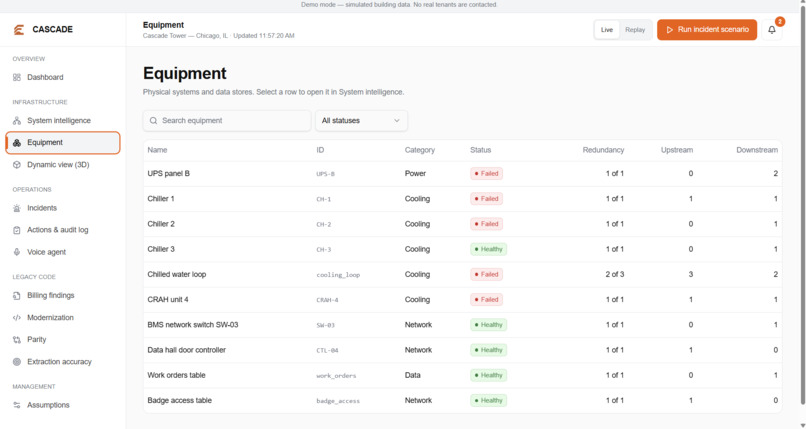
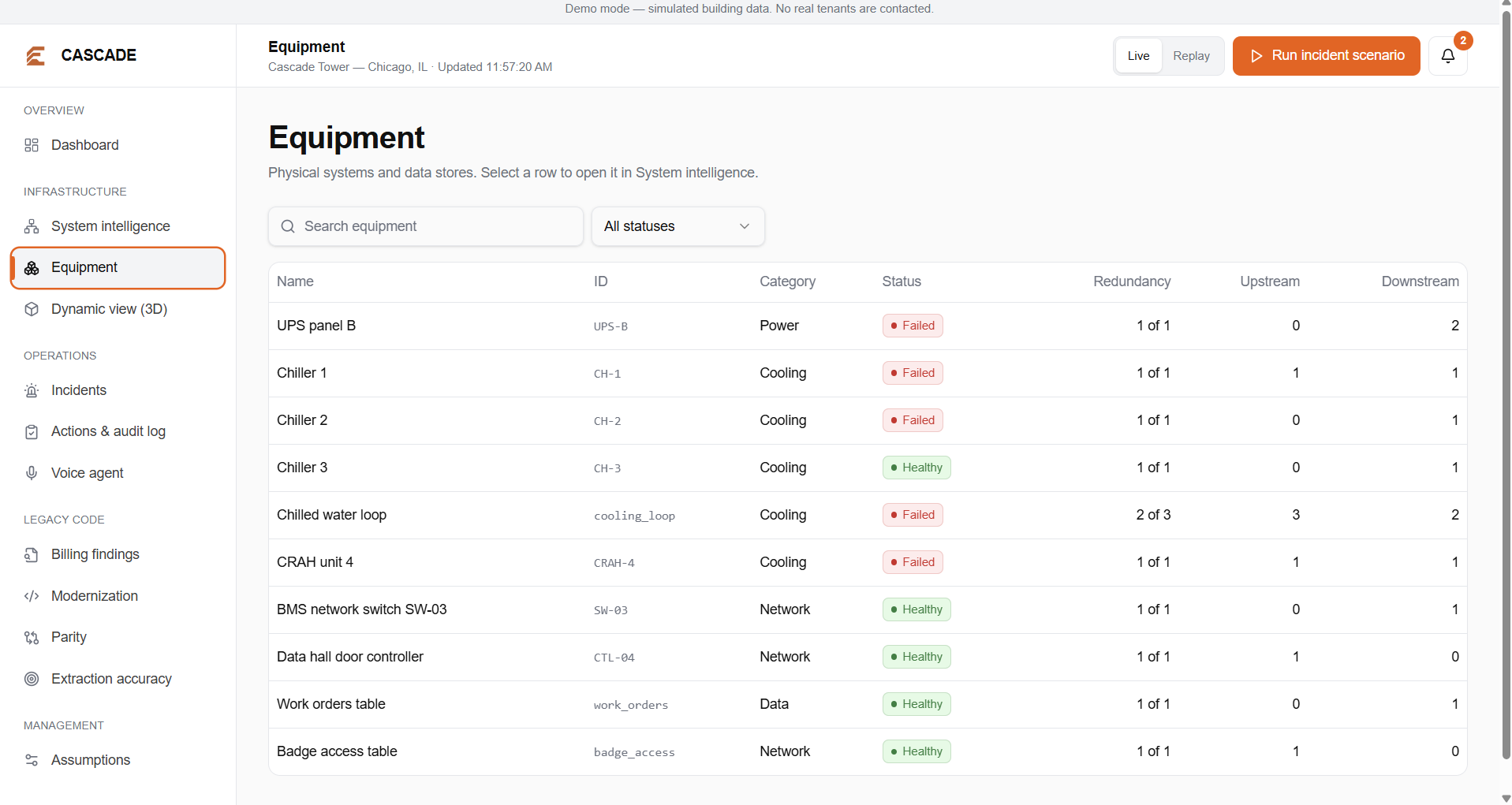
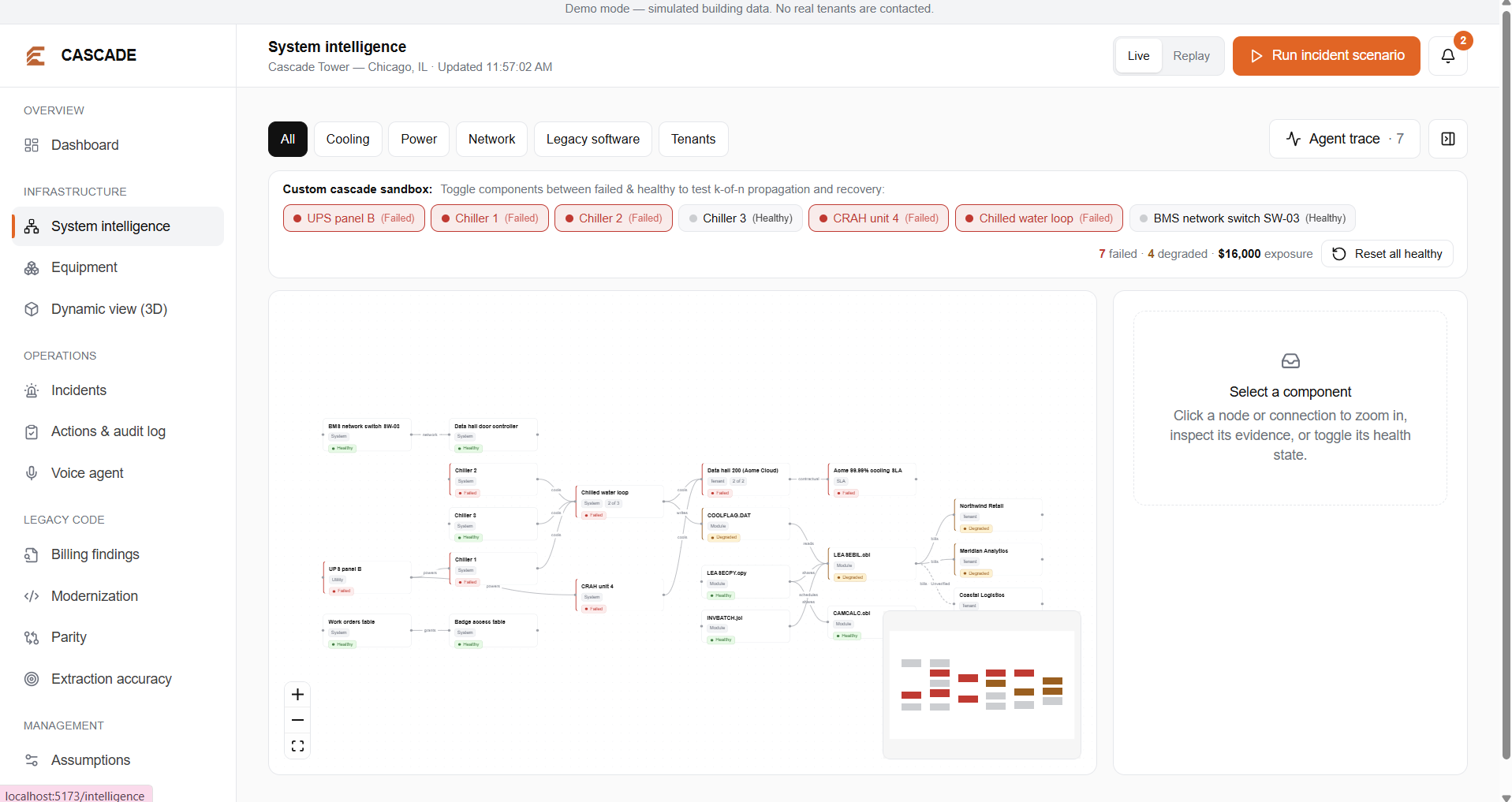
Our fictional demonstration site has 6 customers, 52 cabinets, 101 cords, and 108 circuits. The model traces infrastructure from utility feeds and UPS systems down to individual cabinet cords. It also covers the motor control centers, mechanical panels, and transformers supporting the cooling plant, along with the chilled-water loop serving the data center hall.
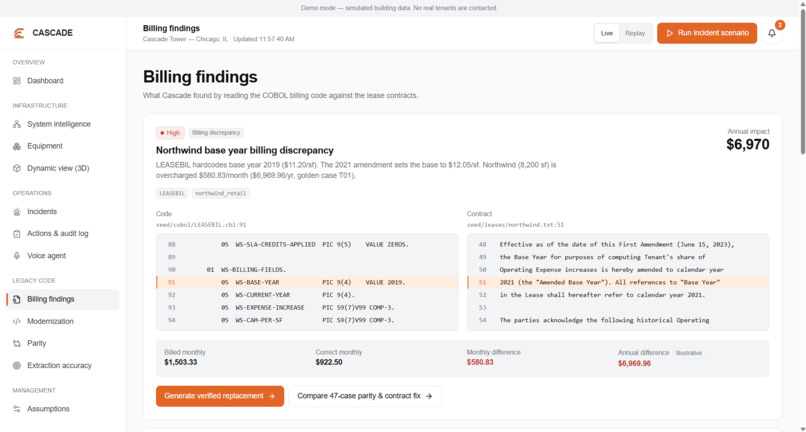
Cascade checks seven categories of risk, including single-corded cabinets, power paths that converge upstream, failover overload, insufficient cooling capacity, shared cooling equipment, and contractual commitments that the infrastructure cannot support.
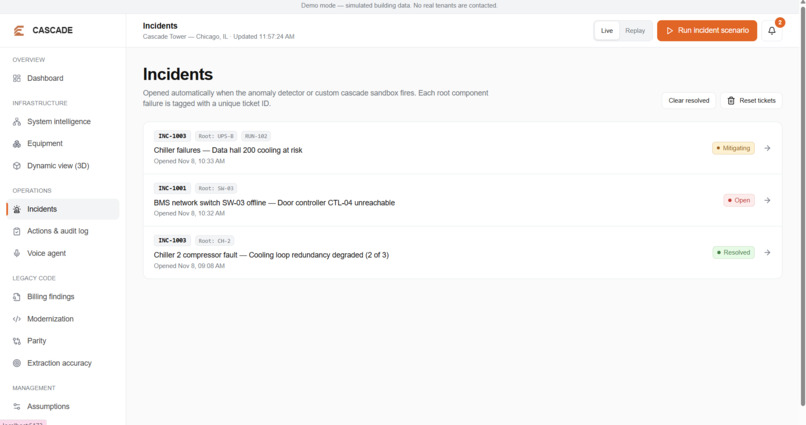
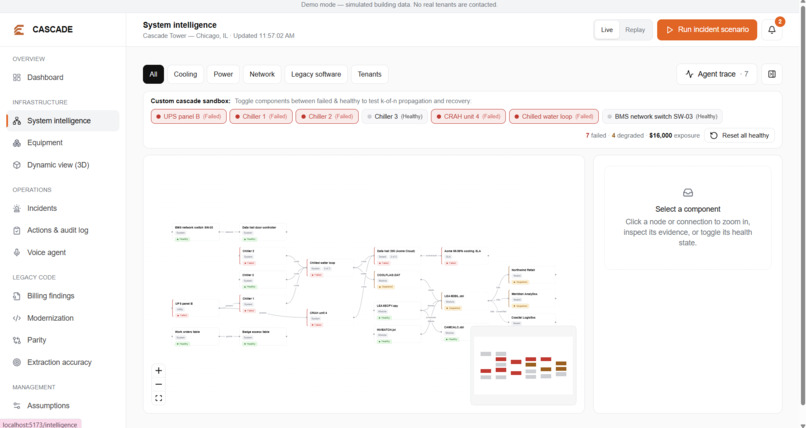
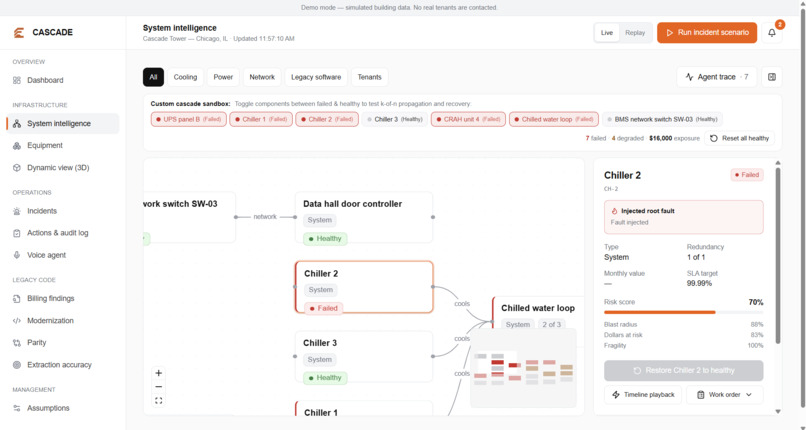
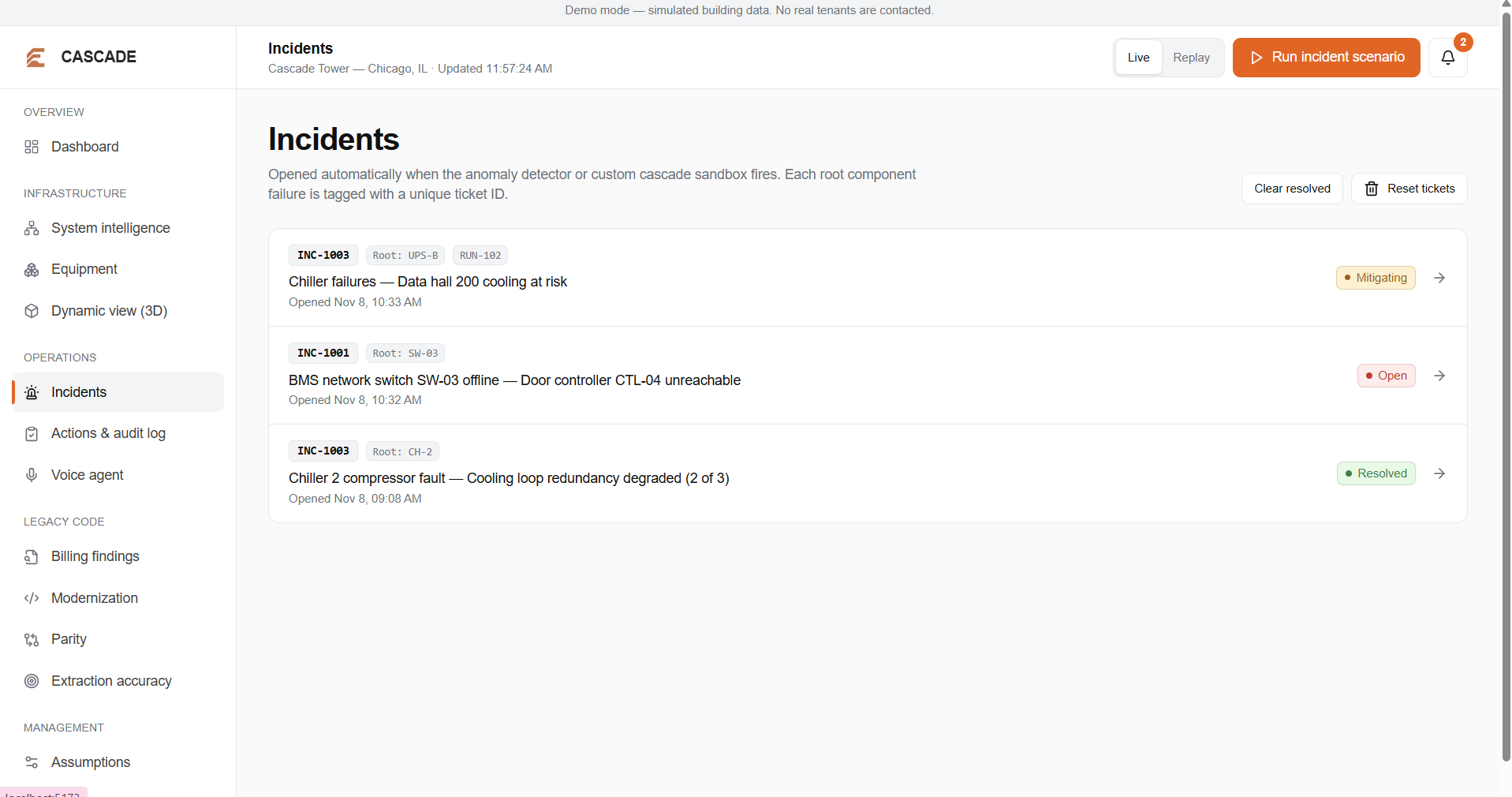
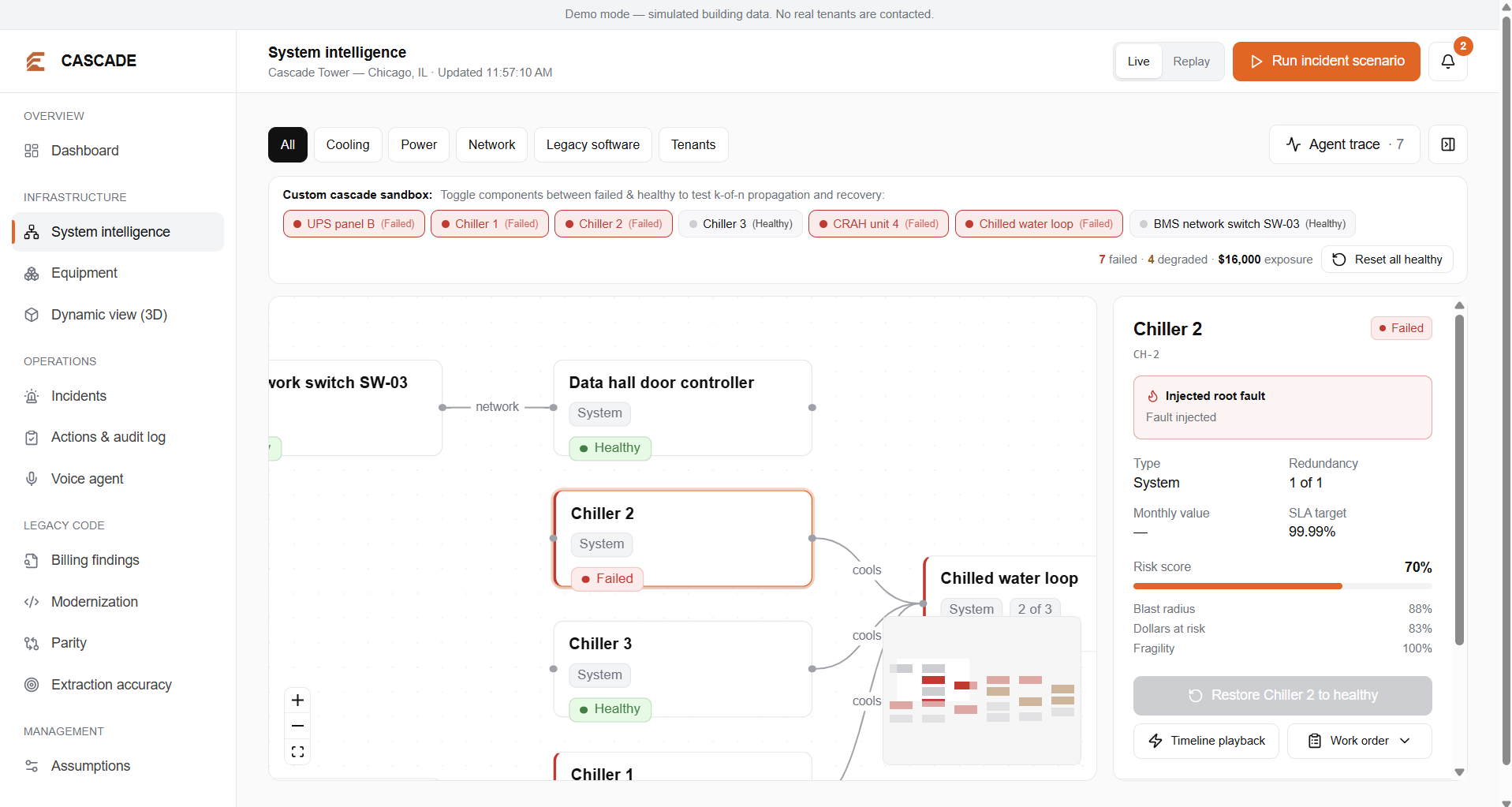
Managers can simulate equipment failures or maintenance shutdowns, identify affected cabinets and customers, and estimate the monthly revenue exposed. Cascade can also propose corrective changes and validate them against the dependency model before submitting them for human approval.
The application has five main workspaces:
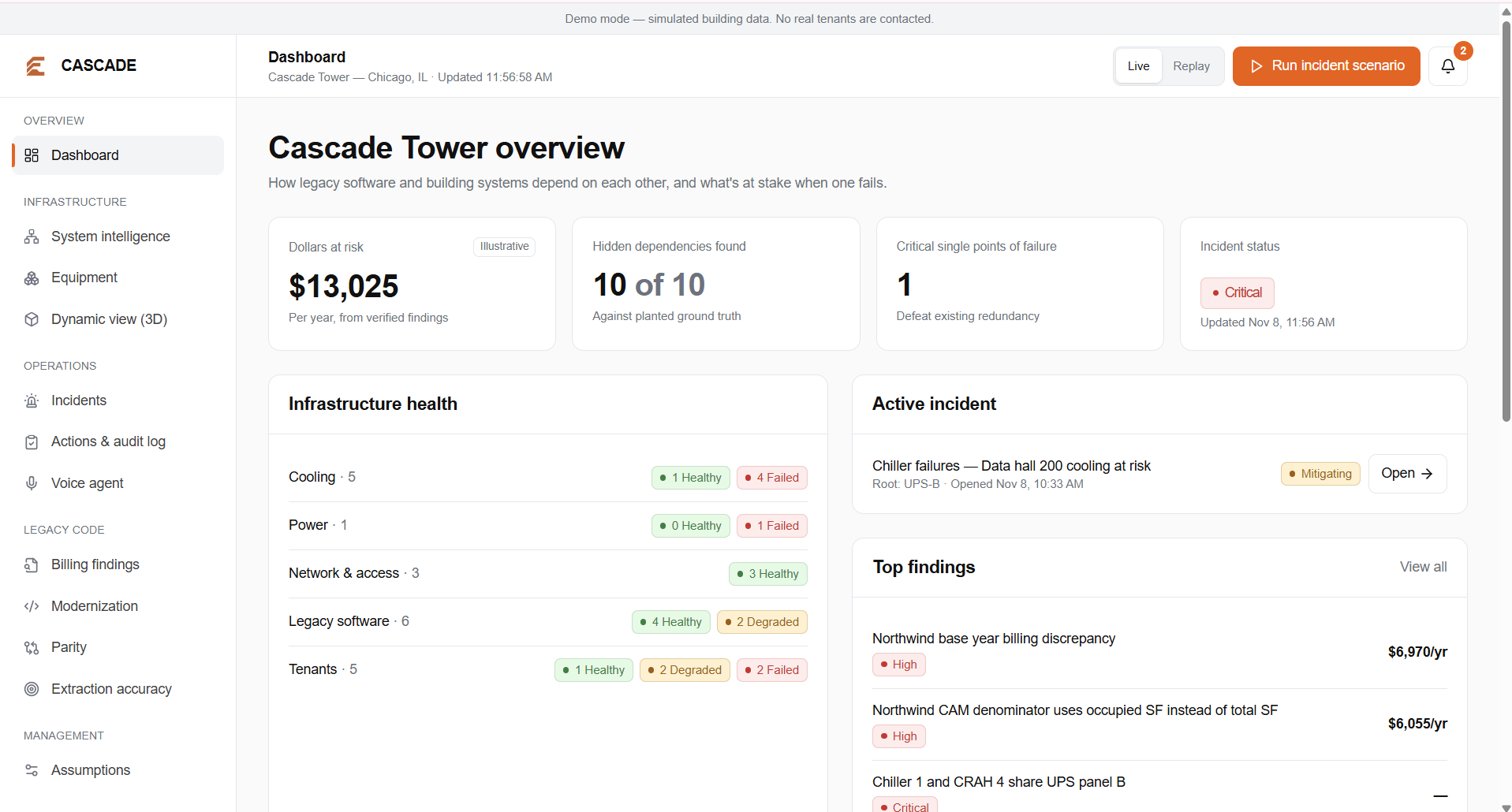
- Site: Facility overview, equipment, dependencies, and identified risks.
- Work Week: Upcoming maintenance activities and their potential impact.
- Handoff: Active issues, unfinished work, and relevant context for the next shift or technical team.
- Procedures: Instructions and supporting information for operational tasks.
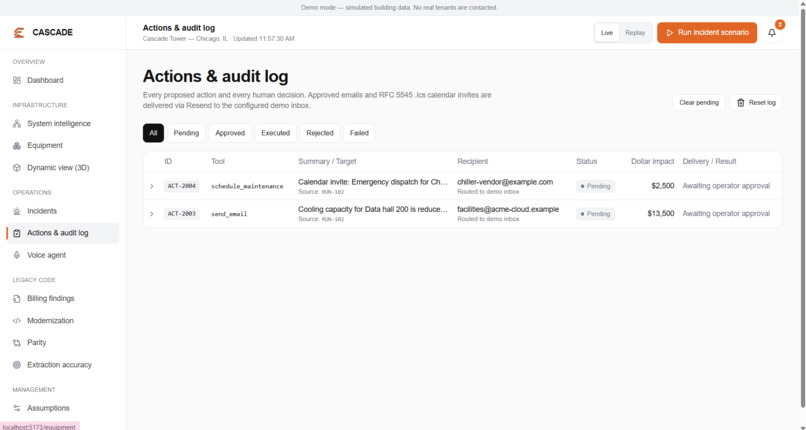
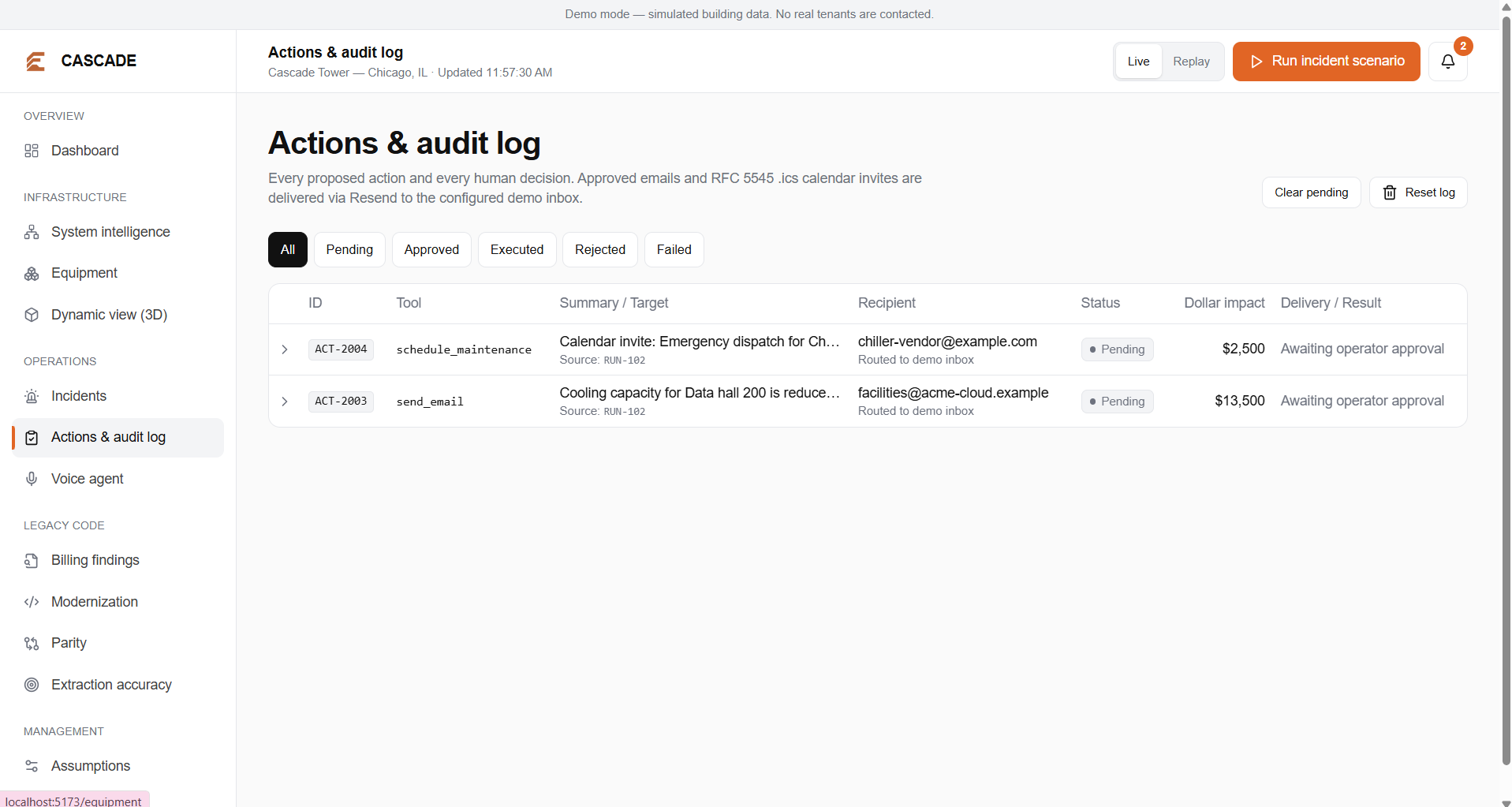
- Approvals: Human review and authorization of proposed actions.
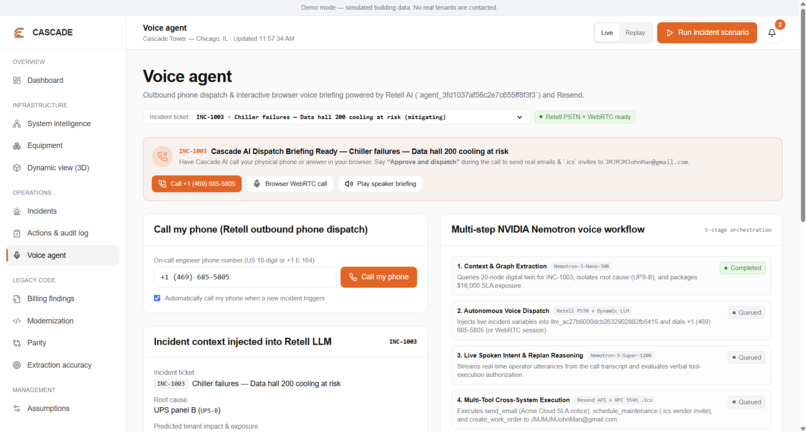
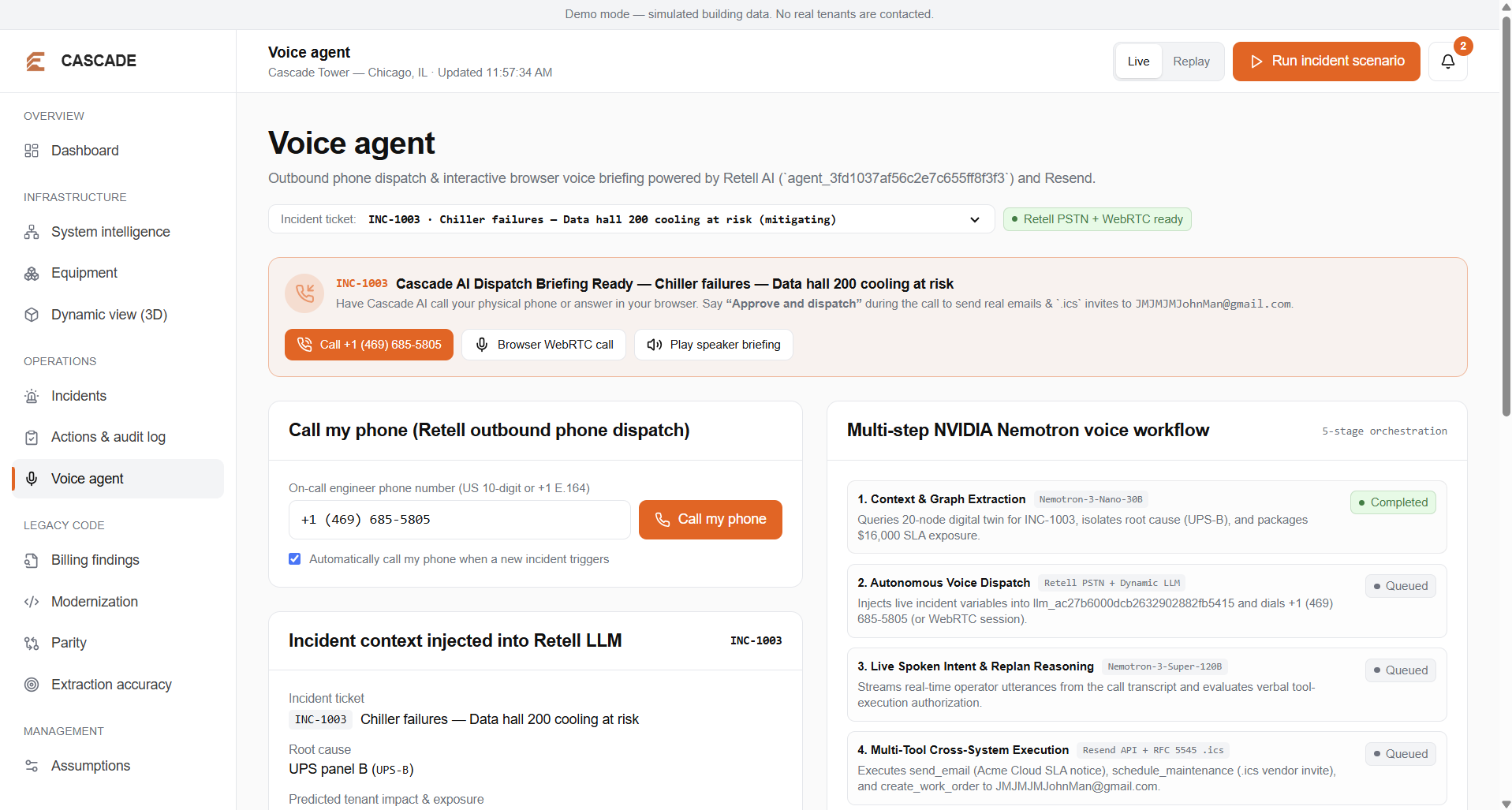
An AI companion allows users to investigate infrastructure and ask questions in plain language. We also developed a phone-based voice interface to connect spoken operational reports with the application.
How We Built It
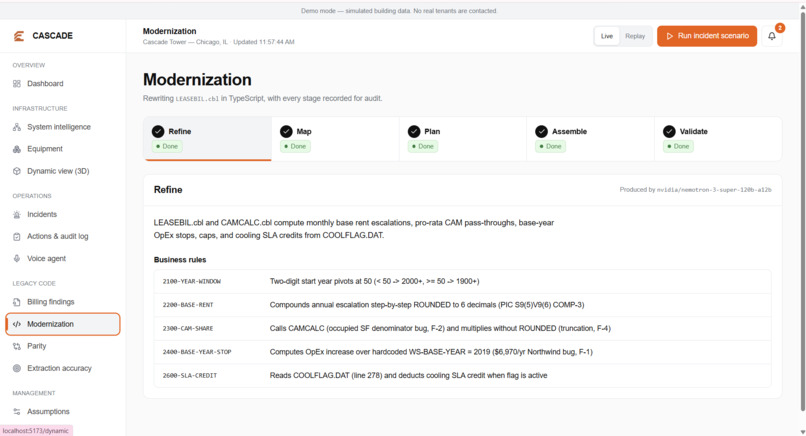
We used Claude and Google Antigravity for AI-assisted development, alongside hands-on engineering of the application and its NVIDIA Nemotron-powered agent workflow.
The frontend uses React and TypeScript, with React Three Fiber for the 3D facility visualization and xyflow for dependency diagrams. An Express backend connects document processing, infrastructure analysis, the user interface, and approval workflows.
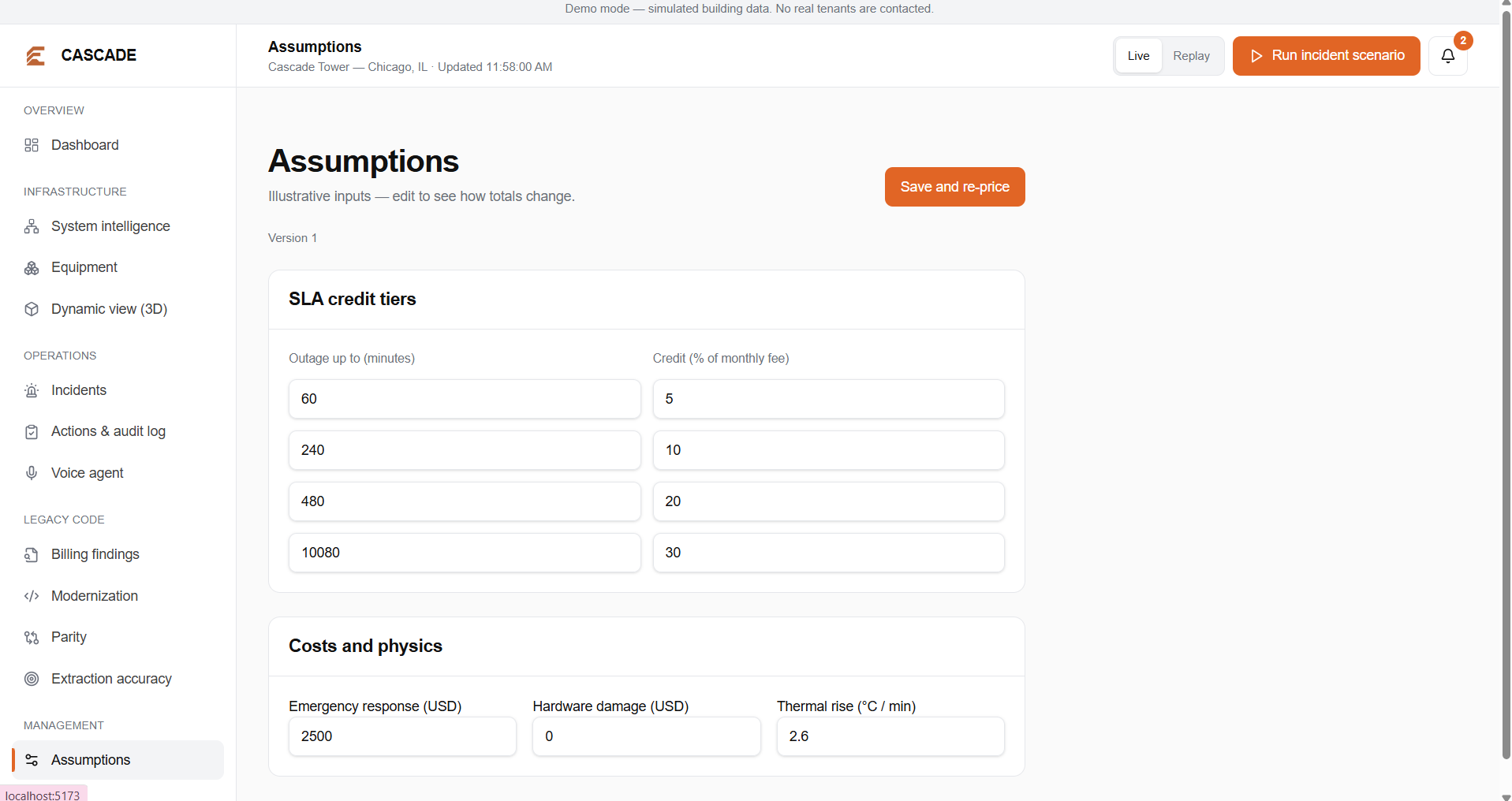
At the core of Cascade is a deterministic TypeScript analysis engine. It assembles the facility model and calculates how failures propagate through power and cooling infrastructure. Its calculations account for equipment capacity, redundancy, transfer switches, UPS battery ride-through, and how long equipment can operate before overheating. It also checks whether proposed corrective actions introduce new risks.
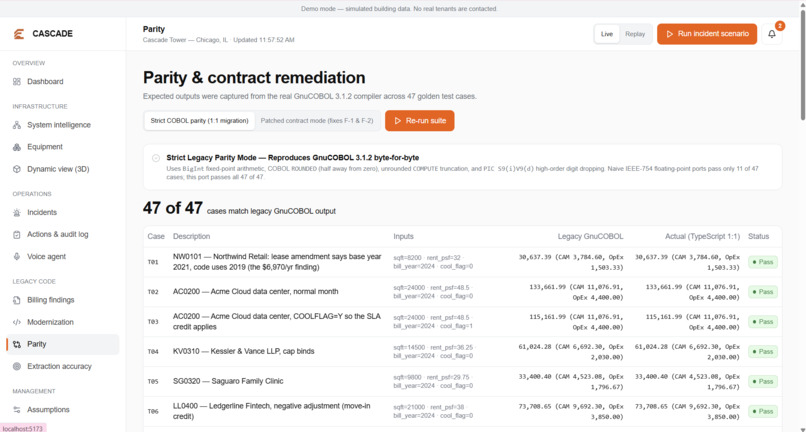
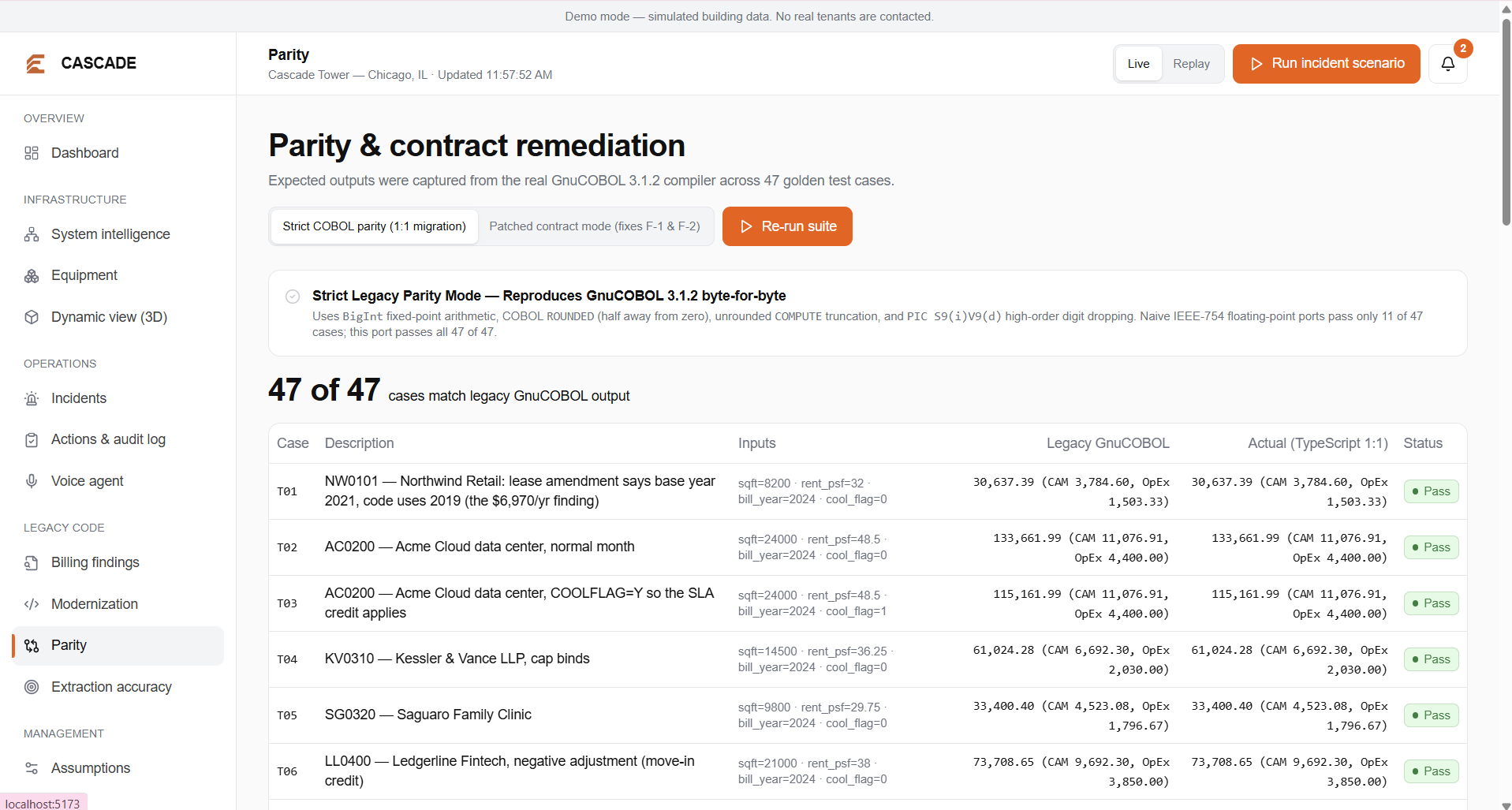
To independently validate the engine, we built a separate model in Python. It reads the same documents and recomputes the outcome of every single-component failure. Both models agree on all 166 single-component failure scenarios at our demonstration site.
Nemotron handles tool selection and explains analysis results, while the deterministic engine computes the underlying facts and numbers. Both the AI companion and the application interface use the same analysis engine.
When required information is missing, Cascade returns an unknown result rather than inventing an answer. This separation allows generative AI to make infrastructure analysis more accessible without making it responsible for critical calculations.
Challenges We Faced
Designing a familiar operational interface.
Infrastructure relationships can quickly become overwhelming. We organized the application around the decisions facilities managers make throughout their day, from reviewing the site and coordinating maintenance to handing off work and approving responses.
Integrating Nemotron with the application.
Coordinating model responses, tool calls, and application state required careful engineering. The agent needed to investigate problems and prepare corrective proposals while keeping consequential actions under human control.
Connecting phone conversations to useful context.
We worked on making voice reports part of the operational workflow, so information shared during a phone call could become actionable context inside the application rather than remaining isolated in a conversation.
Resolving conflicting documents.
Different records can describe different connections for the same equipment. We established explicit source-priority rules: live monitoring data takes precedence, followed by the circuit roster, equipment register, and contracts. We also preserved supporting evidence so users can understand how the infrastructure model was assembled.
Modeling cooling realistically.
A cooling failure does not immediately cause cabinets to overheat. They have a limited thermal ride-through period before temperatures become critical. Cascade must evaluate cooling shortfalls against the load still operating when that period expires. It also treats a shared chilled-water loop as a potential single point of failure for the entire hall.
Evaluating the system honestly.
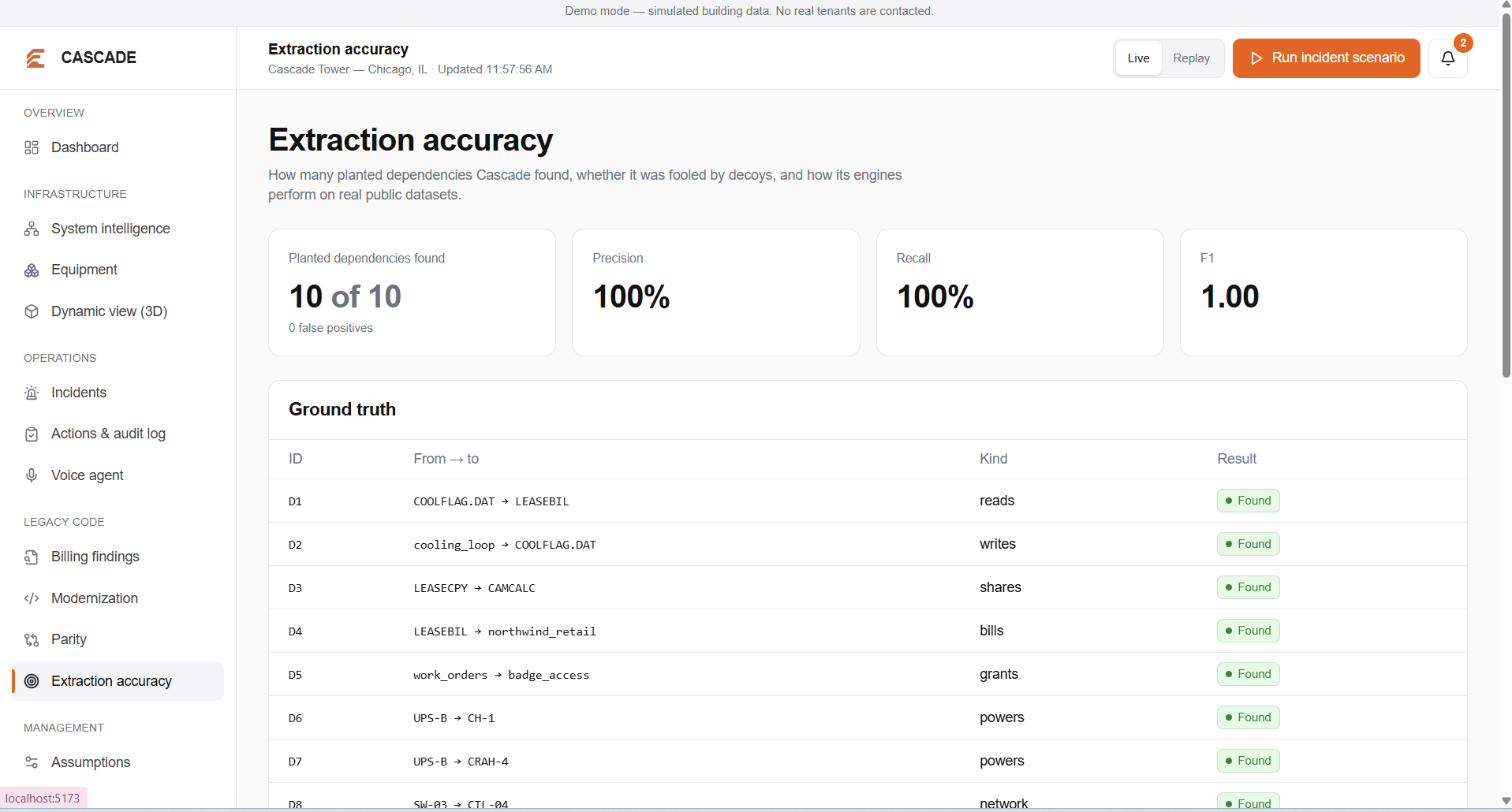
Complete, connected sets of real facility records are difficult to obtain. We built a synthetic demonstration site containing known defects and decoys so we could evaluate the system against predefined expectations.
Accomplishments We're Proud Of
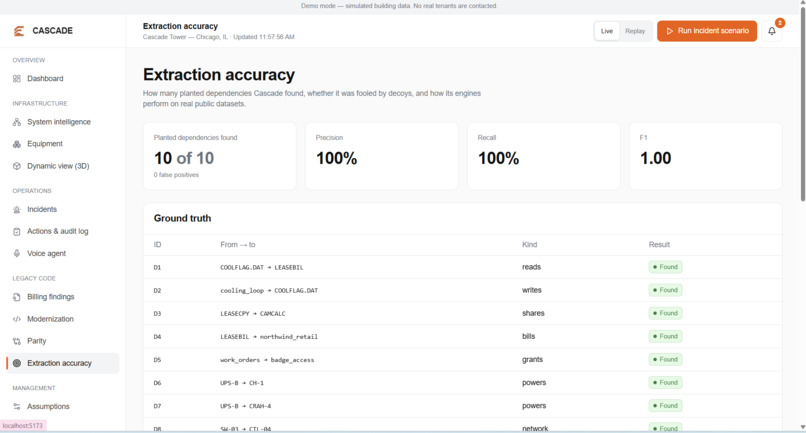
Our internal accuracy test identifies 9 out of 9 planted defects while correctly leaving 0 out of 4 decoys unflagged. These results demonstrate consistency against our synthetic test data; accuracy on real operators' documents has not yet been measured.
Our independent Python model also agrees with the TypeScript analysis engine across all 166 single-component failure scenarios at the demonstration site. This provides an additional validation check using a separately implemented model, rather than relying exclusively on the engine's own calculations.
We're also proud of connecting document ingestion, dependency analysis, failure simulation, corrective planning, and human approval into one operational workflow. Managers can move from identifying a potential risk to evaluating a proposed response with its supporting context in one application.
What We Learned
Redundancy must be evaluated across the entire dependency chain. Two cords do not necessarily guarantee independent power paths. Backup equipment only helps when sufficient capacity remains, and the power and cooling systems supporting IT equipment can depend on each other in ways that are not immediately obvious.
Working with Nemotron taught us how to connect generative AI to structured tools and application state. We learned that deterministic calculations make an agent's explanations more useful, and that independently implementing a second model provides a valuable way to validate those calculations.
Our research into facilities operations also shaped our understanding of the problem: identifying a fault is only the beginning. Managers need to understand its impact, prepare an appropriate response, communicate it clearly, and transfer responsibility to the right people.
What's Next for Cascade
We want to evaluate Cascade with real facilities teams and their operational documents, expand the range of equipment and infrastructure relationships it can model, and improve the voice-reporting workflow.
Our goal is to help facilities managers make better-informed maintenance decisions and give every shift a clear picture of what is happening, what is at risk, and what needs to happen next.
Built With
- claude
- codex
- express.js
- gemini
- node.js
- nvidia-nemotron
- radix-ui
- react
- react-flow
- react-three-fiber
- resend
- tailwind-css
- tanstack-query
- tanstack-router
- three.js
- typescript
- vite