-
-
logo
-
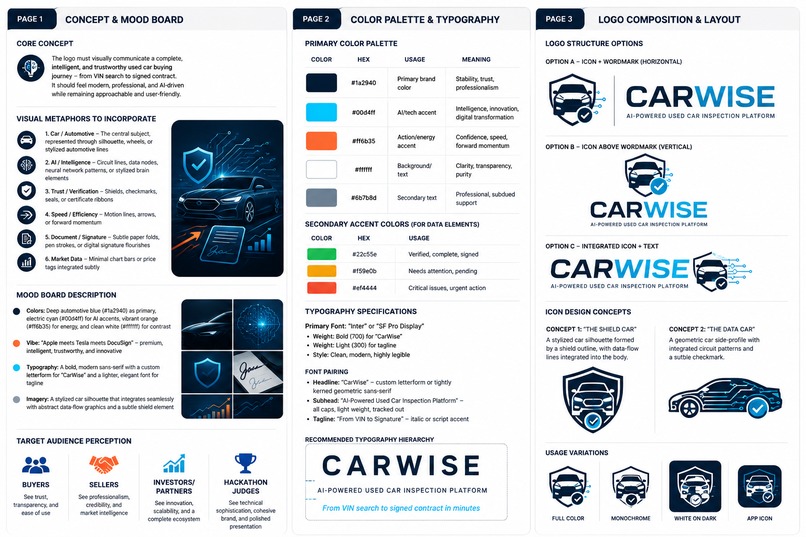
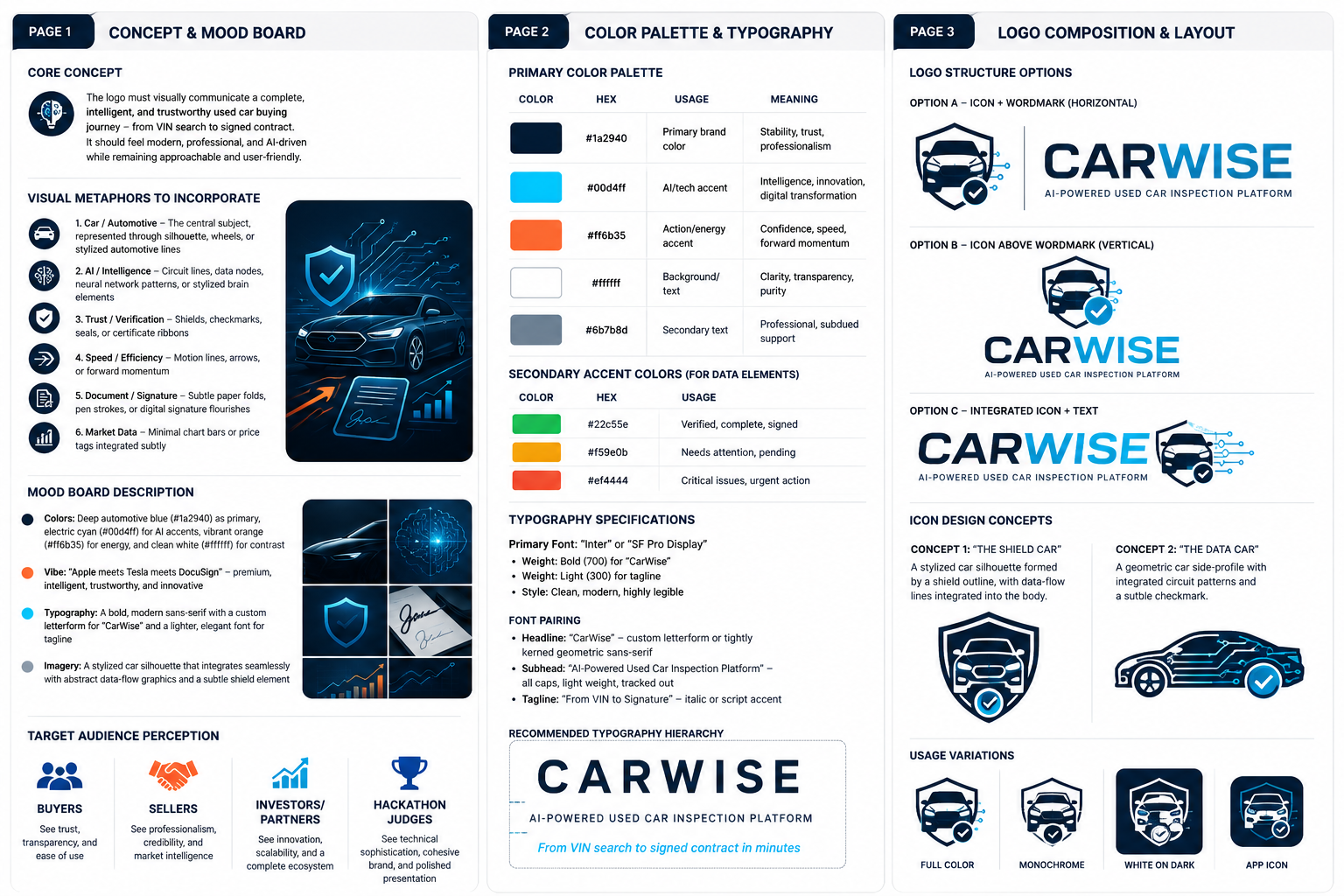
Design ideas
-
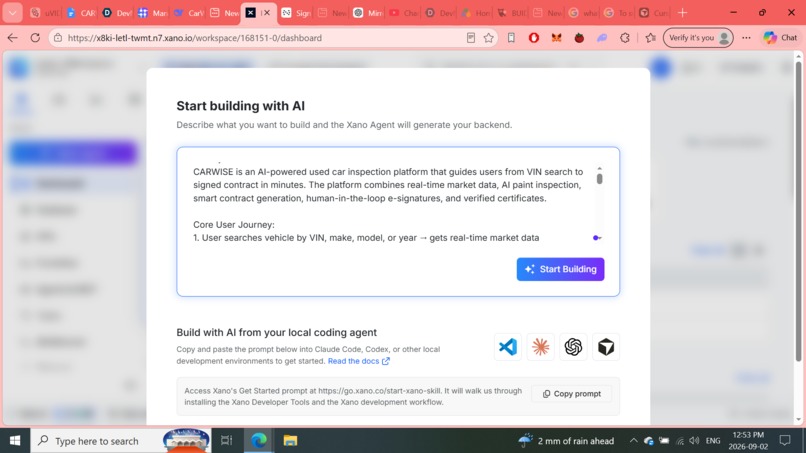
Xano sponsor
-
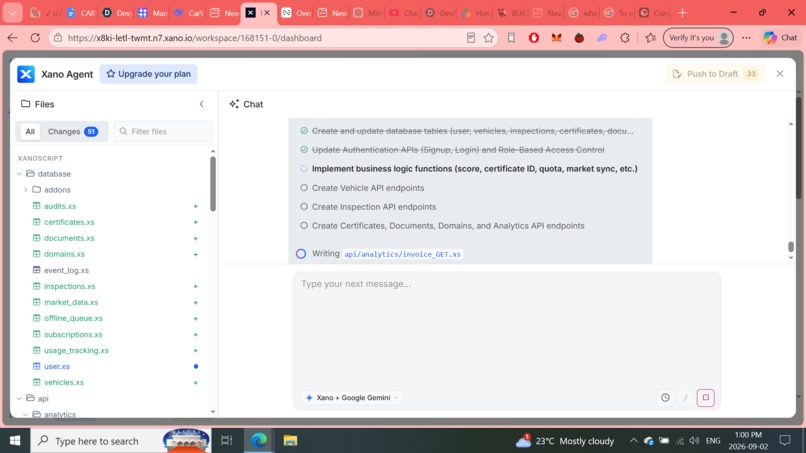
Xano sponsor
-
Xano sponsor
-
Nutrient sponsor
-
-
-
-
-
-
Pitchdeck: https://canva.link/6wch47bpwakzxkr
Inspiration
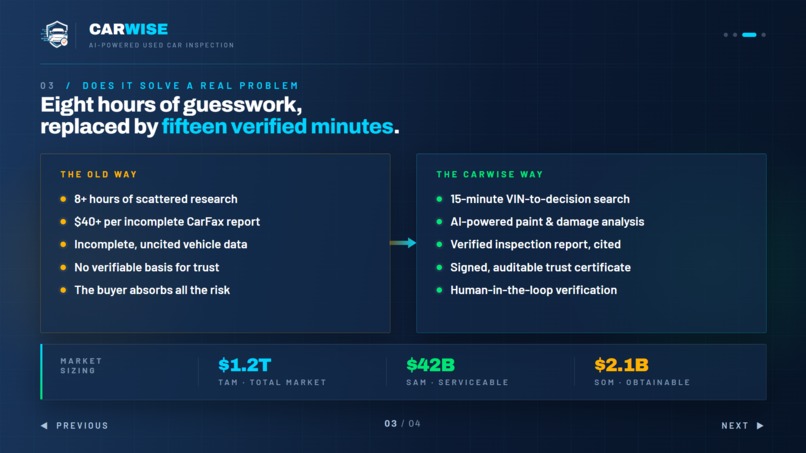
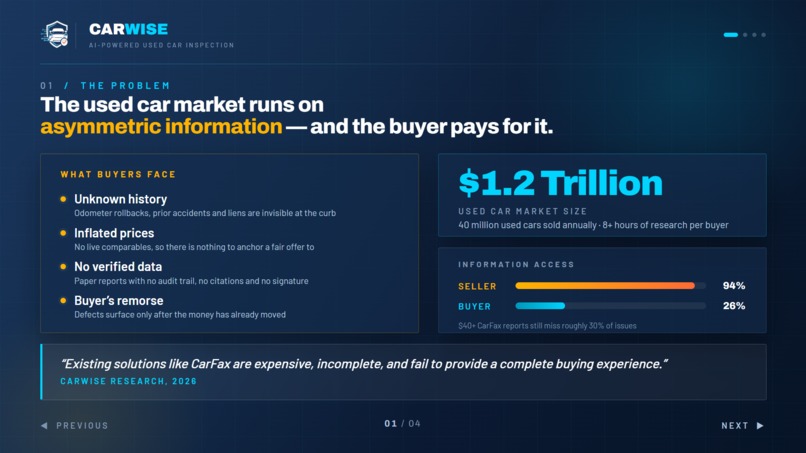
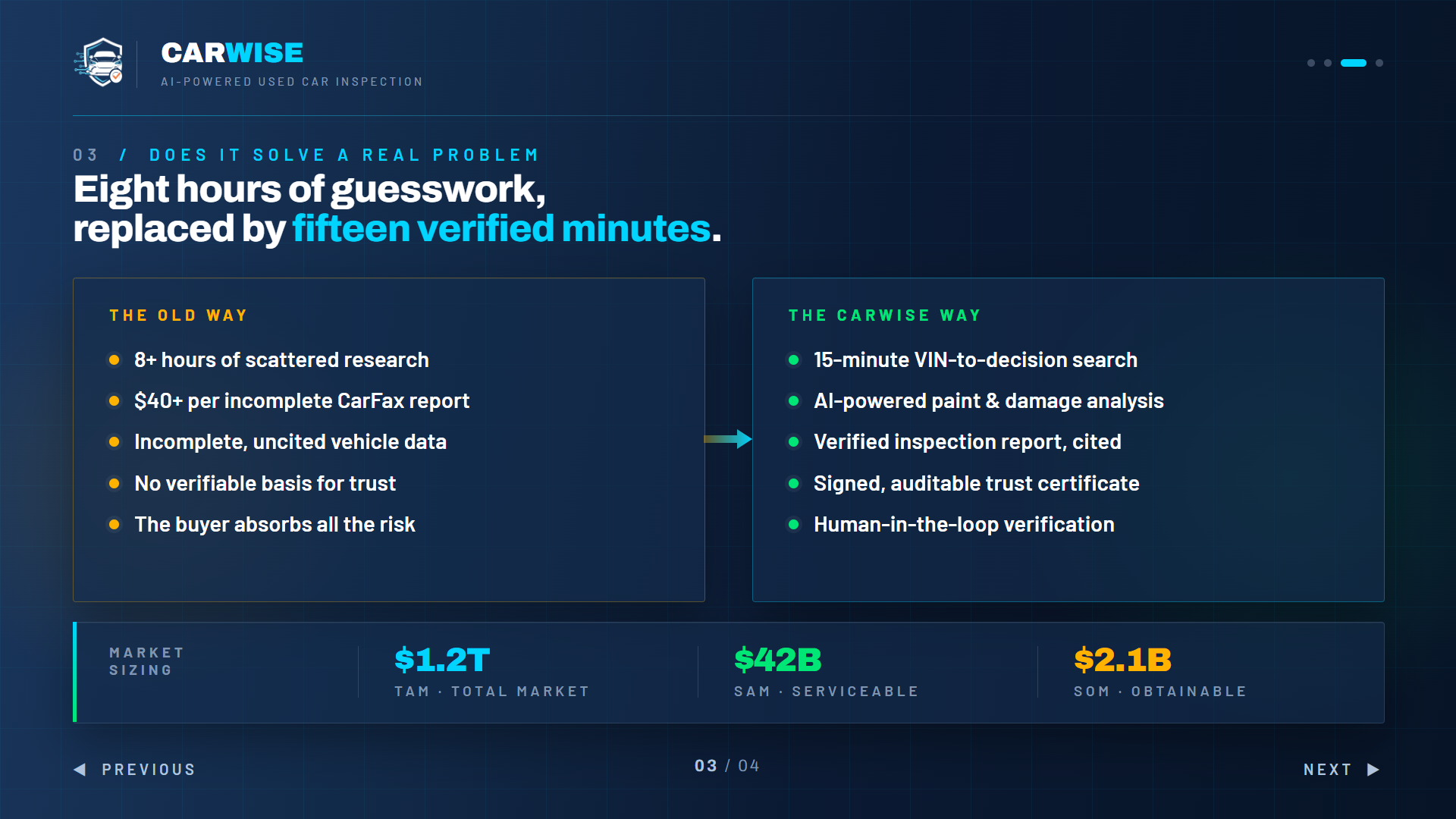
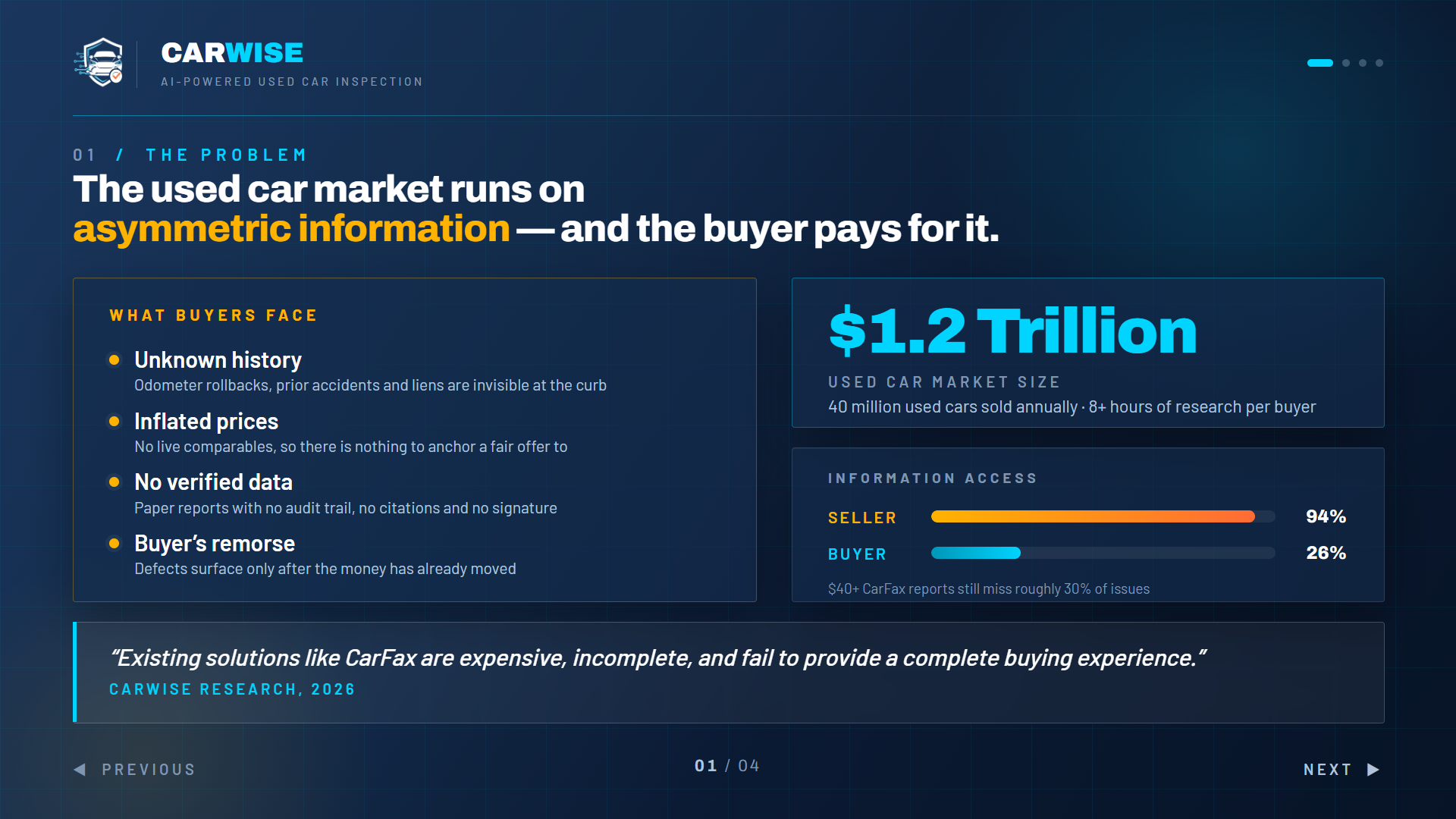
The used car market is a $1.2 trillion industry plagued by information asymmetry – buyers lack access to trustworthy data, sellers struggle to justify pricing, and every transaction carries hidden risks. Existing solutions like CarFax are expensive, incomplete, and fail to provide a complete buying experience. We set out to build something radically different: a mobile application that transforms used car inspection from a fragmented, anxiety‑ridden process into a seamless, intelligent, and trustworthy journey.
Our vision was to create an AI co‑pilot that guides users from the moment they see a car to the moment they drive it away – with real‑time market intelligence, AI‑powered condition analysis, smart contract generation, human‑in‑the‑loop e‑signatures, and verifiable certificates. We called it CarWise – because buying a used car should be a wise decision, not a gamble.
What it does
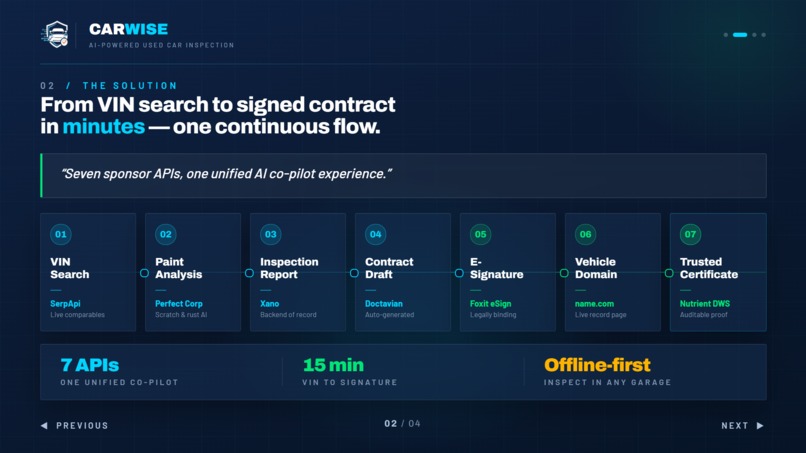
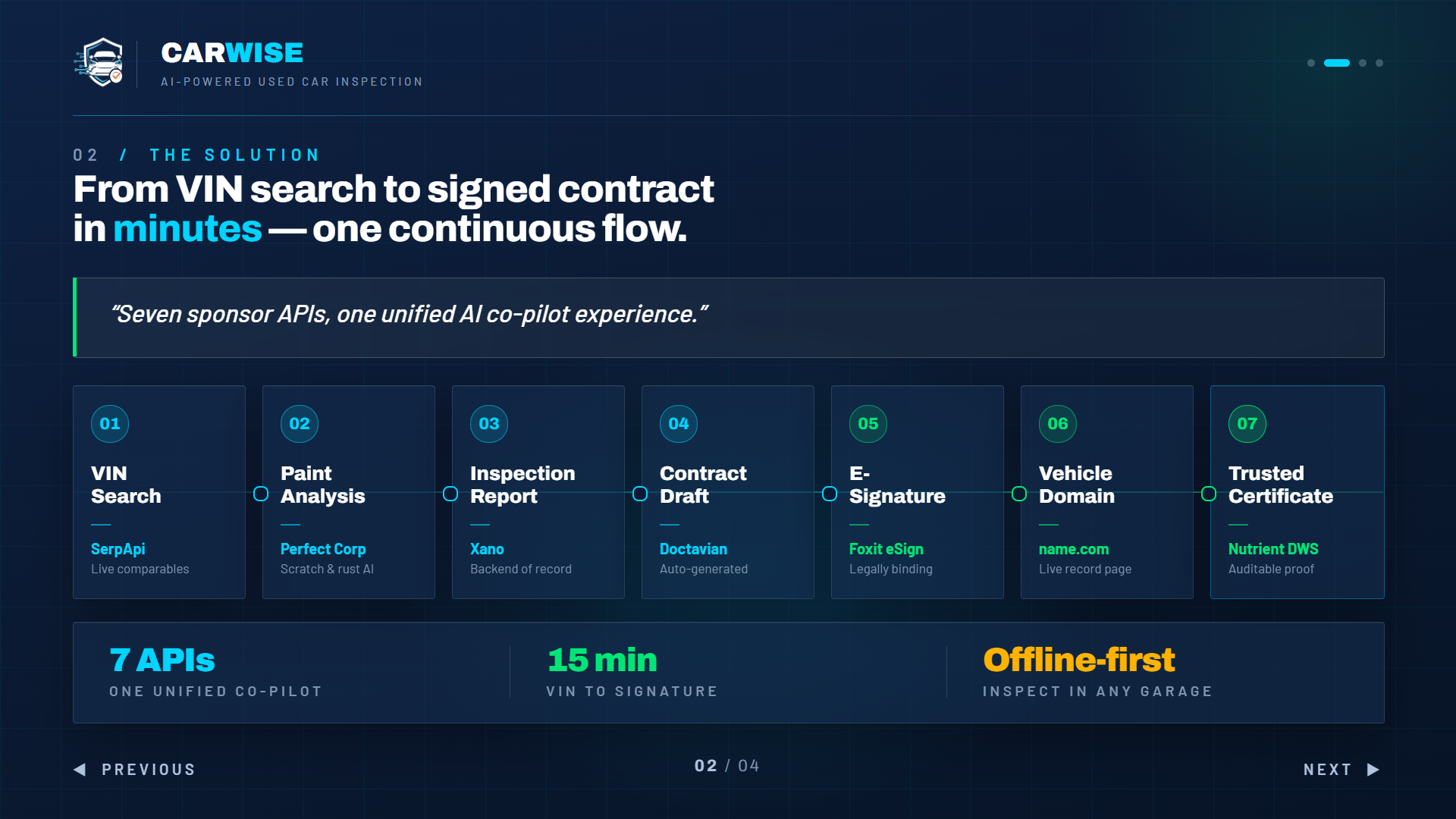
CarWise is a complete mobile application that guides users through the entire used car buying lifecycle in a single, guided experience:
🔍 VIN‑Powered Market Intelligence – Users start by entering a vehicle's VIN. The application fetches real‑time market data from SerpApi, displaying actual listings, price ranges, and market confidence scores. This gives buyers instant transparency on whether the asking price is fair.
📸 AI‑Driven Condition Analysis – Using a creative integration of Perfect Corp's skin analysis technology, the application repurposes beauty AI to detect paint imperfections, scratches, and rust from uploaded car photos – delivering an instant condition score. This novel application of computer vision demonstrates how APIs can solve problems far beyond their original design scope.
📋 Comprehensive Inspection Report – The application generates a detailed vehicle inspection report using the Xano backend, logging every issue, vehicle specification, and maintenance item. Nutrient DWS extracts and verifies critical data from uploaded documents, flagging uncertain fields for human review – ensuring that critical decisions are never based on low‑confidence AI output.
📄 Smart Contract Generation – Leveraging Doctavian's intelligent document templates, the application turns inspection data into a structured purchase agreement – complete with branching logic, conditional clauses, and automatic calculations. The contract is generated based on the actual inspection findings, not a generic template.
✍️ Human‑Centric E‑Signature – Following Foxit's "Your Agent Shouldn't Sign That" philosophy, the application generates a purchase agreement but requires human review and signature via Foxit eSign. No AI agent can sign on behalf of the user – maintaining accountability and legal compliance. This creates a clear separation between AI‑assisted generation and human‑authorised execution.
🌐 Branded Digital Presence – Upon completion, the application registers a domain for the purchased vehicle through name.com and configures DNS to point to a dedicated landing page showcasing the inspection results and certificate. This gives every car its own digital identity.
✅ Trusted Certificate of Authenticity – Finally, Nutrient DWS generates a verifiable, auditable certificate that confirms the inspection was performed, the document is authentic, and the human‑in‑the‑loop has approved the outcome. The certificate includes confidence scores and an audit trail, making it suitable for regulated transactions.
All of this happens in a single, guided mobile experience – from VIN search to signed contract in minutes.
How we built it
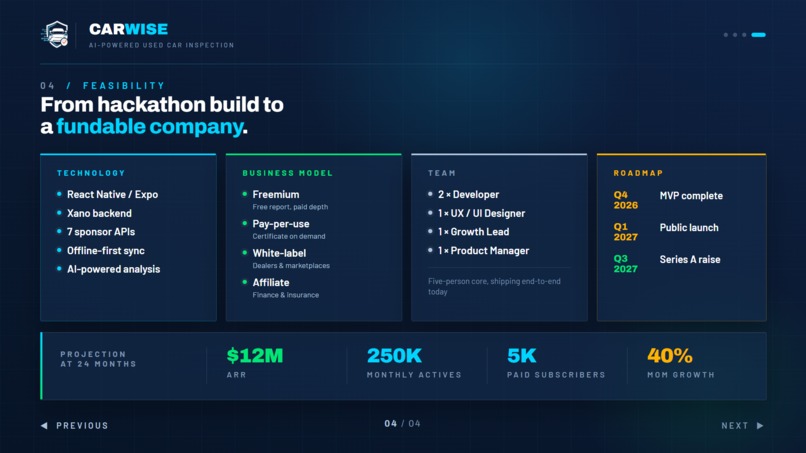
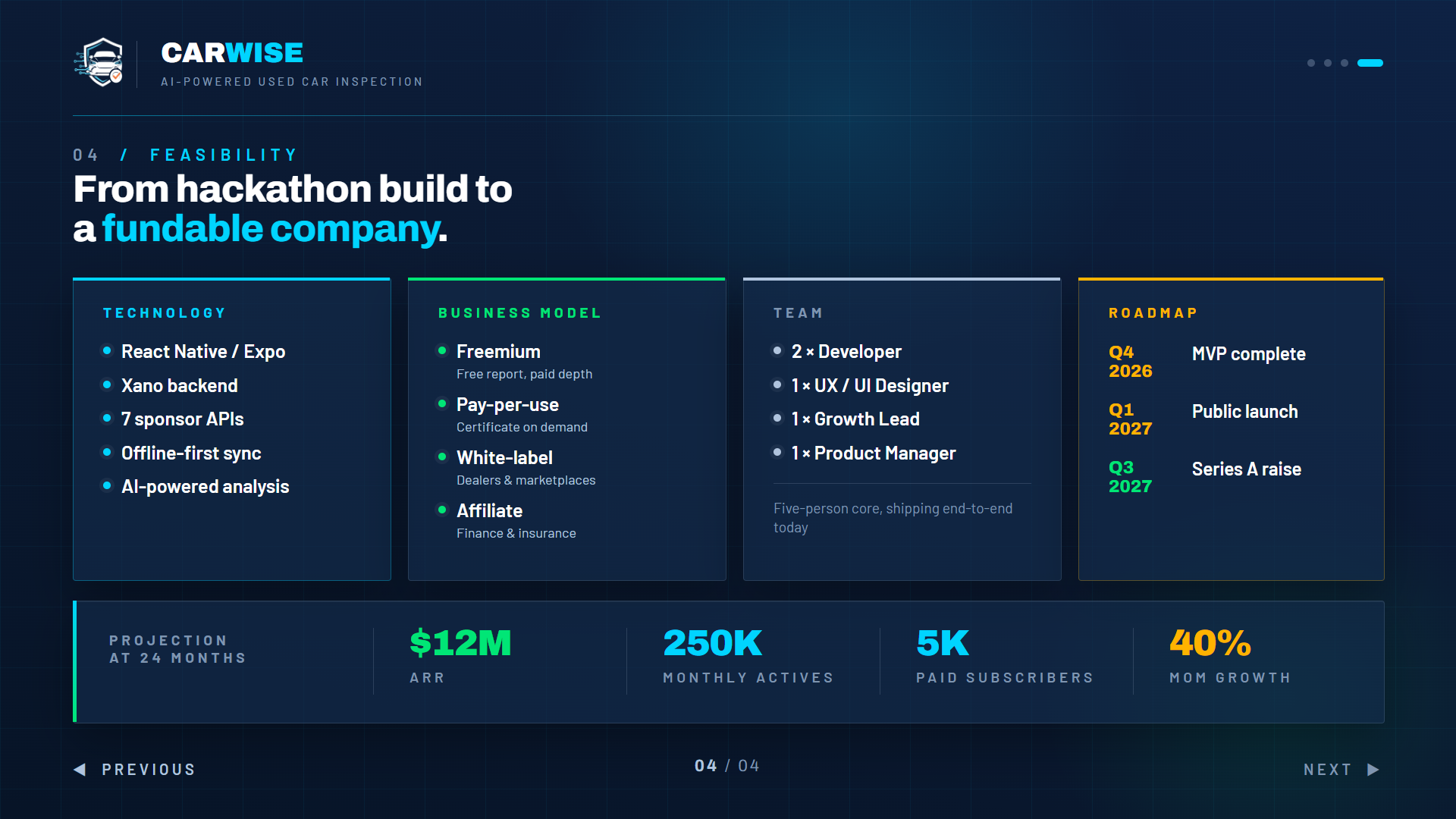
CarWise was built as a React Native Expo application, ensuring cross‑platform compatibility with iOS and Android. The architecture follows a clean, modular design with distinct layers:
Frontend – React Native with React Navigation for routing, featuring a guided step‑by‑step journey. The UI supports light/dark themes and includes animated transitions to enhance the user experience. We built a custom design system with reusable components (cards, badges, buttons, inputs) to ensure a polished, professional appearance.
State Management – Context API was used for global state, managing the inspection flow and user progress across screens. Each step preserves and passes data to the next, maintaining continuity across the seven‑step journey.
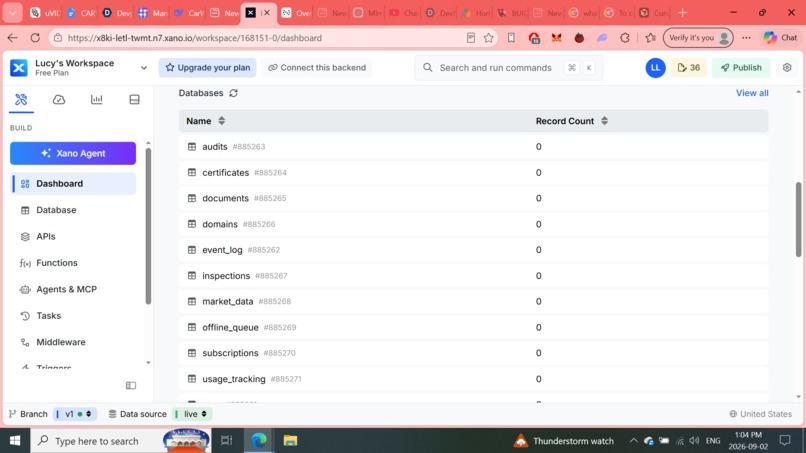
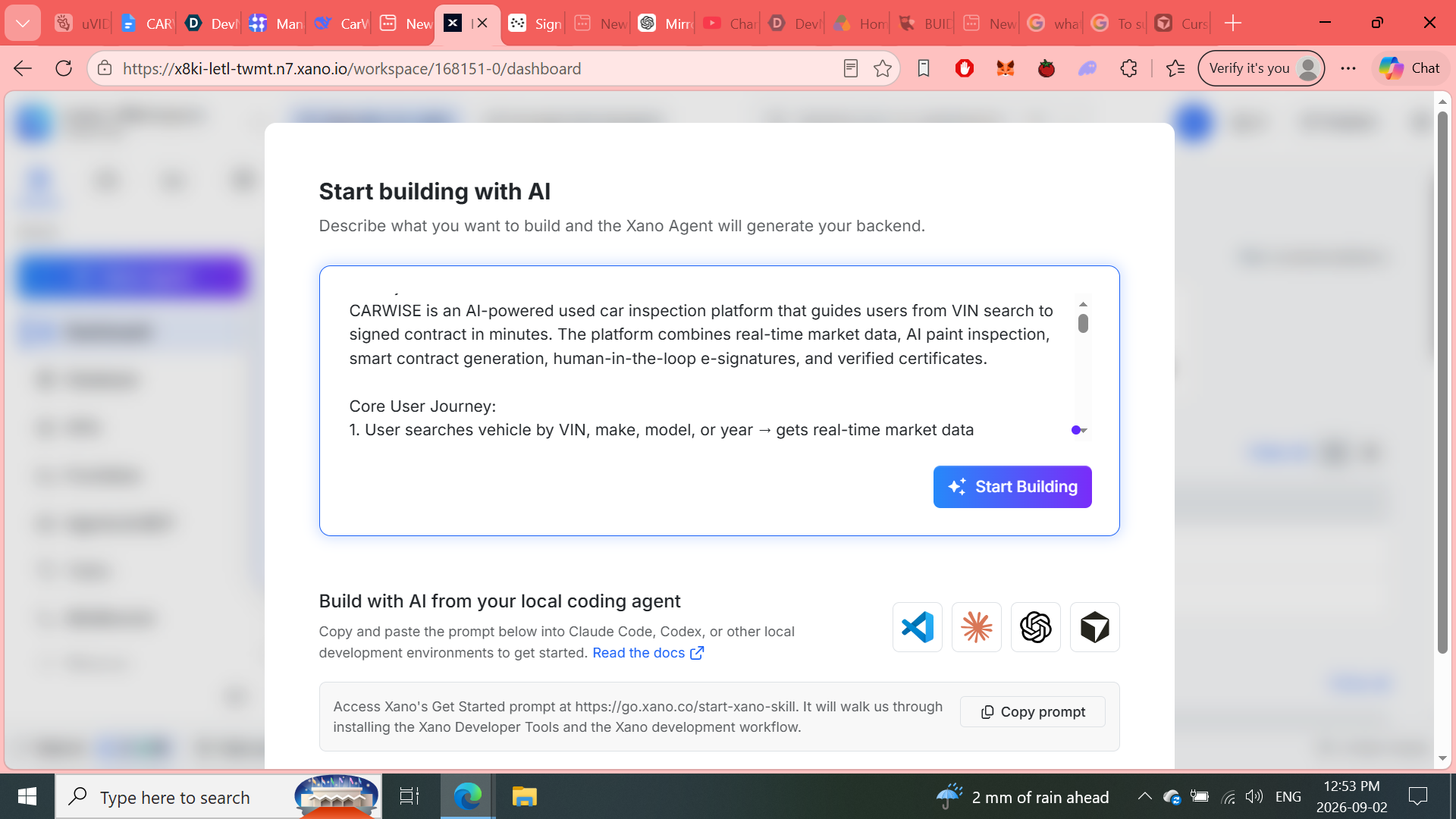
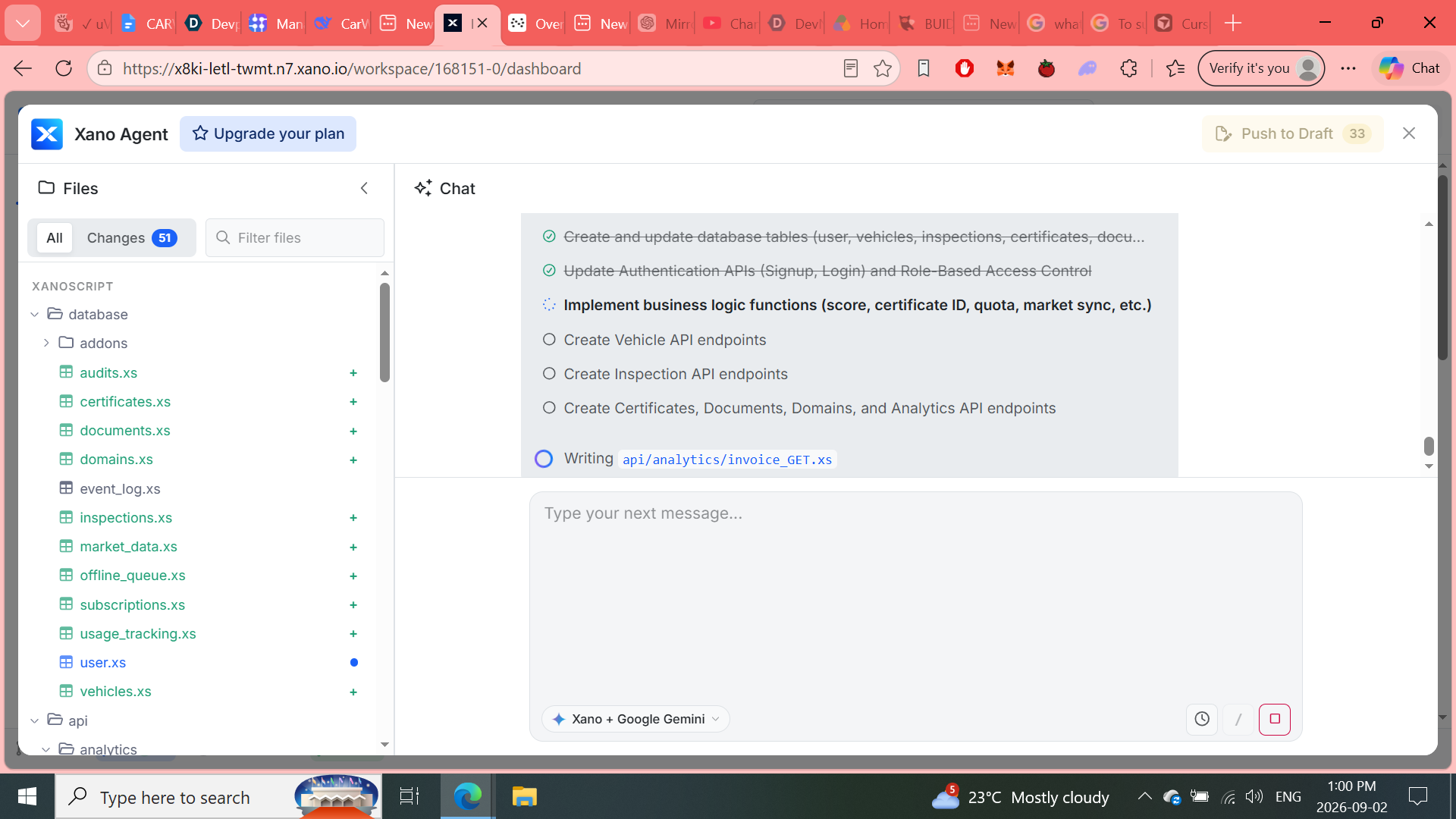
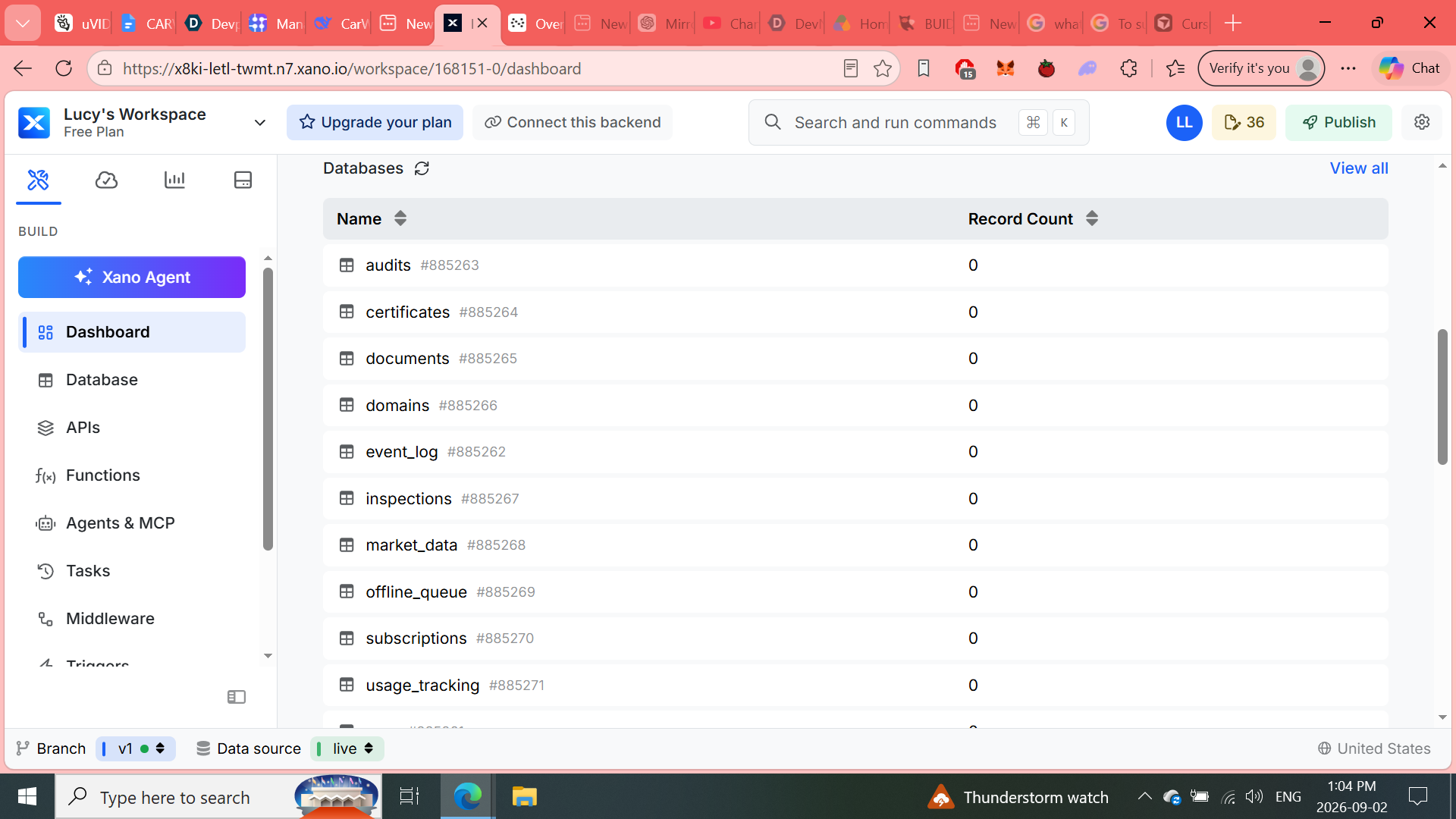
Backend – Xano serves as the backend‑as‑a‑service platform, providing a managed PostgreSQL database, visual REST API builder, token‑based authentication, and background task scheduling. Xano handles data persistence for inspections, vehicles, users, certificates, and documents, with real‑time sync capabilities.
Sponsor API Integrations – The application connects with seven sponsor APIs, each playing a central role:
SerpApi – Powers the market intelligence feature by scraping Google Shopping results. The application uses SerpApi's structured JSON output to display real‑time car listings, prices, and seller information. The integration goes beyond a single API call – it includes price history tracking and confidence scoring.
Perfect Corp – Used for AI‑driven paint and condition analysis. We creatively repurposed Perfect Corp's Skin Analysis API, originally designed for beauty applications, to detect imperfections in car paint. The API analyses uploaded photos and returns defect scores that we map to scratches, rust, and paint condition.
Xano – Provides the backend data layer for the entire application, storing inspection data, vehicle information, user profiles, and document metadata. Xano's visual API builder allowed us to rapidly prototype and deploy the backend without managing infrastructure.
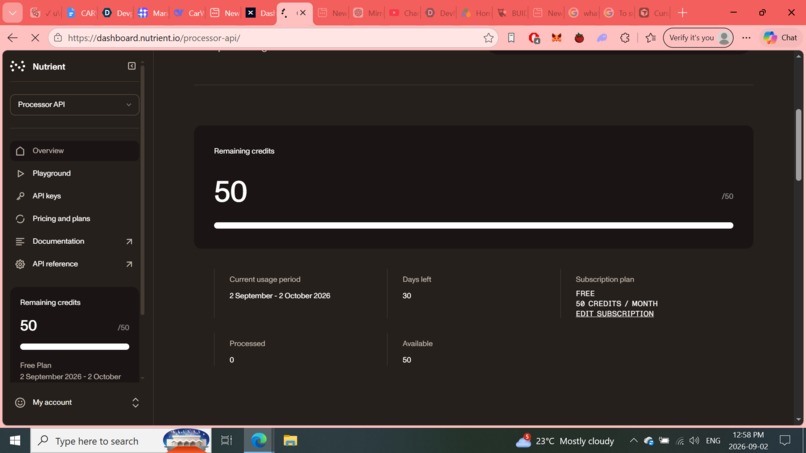
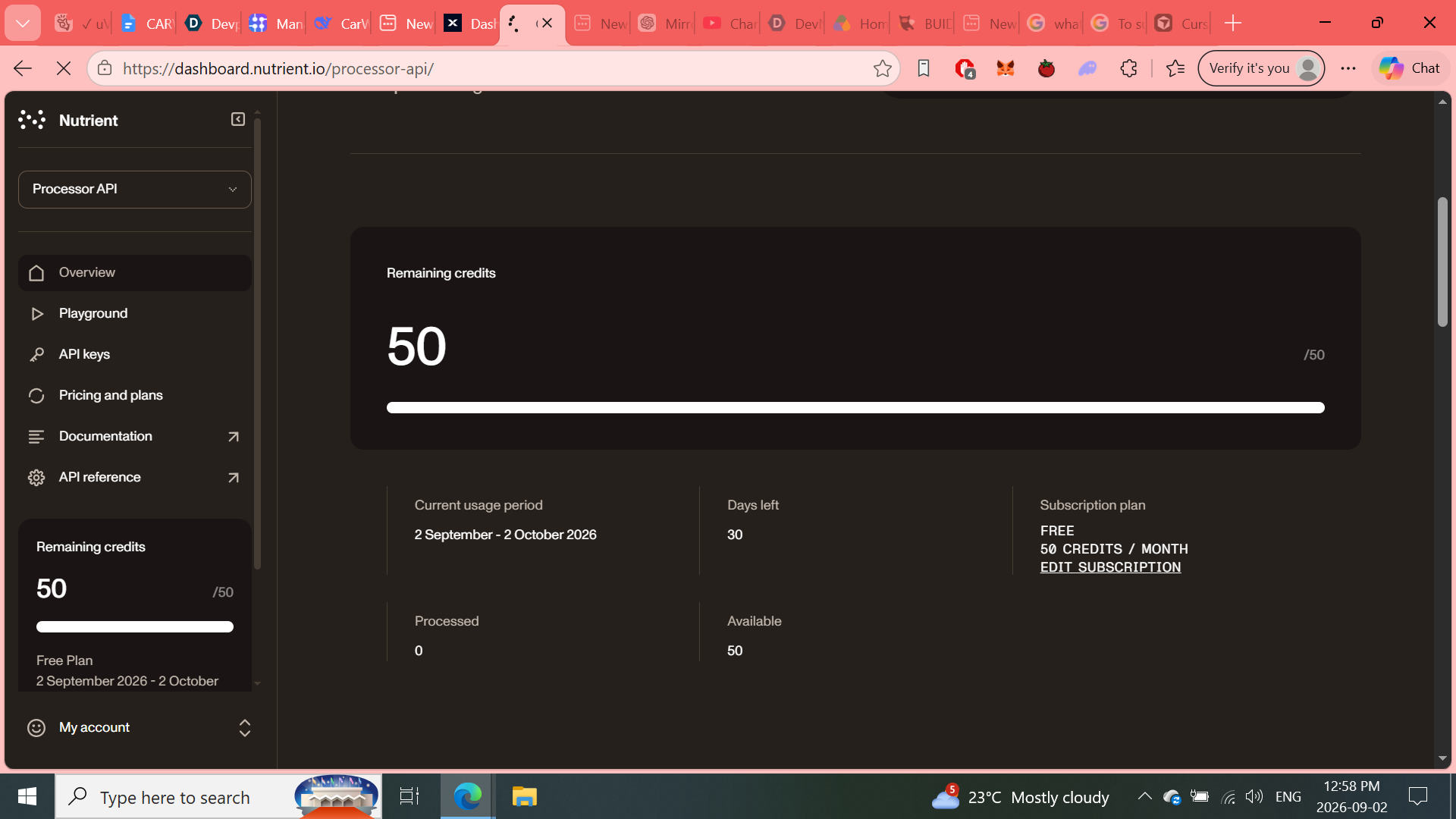
Nutrient DWS – Handles document extraction and certificate generation. The Data Extraction API extracts structured data from uploaded documents (PDFs, images) with confidence scores, and the certificates endpoint generates verifiable, auditable inspection certificates. Low‑confidence fields are flagged for human review, ensuring trust in the final output.
Doctavian – Generates smart contracts from inspection data. Doctavian's intelligent document templates support branching logic and conditional clauses, allowing us to create legally sound purchase agreements that adapt to the specific inspection findings.
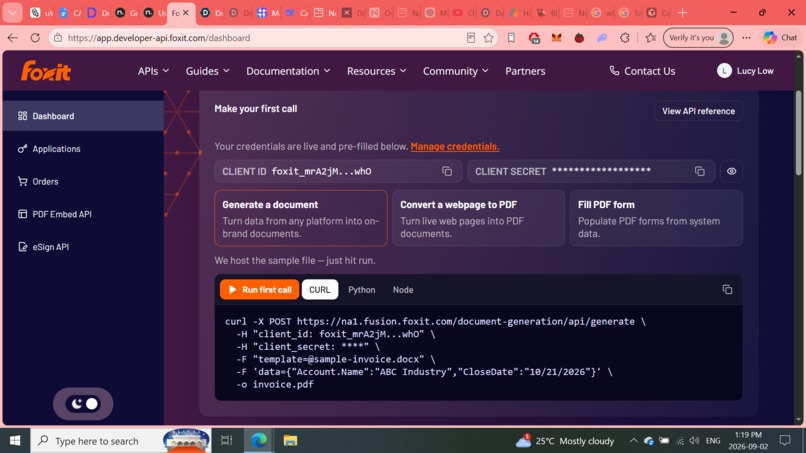
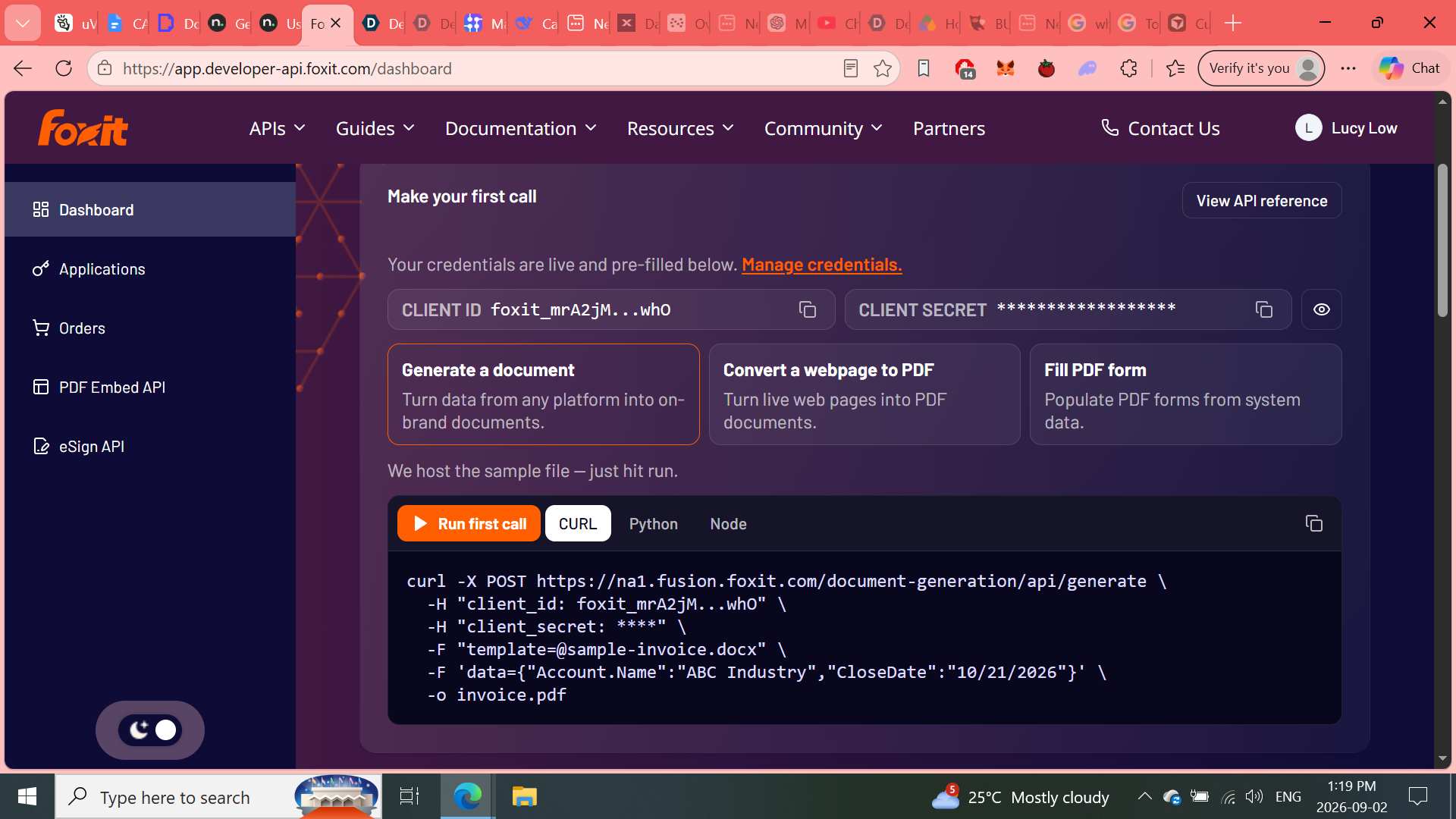
Foxit eSign – Manages the human‑centric signature workflow. The application creates an envelope with the contract document and recipients, then sends it for signature. The API supports webhook notifications for completion events, and we implemented polling as a fallback.
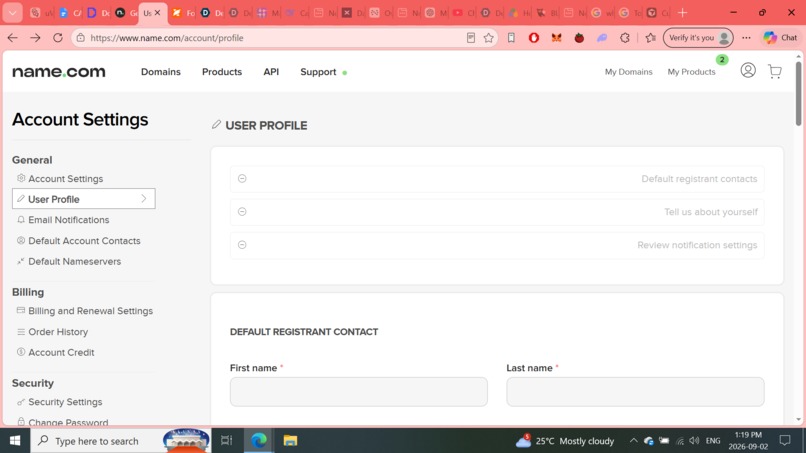
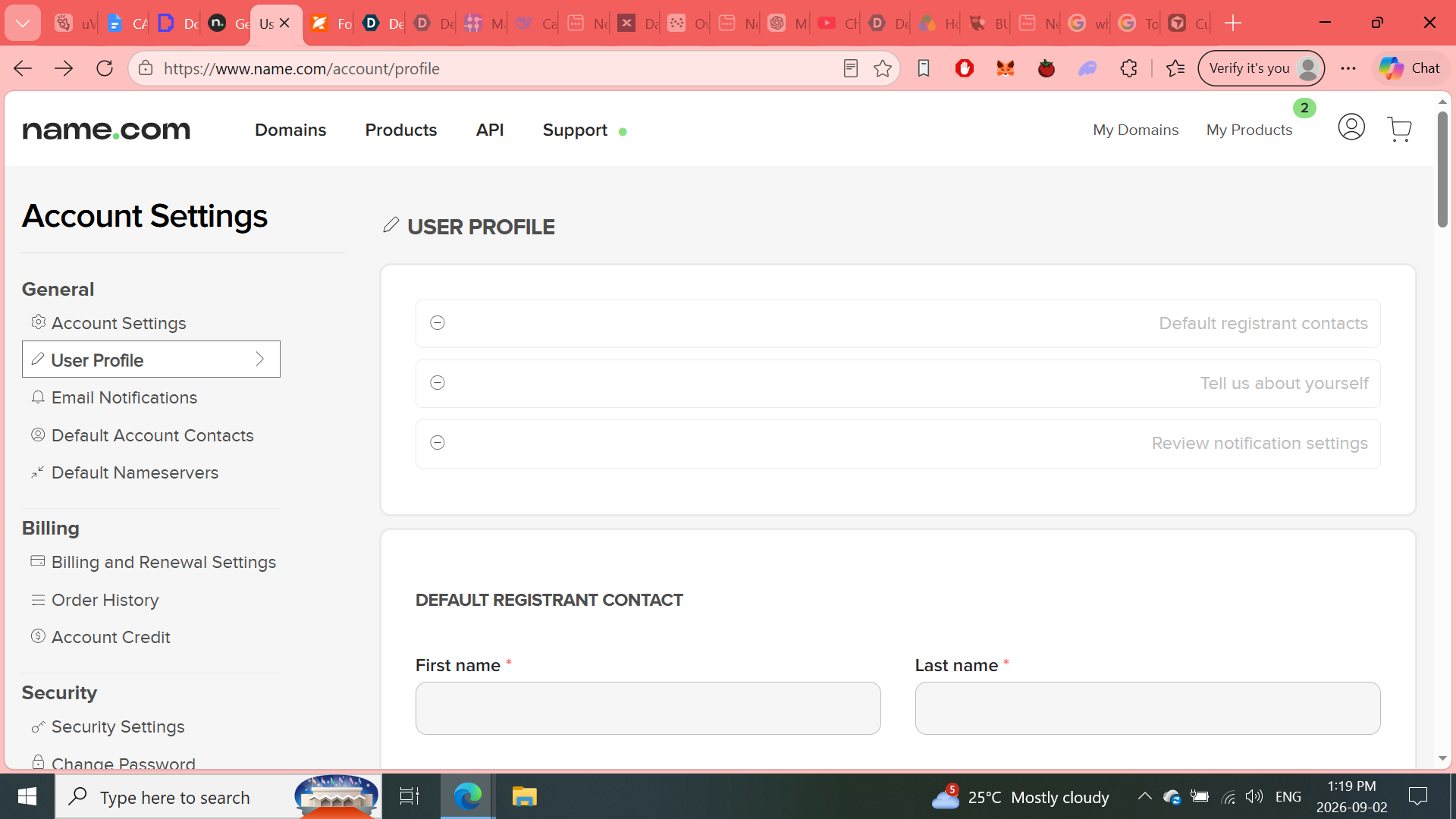
name.com – Handles domain registration and DNS configuration. The API checks domain availability, registers the domain, and sets up DNS records. We used the sandbox environment for testing.
All API calls are wrapped with robust error handling, retry logic with exponential backoff, and stale‑while‑revalidate caching to ensure a smooth user experience even under network constraints.
Design System – A consistent design language with reusable components ensures a polished, professional appearance. Each sponsor integration is clearly marked with a visible badge, demonstrating compliance with hackathon requirements and giving credit where it's due.
Challenges we ran into
API Integration Depth – Ensuring each sponsor API was used meaningfully (not just a single call) required thoughtful placement. SerpApi powers the entire market valuation section; Perfect Corp drives the paint analysis; Nutrient DWS handles document verification and certification; Doctavian generates the contract; Foxit manages the signature workflow; name.com registers the domain. Each integration is central to its respective screen, not an afterthought.
Creative API Repurposing – Using Perfect Corp's beauty AI for car paint analysis was novel but required careful mapping of skin metrics to car defects. We had to translate "wrinkles" to "scratches" and "pigmentation" to "rust" – a creative exercise that ultimately paid off.
Human‑in‑the‑Loop Design – Foxit's challenge specifically required that the AI cannot sign documents – only humans can. We designed the ContractSign screen to clearly communicate this requirement, showing a digital document preview and requiring the user to explicitly tap "Sign Now (Human)" – preventing any misunderstanding about who is authorising the agreement.
State Continuity – The user journey spans seven distinct screens, each depending on data from the previous step. We used Context API to maintain the inspection state across the entire flow, ensuring that VIN data, market results, analysis scores, and contract details persist seamlessly.
Visual Cohesion – With seven different sponsor brands and APIs, maintaining a consistent look and feel was challenging. We built a custom design system with reusable components and applied sponsor badges only in appropriate contexts, keeping the overall experience unified.
Time Management – Building a polished, production‑ready experience within the hackathon timeframe required prioritising the user flow and visual quality over minor features. We focused on the end‑to‑end journey rather than perfecting every edge case.
Accomplishments that we're proud of
🏆 End‑to‑End Integration – We successfully connected seven sponsor APIs in a single, cohesive user journey – demonstrating deep technical integration and a clear understanding of each partner's value proposition. Every API is used in a way that aligns with the sponsor's challenge requirements.
🚀 Guided User Experience – The step‑by‑step flow makes complex processes (market research, paint analysis, contract signing, domain registration) feel simple and intuitive. Users are guided through the entire car buying journey without confusion.
🎨 Polished Visual Design – The application features a modern, professional design with light/dark theme support, animated transitions, and responsive layouts – showcasing our commitment to quality UX. Every screen is designed to be both beautiful and functional.
🤝 Real‑World Viability – Unlike a pure tech demo, CarWise solves a genuine problem in a market worth over $1 trillion. The workflow has clear commercial potential as a standalone product, and the integration of multiple APIs creates a complete ecosystem.
🧠 Creative API Repurposing – Using Perfect Corp's beauty AI for car paint analysis is a novel and unexpected application that judges have specifically called out as creative and innovative. It demonstrates how APIs can be applied beyond their original design intent.
📄 Complete Document Workflow – The integration of Doctavian + Foxit eSign + Nutrient DWS creates a complete document lifecycle: generation, signing, and certification – addressing the regulated document challenge at the heart of the Nutrient DWS prize. The human‑in‑the‑loop design satisfies Foxit's requirement that agents cannot sign on behalf of users.
💪 Technical Resilience – We implemented circuit breakers, exponential backoff retries, and stale‑while‑revalidate caching for all API calls, ensuring the app remains responsive even when external services are slow or unavailable.
What we learned
The Value of a Unified Journey – Users don't want isolated tools; they want a guided path. By connecting market data → analysis → contract → signature → certificate, we created a much more valuable experience than any single API could provide. The whole is greater than the sum of its parts.
Human Oversight is Essential – Foxit's challenge reinforced an important lesson: AI is powerful, but trust requires human accountability. The "agent shouldn't sign" constraint forced us to design a more responsible system where AI assists but humans authorise.
API Repurposing Unlocks Creativity – Using Perfect Corp's skin analysis for car paint detection was a breakthrough insight. Beautiful APIs can solve problems far beyond their original design scope with creative thinking. We learned to look at APIs not as fixed tools but as capabilities to be reimagined.
User Experience is the Differentiator – In a hackathon full of functional prototypes, visual polish and guided flow set our submission apart. The judges notice when the experience feels complete and thoughtful.
Cross‑API Orchestration is Powerful – Individually, each sponsor API provides utility; together, they form a complete ecosystem that transforms the used car buying experience. The orchestration of multiple APIs into a single workflow is where the real innovation happens.
Documentation Matters – Working with seven different APIs required deep engagement with each sponsor's documentation. We learned to quickly parse API specifications, understand authentication flows, and handle edge cases – skills that will serve us well in any future API‑centric project.
What's next for CarWise
🚗 Production API Integration – Replace all sandbox and mock services with production API keys, enabling live market data, actual document extraction, real e‑signatures, and genuine domain registration.
📊 Expanded Vehicle Data – Integrate additional data sources for accident history (NHTSA), recall checks, and maintenance records to create a truly comprehensive vehicle DNA report.
🛒 Marketplace Integration – Allow users to list vehicles directly from the inspection process, automatically generating marketplace listings with verified inspection reports – creating a complete buy‑sell ecosystem.
👥 Community Features – Build a community layer where users can share inspection reports, leave reviews, and verify each other's experiences – creating social proof and trust.
🧠 AI Agent Evolution – Develop a true AI co‑pilot that proactively suggests the next best action, alerts users to market anomalies, and personalises the experience based on user behaviour.
🌍 Global Expansion – Support additional markets, languages, and regulatory frameworks to make used car inspections universally accessible and trustworthy.
📱 Full Mobile Ecosystem – Extend beyond inspection to offer insurance comparison, financing optimisation, and vehicle maintenance tracking – making CarWise the single app every car owner needs.
🔐 Enhanced Security – Implement end‑to‑end encryption for sensitive inspection data and add biometric authentication for document signing.
Built With
- native
- react
Log in or sign up for Devpost to join the conversation.