Inspiration
Online shopping gives us plenty of choices, but finding the right product within a limited budget can be surprisingly time-consuming. A product may look appealing but not suit our actual needs, or it may exceed what we can afford.
As a student, I wanted to explore how AI could make this decision easier. Instead of forcing users to search through product listings manually, I wanted to let them describe what they need in everyday language, set a budget, and receive a shortlist with clear explanations.
That idea became CartWise AI — smarter shopping decisions, within your budget.
What it does
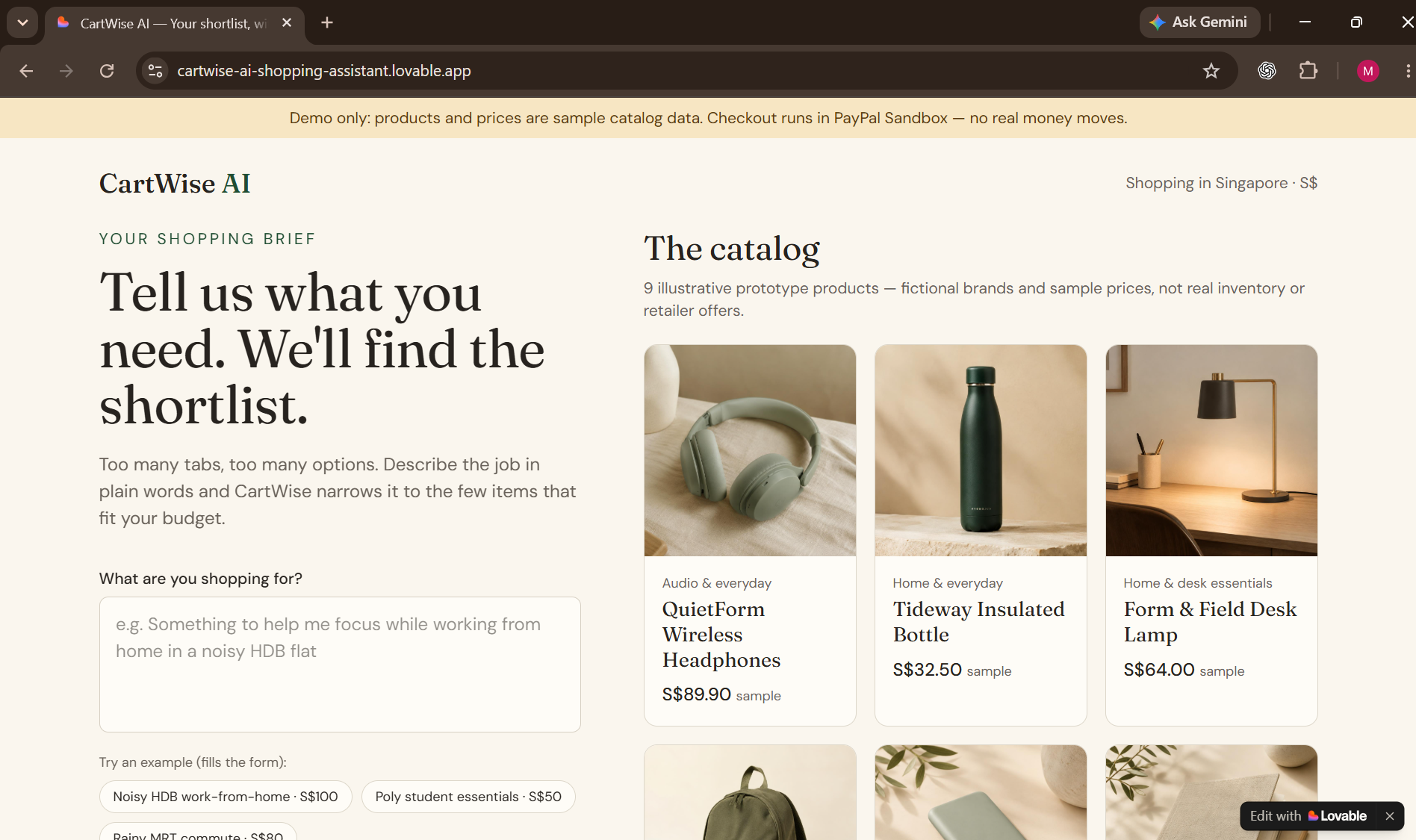
CartWise AI is a Singapore-focused AI shopping assistant that connects natural-language recommendations, budget validation, and checkout in one experience.
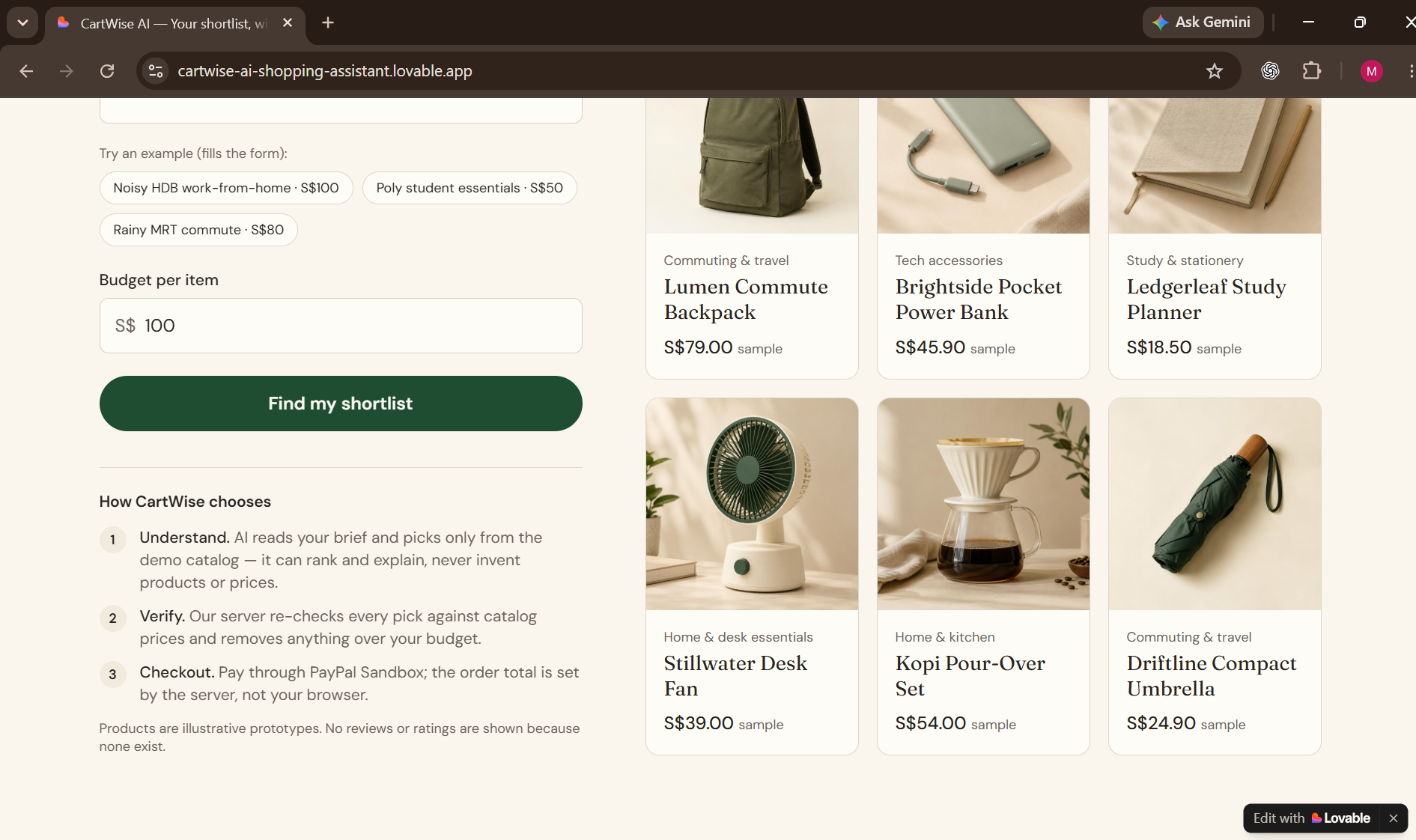
Users describe what they are looking for and set a budget in Singapore dollars. The AI interprets their request and recommends suitable products from a curated demonstration catalog, explaining why each product may fit their needs.
CartWise then applies a server-side budget check using authoritative catalog prices. For example, when a shopper has a S$40 budget, a S$64 desk lamp should not appear as an eligible recommendation.
When a shopper chooses a product, they can continue to PayPal Sandbox checkout. The server creates the order using the product and price stored in the catalog, and the application confirms success after the payment is captured.
The current catalog contains nine fictional demonstration products with illustrative prices. It is a working prototype, not a live retailer, and PayPal Sandbox does not process real payments.
How we built it
I built CartWise AI using Lovable, with React, TypeScript, and TanStack Start. Lovable AI powers the natural-language recommendation workflow, while server functions handle trusted application logic.
The main implementation decisions were:
- AI recommendations: The AI selects and explains products from the catalog provided to it, rather than being allowed to invent product listings or prices.
- Budget enforcement: Server-side validation removes unknown or duplicate product IDs and excludes products above the user's budget. Product prices come from the server-owned catalog, not from browser input.
- PayPal integration: PayPal Sandbox handles order approval and capture, allowing the checkout flow to be demonstrated without real-money transactions.
- User experience: I refined the interface around a clean, responsive design, clear product explanations, sample shopping prompts, and visible feedback for users.
I developed the project iteratively, testing the recommendation and payment flows as I improved the implementation.
Challenges we ran into
One of the biggest challenges was making AI recommendations reliable. A language model can produce plausible-sounding suggestions, but plausible output is not enough when a user's budget matters. I addressed this by separating AI-based selection from trusted server-side validation.
Payment integration presented another challenge. The application needed to use server-authoritative product prices, create valid PayPal Sandbox orders, and show payment success only after confirmation.
I also had to work through frontend and backend integration, configuration, and testing while developing the application in an AI-assisted environment. These challenges reinforced the importance of checking the actual running application rather than assuming that code which looks correct will work end to end.
Accomplishments that we're proud of
I'm proud that CartWise AI brings together three connected parts of a shopping journey: understanding a user's needs, finding products that fit a budget, and completing checkout.
The project has progressed from a basic shopping prototype to a published application featuring AI-generated recommendations, a nine-product demonstration catalog, server-side product and budget validation, and working PayPal Sandbox checkout.
I also created a public GitHub repository with project documentation and an MIT license. Most importantly, I tested the published website and successfully completed a Sandbox checkout.
What we learned
This project taught me that useful AI applications need more than a model and a polished interface.
AI output must be constrained by reliable application logic. Prices and payment operations need trusted server-side handling. Error states and user feedback matter just as much as the successful path. Finally, integration testing is essential: a feature is not truly complete until it works in the running application.
I also learned how AI-assisted development tools can accelerate implementation, while human review, testing, and deliberate design decisions remain essential to building something dependable.
What's next for CartWise AI
The next step is to move beyond the illustrative catalog toward verified real-world product data, richer product comparisons, and more personalized recommendations.
I would also like to explore additional decision factors such as product durability, sustainability, and long-term value, helping users consider more than the initial purchase price.
Further payment methods could be investigated when their eligibility and integration can be properly verified. For now, the priority is to keep the existing recommendation and PayPal Sandbox experience reliable while improving the quality and usefulness of the shopping decisions CartWise supports.
Built With
- lovable-ai
- paypal
- react
- tailwind-css
- tanstack-start
- typescript


Log in or sign up for Devpost to join the conversation.