-
-
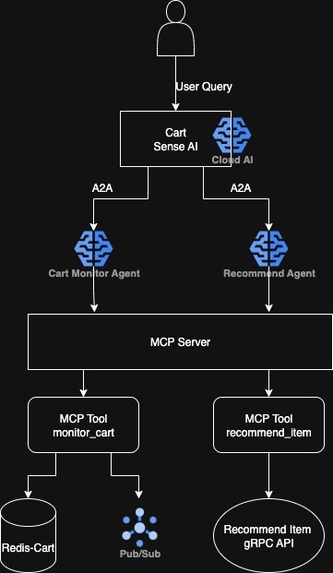
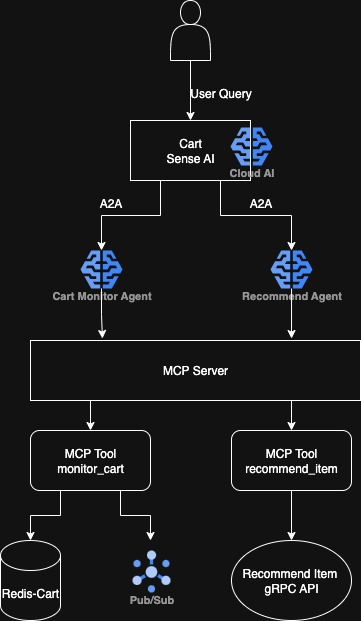
Architectural Diagram
📖 About the Project
🌟 Inspiration
Our team was inspired by the challenge prompt: “Give Microservices an AI Upgrade.” We wanted to explore how an existing microservice-based application—Online Boutique—could be enhanced without altering its core code.
E-commerce is full of scenarios where customers add items to their cart but never complete the purchase. This provided us with a relatable, high-impact use case: abandoned carts. We decided to focus specifically on fashion items because they often involve style, preference, and recommendation opportunities, making them a perfect playground for AI-driven personalization.
🛠️ How We Built It
Our solution, CartSense AI, is built as a proof-of-concept extension that integrates with the Online Boutique demo application using external, containerized agents.
Architecture
- Google Kubernetes Engine (GKE): All agents and services are deployed as containers in GKE, running alongside the Online Boutique.
- Model Context Protocol (MCP): We use MCP to interact with the Boutique’s APIs, particularly for monitoring cart states and product IDs.
- Agent Orchestration:
- Cart Monitor Agent: Periodically or event-driven, detects when carts contain fashion items.
- AI Reasoning Filter: Determines if a cart has been abandoned.
- Recommendation Agent: Uses Gemini models to suggest complementary products based on cart contents.
- Notification Generator: Creates mock push notifications/emails with the recommendations (since this is demo data, no actual users are contacted).
- Cart Monitor Agent: Periodically or event-driven, detects when carts contain fashion items.
- Google Gemini Models: Provide reasoning and contextual personalization to ensure the recommendations feel intelligent rather than static.
📚 What We Learned
- Agentic AI is modular and powerful: We realized how external agents can bring intelligence into existing systems without requiring invasive changes.
- MCP unlocks flexibility: Using MCP to bridge APIs allowed us to treat the Online Boutique as a black box while still interacting with it meaningfully.
- Kubernetes orchestration: We sharpened our skills in deploying and managing multiple agent containers on GKE.
- AI reasoning ≠ traditional rules: Adding Gemini to filter abandoned carts and generate recommendations showed us the difference between simple if/else rules and context-aware reasoning.
⚔️ Challenges We Faced
- No real users: Since Online Boutique is a demo app, we worked only with sample carts and synthetic data, so our notifications and recommendations are mock outputs.
- API limitations: The Boutique APIs aren’t designed for real-world AI workflows, so we had to carefully design agents to work within those boundaries.
- Agent orchestration: Coordinating multiple agents (monitoring, reasoning, recommending, notifying) and ensuring they communicated correctly required careful workflow design.
- Deployment on GKE: Managing containers, services, and ensuring our setup scaled correctly took extra debugging and iteration.
🚀 Takeaway
CartSense AI demonstrates how agent-driven intelligence can be layered onto microservice applications. Even in a fictional boutique with sample data, the concept illustrates how future e-commerce systems could:
- Detect user behaviors (like abandoned carts).
- Reason about intent and context.
- Deliver personalized, AI-powered suggestions.
In short, we learned that agents + microservices + AI = a powerful recipe for innovation.
Built With
- adk
- apis
- cli
- docker
- github
- kubectl-ai
- kubernetes
- mcp
- python
- vscode
- yaml

Log in or sign up for Devpost to join the conversation.