-
-
App icon (1024 x 1024, uncropped).
-
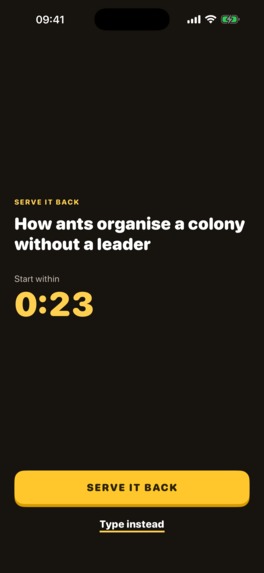
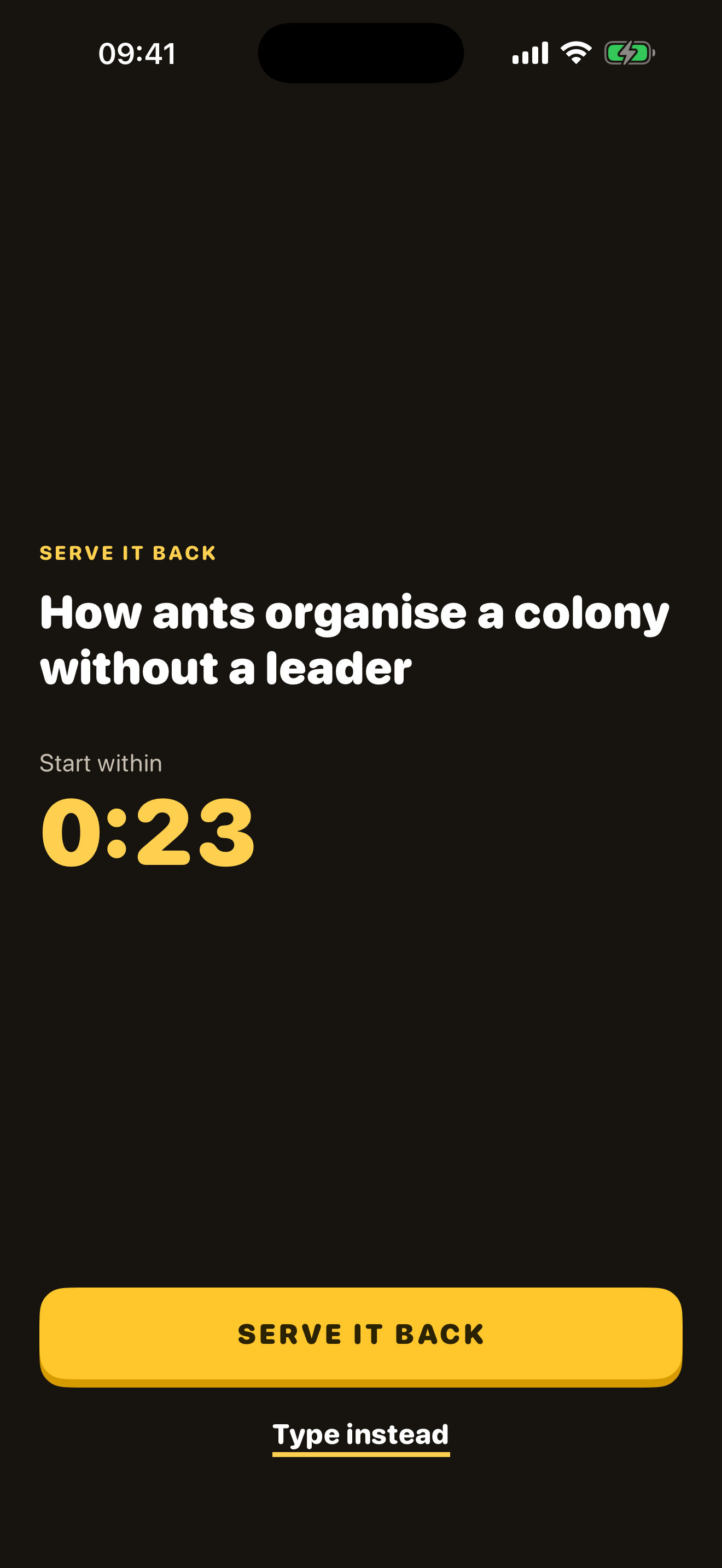
Serve It Back: 30 seconds to start explaining.
-
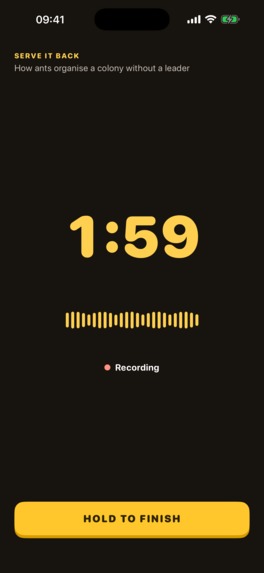
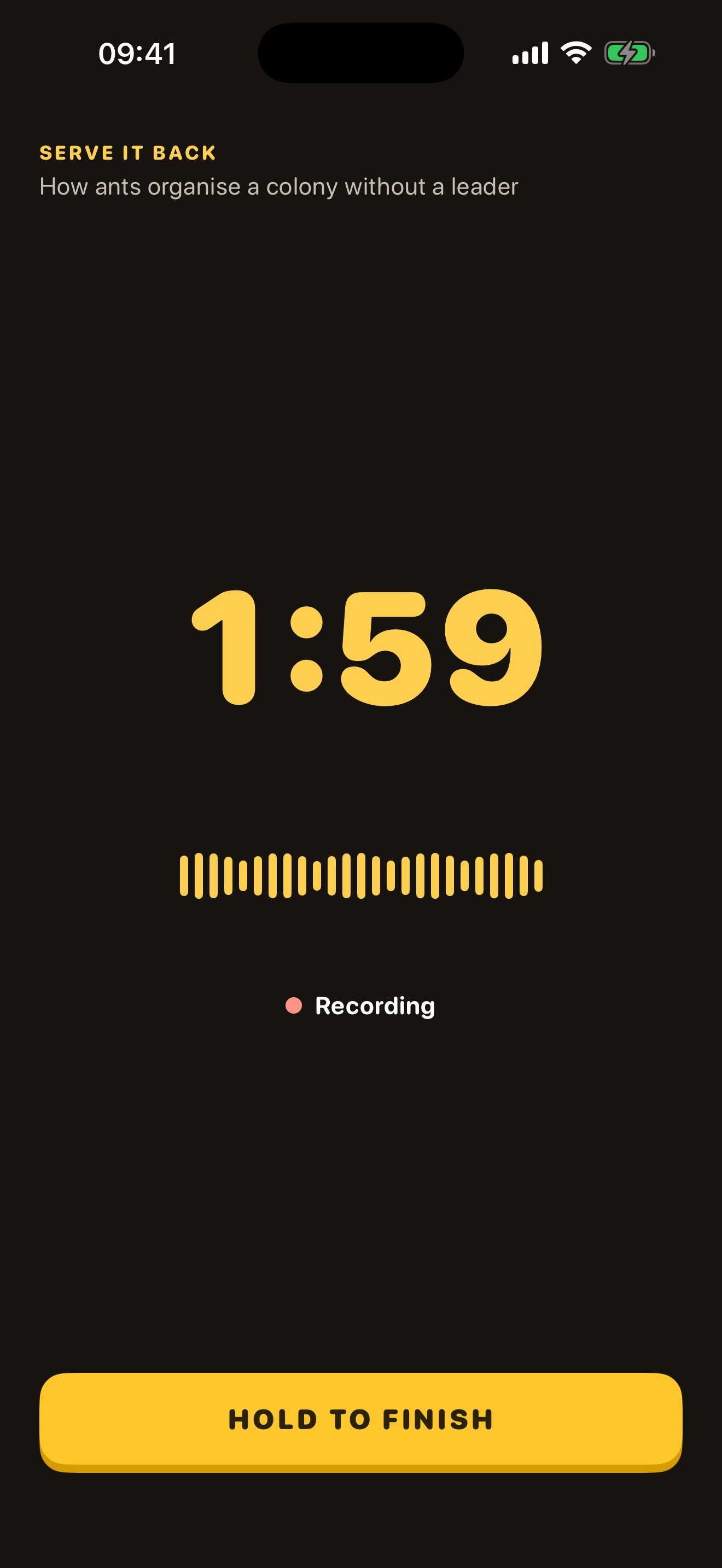
Serve It Back: recording your explanation out loud.
-
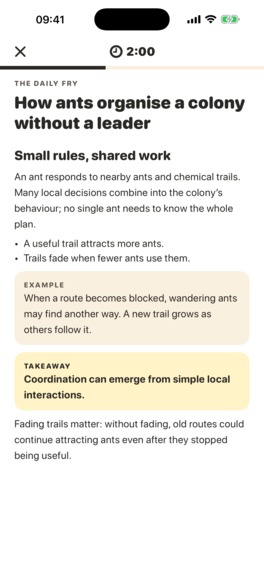
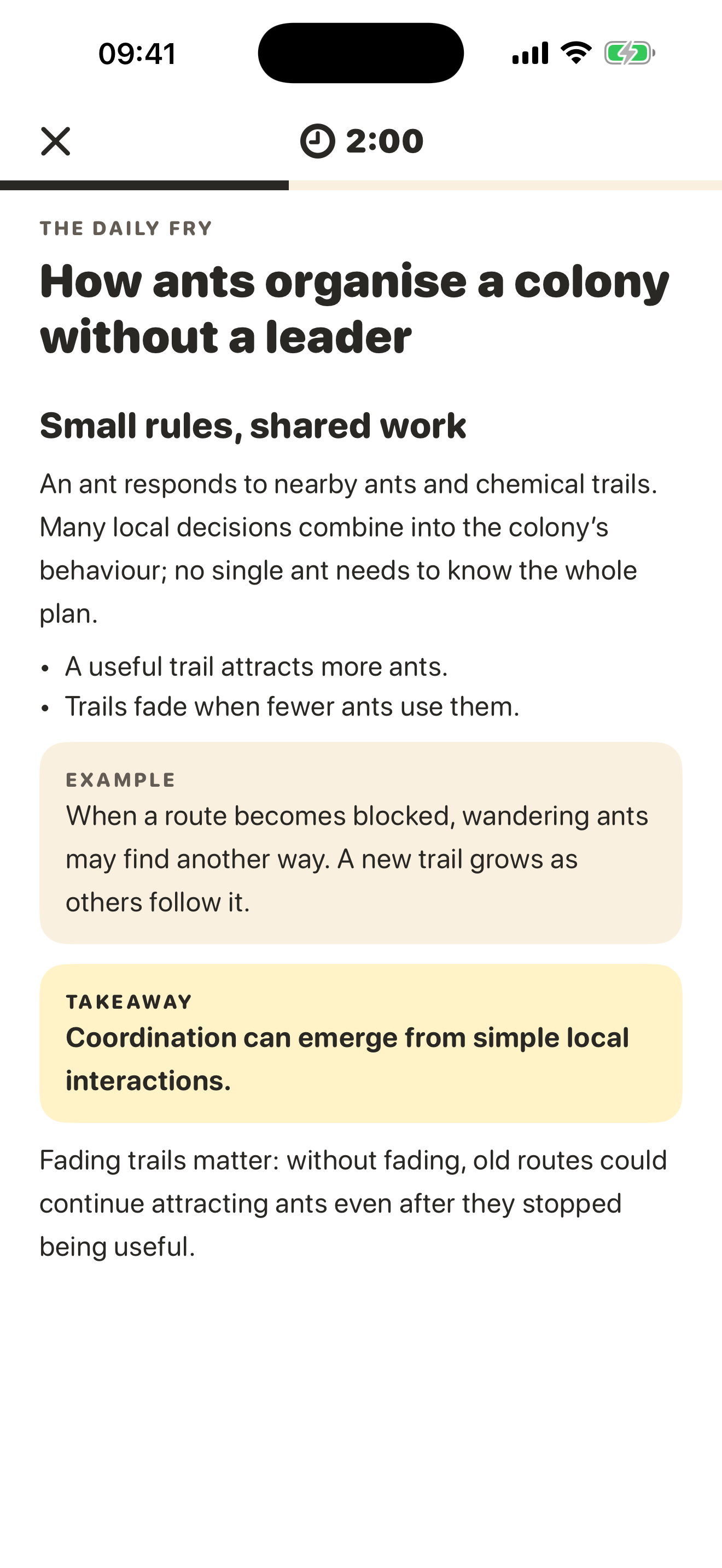
Learning: the lesson, with the timer running.
-
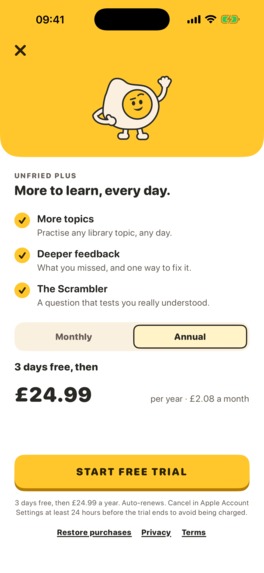
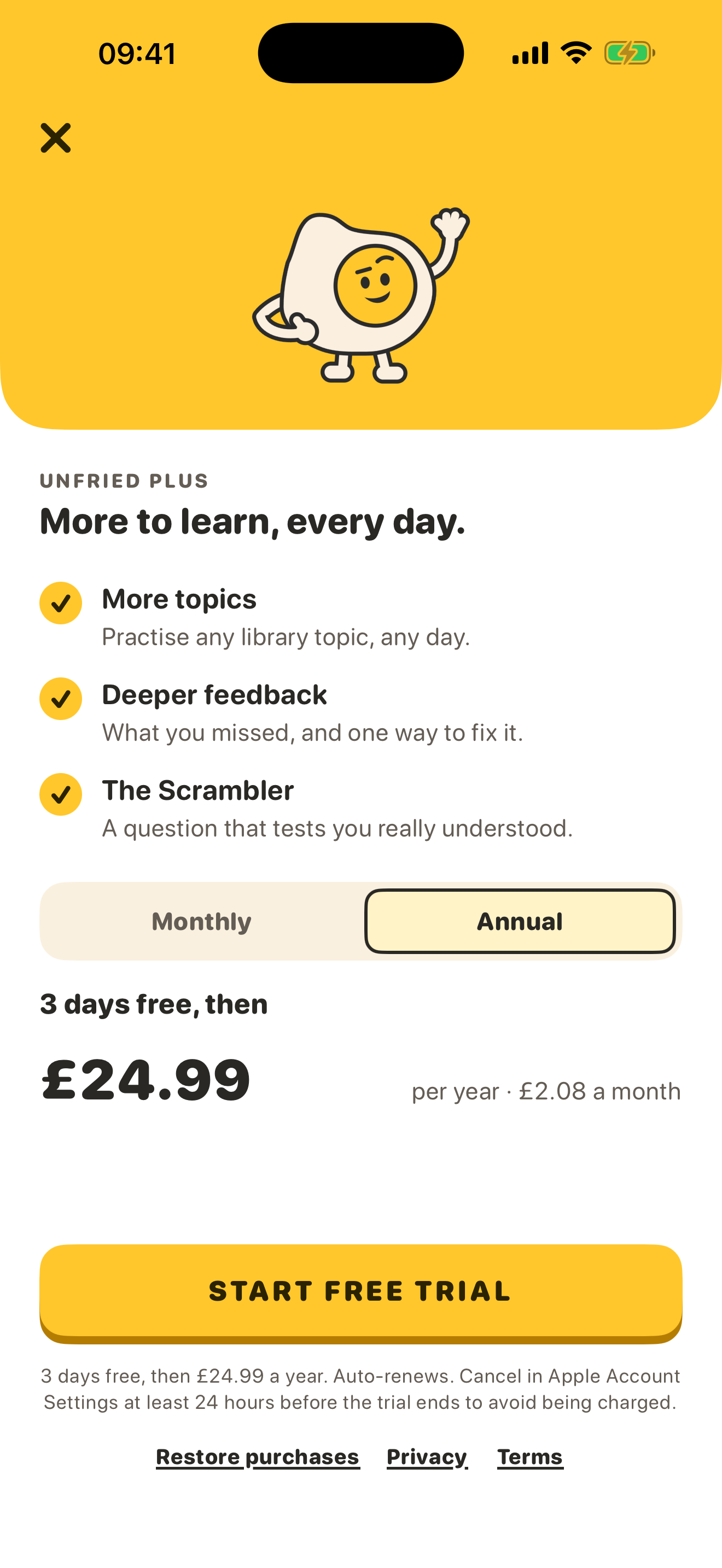
Unfried Plus paywall: Monthly or Annual, with a 3-day free trial.
-
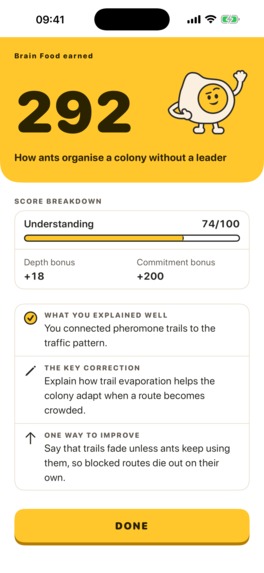
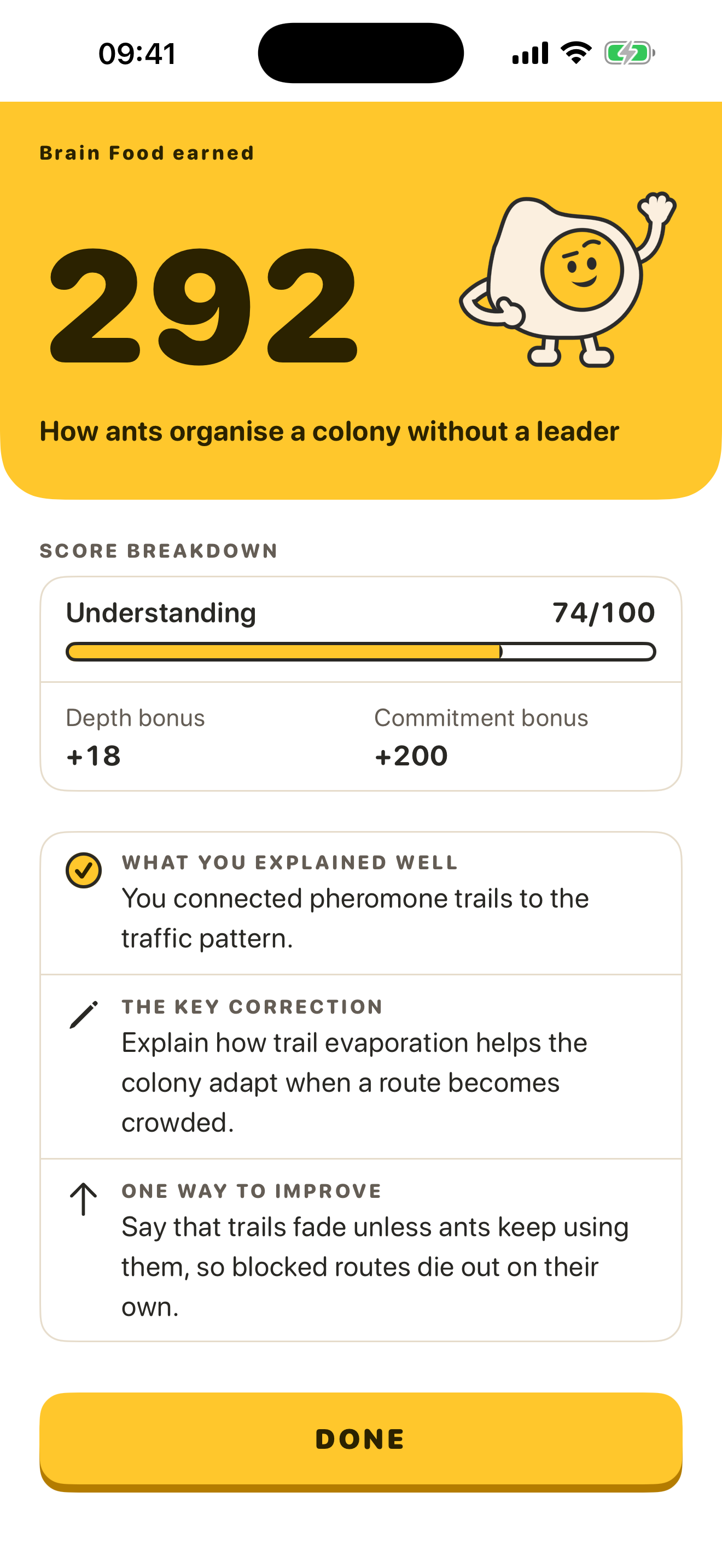
Results: Understanding out of 100, bonuses, and what you nailed or missed.
-
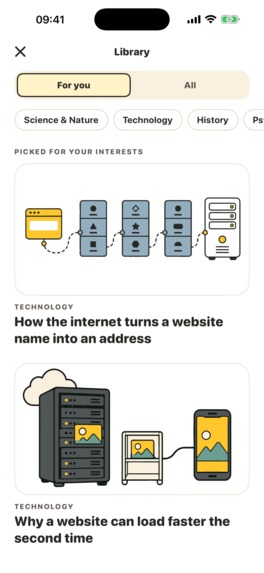
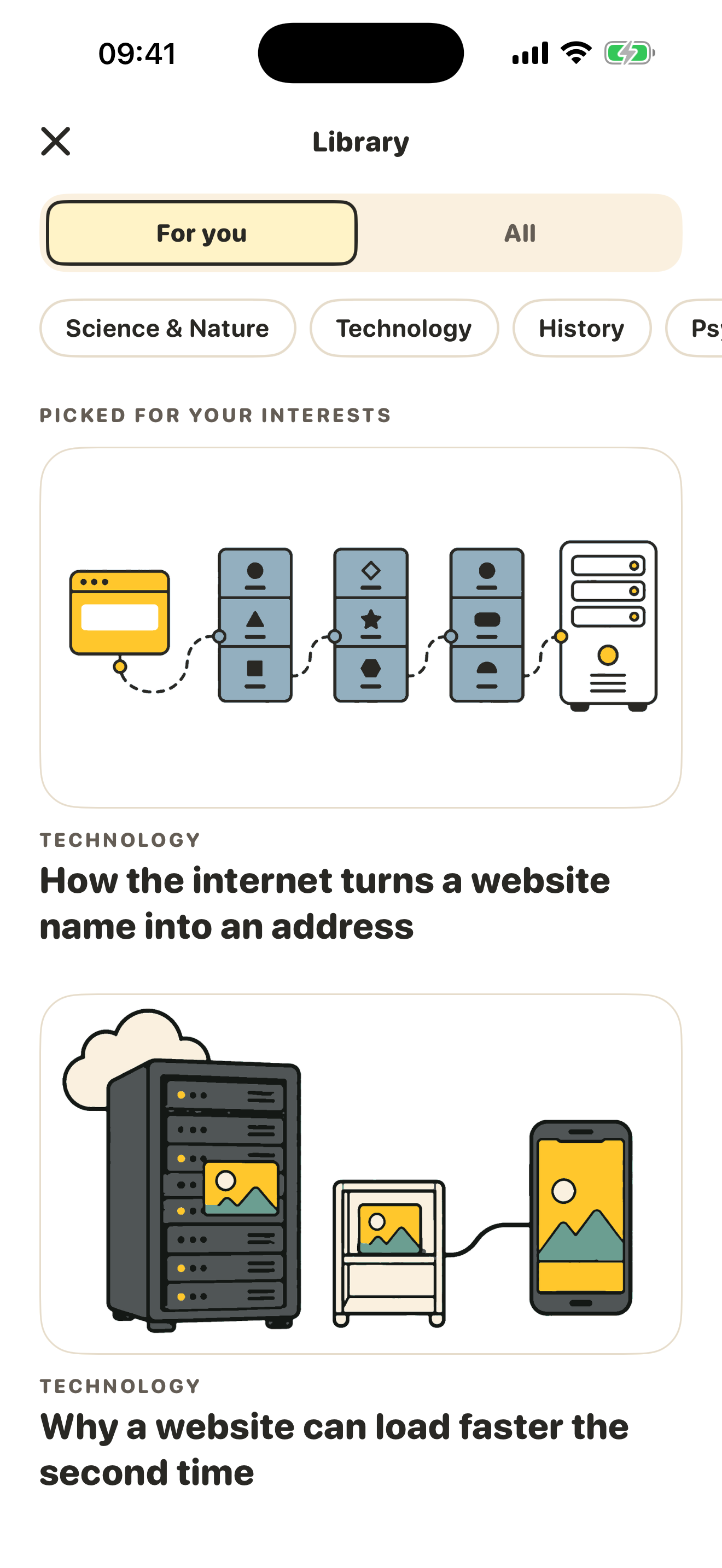
Library (Unfried Plus): any topic, any day.
-
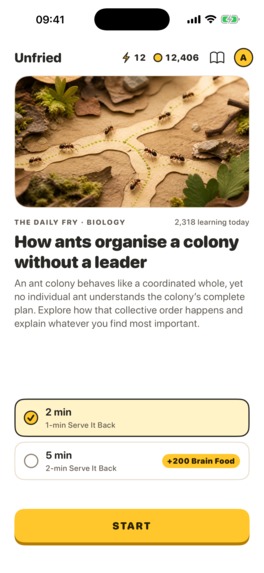
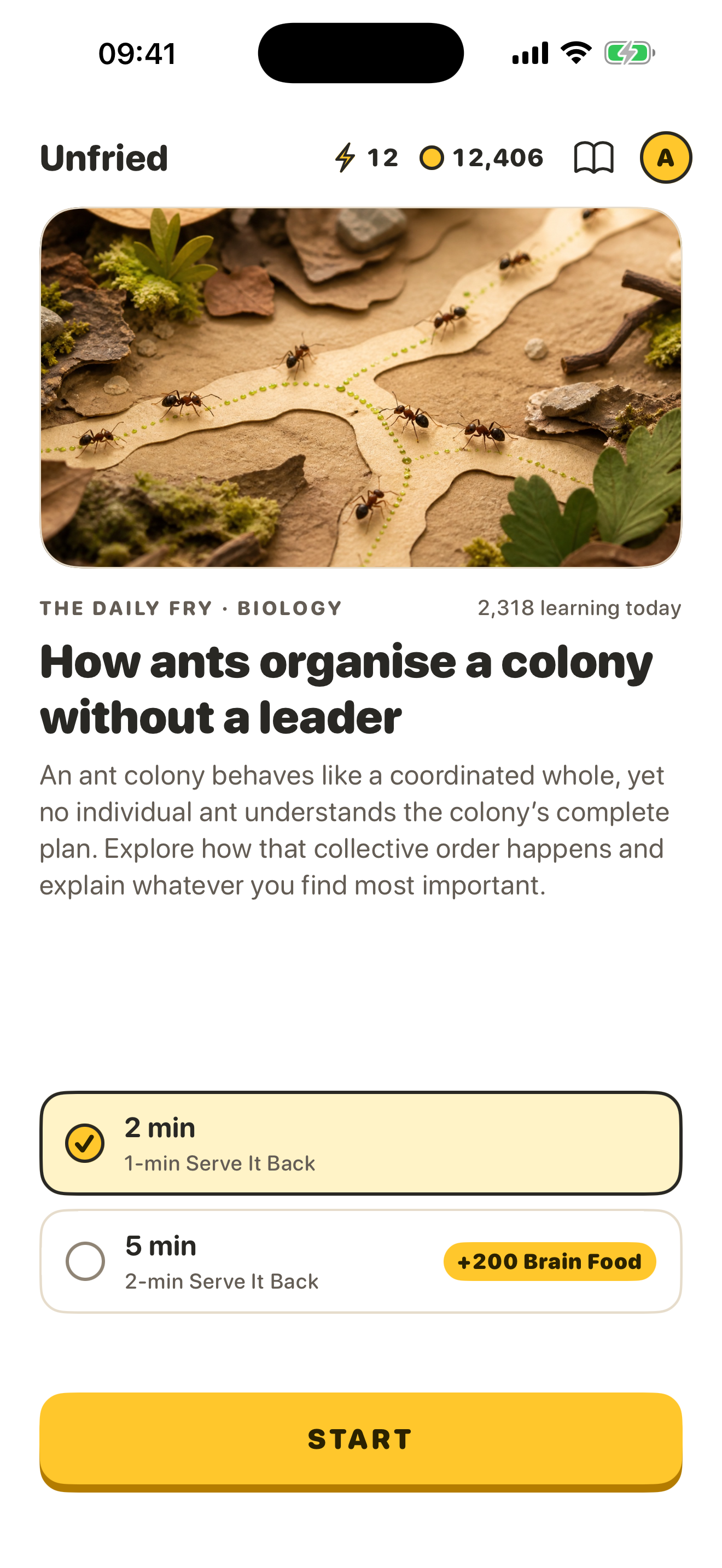
Today: The Daily Fry. One topic for everyone, 2 or 5 minutes.
Inspiration
I'm embarrassed to admit it, but my attention span is completely cooked. I can't watch a TikTok video that is longer than two minutes, and the ones I do watch, I watch at 2x speed. Growing up, I was a massive book nerd, and while I still love reading, I tend to skim-read everything, because I don't want to slow down and actually pay attention to what's on the page. And I am almost certain that my degrading attention span is the culprit.
Turns out it is not just me. Scientists at UC Irvine have spent two decades measuring how long people stay on one screen before switching. In 2004 it was two and a half minutes, today, it's 47 seconds.
So I went looking for a fix, I didn't want another app telling me to scroll less or simply "lock my apps", I wanted something that gives my brain a small, real workout every day, in less time than one short video.
This took me back to my high school and university days, when my go-to technique for studying was the Feynman technique. Whatever topic I was studying, I'd learn it and then teach it back to a friend. This way, I was forced to make sure that I was actually understanding the topic and was paying attention to what I was reading.
This is what inspired Unfried. Everyone gets the same topic each day, learns it in two (or five) minutes, then teaches it back to Yolki out loud, and gets scored on what actually stuck.
What it does
Every day, everyone on Unfried gets the same topic, with the topic brief, called the "Daily Fry. Today's might be how ants organise a colony without a leader, or why the sky is blue but sunsets are red.
Users can pick between between two or five minutes and learn it. When the timer runs out, you've got 30 seconds to start "Serving It Back": explaining what you learned, out loud, in your own words, to Yolki (our egg mascot). If you can't talk out loud, you can type instead.
Then AI scores your explanation. You get an Understanding score out of 100 for how well you actually explained it, a bonus for going deeper, and a big bonus if you went for the five-minute session. It tells you what you explained well, the key thing you missed, and exactly where your points went. It all adds up as Brain Food (points), which builds your streak and puts you on the leaderboard, where everyone is ranked on the same topic that day.
Unfried is free to play every day. Unfried Plus unlocks:
- The full library: any topic, any day, not just the Daily Fry.
- Deeper feedback: what you missed, and one way to fix it.
- The Scrambler: one harder follow-up question to prove it really stuck, worth +20 Brain Food.
How I built it
I built Unfried on my own, as a solo developer, but I didn't do it alone. I treated AI coding agents like a small team. Claude Code worked on the app and did most of the testing, Codex looked after the backend, and I acted as the product lead: writing what I wanted, the architectur design, testing every TestFlight build on my phone, and sending feedback (often a lot of it, often grumpy) The agents left handoff notes for each other so nothing got lost between them.
Design worked the same way. I'd sketch an idea as a wirefram, sent it to Claude Design for refinement, get a few options back (the paywalls, Yolki's poses, the leaderboard, the app icon), pick the one that felt right, and then have it rebuilt properly in SwiftUI.
Version 1.0 was the core loop: one topic, learn it, explain it out loud, get scored.
Challenges I ran into
Scoring a spoken explanation fairly.: Grading someone talking for a minute about a particular topic is a lot harder than grading a simple multiple-choice quiz. Early TestFlight builds gave scores that felt random, and at one point scoring broke completely. It took a lot of rework to get an Understanding score that feels fair, with feedback on what you nailed and what you missed.
Learning paywalls and retention from scratch.: This is the first B2C product I've ever built, so paywalls, onboarding and retention were all new to me. My initial approach was a simple one: to just have a list of features about Unfried and then have a sign-up form. It turns out that's terrible for real sign-ups and retention. Throughout this process, I learned that users need to see value and need to feel invested in the app for them to want to sign up, let alone pay for a subscription. The onboarding process went through four cycles before landing on what we have now. The big shift was making onboarding about getting people invested before asking for anything. Now you meet Yolki, pick a breakfast buddy to be your avatar, set your goal and your session length, and then play today's Daily Fry straight away however, your score will be gatekept by the sign-up screen, and by then you've already learned something and explained it out loud. You're invested. Plus followed the same idea. There's no paywall at the start, it shows up at the moments you'd actually want more: after your first score, when you want another topic from the Library, or when you want to prove it really stuck with The Scrambler.
Sharing a backend with another app: In order to move fast I started Unfried on the same Supabase project as another app I built to stay within the free tier. That came back to bite me when the other app overwrote one of Unfried's backend functions. That was when I then realised that both apps were also sharing the same authentication, so if a customer was using both apps and then deleted their account in one app, it could have also affected the authentication in the other app. Mid-hackathon we had to split the two apps apart: separate data, separate rules, and even separate sign-up emails, so Unfried users don't get emails branded as the other app.
Marketing, as an introvert: Turns out building the app is the easy part. I'm super introverted and I don't post on social media at all, so telling people about Unfried has been the hardest thing in this whole hackathon. I honestly didn't know where to start and it's still very much a learning process, and figuring out how to market an app on social media without it feeling fake is what I'm working on next.
Accomplishments that I'm proud of
- Shipping an app that people actually use: I'm still new to building apps, and a month ago Unfried was just an idea. Now it's live on the App Store with a handful of downloads less than a day after launch.
- Learning paywalls and retention from scratch. I'm new to building apps, and this was my first time really thinking about paywalls, onboarding and retention.
What I learned
Let people try before you ask for anything: The biggest lesson of the whole build. Asking for an account, or money, before someone has felt the app work just loses them. Letting people play first, then asking at the moments they'd actually want more, changed everything about how I think about onboarding and paywalls.
Less is usually better. A lot of my best changes were removals: a separate permissions screen that got in the way, extra steps in onboarding, paywalls in the wrong places. Every time I cut something, the app felt better.
Shortcuts cost you later: Sharing a backend to save time and money worked right up until it didn't. Splitting it apart mid-hackathon took far longer than doing it properly would have at the start.
Write everything down: Working with AI agents taught me to be really specific about what I want, and to save decisions so they don't get lost. It turns out that's just good product work.
Start marketing on day one. I left telling people about Unfried until the app was done, and that was a mistake, especially as someone who doesn't post online. Next time I'll start sharing much earlier, even when it feels uncomfortable.
What's next for Unfried
Brain-teaser mini-games: Similar to New York Times Games, but built around what you just learned. Short daily puzzles on today's topic, like a Connections-style grid of key ideas, a quick word game or a "which of these is true?" round. The same topic for everyone, so you can compare with friends. It keeps your brain working in the moments you'd normally reach for your phone.
Competing directly with friends: Everyone already gets the same topic each day, so the next step is making that even moer social by challenging a friend to today's Daily Fry and compare who explained it better.
*Telling more people about it: As someone who doesn't post online, this is my biggest personal goal. Learning to share Unfried on social media and building an audience, one video at a time.

Log in or sign up for Devpost to join the conversation.