Inspiration
Keyword search works the moment you already know the product words. Real shopping conversations aren't like that. Preferences arrive in fragments, change halfway through, and are sometimes deliberately withheld ("no preference, you pick").
What reframed the project for us was reading the scoring loop closely. The evaluator ends a session the instant the target product appears in the returned list, and the rank at that moment is locked in permanently. That means recommending a product you're unsure about isn't a free guess. It is an irreversible commitment. A confident wrong answer is worse than an honest question.
Everything we built follows from that one observation.
What it does
Cartographer treats shopping dialogue as active search. Each turn it does two things: ranks the products it can justify, and asks the question expected to remove the most uncertainty.
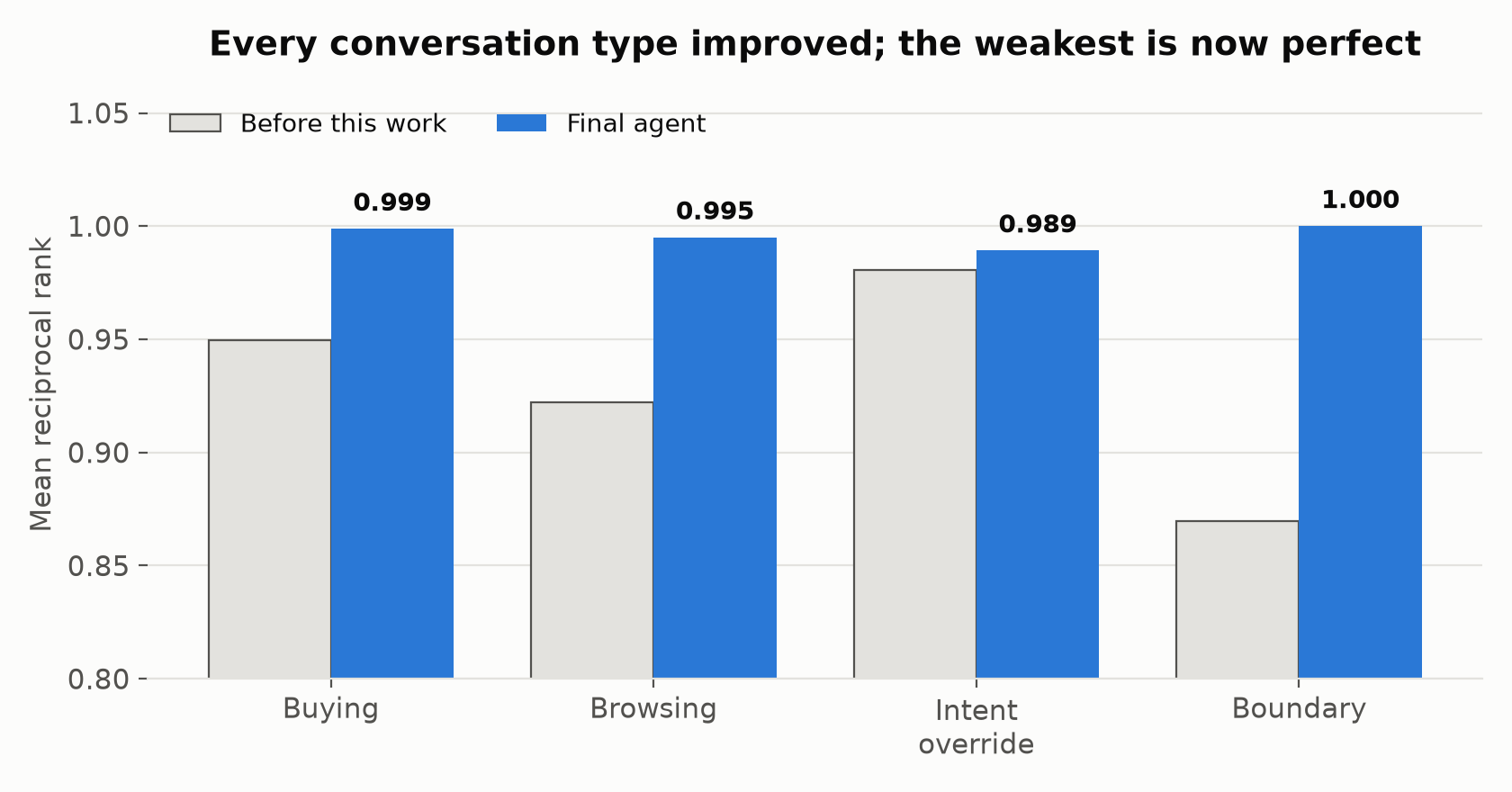
It routes every message into a Buying track that locks hard constraints into destructive filters, or a Browsing track that widens and diversifies. It maintains explicit, rewritable state, so when a shopper corrects themselves it retires only the superseded preference and keeps everything else they've disclosed.
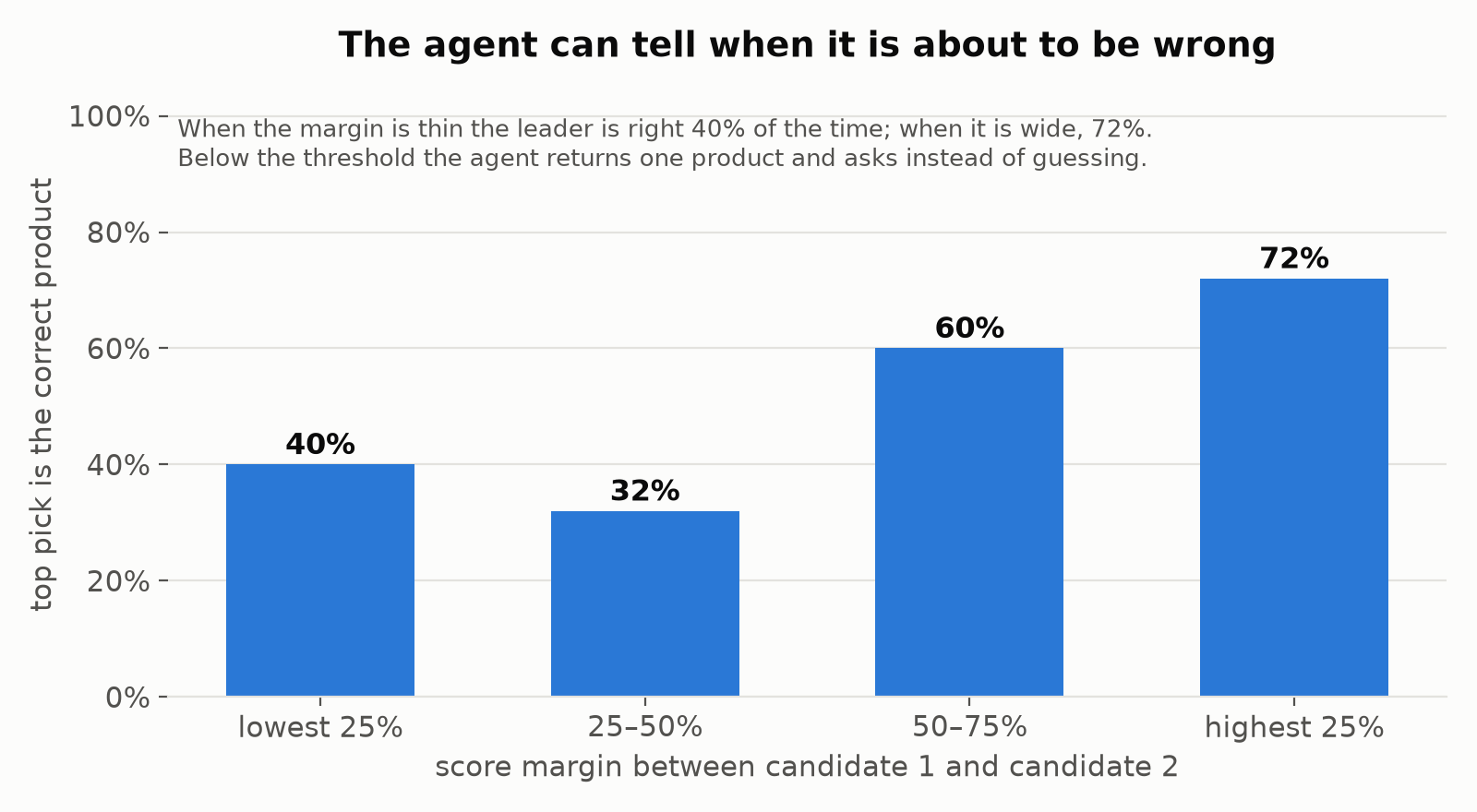
Most distinctively, it withholds. When its top candidate isn't clearly ahead of its second, it returns one product instead of ten and spends the turn converging. It would rather ask than lock in rank 4.
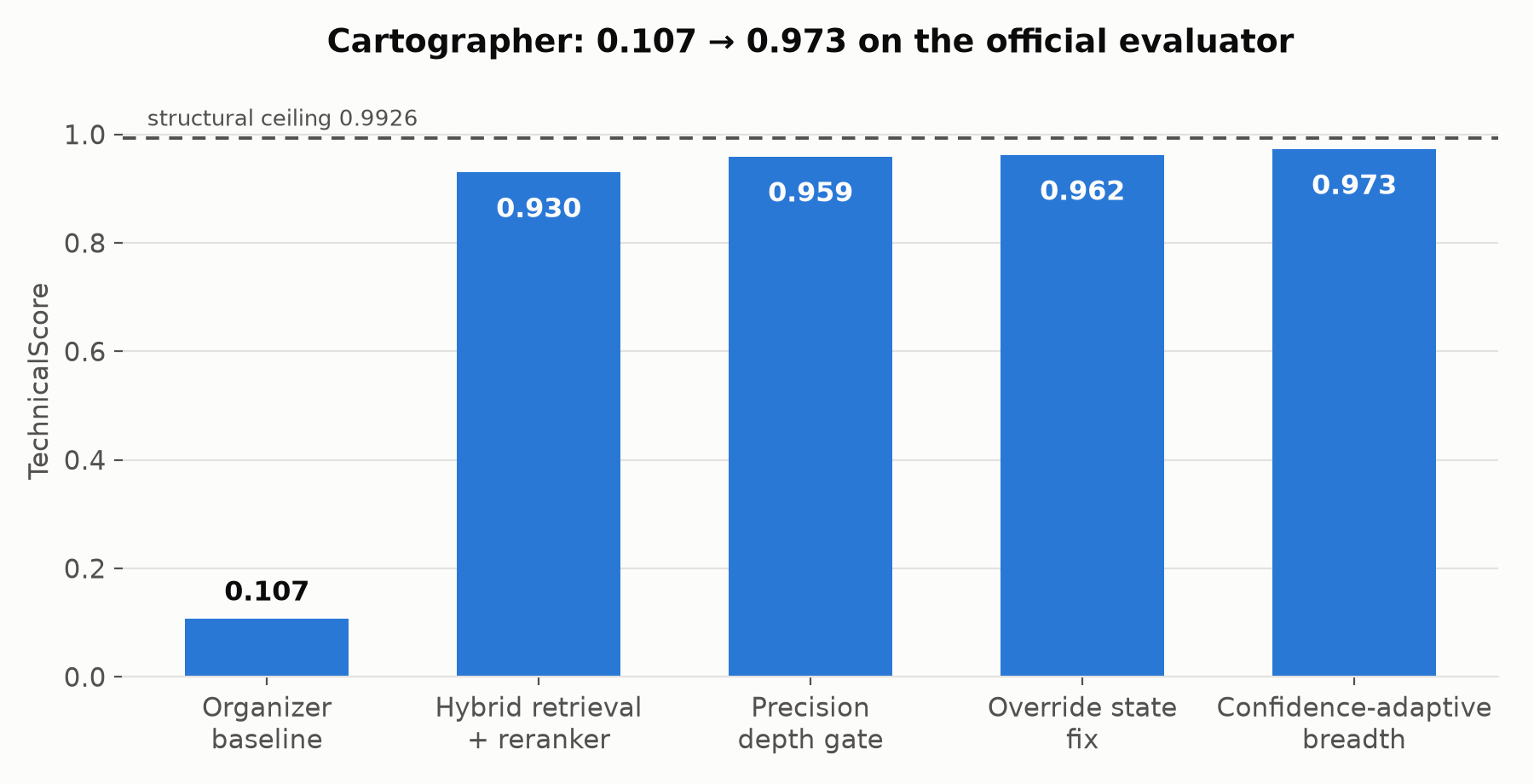
Results with the unmodified official evaluator across 1,000 labelled sessions:
| Metric | Starter baseline | Cartographer |
|---|---|---|
| TechnicalScore | 0.10671 | 0.973062 |
| MRR | 0.068 | 0.9959 |
| Mean turns to conversion | 9.81 | 2.26 |
Zero LLM tokens. Zero API cost. CPU-only, offline, deterministic.
How we built it
The deterministic runtime is pure Python standard library: SQLite FTS5 for keyword retrieval, plus hand-built intent fingerprints and a category prior, fused by route-aware scoring and reordered by a dependency-free learned reranker of eleven weights per route.
We built an experiment harness that scores every candidate change end-to-end through the untouched evaluator, and a diagnostic dashboard for replaying single conversations turn by turn. We also generated an 800-session held-out set sharing no target product and no sample ID with the public data, so we always had an honest out-of-sample number.
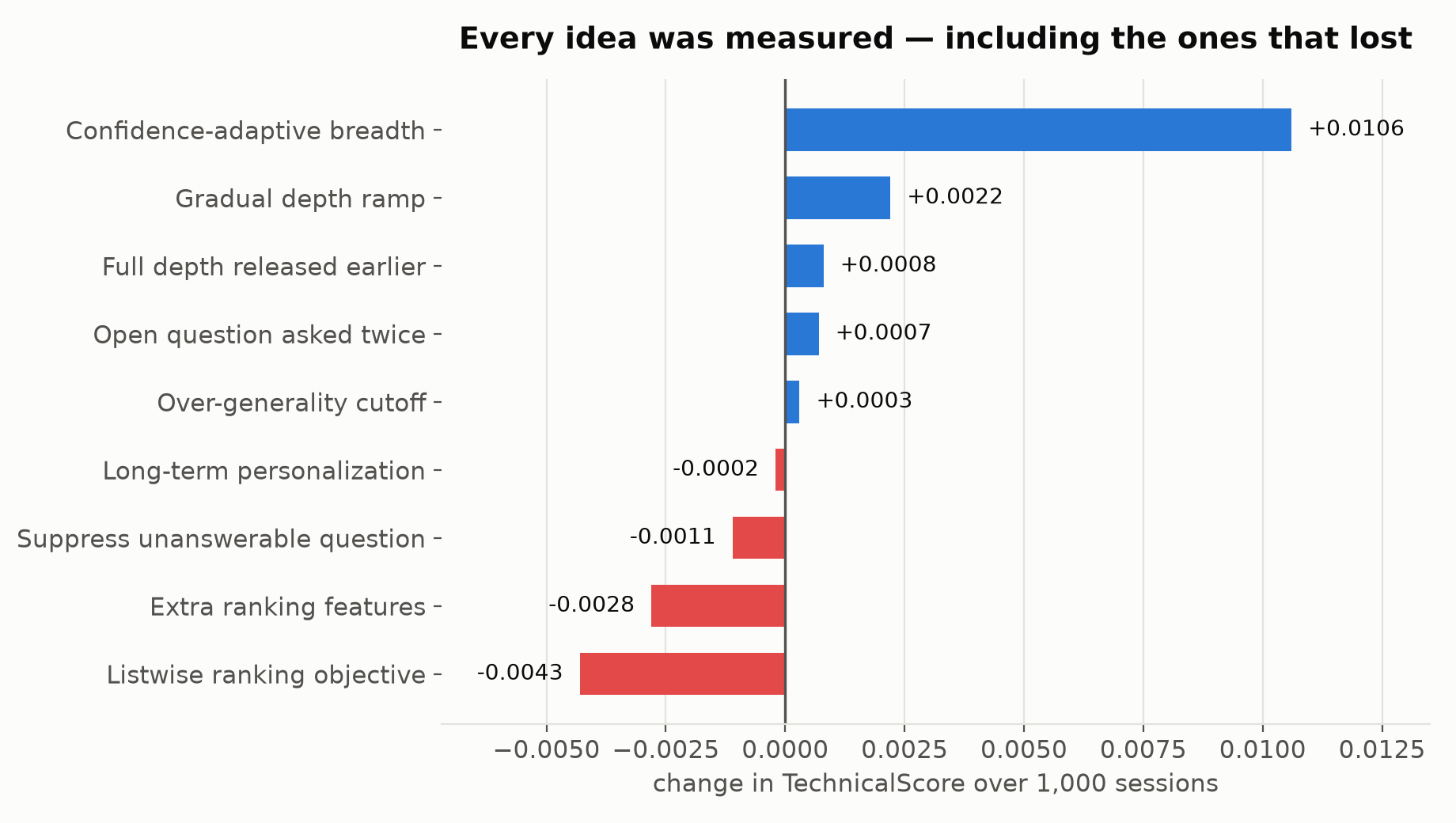
The rule we held to: no change ships on reasoning alone. Every promoted mechanism was measured, and the rejected ones are documented with their costs.
How our solution addresses the problem statement
The brief asks for four pillars, and each maps to a specific part of the agent:
I. Intent routing and hybrid pipeline. Dual-track routing sends every message to a high-precision Buying filter that locks hard constraints, or a diversified Browsing track for open-ended exploration. Candidates come from four in-memory routes, keyword (SQLite FTS5/BM25), category prior, exact intent fingerprints, and an optional dense vector route, fused by route-aware scoring and reordered by a learned residual ranker.
II. Multi-turn dialog strategy. A state machine accumulates incremental slots and rewrites them on abrupt intent override, retiring only the superseded preference. When the candidate pool is too broad to answer with a list, an over-generality cutoff returns a probe and spends the turn on a structured clarification prompt.
III. Self-evolution through dynamic context programming. Recommendation breadth is re-planned every turn from live evidence rather than a fixed rule, and finished sessions are distilled into durable long-term shopper profiles that reload on the next visit.
IV. Evaluation. Every claim is measured with the organizer's evaluator, unmodified, across 1,000 labelled sessions.
Development tools used
VS Code, Git and GitHub, Python 3.12 on Linux, a purpose-built Gradio dashboard for replaying individual conversations turn by turn, a custom experiment harness that scores every candidate change end to end through the untouched evaluator, and matplotlib for the figures above.
APIs used
None. No external API is called during training or inference. There is no LLM in the loop, no network dependency at runtime, and no paid service. This was deliberate: a deterministic, inspectable pipeline proved both cheaper and far easier to debug than an opaque one, and it reports zero tokens at zero cost.
Libraries and frameworks used
The submitted agent uses only the Python standard library: sqlite3 for FTS5 keyword retrieval, plus json, re, math and hashlib. That is the entire runtime dependency list.
Everything else is optional or development-only. numpy, PyTorch (CPU) and sentence-transformers support the offline BGE embedding route, which we evaluated and left disabled. gradio powers the diagnostic dashboard and matplotlib generates the figures. None of them are imported by the scored agent.
Datasets and assets used
- The organizer's frozen 50,000-product catalog derived from Amazon Reviews 2023 (McAuley Lab, UCSD), verified by SHA-256 and never redistributed.
- The 200 labelled public sessions provided with the participant kit.
synthetic_800_v1.jsonl, an 800-session held-out set we generated to the official scenario mix. It shares no target product and no sample identifier with the public sessions, so it serves as a genuine out-of-sample check.BAAI/bge-small-en-v1.5sentence embeddings, built offline and checksum-verified, used for the dense retrieval experiment we ultimately rejected.
Challenges we ran into
Our best ideas kept losing. A listwise loss that should have matched the objective lost 0.004. Adding five well-motivated features lost 0.003. Suppressing a question we'd proven was 21% unanswerable lost 0.001. Each was sound on paper and wrong in measurement.
Dense retrieval failed three ways. We built and verified BGE embeddings, then rejected them on an end-to-end grid, a fixed-message rank replay, and a dense-retrained cross-validation. The reason turned out to be structural: this customer discloses requirements as verbatim substrings of the product's own text, which exact matching resolves precisely and cosine similarity blurs.
A feature that scored exactly 0.000000. Enabling long-term personalization changed the score by precisely zero, which was the tell. A feature that genuinely runs essentially never ties. It exposed two real bugs: distillation never fired because the evaluator allocates a fresh session ID per conversation, and shopper identity drifted because recall enriched the very profile the next distillation keyed on.
Accomplishments that we're proud of
Withholding as a strategy. Adaptive recommendation breadth, driven by the live score margin between the first and second candidate, was worth +0.0118, more than every model-tuning experiment combined. We validated the signal before trusting it, and ran an always-narrow control to prove the adaptivity was doing real work.
Knowing when to stop. We proved the reranker was saturated rather than under-trained: 8x more training data moved the score by -0.0002, and in-sample and out-of-fold agree to 0.0002. That redirected effort away from model tuning toward agent logic, where the real gains were.
Honest numbers. Hit Rate is 0.9990, not 1.0. The confidence gate trades one session in a thousand for ranking. We documented the mechanism instead of rounding it away, and we publish the ceiling too: 0.9926 is the structural maximum here, because override sessions can't convert before their override arrives.
What we learned
Read the scoring function like a specification. The single most valuable insight wasn't an algorithm. It was noticing that rank locks on first appearance. That reframed recommendation as a commitment decision and produced most of our gain.
Static metrics don't predict end-to-end outcomes. We had airtight evidence that one question type was near-useless. Removing it lost score, because it reshuffled the entire dialogue path. On 100 sessions, only the full evaluator tells the truth.
Small data has a ceiling, and it's worth finding. Eleven weights fitted to 200 sessions can't be improved by more data, more features, or better losses. We tested all three. Recognising that saved us from optimising something already finished.
The best bug reports come from suspicious results. "No change" and "exactly zero" are findings, not non-events.
What's next for Cartographer
Hunt more logic bugs. Fixing how intent override rewrites state was worth +0.0043, five times our best model tweak. The dialogue state machine has never been systematically audited against the evaluator's real behaviour, and that's where the remaining value is.
Close the browsing gap. Browsing is 40% of sessions and the largest remaining loss pool. On turn one its message carries almost no information, so the agent ranks on category and popularity alone.
Make personalization pay. The long-term profile store works but costs 0.0002 here, because the agent already converges in ~2.3 turns. It's built for a deployment with genuinely returning shoppers, and that's where it should be measured.
Real-world hardening. Multilingual and typo-tolerant parsing, new taxonomies beyond English clothing, and online measurement of actual conversion lift rather than a simulated proxy.
Try it yourself
Demo video: Cartographer end to end
git clone https://github.com/psh12320/cartographer
python3 -m cartographer.reproduce
Built With
- bm25
- cloudflare
- conversational-ai
- gradio
- information-retrieval
- learning-to-rank
- matplotlib
- natural-language-processing
- numpy
- python
- pytorch
- recommender-systems
- search
- sentence-transformers
- sqlite
- sqlite-fts5


Log in or sign up for Devpost to join the conversation.