Inspiration
Agentic commerce stopped being a forecast this autumn. Stripe reported agent-initiated purchases on Link multiplied by 38 in September 2026 (~200 agents, ~$100 tickets), naming PayPal among the rails "preparing their own solutions". Amex presented its Intent Intelligence Framework on 13 October 2026: intent + limits become a token, non-compliant purchases get blocked. Mastercard's Verifiable Intent (open spec with Google, March 2026) formalises the authorization chain: issuer, user constraints, agent proves scope.
All of it is the authorization half. And while this hackathon ran, the rails scaled the distribution half too: PayPal put its agent checkout on Glance (15 October 2026, tens of millions of US consumers), extended it to 60M living-room devices (17 October), and made every merchant that accepts PayPal automatically Agent Ready (16 October); Mastercard's Agent Pay reached general availability and added x402 micropayments (26 October); Visa announced trust-and-control capabilities for agentic payments (21 October).
The press sentence that started this project is the other half: "the delicate case is when the purchase was authorized but badly executed by the agent... hence the value of keeping a clear trace of your instructions." No protocol writes down what happens then: who holds the buyer's words, what the seller submits, which of PayPal's evidence slots it fits. We verified the gap on PayPal's own surfaces: the official @paypal/mcp server moves money with no approval hook (so we put it behind ours), the official AI-Toolkit ships best practices but no enforcement, and pre-dispute alerts have no webhook at all (verified: PRE_DISPUTE_ACTIVITY is not a valid event name). So we built the layer where authorization becomes evidence: for the buyer, the seller and the agent, verifiable by anyone, with no trust in us.
What it does
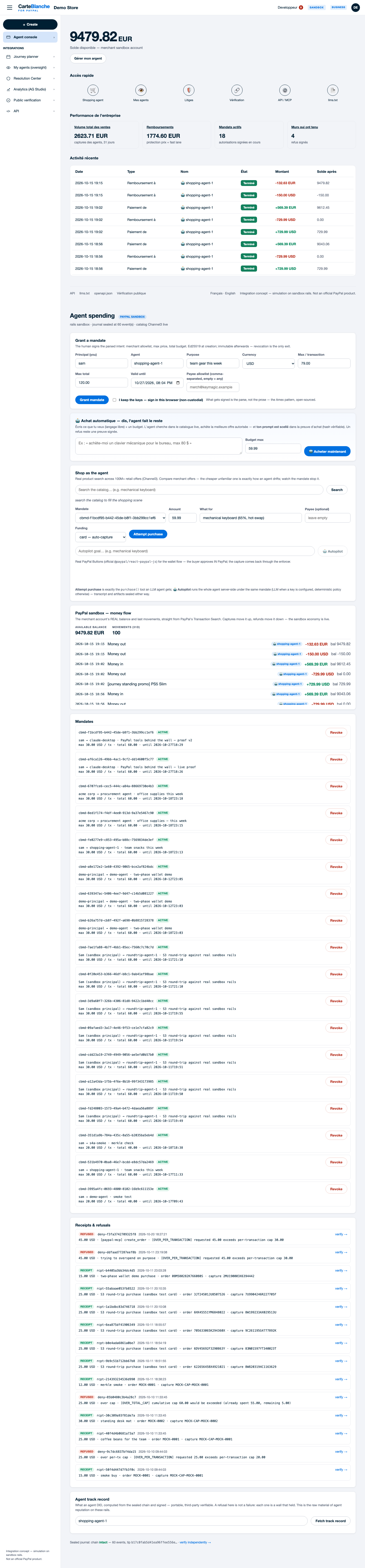
For the buyer (the Agent console)
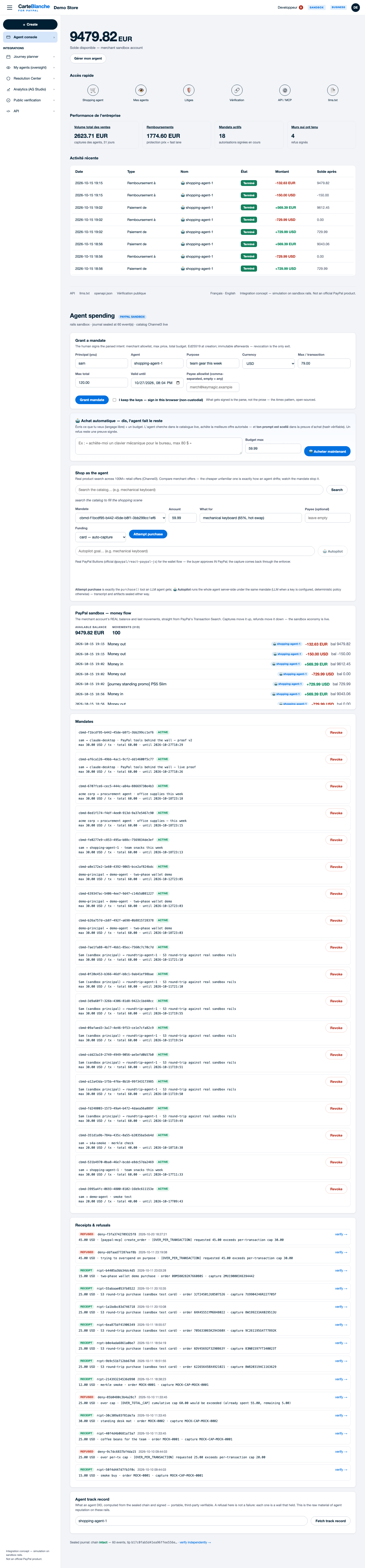
- Mandates: an Ed25519-signed, immutable spending mandate with per-transaction cap, cumulative cap, currency, payee allowlist, time window and recurrence ("up to $40/month at the grocer"). Only revocation changes behavior; it is instant and journalled.
- Say it, the agent does the rest: a prompt + a budget. The autopilot shops the live catalog and buys under the mandate; the buyer's verbatim words are sealed (intent_text, SHA-256 of the full utterance, channel, session) into the journal and stamped on the receipt. The "I never told my agent that" defense, on the rail instead of in a chat log.
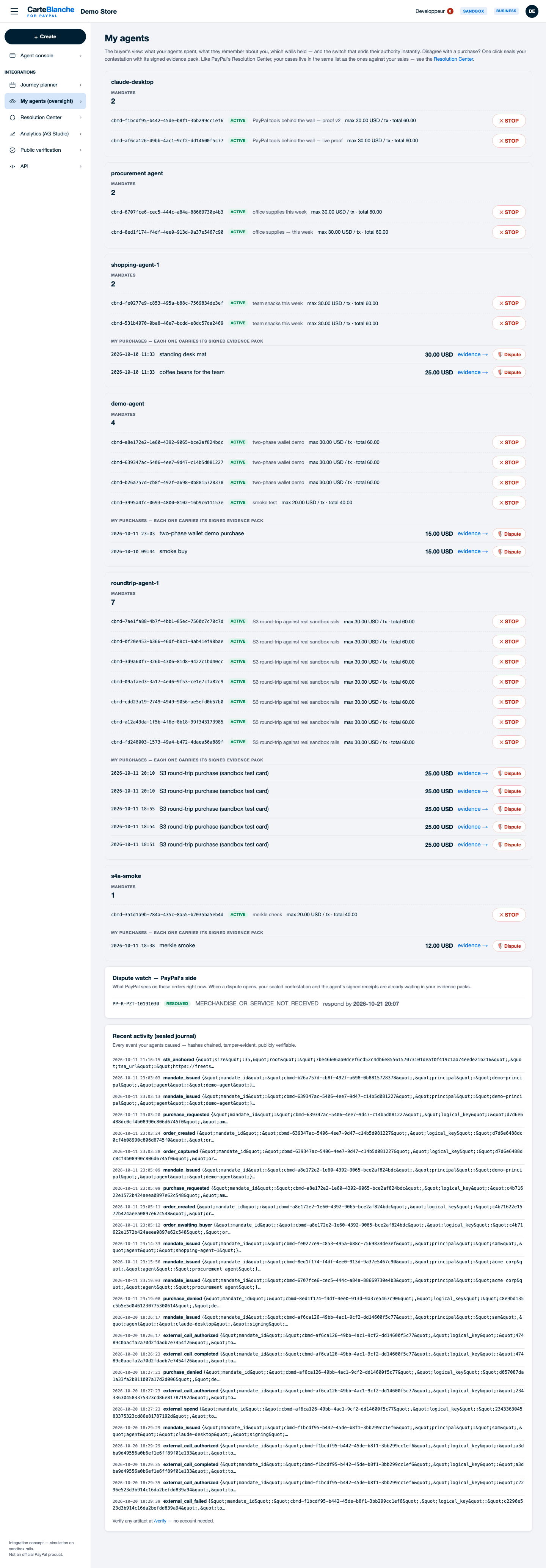
- Enforcement before money moves: every mutative call is checked; violations return signed proofs of refusal naming the wall (OVER_PER_TRANSACTION, OVER_WINDOW_CAP, OVER_TOTAL_CAP, PAYEE_NOT_ALLOWED, MANDATE_REVOKED...). A refusal is evidence of the principal's standing decision, not an error.
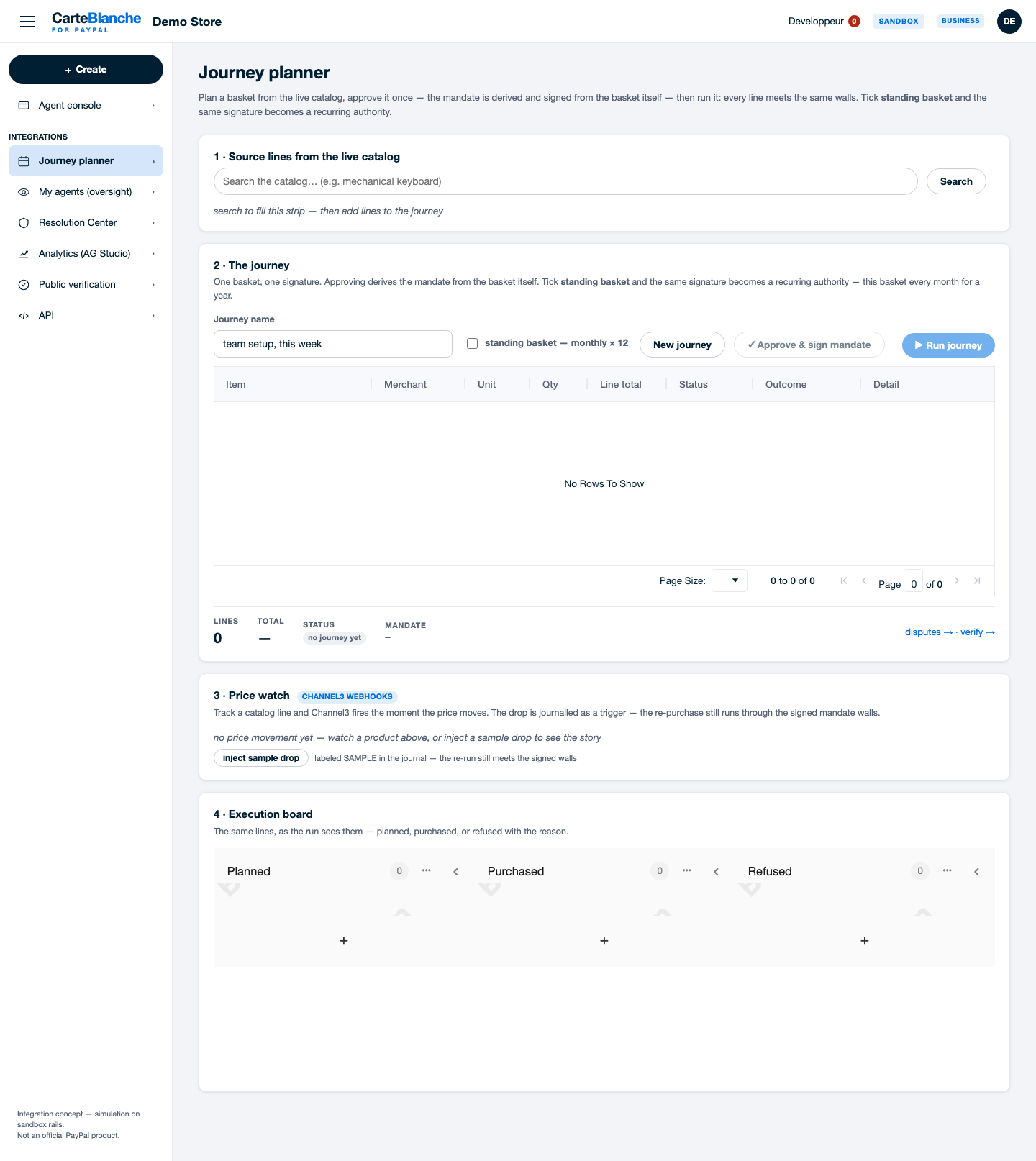
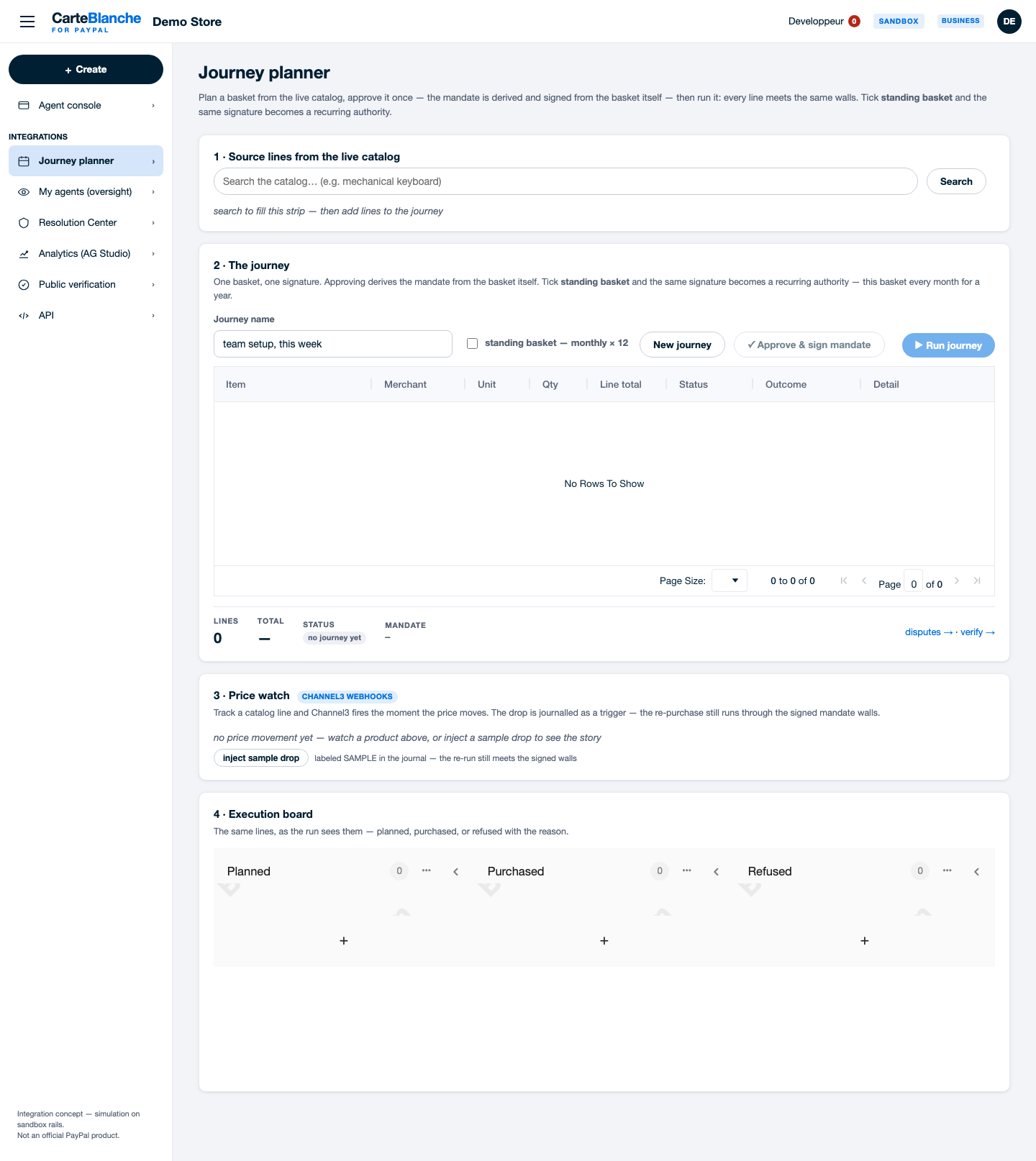
- Purchase journeys: plan a basket from the live catalog, approve ONCE; the mandate is derived from the basket. Price drops re-price the lines; if the agent already paid, price protection refunds the difference with a real PayPal refund, journalled.
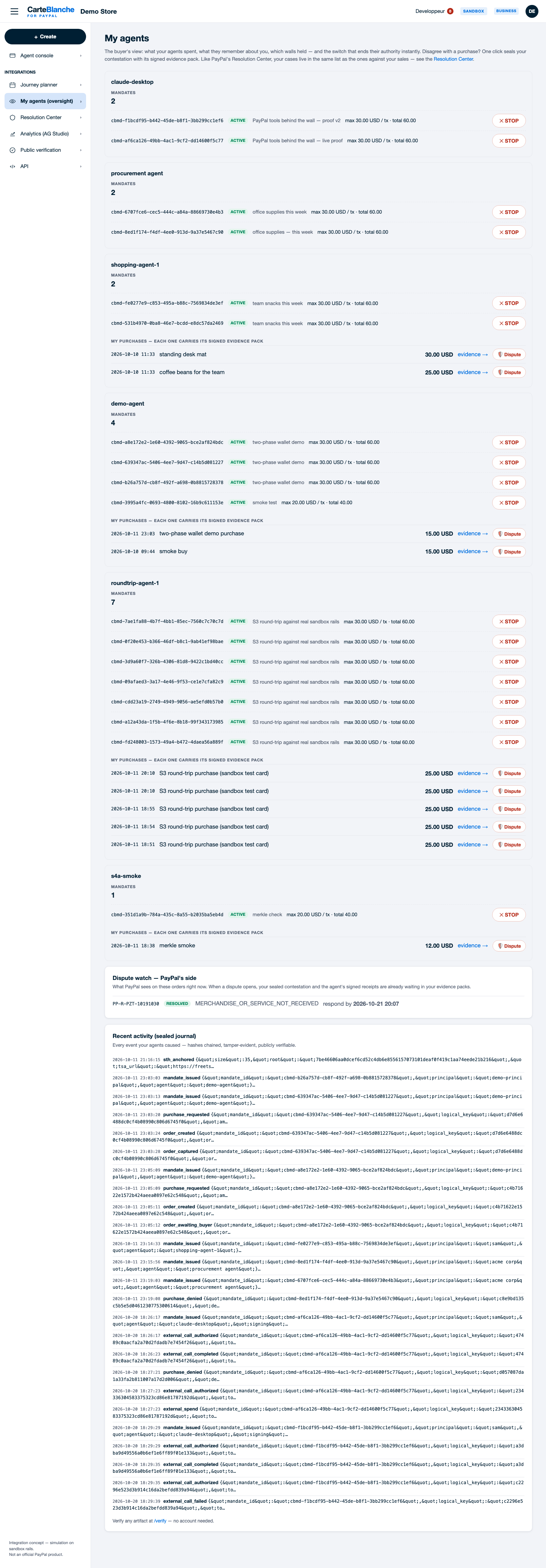
- Oversight: every agent purchase with its evidence pack, agent passports (Ed25519, did:cb:ed25519:..., proof-of-possession), the STOP switch, and sealed contestations: one click seals the buyer's dispute intent before it is filed on PayPal.
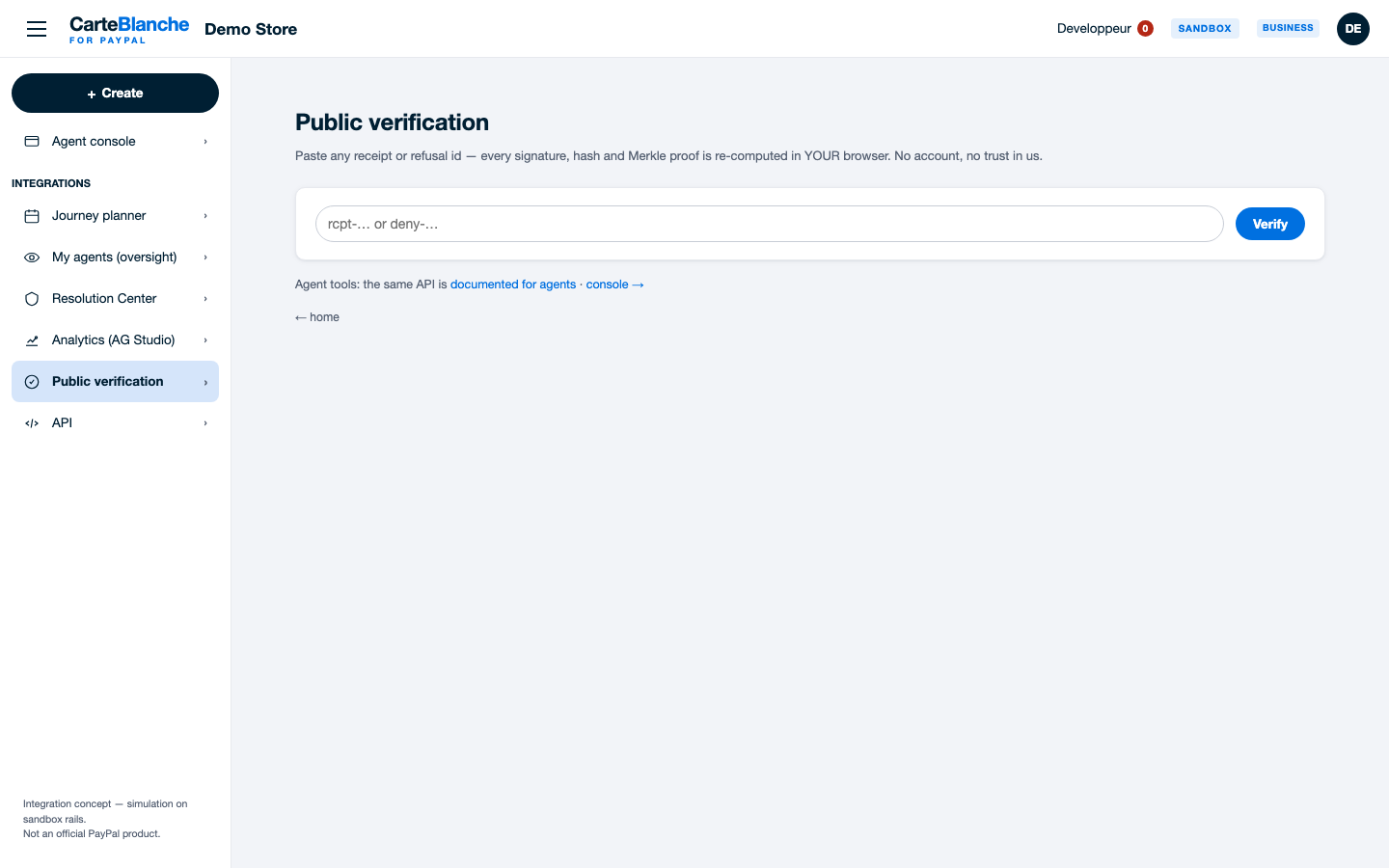
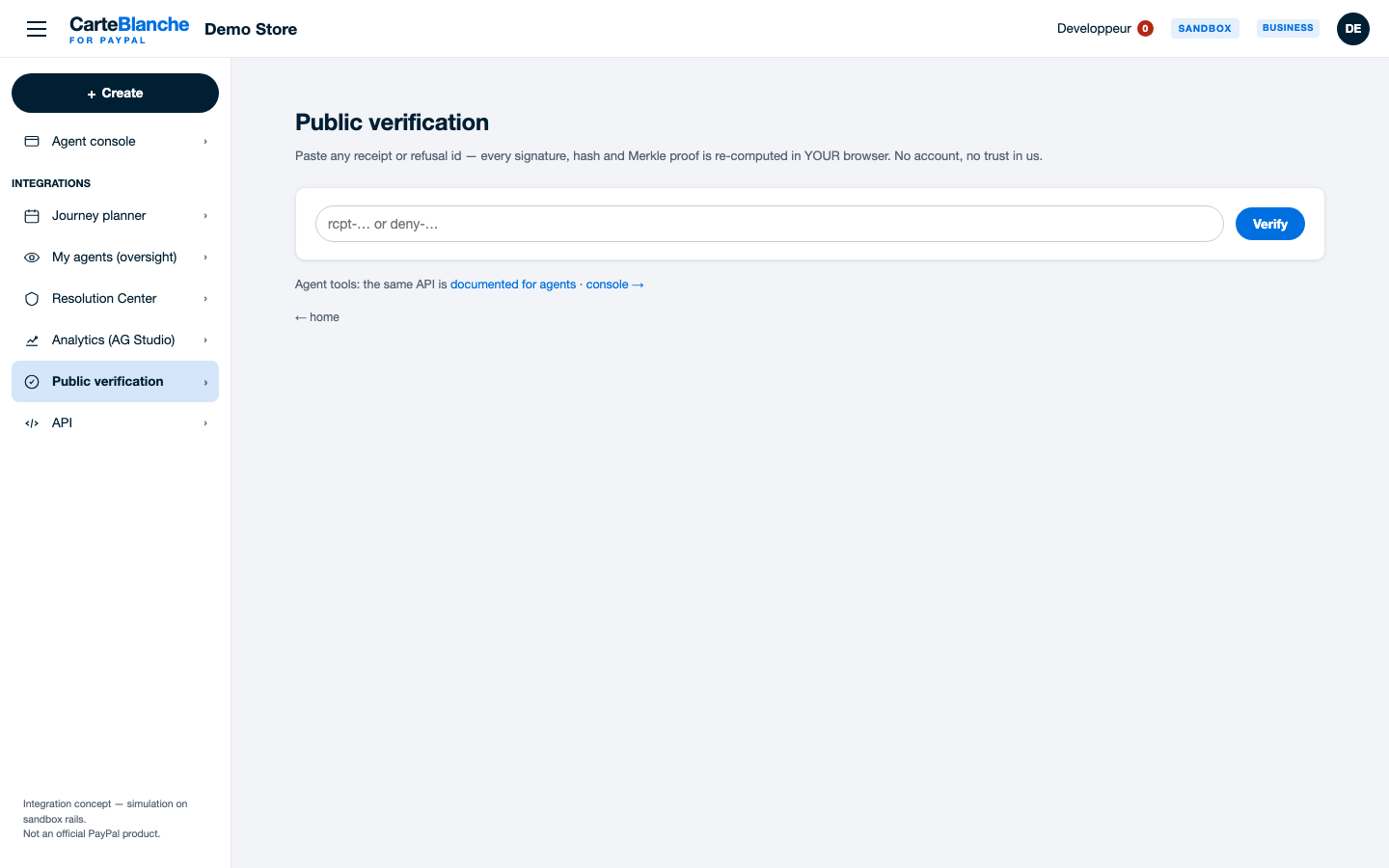
- Public verification: anyone holding a receipt or refusal id verifies every signature and the chain position at /verify/, no account. Each receipt carries a Merkle inclusion proof against a signed tree head; checkpoints are anchored by RFC 3161 timestamps.
For the seller (the Resolution Center)
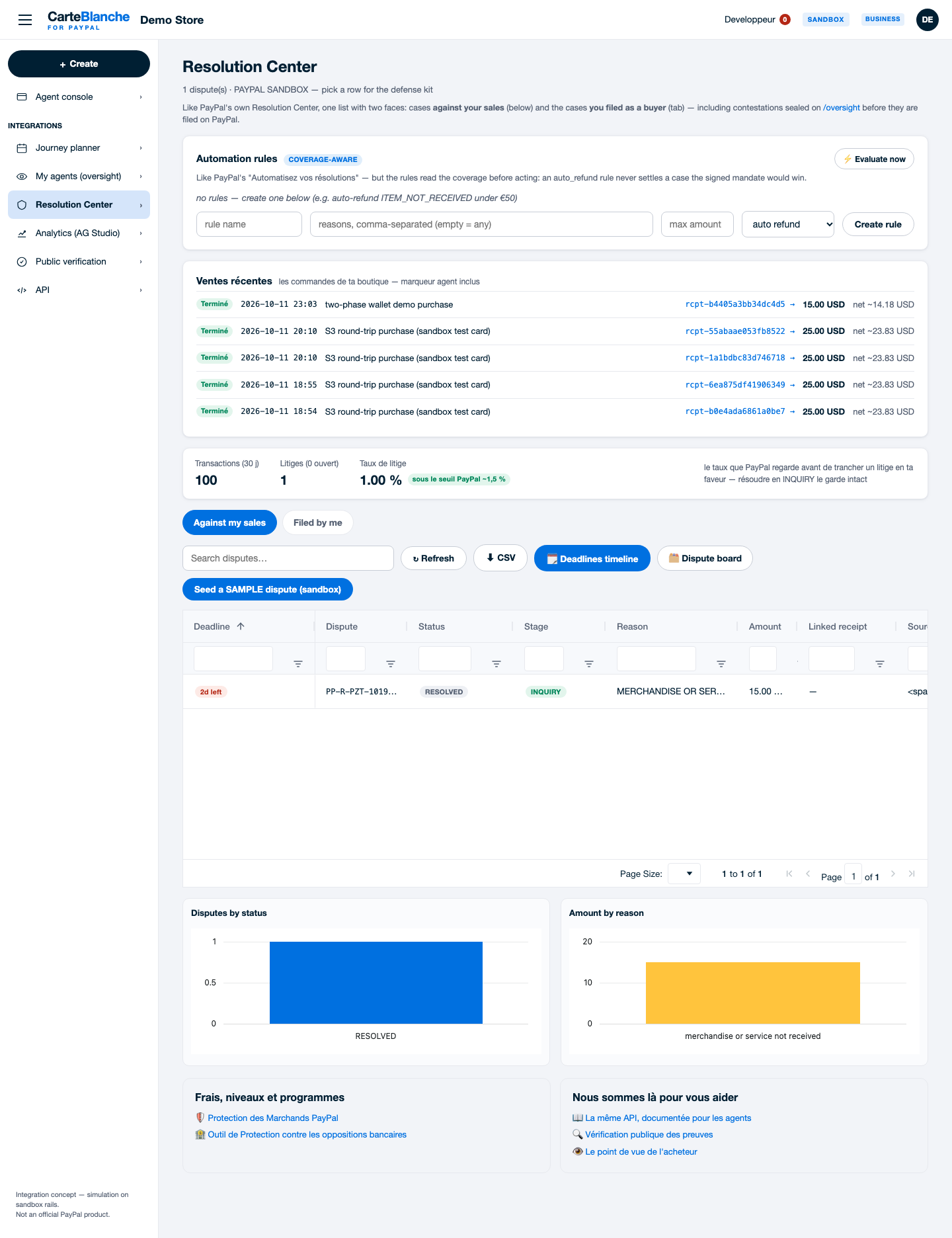
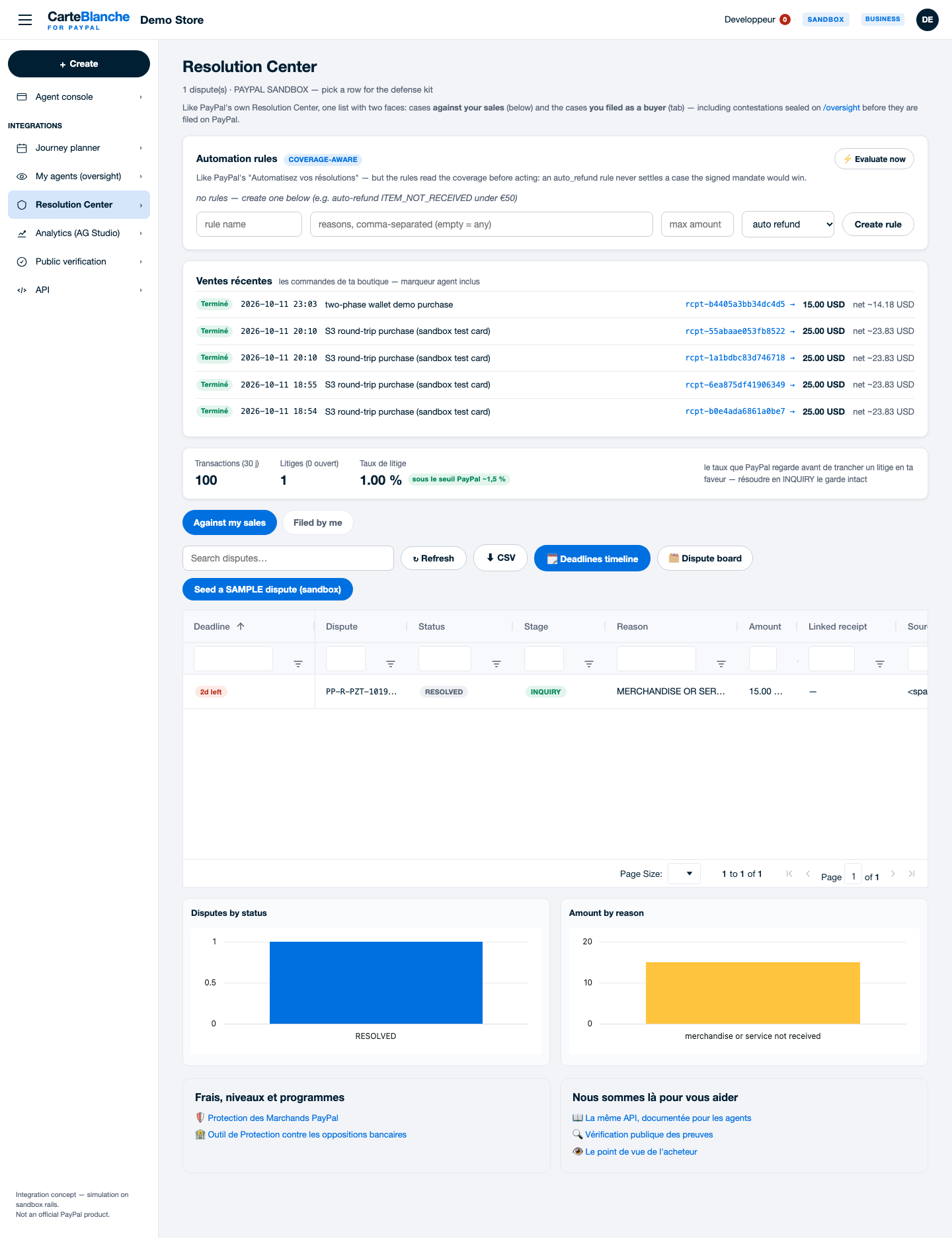
- One list, two faces: cases against my sales and cases filed by me, like PayPal's own Resolution Center, with the real merchant balance from Transaction Search.
- Coverage matrix: each case is scored against the evidence slots PayPal really accepts for that reason (PROOF_OF_FULFILLMENT, PROOF_OF_REFUND, OTHER), producing a recommendation: FIGHT (signed mandate + sealed words = the case is falsified) or REFUND FIRST (no tracking on ITEM_NOT_RECEIVED, settle inside the inquiry window, no $15-30 fee).
- Fast lane: refund now (real /v2/payments/captures/{id}/refund) or fight with the pack; a fulfillment slot with real shipment trackers (/v1/shipping/trackers); the evidence pack submitted to PayPal's Disputes API in one click.
- Automation rules, coverage-aware: "auto-refund ITEM_NOT_RECEIVED under $50" like PayPal's own automation, except a rule never settles a case the signed mandate would win.
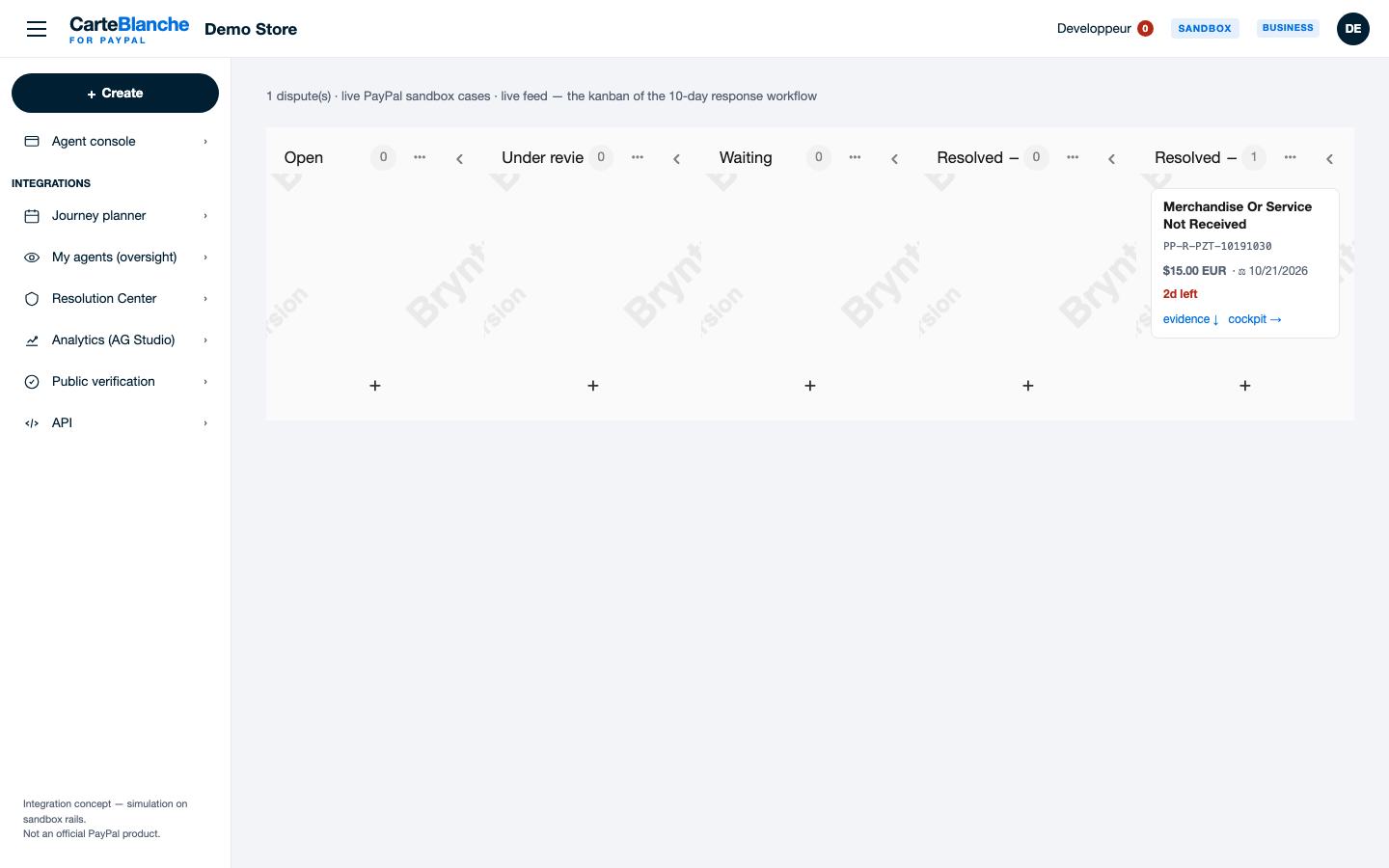
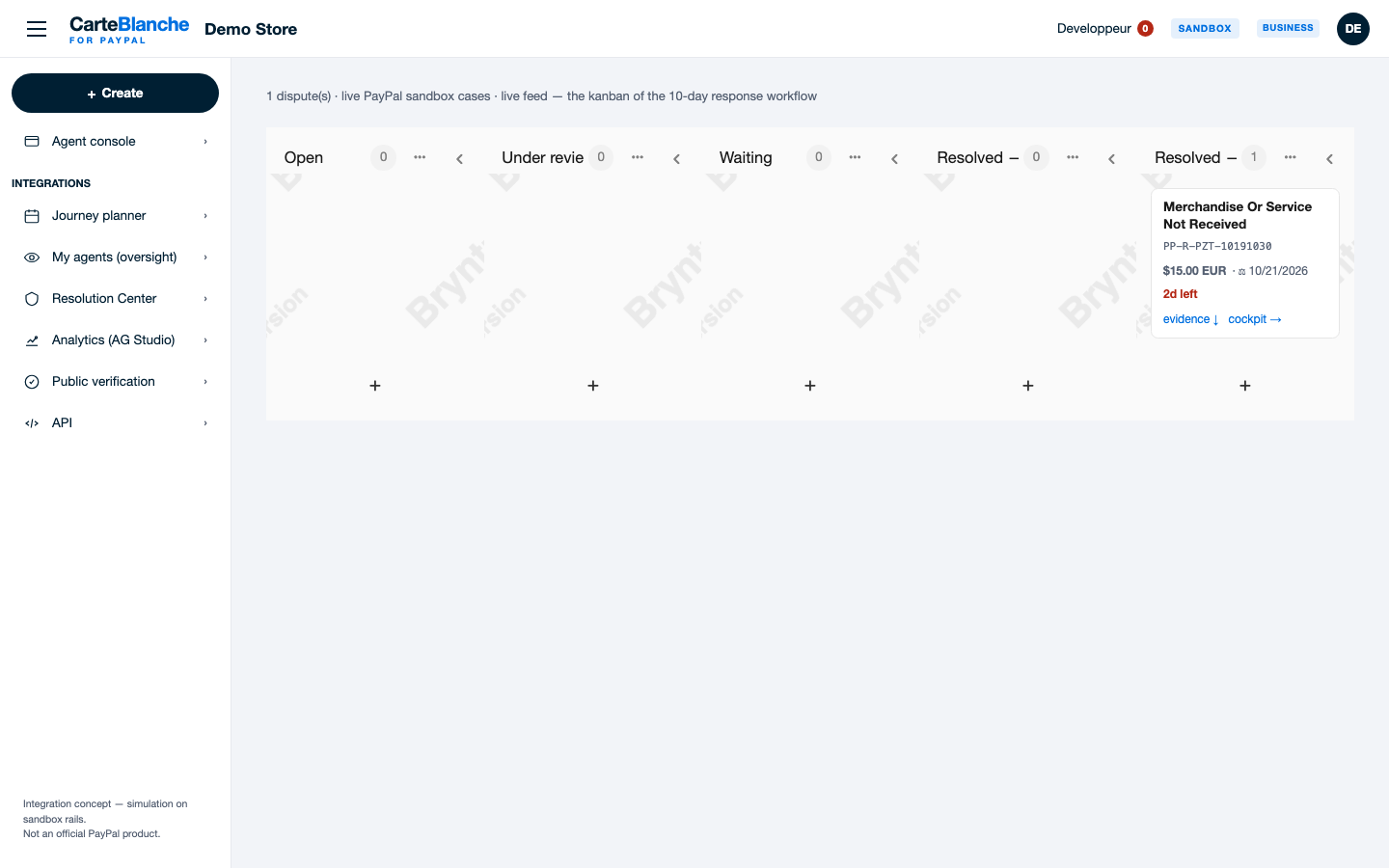
- Seller health: dispute rate vs PayPal's ~1.5% threshold, a deadline banner for cases due within 3 days, net-after-fees on every sale, a one-click amicable message for INQUIRY-stage cases, and a Bryntum deadlines timeline / dispute kanban.
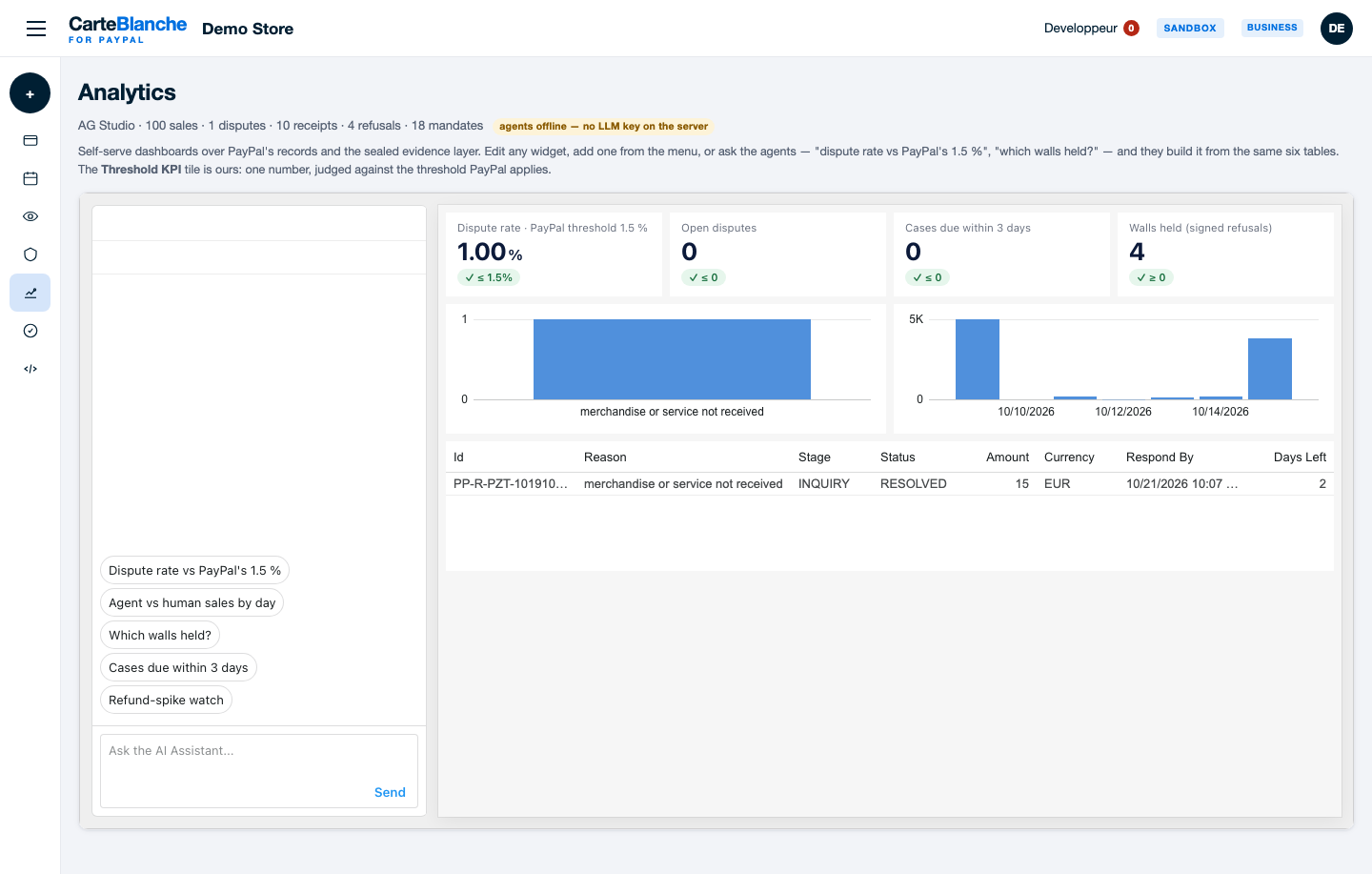
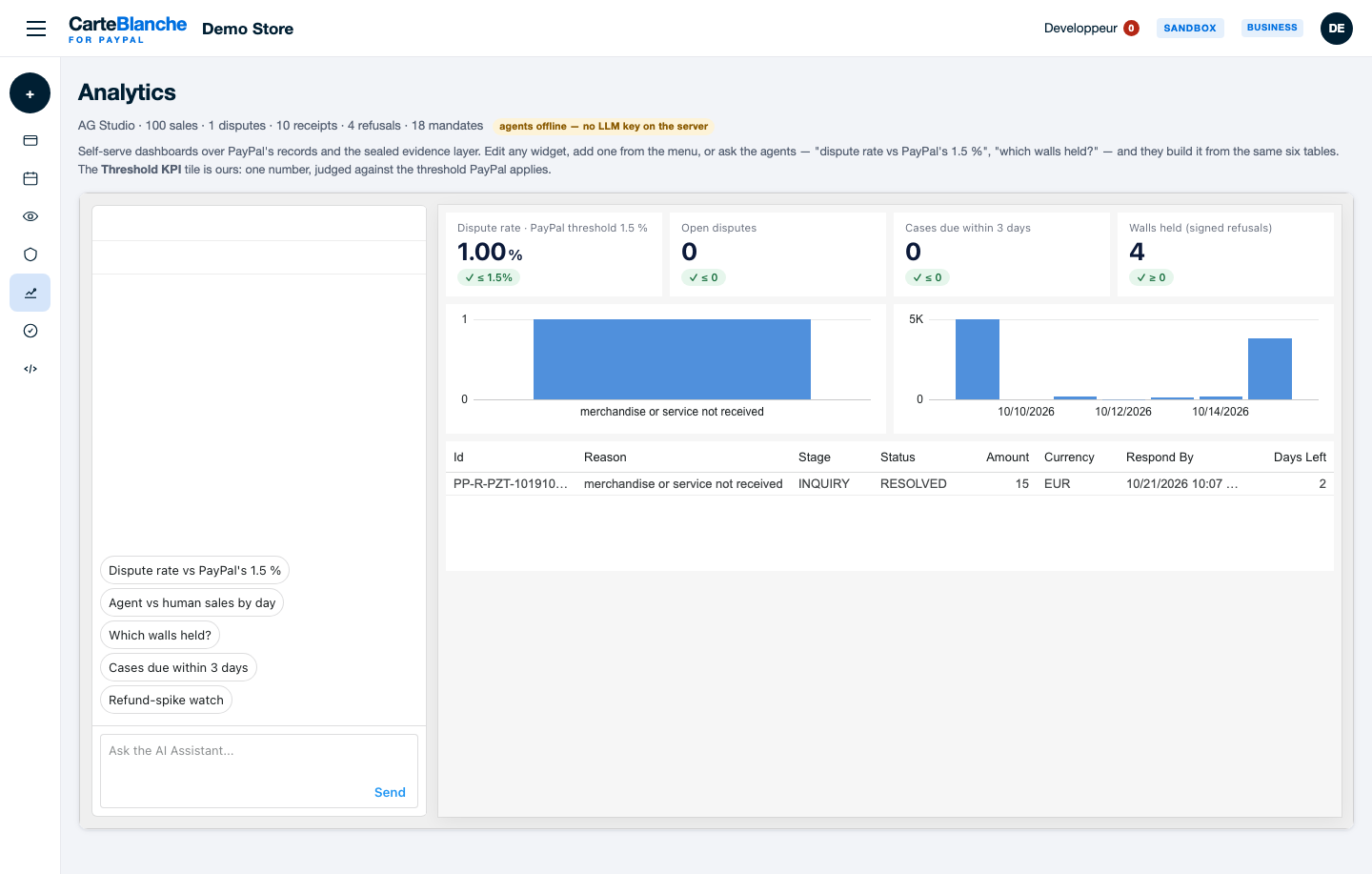
- Analytics (AG Studio): self-serve dashboards over sales, disputes, agent receipts, refusals, mandates and a health summary; edit any widget or ask the Studio agents to build one. Our Threshold KPI tile judges one number against the threshold PayPal applies.
For agents and integrators
- PayPal's own agent tools, behind the wall: the instance runs PayPal's official MCP server (@paypal/mcp) as a child and re-exposes all 28 tools unchanged (paypal_create_order, paypal_pay_order, paypal_create_refund, invoices, subscriptions, tracking, disputes...) with one rule: a live signed mandate for every call, the money walls for the three that spend (pay_order reads the order back before capturing), signed denials for refusals, and the sealed journal for everything forwarded. Live-proven on sandbox: an order created through the wall, a 45 USD order refused at a 30 USD cap before PayPal heard about it.
- An MCP server (14 tools of ours + the 28 above = 42) exposing the same API as agent tools. The purchase tool documents intent_text as MUST-pass; llms.txt for agents that read before they act; an OpenAPI 3.0 contract validated by APIMatic with a generated TypeScript SDK and a prototype that generates an MCP server straight from the spec.
- Every PayPal order is stamped cb|agent=...|mandate=... in custom_id, so agent purchases are detectable on PayPal's own Transaction Search without PayPal changing anything, proven live.
- Track records: signed agent reputation computed from the sealed chain.
How we built it
- Stack: TypeScript/Node, Express API, React + Vite SPA (PayPal's own front-end stack) styled as a PayPal back-office; a strict no-float rule in the authorization path (bigint minor units only). 116 tests across 23 files; every demo stage sealed in a tamper-evident journal.
- PayPal rails, seven API families, all live on sandbox: Orders v2 (create/capture, deterministic PayPal-Request-Id), Payments v2 (refunds for the fast lane and price protection), Disputes v1 (list/get/provide evidence), Shipment Tracking v1, Transaction Search (real balance via ending_balance, agent-marker detection via custom_field), Webhooks with signature verification (CUSTOMER.DISPUTE.*, PAYMENT.CAPTURE.COMPLETED), and Identity / Connect with PayPal (OpenID Connect): the only way to log in, no demo form, one PayPal account, both faces. Wallet flow with @paypal/react-paypal-js. PayPal's AI tools too: the official MCP server (@paypal/mcp, on their agent-toolkit) runs inside the instance and its 28 tools are served through the enforcer. We did not rebuild PayPal's tools, we put the walls around them.
- Cryptography: Ed25519 (server-custodial AND non-custodial: the browser can hold the principal's keys via WebCrypto, the server verifies only), canonical JSON under every signature, padded Merkle trees for inclusion proofs, RFC 3161 timestamp tokens anchored into the chain, agent passports with proof-of-possession.
- AI: the autopilot runs an LLM policy over the same HTTP tools a human uses (any OpenAI-compatible endpoint via OPENAI_BASE_URL, live with Groq gpt-oss-120b), with a deterministic scripted fallback so the walls can be demonstrated without a key. The model never touches money directly: it calls the purchase tool, the enforcer decides.
- Sponsors, each at a verified depth:
- AG Grid: AG Studio (/analytics), the seller's self-serve dashboard over six tables, two pre-built pages, a custom Threshold KPI widget (one number judged against the threshold PayPal applies: dispute rate vs 1.5%), and the Studio Agent Framework wired through our own LLM proxy (the key never reaches the browser). Plus ag-grid-react 36 (JSX cell renderers, pinned pills, quick filters, CSV, Theming API) for the Resolution Center and journey grids, and AG Charts.
- Bryntum: Calendar (dispute deadlines) and TaskBoard x2 (dispute kanban, journey board), including a documented v7 taskRenderer behaviour and the one-bundle-per-page constraint.
- APIMatic: the OpenAPI contract validated through their API, a committed TypeScript SDK, and an OpenAPI-to-MCP generator prototype plus a Context Plugin scaffold.
- Channel3: live product search + offers feeding the agent, price tracking wired to recurring mandates and price protection, extracted as the open channel3-lite package.
- Render: the live deployment, operated through their deploys/env-vars API, Blueprint with PR previews.
Challenges we ran into
- The free tier kills OAuth: the buyer sits on PayPal's consent page, the instance spins down, the callback hits a dead process. So sessions and in-flight OIDC states are persisted and survive restarts.
- Business sandbox accounts fail PayPal's userinfo with empty profiles; the login falls back to the id_token claims.
- PayPal's sandbox card rails ignore payee routing. Solved by carrying payee intent in custom_id, which became a feature: the agent-purchase label visible in Transaction Search.
- Pre-dispute alerts have no API: PRE_DISPUTE_ACTIVITY is not a valid event name; the earliest machine-readable signal is CUSTOMER.DISPUTE.CREATED. The cockpit answers it with an instant stage playbook and the fast lane, and the missing webhook became our ask to PayPal.
- Evidence slots are strict: claiming PROOF_OF_REFUND without a journalled refund poisons a case, so the pack only targets slots it can honestly fill.
- Bryntum v7's taskRenderer mutates a config object (return value ignored), trial bundles cannot share a page, and React StrictMode double-invokes singleton UMD widgets. All documented.
- Free-tier LLM rate limits (Groq, 8k tokens/min): the catalog results handed to the agent are slimmed server-side and the loop retries patiently on 429.
Accomplishments we're proud of
- Both faces run live on real PayPal sandbox rails: a real Connect-with-PayPal login, a real merchant balance, real refunds, real shipment trackers, real dispute evidence submission.
- The LLM autopilot verified end-to-end on the deployed instance: mandate check, live catalog search (Microsoft Wired Keyboard 600, $32.99 at cdw.com), purchase under an $80 cap, and the buyer's verbatim words sealed on the signed receipt.
- The four-actor story on one command (npm run demo:full): buyer signs intent, agent shops the live catalog, mandate derived from the basket, off-list drift refused with signed proof, track record sealed.
- Three distinct walls from ONE standing mandate (npm run demo:recurring): per-transaction, per-window and mandate-wide refusals, resetting each month.
- PayPal's 28 official agent tools behind the wall, @paypal/mcp unchanged, every call under a signed mandate; pay_order reads the order back before capturing; a 422 "payer has not approved" is recognised as not-a-spend and never counted.
- Agent purchases visible on PayPal's side via custom_id: a bridge PayPal can adopt with zero effort; and the AP2 mapping: every "future work" item in PayPal's AP2 docs has a running counterpart here (docs/AP2-ALIGNMENT.md).
What we learned
- The hard part of agent payments is not authorization, it is arbitration: evidence is the product. Signed refusals are as valuable as signed receipts: they prove what the human decided.
- The seller is the forgotten actor. Every protocol protects the buyer's authorization; nobody tells the merchant which slot to fill, when to refund, or that their dispute rate is at stake.
- Idempotency is a safety feature: logical keys + deterministic request ids mean a buggy agent retry loop literally cannot double-spend.
- Prior art is a map, not a threat: Verifiable Intent and the Amex framework specify the authorization chain we implement; the words, the artifacts and the seller's workflow are where we go further.
How this differs from existing concepts
| Authorization chain | Buyer's words sealed | Signed refusals | Seller dispute workflow | Live on a rail | |
|---|---|---|---|---|---|
| Mastercard Verifiable Intent / Agent Pay | yes, 3-layer SD-JWT, 8 constraint types | no | no | no | spec v0.1; Agent Pay GA + x402 (Oct 2026) |
| Visa Trusted Agent Protocol | agent identity (signed requests) | no | no | no | merchant-side signal; trust & control caps (Oct 2026) |
| Amex Intent Intelligence | yes, intent token + limits | no | blocks, no artifact | no | announced + merchant playbook (Oct 2026) |
| Stripe Link agents | virtual card + caps | no | no | no | yes |
| ACP / AP2 / x402, @paypal/mcp | checkout & payment protocols | no | no | no | yes |
| Carte Blanche | yes, signed mandate + agent passports | yes, intent_text + SHA-256 | yes | yes: coverage matrix, fast lane, trackers, rules | yes, PayPal sandbox |
What's next
- Pre-dispute webhook: our ask to PayPal. Expose Resolution-Center pre-chargeback alerts as an event, so the fast lane can act inside the ~20h refund window automatically.
- Seller-to-buyer messaging through an API (today: one-click amicable message to paste).
- Shipping labels: today we push carrier tracking to PayPal; label generation is next.
- Buyer-side filing end-to-end once buyer filing APIs open up (intents and evidence seal today).
- Publish channel3-lite and the OpenAPI-to-MCP generator; merchants accepting cb|agent=...|mandate=... labels at checkout become dispute-free by construction.
Try it in 60 seconds (judges)
Login is the real Connect-with-PayPal flow (sandbox), no demo form. A test account and the full tour are in the judges' testing instructions. Quick version:
- Agent console (/): grant a mandate with the defaults, then type a goal and a budget in Autopilot: the agent buys under the mandate and your words are sealed on the receipt. Try a goal that exceeds the cap and a signed refusal names the wall.
- Journey planner (/planner): search the live catalog, add lines, approve once; inject a sample price drop and watch the lines re-price (and refund if already paid).
- Oversight (/oversight): every purchase with its evidence pack; press Dispute to seal a contestation before it ever reaches PayPal.
- Resolution Center (/dashboard): the seller's seat. Pick a case: coverage matrix, FIGHT / REFUND FIRST recommendation, fast lane, evidence pack with the buyer's sealed words, one-click submit to PayPal; the deadlines timeline and dispute board.
- Analytics (/analytics): the AG Studio dashboard: KPI tiles, charts and grids over the six tables; open the agent panel and pick a prompt starter.
- Verify anything (/verify): paste any receipt or refusal id: every signature and the Merkle inclusion proof check in your own browser, no account.
Built With
- ag-charts
- ag-grid-react
- ag-studio
- apimatic
- bryntum-calendar
- bryntum-taskboard
- channel3-api
- connect-with-paypal-oidc
- ed25519
- express.js
- mcp
- merkle-trees
- paypal-disputes-v1
- paypal-orders-v2
- paypal-payments-v2
- paypal-shipment-tracking
- paypal-transaction-search
- paypal-webhooks
- react
- react-paypal-js
- render
- rfc3161-tsa
- typescript
- vite

