Inspiration
Online shoppers sometimes face payment interruptions, checkout delays, or uncertainty about whether their payment was successful. This confusion can lead to abandoned purchases and repeated payment attempts, potentially resulting in duplicate charges.
We wanted to build a solution that helps shoppers understand what happened during checkout and guides them toward safe next steps. This inspired us to create CartBridge AI, an intelligent checkout recovery assistant that complements existing payment infrastructure.
What it does
CartBridge AI helps shoppers recover from confusing checkout situations through contextual AI-assisted guidance and backend payment verification.
Key features include:
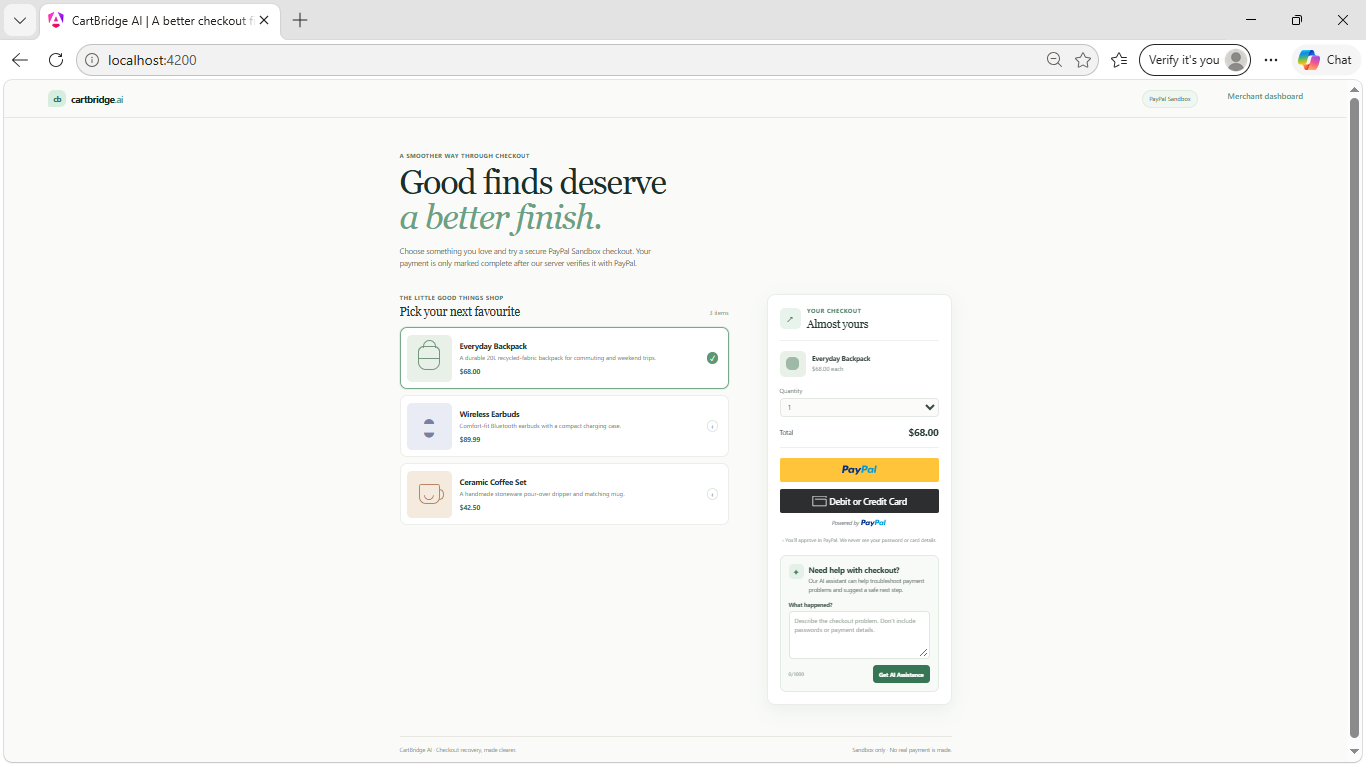
- PayPal Sandbox Integration: Enables shoppers to complete payments through PayPal Sandbox.
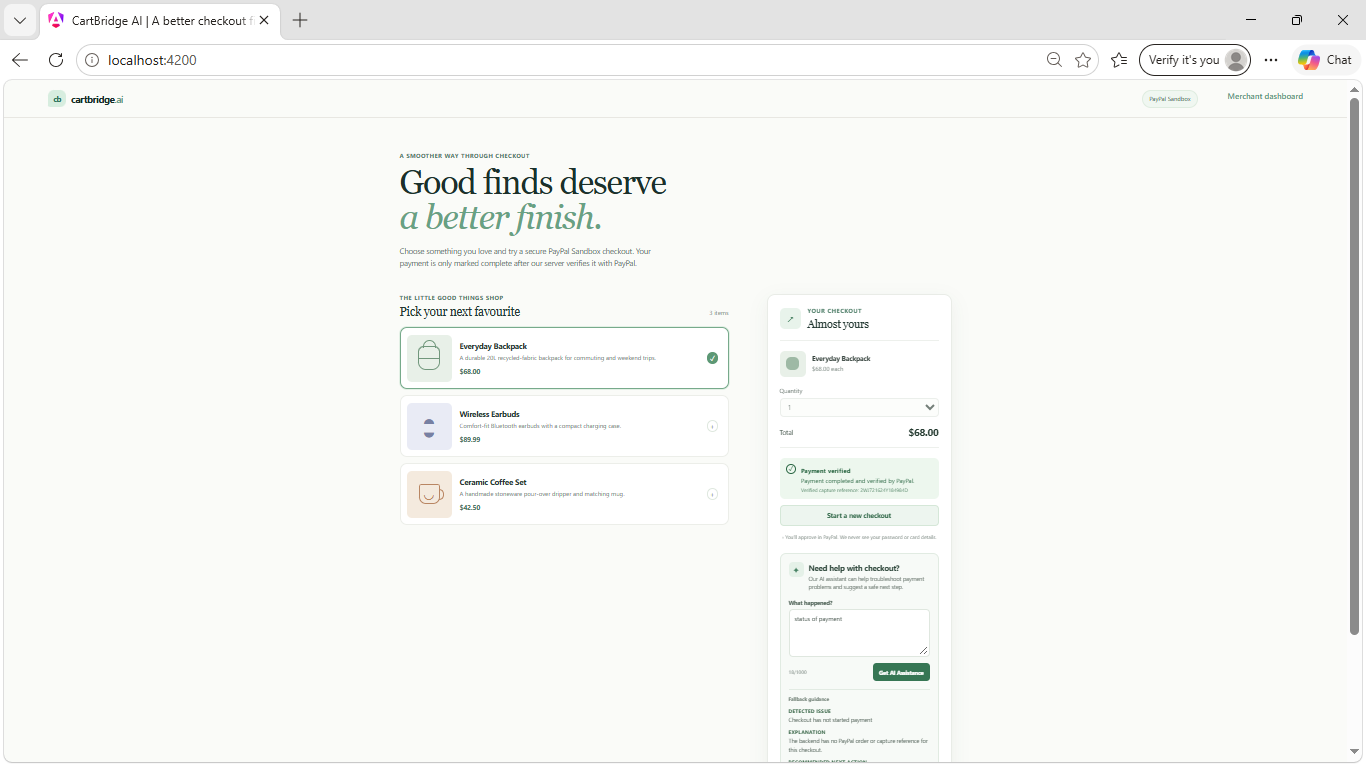
- Payment Verification: The Spring Boot backend verifies PayPal order details, payment status, amount, and currency before confirming a successful payment.
- Duplicate Payment Prevention: Implements idempotency and payment-state checks to reduce duplicate payment attempts.
- AI Recovery Assistant: Analyzes the shopper's reported checkout problem alongside backend checkout context and provides an explanation, recommended next action, and safety guidance.
- Fallback Recovery Guidance: Provides safe server-generated advice when Gemini is unavailable or AI assistance cannot be completed.
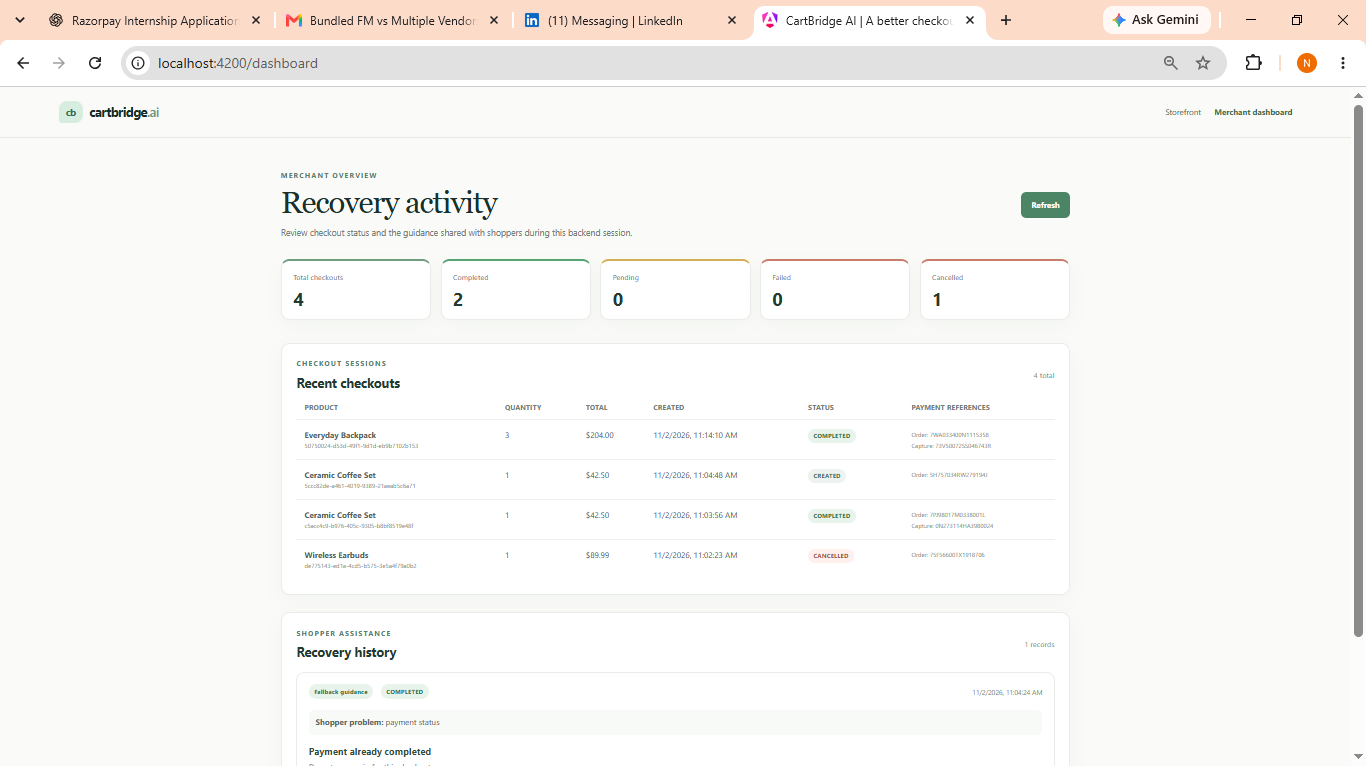
- Merchant Dashboard: Displays checkout activity, payment statuses, and recovery history.
How we built it
We developed CartBridge AI using a full-stack architecture.
Frontend: Angular, TypeScript, and SCSS provide the storefront, PayPal checkout experience, recovery assistant interface, and merchant dashboard.
Backend: Java 17 and Spring Boot handle checkout sessions, product information, payment operations, payment verification, and recovery workflows.
Payment Integration: We integrated the PayPal REST Orders API and PayPal JavaScript SDK using PayPal Sandbox. The backend verifies payment details before marking a transaction as completed.
AI Integration: Google Gemini API is integrated for contextual checkout recovery advice. We also implemented a fallback mechanism to ensure shoppers receive safe guidance when the AI service is unavailable.
Safety: The recovery assistant does not execute payments or independently declare transactions successful. Payment confirmation depends on backend verification through PayPal.
Challenges we faced
- Integrating the PayPal Sandbox checkout and handling the order approval and capture lifecycle.
- Ensuring payment status, amount, currency, and order details are verified by the backend.
- Preventing duplicate payment operations through idempotency and state validation.
- Handling AI service timeouts and availability issues without interrupting the recovery experience.
- Designing recovery recommendations that remain safe and consistent with the actual backend payment state.
- Connecting checkout activity and recovery history to the merchant dashboard.
What we learned
Building CartBridge AI helped us understand practical payment integration, REST API development, backend payment verification, idempotency, AI integration, error handling, and full-stack application development.
We also learned that AI-powered payment assistance must be grounded in verified transaction information. An AI recommendation should never replace authoritative payment verification.
What's next
Future improvements include persistent database storage, secure merchant-scoped dashboard access, enhanced recovery analytics, and improved AI availability.
Built for PayPal AI Hackathon 2026
CartBridge AI is a prototype designed to complement existing payment infrastructure and make checkout recovery safer, clearer, and more informative.
Built With
- ai
- angular.js
- css
- geminiapi
- generative
- html5
- java
- javascript
- maven
- paypal
- restfulapi
- sandbox
- scss
- sdk
- springboot
- typescript

