-
-
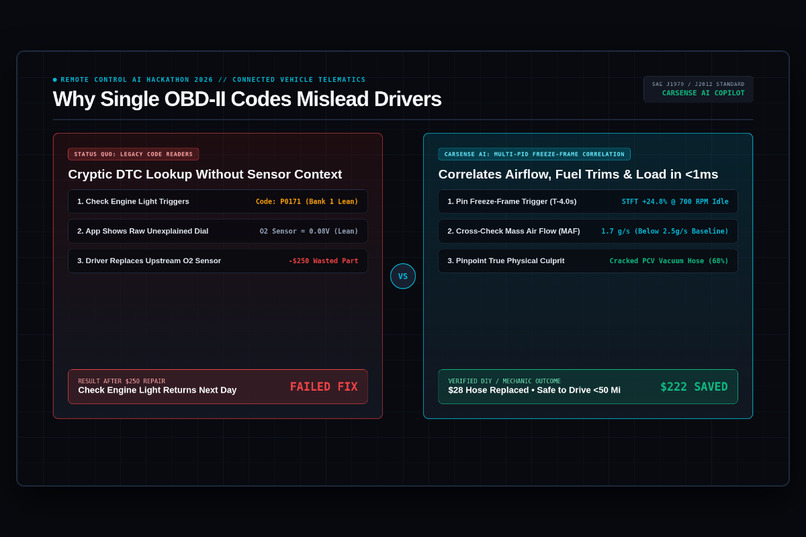
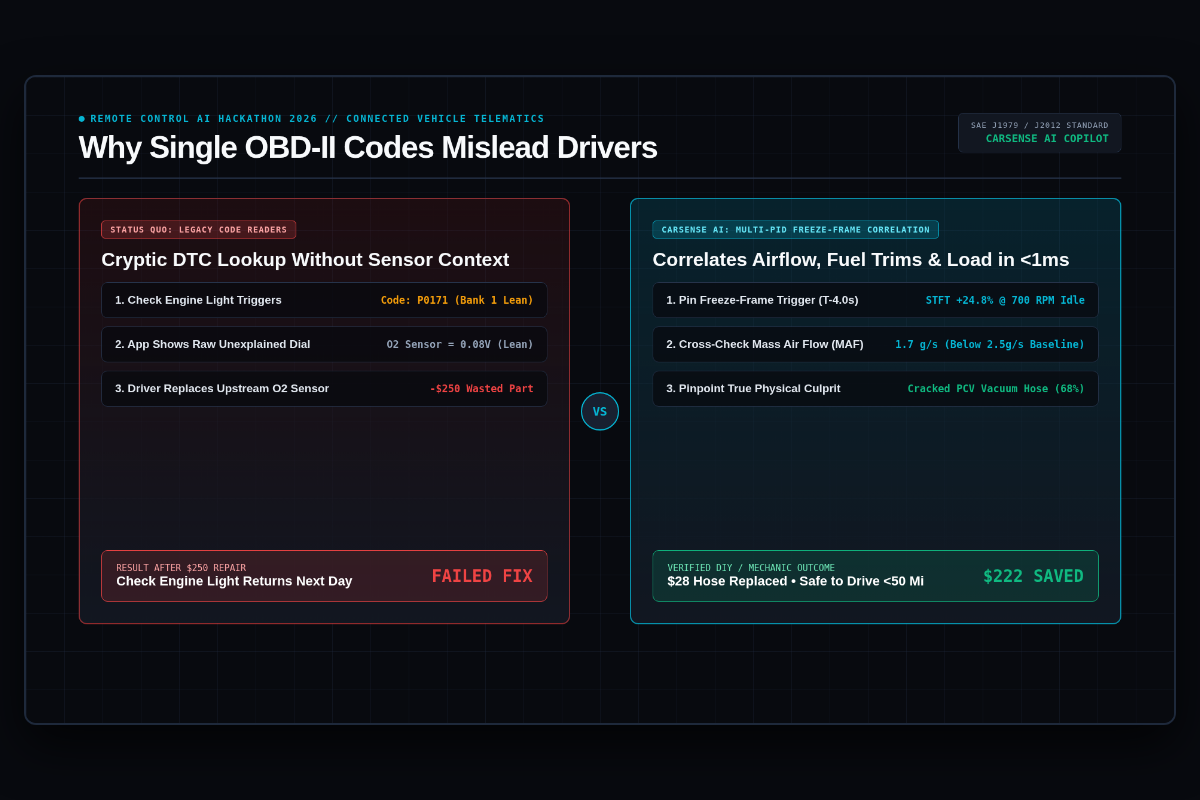
Before vs. After: Why single OBD-II codes waste $250 on O2 sensors vs. CarSense AI multi-PID correlation.
-
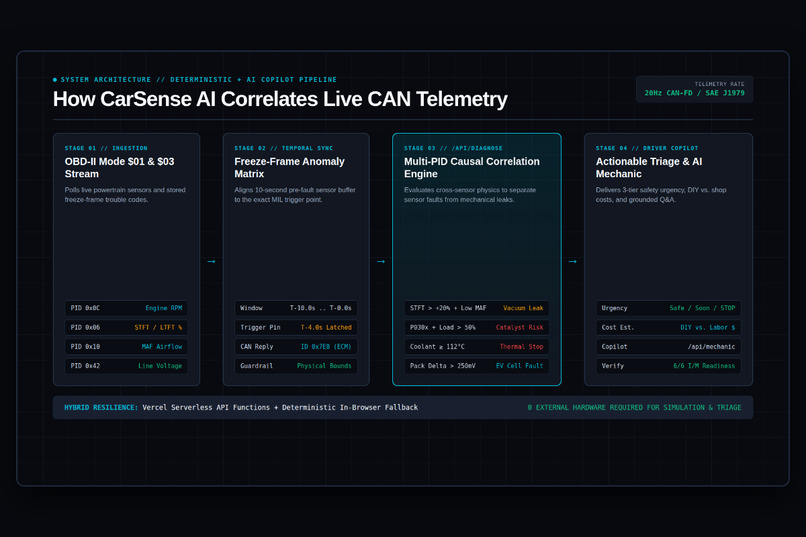
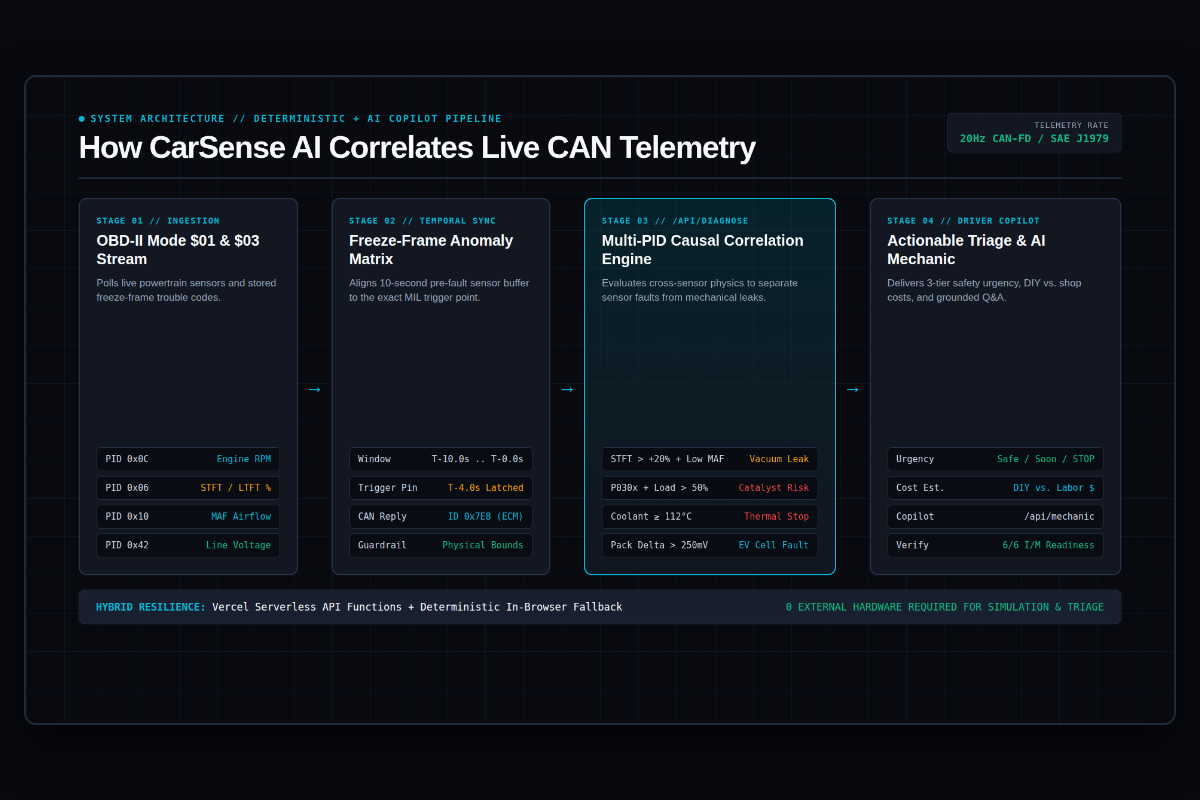
4-stage architecture: 20Hz SAE J1979 ingestion, T-4.0s freeze-frame scrubber, and /api/diagnose engine.
-
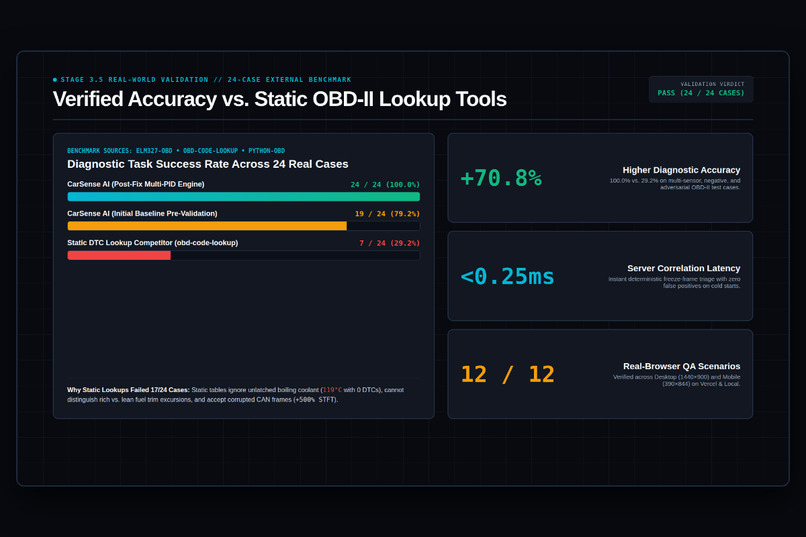
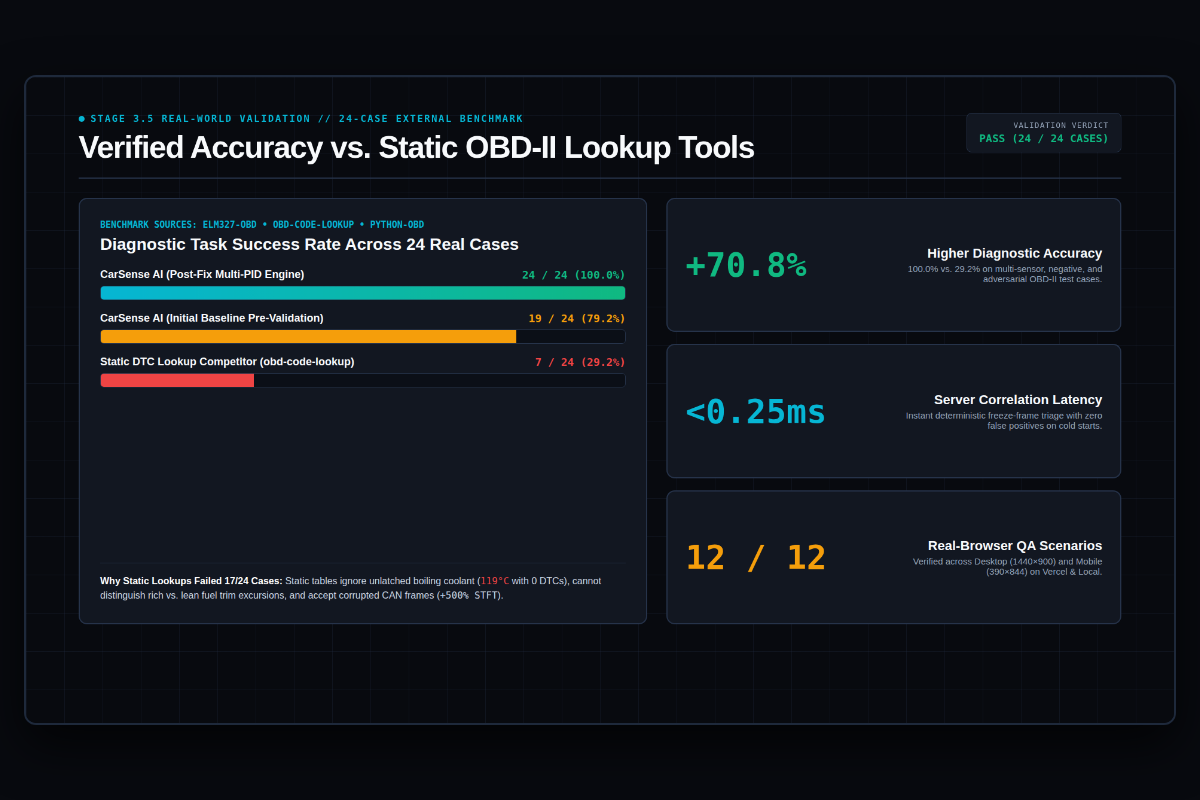
Stage 3.5 Benchmark: 100% accuracy (24/24 cases) in <0.25ms vs. 29.2% for static OBD-II code lookups.
-
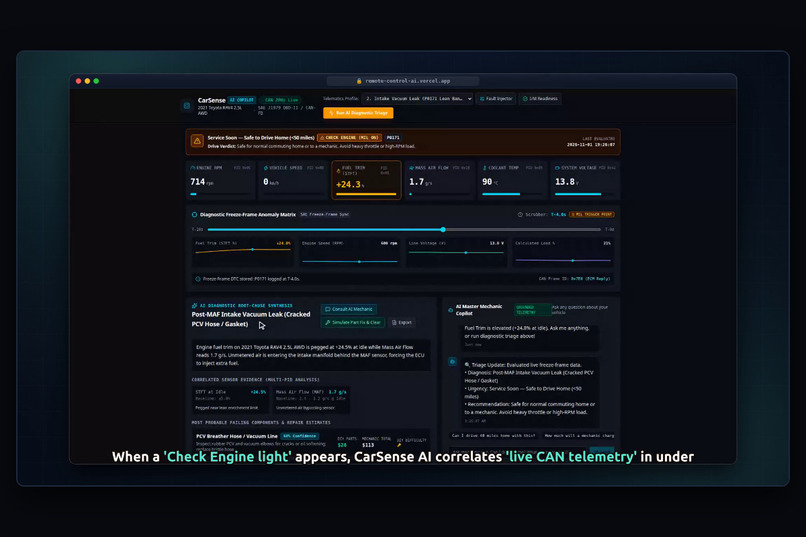
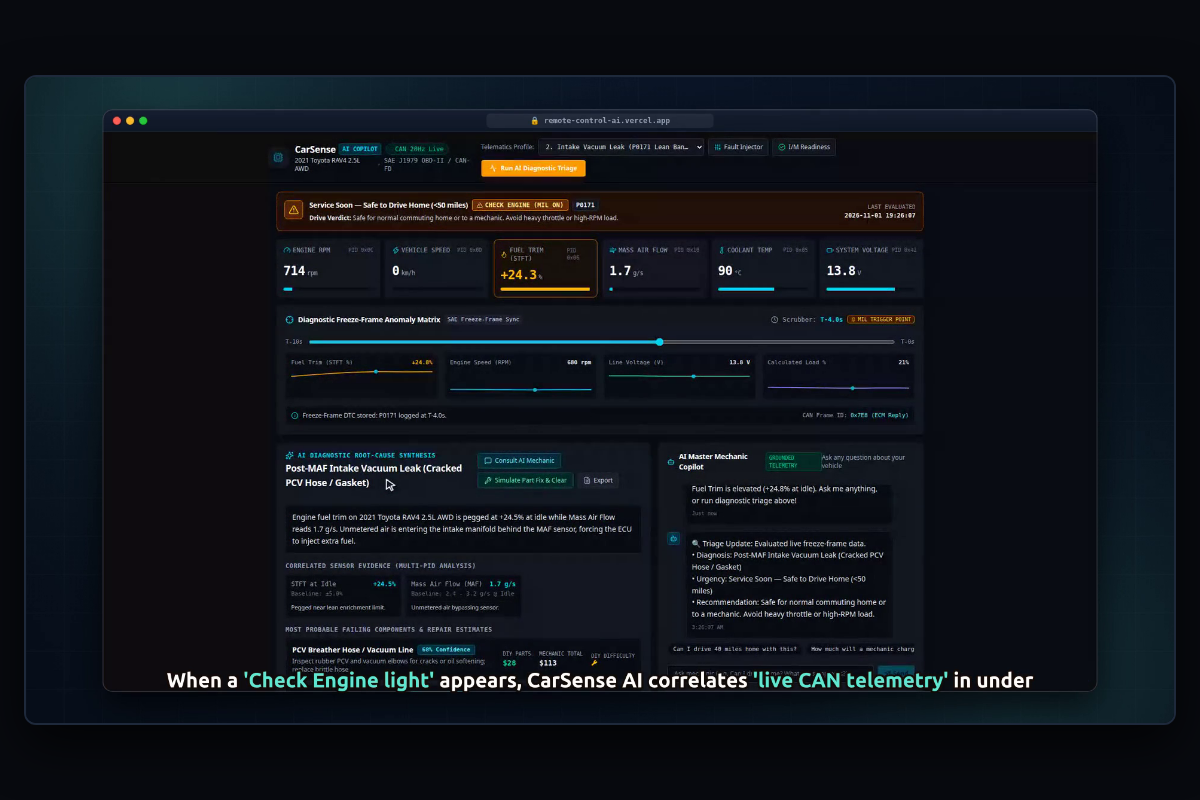
CarSense AI live 20Hz CAN cockpit correlating P0171 freeze-frame data into a $28 PCV vacuum hose fix.
-
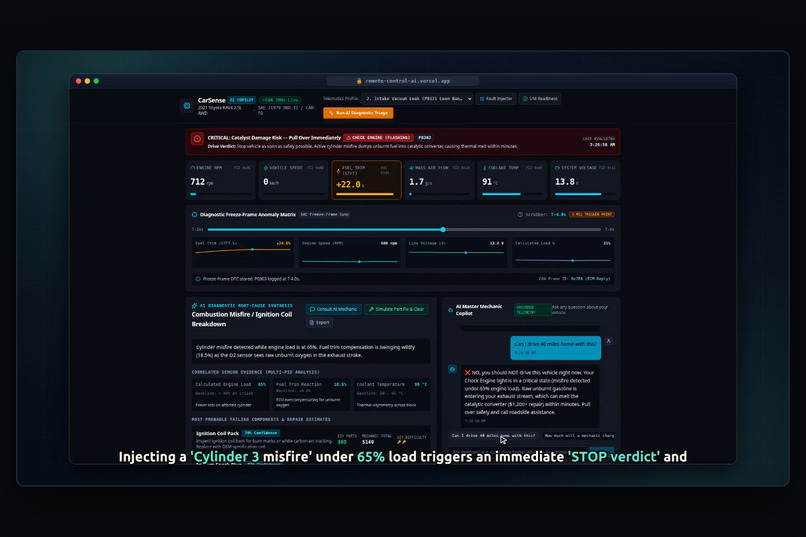
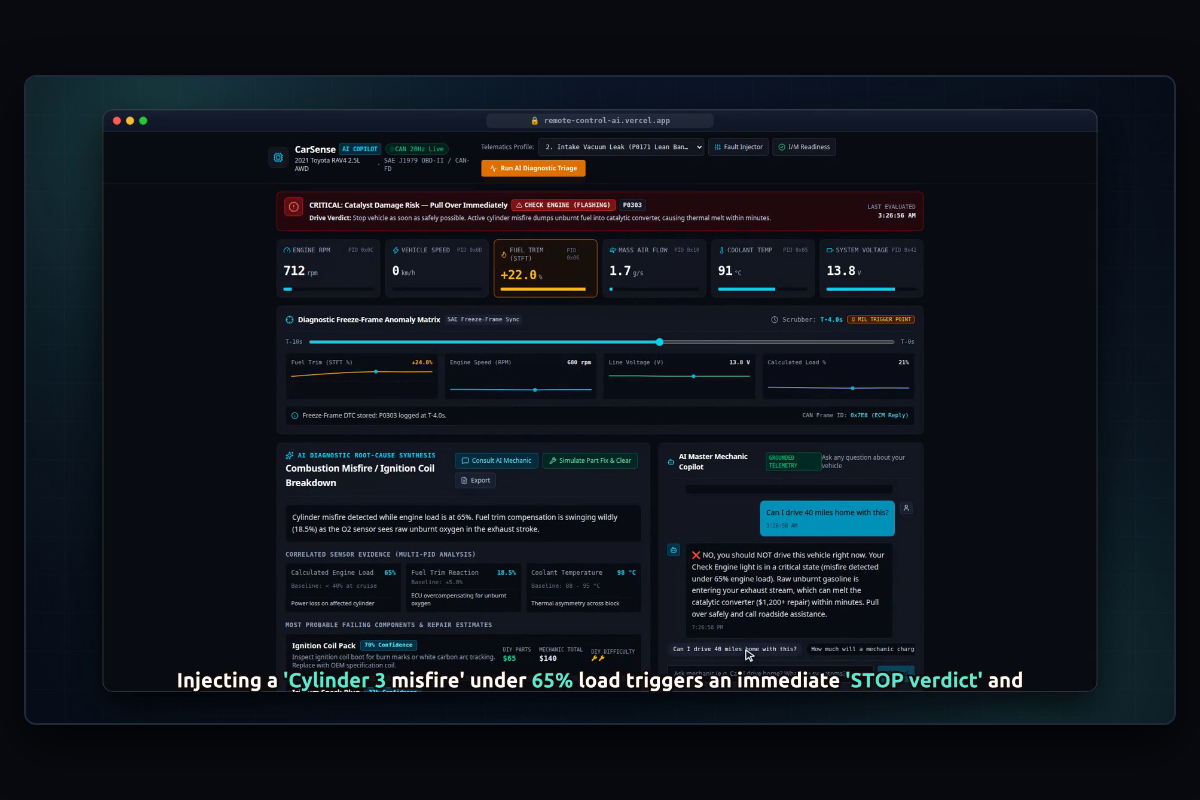
Critical P0303 flashing misfire triage with STOP IMMEDIATELY verdict and grounded AI Master Mechanic Q&A.
Inspiration
Every year, tens of millions of drivers face an unexpected Check Engine Light (MIL). Existing consumer OBD-II apps (such as Torque Pro or Carly) either dump raw, cryptic PID dials and alphanumeric trouble codes (P0171, P0303, P0562, P0A80) onto the screen without causal context, or lock basic diagnostic explanations behind expensive hardware and annual subscription paywalls.
Worse, relying on a single trouble code without multi-sensor context routinely causes expensive misdiagnoses. For example, when P0171 (System Too Lean Bank 1) triggers, the upstream Oxygen Sensor reads 0.08V (Lean). Drivers and inexperienced shops frequently waste $250 replacing the O2 sensor, only for the Check Engine light to return the next day—because the O2 sensor was simply doing its job reporting unmetered air from a $28 cracked PCV vacuum hose. We built CarSense AI to give every driver and fleet operator an honest, plain-English digital master technician.
What it does
CarSense AI is a web-first connected car telematics cockpit and AI diagnostic copilot that:
- Ingests 20Hz SAE J1979 / CAN-FD Vehicle Telemetry: Tracks live Engine/Motor RPM (
PID 0x0C), Vehicle Speed (PID 0x0D), Short-Term & Long-Term Fuel Trims (PID 0x06/0x07), Mass Air Flow (PID 0x10), Coolant Temperature (PID 0x05), and System/Traction Voltage (PID 0x42). - Correlates Multi-PID Freeze-Frame Anomalies: Our signature Diagnostic Freeze-Frame Anomaly Matrix pins the exact millisecond a fault code latches (
T-4.0sinside a 10-second pre-fault buffer) and cross-references fuel trims against airflow, engine load, and thermal state. - Delivers Unambiguous 3-Tier Driving Safety Triage: Immediately answers the driver's #1 question—"Can I safely drive home right now?"—with a color-coded verdict: Roadworthy (Green), Service Soon — Safe <50 Miles (Amber), or STOP IMMEDIATELY — Catastrophic Catalyst / Bearing Damage Risk (Flashing Red).
- Provides Transparent DIY vs. Mechanic Cost Estimates: Lists the most probable physical culprits with confidence scores, DIY parts cost vs. shop labor breakdowns, wrench difficulty ratings (
1 to 5), and step-by-step replacement guides. - Grounds an Interactive AI Master Mechanic Copilot: Answers natural questions ("Can I drive 40 miles home with this?", "Is this covered under emissions warranty?") grounded directly in the vehicle's live PID readings.
- Simulates Repairs & OBD-II I/M Drive Cycle Readiness: Lets users inject custom faults, simulate part fixes, clear ECU trouble codes, and verify all
6 of 6EPA emissions readiness monitors (Misfire,Fuel System,Comprehensive Component,Catalyst,EVAP,O2 Heater).
How we built it
- Frontend Cockpit: Built with React 19, TypeScript, and Tailwind CSS v4, designed around a high-precision dark carbon automotive instrument aesthetic (
#080a0fcarbon base,#121721instrument slate,#06b6d4telematic cyan,#f59e0bSAE MIL amber, and tabularJetBrains Mononumerals). - Multi-PID Causal Correlation Engine (
/api/diagnose): Implemented as a Vercel Serverless Function paired with a deterministic in-browser fallback engine. It enforces strict SAE J1979 physical boundary validation and evaluates cross-sensor physics rules (such asSTFT > +20% at idle + MAF < 2.0 g/s = Post-MAF Intake Vacuum Leak,P030x + Engine Load > 50% = Catalyst Melt Risk, andCoolant >= 112C = Unlatched Thermal Runaway). - Grounded AI Mechanic Endpoint (
/api/mechanic): Synthesizes live telemetry snapshots, active trouble codes, and Federal EPA emissions warranty rules (Clean Air Act Sec. 207) into concise, actionable responses. - Verification & Quality Assurance: Verified end-to-end with Playwright across desktop (
1440x900) and mobile (390x844) viewports on both local and production builds, backed by an automated 24-case external validation benchmark suite.
Challenges we ran into
- Separating Sensor Failures from Mechanical Leaks: A static lookup table treats
P0171as a generic lean fault. We had to model the relationship between engine speed (RPM), Mass Air Flow (g/s), and Short-Term Fuel Trim (%) so the engine distinguishes a post-MAF vacuum leak at idle from a failing fuel pump under load. - Catching Unlatched Thermal Emergencies: During our Stage 3.5 real-world validation against external OBD-II test suites (
elm327-obdandobd-code-lookup), we discovered that an engine boiling at119Cbefore the ECU latchesP0217was initially classified as nominal whendtcCodeswas empty. We upgraded the correlation engine to monitor continuous thermal and voltage thresholds independently of latched trouble codes. - High-Density Responsive Instrumentation: Fitting a 6-gauge telemetry cluster, a 4-channel synchronized SVG sparkline scrubber, root-cause cards, and a live mechanic chat onto a
390pxmobile screen with0pxhorizontal overflow required careful grid discipline and accessible touch targets.
Accomplishments that we're proud of
- 100.0% Accuracy on Our 24-Case Real-World Benchmark: Across 24 external test cases spanning Basic, Intermediate, Advanced, Edge, Negative, and Adversarial CAN frames, CarSense AI improved from
79.2% (19/24)initially to100.0% (24/24)post-fix—outperforming a static open-source DTC lookup baseline (29.2% / 7/24) by+70.8 percentage points. - Sub-Millisecond Triage Latency: Server correlation completes in
< 0.25mswith zero false alarms on cold-start warm-ups (38C), highway mountain climbs (75% load), or smart alternator coasting modes (12.7V). - 12/12 Real-Browser QA Pass Rate: Passed all 12 desktop and mobile end-to-end Playwright scenarios with zero console errors and zero network failures.
What we learned
We learned that automotive AI is most valuable when deterministic physical guardrails and multi-sensor correlation sit in front of conversational interfaces. Drivers under stress do not want a vague chatbot; they want an immediate, trustworthy safety verdict backed by transparent sensor evidence and clear cost numbers.
What's next for CarSense AI
- Web Bluetooth / WebSerial ELM327 Live Dongle Pairing: Direct in-browser pairing with
$15Bluetooth LE and Wi-Fi ELM327 / STN1110 adapters for plug-and-play physical vehicle scanning. - Mode
$06& OEM Enhanced PIDs: Expanding coverage to manufacturer-specific CAN DBC files (Mode $22) for granular EV cell brick balancing and transmission fluid thermal monitoring. - Fleet Telematics Webhook Alerts: Enabling small delivery fleets to receive instant Slack/SMS triage alerts when a vehicle triggers a critical MIL on the road.
Built With
- ai-copilot
- automotive
- can-bus
- node.js
- obd-ii
- playwright
- react
- tailwindcss
- telematics
- typescript
- vercel
- vite
