-
-
Carpe Class: from a sentence to Bee on the wrist to a checked lesson on Fire TV, the phone and any Echo.
-
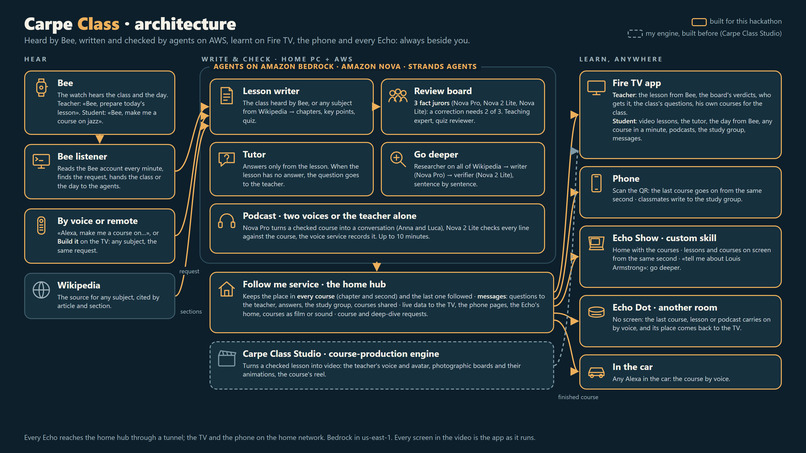
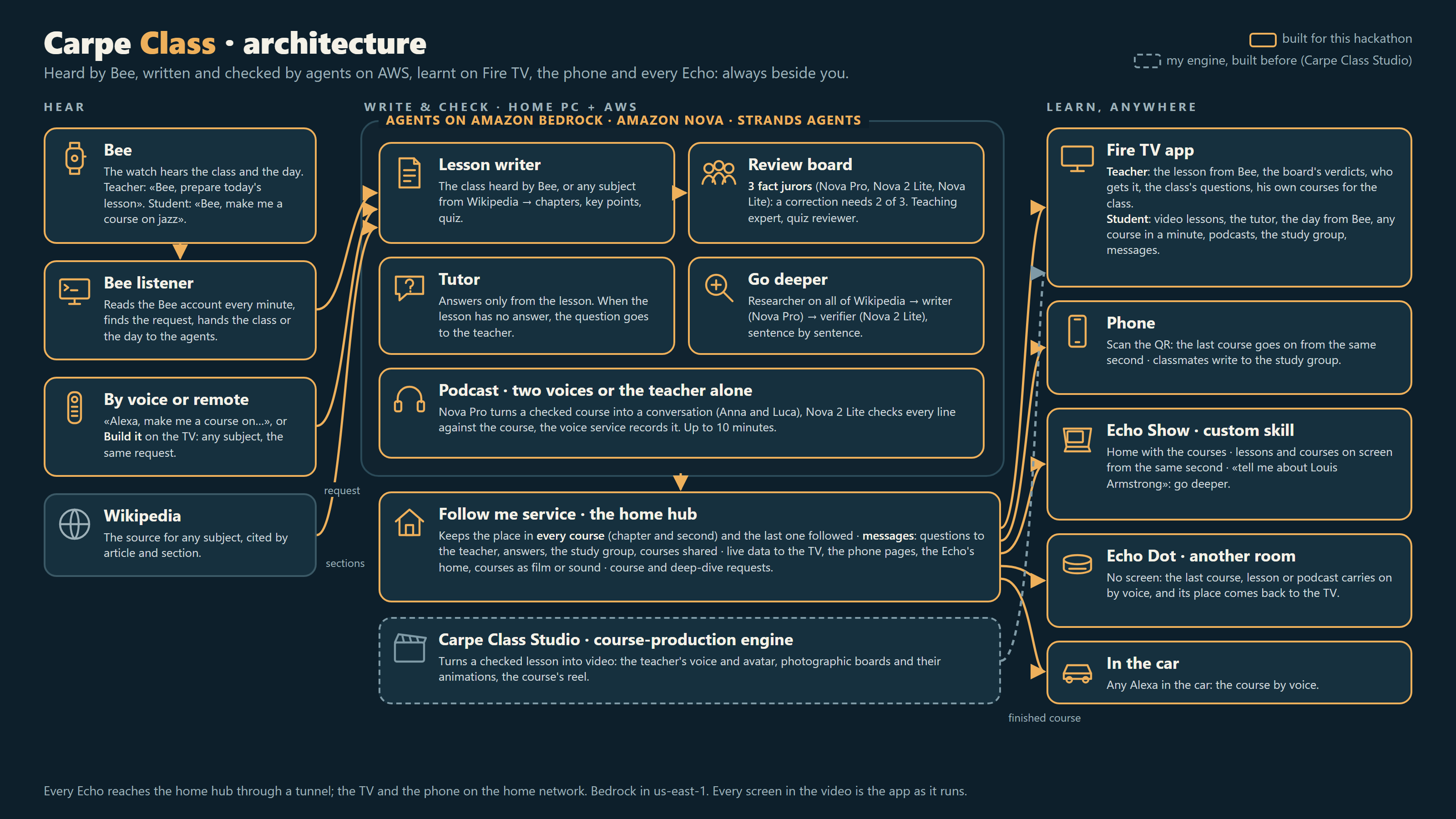
Architecture: Bee, agents on Amazon Bedrock with Nova and Strands, the home hub, Fire TV, phone and Echo devices.
Our mission and the values that moved us
Mission: help people keep up with a world where AI shortens the life of every skill, by putting learning beside them, always.
- Formative, not informative. Information tells you something; learning changes what you can do. Every request becomes a lesson, with chapters, a quiz and a tutor.
- Checked, never invented. Freedom to learn anything, kept honest by reviewers: no sentence reaches a learner before independent models have checked it against its source.
- Always beside you. At home on the TV, in the kitchen, in the car, on the phone in the park: the lesson follows you from the same second.
- For everyone. Subtitles, voice, podcasts, reels and animated boards, so that hearing, sight or dyslexia are not a wall.
- Shared. Knowledge grows when it travels: teachers and students, classmates, a new generation that swaps what it learns as naturally as a photo.
- Open to any institution. A university, a school, a company, a government: anyone who has values and knowledge to pass on. Any internal process becomes a checked course the same day, and change meets less resistance.
Inspiration
Technology shortens the life of every product. AI shortens the life of every skill. What a teacher, a nurse or a civil servant learnt five years ago is already moving under their feet, and knowledge is the lever that helps people win this new challenge. That is what inspired me: the social side of learning. Most of what reaches us today is information: a link, a feed, a summary. It informs; it does not teach. I wanted a gate that is formative, not informative: something that turns what you hear into a lesson, checks it, and keeps it beside you, at home, in the car, in the park, wherever you are. To keep it concrete I built it for a teacher and their students, and for a generation that uses technology natively and swaps what it learns as easily as a photo: an exhibition, a school trip, a curiosity heard at lunch. But nothing in it is tied to a university. The same gate serves a high school, a company training its people on AI or cyber security (imagine AWS teaching its own customers), or a government that has to explain a new law to millions of people. Any internal process, a procedure, a new rule, can become a checked course the same day: people accept a change better when they understand it. Learning is how values and knowledge travel. Bee on the wrist hears the class and the day. Fire TV is the biggest screen in the house, and Alexa is in every room and in the car. Carpe Class joins them: Carpe Class. Seize the lesson.
What it does
The teacher
- Talks to the watch. At the end of the class: «Bee, prepare today's lesson» (it works in Italian too: «Bee, preparami la lezione di oggi»). My listener picks the request up from the Bee CLI and the work starts on its own.
- Agents write the lesson; other agents check it. The Italian transcript becomes chapters, key points, deep dives and a quiz in English, and a board of five agents reviews it claim by claim before anyone studies from it.
- Approves on Fire TV. The teacher's home shows the lesson with their own words and the time, the board's verdicts, the class's open questions. They choose who gets it (the whole class, who missed it, a study group) and send it.
- Builds a course for the class from the sofa. «I want a course on…» on the teacher's TV builds a checked course from Wikipedia in about a minute; it stays in the teacher's Courses until they send it to the class.
- Answers the class. Questions the tutor could not answer arrive with the chapter and the second they came from; the teacher answers by voice, to one student or to everyone.
The student
- Watches a real lesson. A teacher on video, photographic boards that animate with what is said, subtitles, key points, a question at the end of each chapter. Every course opens with a short reel of the teacher telling what is in it.
- Has a tutor that stays inside the lesson. Asked by voice, it answers only from the lesson; when the lesson has no answer it says so, and offers Ask Prof. Rossi: the question goes to the teacher, and the answer comes back to the student's home and the study group.
- Gets the evening from the day. Bee heard the student's day too. An agent proposes up to four courses (go deeper into today's class, follow a curiosity heard at lunch, prepare tomorrow's exhibition), one subject per card. Chores stay out: the plumber on Thursday never reaches the TV.
- Asks for a course on anything. «Bee, make me a course on jazz» to the watch, «Alexa, make me a course on…» to any Echo, or Build it on the TV: in about a minute the course is written from the Wikipedia article and checked by the board against the sections it used. In the video I ask for black holes live: 3,187 words of the article, five chapters, a quiz, about seventy seconds. Every course asked for is kept, in rows, like a film app.
- Listens instead of reading. Any course becomes a podcast with two voices: Anna asks, comments, jokes; Luca brings the facts. Amazon Nova Pro writes the conversation from the checked course, and Nova 2 Lite checks every line against it (80 lines written, 80 kept for the cubism course). Or the teacher alone, if the student prefers. Up to ten minutes.
- Studies together. Courses are shared with the study group, the whole class or chosen classmates; the group talks in a chat that works from the TV and from the phone. A Messages counter on every screen says what arrived: a classmate's course, the teacher's answer, a new question.
- Goes deeper on the Echo Show. «Alexa, tell me about Louis Armstrong» while a course plays: a researcher agent searches all of Wikipedia, Nova Pro writes, Nova 2 Lite checks every sentence. About fifteen seconds, then back to the course at the same second.
- Takes the course anywhere: Follow me. The QR on the TV opens the last course on the phone at the exact second (the lesson, a produced course, or a podcast). «Alexa, open digital teacher» and «continue my lesson» on an Echo Show shows it; on an Echo Dot in another room or Alexa in the car it carries on by voice. The place comes back to the TV. For everyone. Subtitles for who does not hear, voice and podcasts for who does not see, short reels and animated boards for dyslexic learners. Freedom to learn, kept honest by reviewers.
The review board
The agents that write are never the ones that approve.
- Three fact jurors, each a different Amazon Nova model (Nova Pro, Nova 2 Lite, Nova Lite), rule on every written claim: every key point and every sentence of the deep dives.
- A teaching expert judges whether the lesson teaches well, and a quiz reviewer checks every question and answer.
- Code keeps the agents honest. It numbers each claim, sends one chapter per call and counts the rulings, so no claim can be skipped. A correction stands when two jurors out of three agree.
- Strict mode. For generated lessons a claim the source never makes is an error, not only one that contradicts it.
- A second round. A lesson sent back is rewritten with the corrections in hand, and the board meets again. The same idea checks the podcast line by line and the Echo's deep dives sentence by sentence.
How we built it
- Bee: the Bee app on an Apple Watch, read through the Bee CLI. Bee takes no custom commands and sends no events, so
bee_listenasks every 60 seconds for the finished conversations and looks for the requests in the transcript, in English or Italian;bee_dayturns the day into proposals. - Agents: Python services with Strands Agents on Amazon Bedrock and Amazon Nova (us-east-1):
review_board(the five reviewers),lesson_maker(outline, chapters, quiz, with code checking that the chapters cover the class),wikipedia(an agent picks the sections that answer),course_request(any course in a minute),podcast(writer, line checker, the voice service, ffmpeg),deepen(researcher, writer, verifier),tutor_service. - The home hub: one small HTTP service on the PC keeps the place in every course and the last one followed, the class's messages (questions, answers, group chat, shared courses), every course asked for, and serves live data to the TV, the phone pages and the Echo, including each course as film or as sound.
- Fire TV app: a Fire OS app (Java WebView shell) with HTML/JS screens built for the remote, a teacher and a student profile. It finds the hub on the home network by itself.
- Alexa: an Alexa-hosted custom skill. On the Echo Show, APL screens: the home, the lesson, the courses, the deep dive with its three agents. Without a screen (Echo Dot, the car), the AudioPlayer interface plays the last course followed from the same second and reports the place back.
- Built on my own engine. Carpe Class Studio, which I built before the hackathon, turns a checked lesson into video: the teacher's voice and avatar, the photographic boards and their animations, the reel. Everything around it is new: Bee listening, the agents that write and check, Fire TV, the Echo devices, the tutor, the messages, the podcast. The muscle-tissue lesson in the demo was produced earlier with the engine; the jazz and Picasso courses were produced with it from courses this project wrote from Wikipedia.
Challenges we ran into
- Bee cannot be given a command. No registered phrase, no event: I listen by polling, and the answer to the teacher is the lesson on the TV, not an «ok» on the watch.
- Bee's transcripts need care. Two recordings a minute apart came back as one conversation with interleaved sentences: only sorting on
spoken_atrestores the order. - One reviewer is not enough, and "check everything" in one call checked 3 to 5 claims out of 21. One call per chapter, numbered claims, code that counts.
- Things the source never says. Plausible linking sentences passed the first board: that is why strict mode exists.
- A natural podcast. The first scripts were a quiz: she asks, he answers. A tone example and a checker that accepts reactions and paraphrases, while still refusing any new fact, made it a conversation.
- Keeping every course. The first design held only the latest course asked for; the next one replaced it. Now every course is kept, from the TV, Alexa or Bee.
- Voice on Fire TV. Apps cannot use the remote's microphone directly: questions and answers go through the on-screen dictation.
- Video in a WebView on a small stick. A second video with sound froze the picture; I joined the chapters into one video and jump in time. On a Fire TV Stick 4K Max the podcast captions froze after the intro: they now follow the audio on a timer too.
- Account limits. Amazon Polly was blocked by my account's policy and Nova Premier reached end of life during the build: the podcast uses the voice service of my engine, the writing uses Nova Pro.
Accomplishments that we're proud of
- A sentence to the watch becomes a checked lesson. A four-minute class recorded in Italian with Bee, «Fammi su questo una lezione», and on the teacher's TV: four chapters, 33 statements, approved by the board, with the teacher's own words.
- The board catches planted errors in three runs out of three, with all three jurors agreeing, approves the untouched lesson three times out of three, and stops invented sentences in strict mode.
- A course on anything in about a minute, checked, kept, shareable, and a ten-minute podcast of it in about two.
- A real loop between student and teacher: a question the lesson could not answer reaches the teacher with its minute, and the spoken answer comes back to the student's TV.
- One course, every screen: Fire TV, the phone, the Echo Show and an Echo Dot carry on from the same second.
What we learned
A lesson written by a model needs an independent group of models and plain code that counts: the agents judge, the code makes sure every claim is judged. A wearable that hears everything is worth wearing only if it gives something back. Learning sticks when it is close: on the TV in the evening, in the ear in the car, in the hand on the train. And a ten-foot interface is its own craft: big type, one subject per card, the remote and the voice as the only inputs.
What's next for Carpe Class
- Accounts. A Carpe Class account for every teacher and student, at a university, a high school, a company or a public body; the role decides the screens, and the class is delivered through the institution's platform.
- Any institution's content. The same writer and board on a new law, a safety procedure or a course on AI, starting from the official text instead of Wikipedia.
- From the watch to finished video without hands, by connecting the production engine to the agents.
- An acknowledgement on the watch as soon as Bee lets developers register a phrase.
- In the cloud, instead of a PC at home.
- Try the whole platform. Carpe Class Studio, the production engine behind the video lessons, is available free of charge to the judges and to Amazon on request, to try the whole platform end to end.
Built With
- alexa-skills-kit
- amazon-bedrock
- amazon-nova
- android-webview
- apl
- apple-watch
- bee
- echo-dot
- echo-show
- ffmpeg
- fire-os
- fire-tv
- html
- java
- javascript
- python
- strands-agents
- wikipedia-api

Log in or sign up for Devpost to join the conversation.