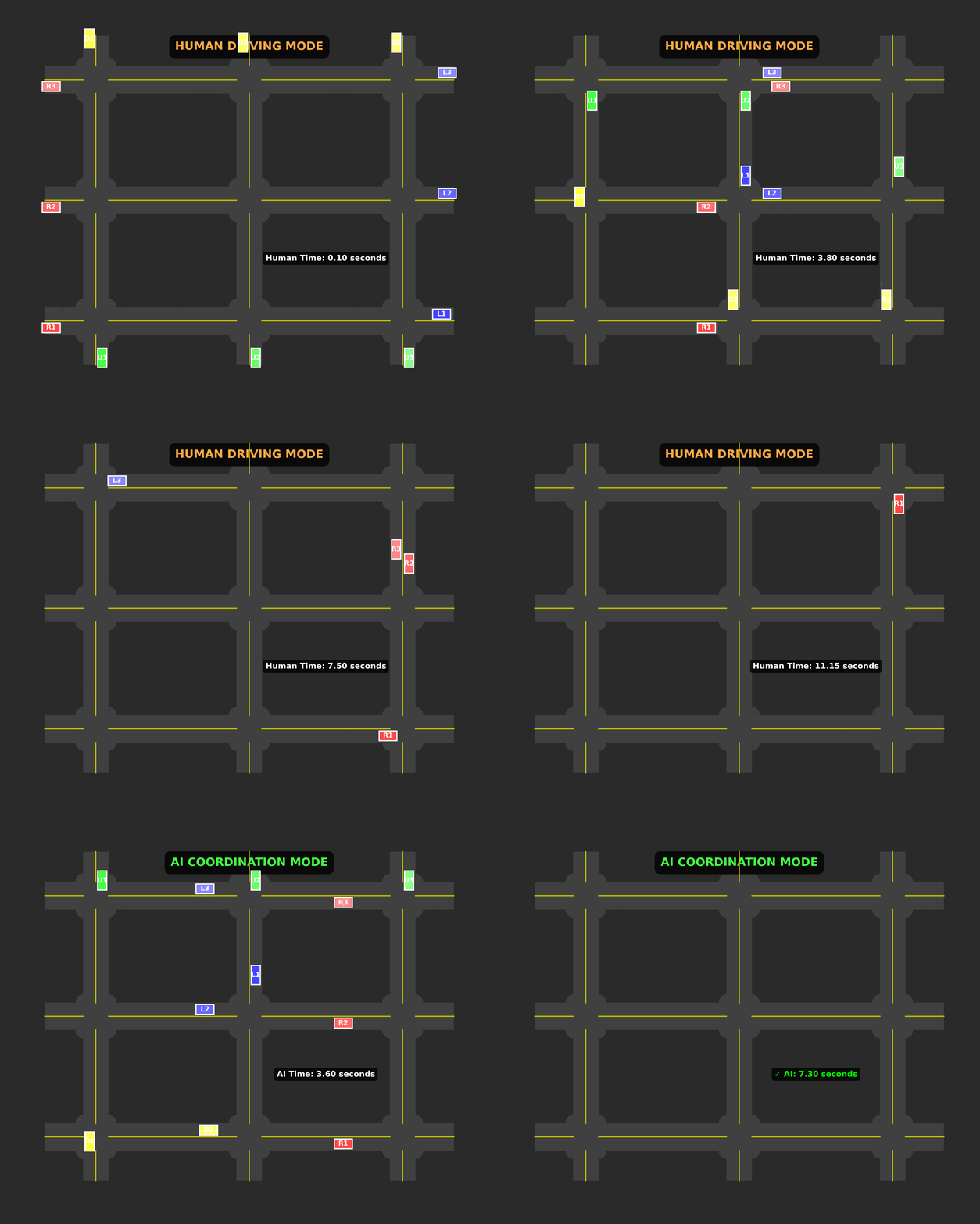
Carmonic was born out of a desire, as drivers, to make the roads we, our, and everyone’s families travel everyday (even just a little bit) safer. Every time you get on the road, you put your life at risk, your valuable time in the hands of every other driver, and an uncountable number of other—out of your hands—factors. For the first time though, as autonomous vehicles and AI reach early maturation stages, both can be coordinated, and their existing technologies coalesce to create a unified driving experience for everyone on the road.
The technological impetus for our idea first arose out of inspiration from watching the massive coordinated drone shows pulled off today; the inter-drone communication and orchestration absolutely mind-boggling to watch as a casual viewer and a technical observer. We also see a lot of promise and potential in Vehicle-to-Vehicle (V2V) communication as is, and took inspiration from Volkswagen’s work with V2V sector leaders and their own attempts at large-scale integration.
Where Carmonic comes in is the unification of all vehicles, changing the driving experience from a reactive one to a proactive one. Our end goal would be to have every vehicle utilize not just V2V communication, but Vehicle-to-Everything (V2X) communication to both communicate with other vehicles on the roads around them, but also everywhere. Accidents become seen before they happen, and impossible-to-see obstacles, obstructions, and drivers suddenly become visible to each vehicle, and by extension, its driver.
Carmonic would start as primarily a vehicle-native navigation addition, running in the underlying systems and accessible to our own proprietary (and any other) navigation app that would show users not only their vehicle and course, but also others when those vehicles became dangerous, or wanted to communicate and coordinate for a coming interference on the road. Even in this early stage, safety on the road starts to transform. For example:
- A zipper merge becomes a planned dance where you know exactly what the person on your left will do.
- Entering the highway peering over your shoulder in fear becomes fearless; you and your car know exactly who is coming, and the time you need to enter the highway.
- A low-visibility corner becomes high-visibility as your vehicle knows who is around the corner, even if you can’t.
- Driving in blustering weather becomes a breeze as you don’t have to rely on your eyes or LiDAR systems to see ahead; your vehicle instead knows exactly who's ahead and where.
As Carmonic matures, and a critical mass of connected vehicles is reached, driving becomes an act of one, interconnected mind, not a billion fallible drivers. Vehicles could coordinate not just to avoid issues in the near future, but the long term. Each car could plan around the routes of the other, avoiding issues before they exist. No busy intersections, no gridlock, no assh*les not letting you merge; instead, the plan already existed 10 minutes ago, and each car and driver can avoid the sticky situations that make driving so dangerous to begin with.
What we’ve built for today is a simulation demonstrating the challenges faced by drivers today, a simulation of the coordination and speed possible with interconnected vehicles, and a game version to begin testing human drivers' performance against AI-coordinated cars. To build our simulations we used Manim, and for our game we used FastAPI, websockets, Next.js, and matplotlib.
For the full realization of Carmonic, we would develop: In-vehicle collision prediction calculators, leveraging current systems used in ADAS systems, and self-driving technology. Small JSON, or other format, information packets transmitted over 5G networks to a (semi) centralized system, and for other vehicles to receive. Modifications to current vehicle cellular connectivity systems to increase ping rate and allow our data to be processed. An in-vehicle native app for users to utilize our increased visibility for themselves as self-driving capabilities continue the path toward full maturation.
Our biggest challenge this hackathon was balancing the scale of our idea with the practicality of what we could build within 23 hours. In our simulation, we ran into issues with collision prediction accuracy, with false positives slowing down traffic, developing proper centralized management of all vehicles, and learning how to use Manim to accurately simulate the gain provided by Carmonic.
Through this process, we attempted many different approaches and learned that for our complex coordination problem, centralization wins. The distributed approach forced cars and drivers to guess at each other’s moves while our centralized control system provided a low-latency, zero-guessing solution to our problem, reducing accidents and improving efficiency for all drivers.
To this end, what we are most proud of is our solidifying conception of Carmonic, and our plan going forward. We are in talks with Ryan Murphy and Marc from Wisconsin Autonomous to run tests and integrate our programmatic ideas and solution with the actual hardware required to turn the ephemeral into the enduring. From there, with successful testing results, we would reach out and begin working with electric auto-manufacturers (our dream being Rivian) to begin integrating and testing, even just in the background and away from drivers, the efficacy of our solution on the road.
Looking ahead, and beyond the Horizon of Badger Build Fest, we are confident in our work and can’t wait to continue developing Carmonic. Over the next 6 months, we hope to develop a full CarPlay-ready app, start developing advanced machine learning enhancements to combine in-car, and in-cloud pattern analysis, anomaly detection, and weather prediction to integrate custom data and predictions with the larger models we plan on leveraging. Our long-term vision involves developing a unified Vehicle-to-Everything standard for the auto industry, centralized systems for mass data processing to provide every driver all the information they need to be in harmony on the road, and to be deployed across multiple major American metropolitan areas.


Log in or sign up for Devpost to join the conversation.