Inspiration
Rapid urbanization, climate change, and industrial growth have increased environmental risks while existing monitoring systems remain largely passive, fragmented, and expensive. We were inspired to build a unified, intelligent environmental platform that moves beyond data collection to autonomous decision-making, enabling proactive safety, sustainability, and resource optimization across multiple domains.
What it does
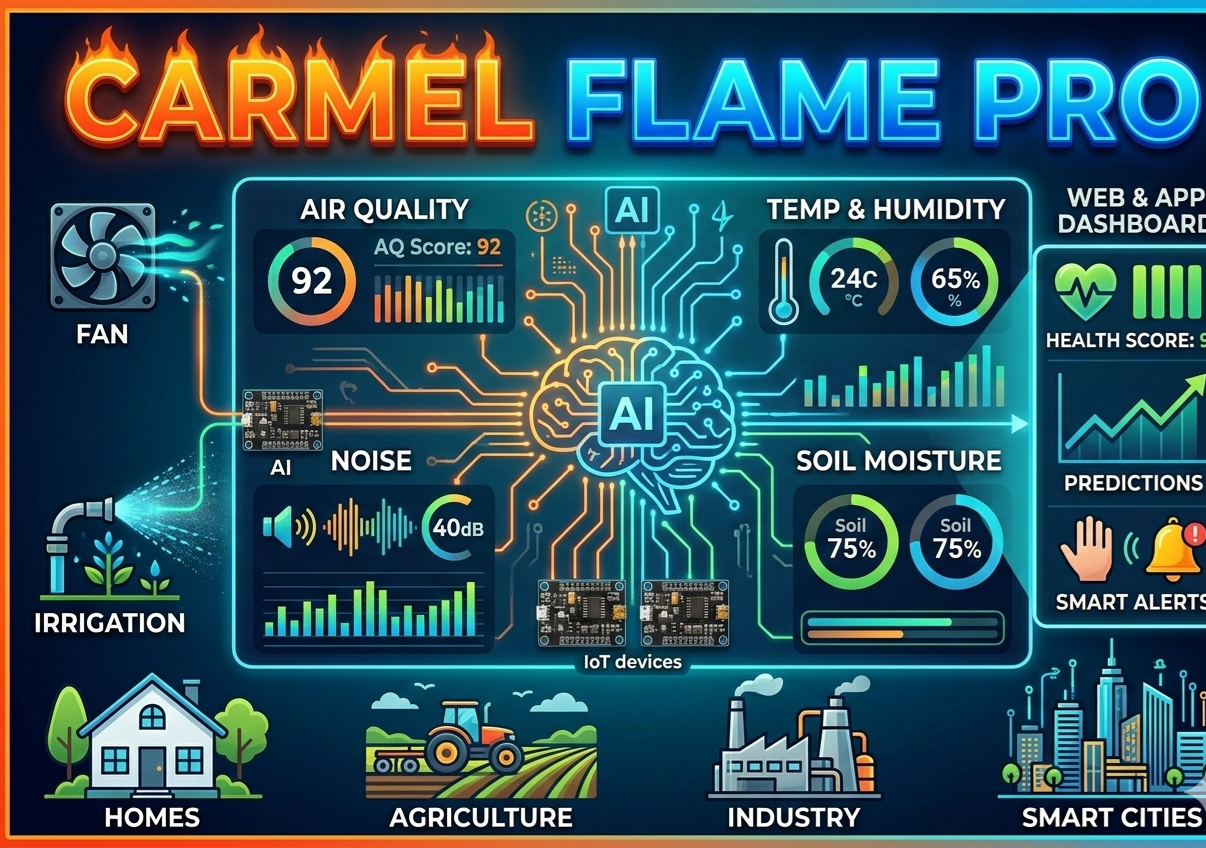
Carmel Flame Pro is an AI-powered IoT environmental intelligence and automation system. It continuously monitors air quality, temperature, humidity, noise levels, and soil moisture using ESP32-based multi-sensor nodes. The system transforms raw sensor data into environmental health scores, predictive insights, and intelligent alerts. Using adaptive rule-based and self-learning logic, it autonomously controls connected devices such as ventilation systems and irrigation units, reducing human intervention and improving environmental efficiency.
How we built it
The system was architected using a distributed IoT model with ESP32 devices handling real-time sensing and edge processing. Firmware was developed in C/C++ to ensure reliable data acquisition and low-latency communication. Sensor data is transmitted via Wi-Fi to a cloud backend powered by Firebase Realtime Database, enabling live synchronization. A fully custom web dashboard was built to visualize analytics, trends, alerts, and system status. AI logic processes historical and live data to drive predictions and automation decisions.
Challenges we ran into
Major challenges included ensuring sensor accuracy and calibration, managing real-time data consistency across hardware and cloud layers, and designing automation logic that avoids false triggers. Hardware limitations, network latency, and time constraints required careful optimization of data flow, AI logic, and system reliability.
Accomplishments that we're proud of
We delivered a fully functional end-to-end AIoT prototype that seamlessly integrates hardware, cloud infrastructure, AI logic, and a production-ready web interface. The system demonstrates real-time monitoring, intelligent predictions, and autonomous device control, proving its feasibility for real-world deployment across multiple sectors.
What we learned
This project deepened our understanding of AI-driven automation, edge-to-cloud architectures, real-time systems, and full-stack development. We learned how to design scalable IoT solutions, balance hardware and software constraints, and convert raw environmental data into actionable intelligence.
What's next for CARMEL FLAME PRO
Future development will focus on advanced AI models for predictive analytics, anomaly detection, and long-term environmental trend forecasting. We plan to expand sensor support, enhance system scalability, and prepare the platform for large-scale deployment in smart cities, industrial monitoring, and precision agriculture, with a strong emphasis on security, energy efficiency, and reliability.
Built With
- ai
- and
- and-soil-moisture-sensors-c-/-c++-?-esp32-firmware-development-arduino-framework-?-hardware-programming-and-sensor-integration-html
- apis
- application
- automation
- basic
- between
- cloud
- codeesp32-?-microcontroller-for-sensor-data-collection-and-wi-fi-connectivity-environmental-sensors-?-air-quality
- communication
- css
- dashboard
- data
- database
- deployment
- development
- esp32
- esp32-?-microcontroller-for-sensor-data-collection-and-wi-fi-connectivity-environmental-sensors-?-air-quality
- firebase
- hosting
- http
- humidity
- intelligence
- javascript
- logic
- noise
- real-time
- realtime
- rest
- rule-based
- self-learning
- storage
- studio
- synchronization
- temperature
- visual
- web

Log in or sign up for Devpost to join the conversation.