-
-
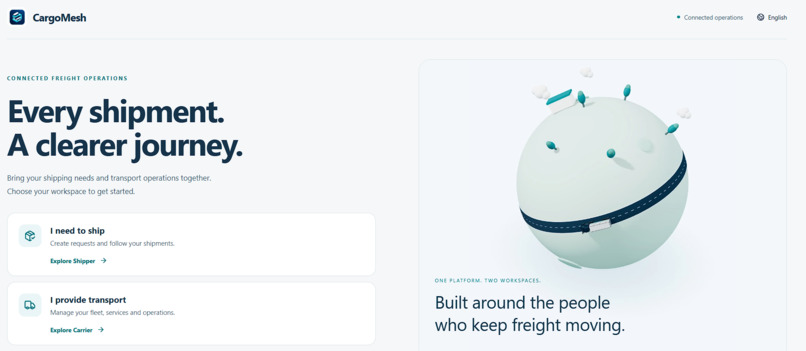
Landing Page
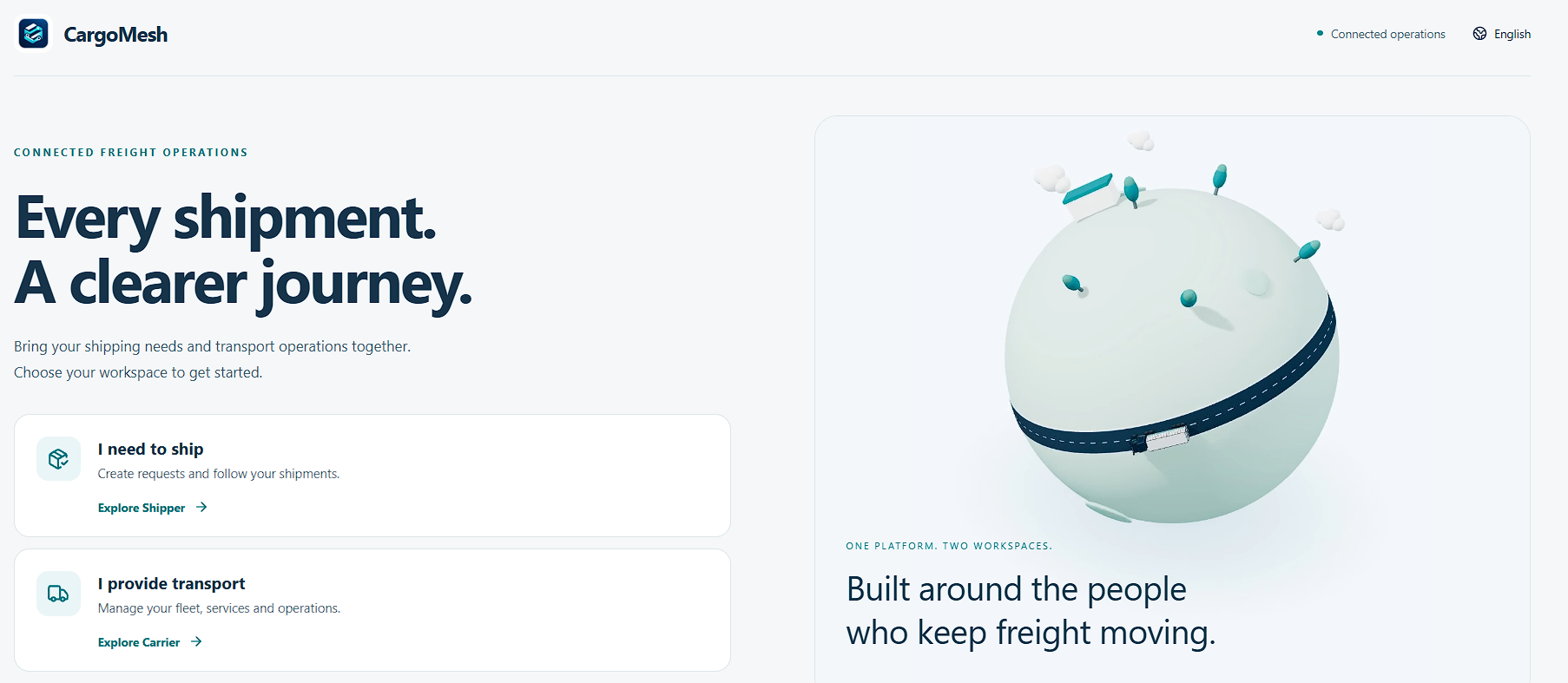
CargoMesh — Intelligent Freight Orchestration
Inspiration
Freight transportation involves much more than moving goods from one location to another. Businesses must find suitable carriers, communicate cargo requirements, compare transportation options, verify vehicle capacity, coordinate schedules, and manage bookings.
These activities often happen across disconnected systems, making freight coordination unnecessarily complicated.
We created CargoMesh to bring shippers and carriers into a connected workspace where logistics requests can become structured, actionable transportation plans.
Our vision is simple: making freight coordination more accessible, intelligent, and transparent through AI-assisted workflows.
What it does
CargoMesh is a B2B freight orchestration platform connecting two workspaces:
For Shippers:
- Create freight requests with cargo details, dimensions, weight, locations, and schedules.
- Use conversational assistance to describe transportation needs and review missing information.
- Evaluate available carrier offers and authorize bookings.
- Follow transportation orders and reported operational milestones.
For Carriers:
- Manage vehicles, drivers, services, and operational availability.
- Discover and evaluate compatible freight opportunities.
- Generate transportation plans based on cargo requirements and fleet constraints.
- Prepare carrier-specific quotations and manage confirmed orders.
Intelligent vehicle planning
One of CargoMesh's core capabilities is evaluating how freight can be allocated across different vehicles.
For example, a shipment containing 12 tons of cargo in two indivisible crates may require two trucks rather than one.
CargoMesh evaluates vehicle capacities, cargo constraints, availability, route eligibility, and operating costs to identify feasible transportation plans.
Our synthetic demonstration connects this process to a commercial workflow: one carrier offer, one booking, and two confirmed vehicle reservations.
How we built it
CargoMesh combines a web platform, a shared logistics backend, an authenticated MCP server, and conversational AI.
The application uses Next.js, React, TypeScript, and Hono, with Supabase PostgreSQL, Authentication, and Row Level Security for persistent data and access control.
Our Model Context Protocol (MCP) integration exposes authorized logistics capabilities, allowing compatible AI clients to interact with structured freight workflows while respecting identity and permissions.
For conversational assistance, we integrated Amazon Nova through Amazon Bedrock, using a Python gateway built with Strands Agents and deployed through AWS infrastructure.
The web experience provides a simulated Alexa+ interaction path. It is not presented as a verified live Alexa or Echo integration.
Most importantly, we separated AI assistance from business authority: the assistant helps users understand and prepare requests, while application services validate cargo, calculate eligible plans, and require explicit authorization for commercial actions.
Challenges we faced
1. Complex freight constraints
Selecting a truck is not simply choosing the largest available vehicle. Cargo may have indivisible units, physical dimensions, different equipment requirements, and delivery deadlines.
We developed planning and validation logic to evaluate feasible combinations without assuming that every cargo item can be divided or transported by any truck.
2. Transactional consistency
When one booking requires multiple trucks, the platform must prevent overlapping reservations and incomplete confirmations.
We implemented transactional safeguards for concurrency, atomicity, idempotency, authorization, and changes in resource availability.
3. Connecting conversational AI to reliable operations
Integrating AI with real application workflows required handling incomplete information, corrections, voice-session behavior, and explicit user consent.
We learned that a useful logistics assistant must explain verified results instead of inventing prices, availability, or booking decisions.
4. Coordinating a full-stack system
Bringing together two workspaces, logistics rules, database security, MCP, AWS services, and conversational interfaces required careful integration and reproducible testing.
Accomplishments
- Built connected Shipper and Carrier workspaces.
- Developed capacity-aware planning for multi-vehicle freight requests.
- Connected quotations, bookings, and vehicle reservations.
- Implemented authenticated MCP capabilities backed by shared application services.
- Integrated Amazon Nova into a conversational web architecture.
- Validated critical booking consistency and access-control scenarios using automated tests.
- Created reproducible synthetic logistics scenarios for demonstrating the workflow.
What we learned
The biggest lesson was that AI works best when paired with reliable domain logic.
Instead of allowing an AI assistant to make unsupported logistical decisions, CargoMesh uses structured data, deterministic validations, explicit approvals, and auditable operations.
We also learned how important it is to preserve consistency across different interfaces and systems: the same shipment must remain understandable and traceable from request creation to carrier confirmation.
What's next
We plan to expand CargoMesh with improved fleet scheduling, multi-order consolidation, more advanced route planning, additional carrier integrations, and broader transportation support.
Our long-term goal is to make CargoMesh an interoperable logistics orchestration platform where businesses can coordinate transportation through natural language without losing control over operational and commercial decisions.
CargoMesh — From freight requests to coordinated transport.
Built With
- amazon-bedrock
- amazon-nova
- aws-ecr
- aws-ecs
- aws-secrets-manager
- google-maps-platform
- hono
- kiro
- model-context-protocol
- next.js
- postgresql
- python
- react
- strands-agents
- supabase
- tailwind-css
- three.js
- typescript
- vercel


