-
-
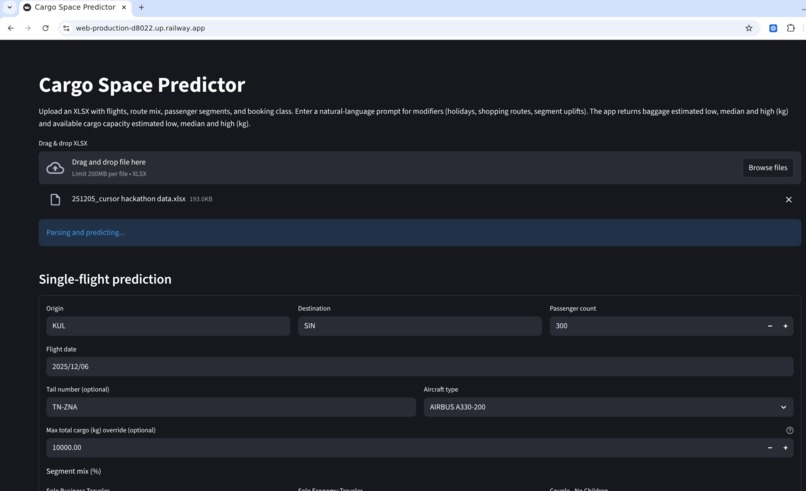
Cargo-predict. A simple, focused solution to a complex problem
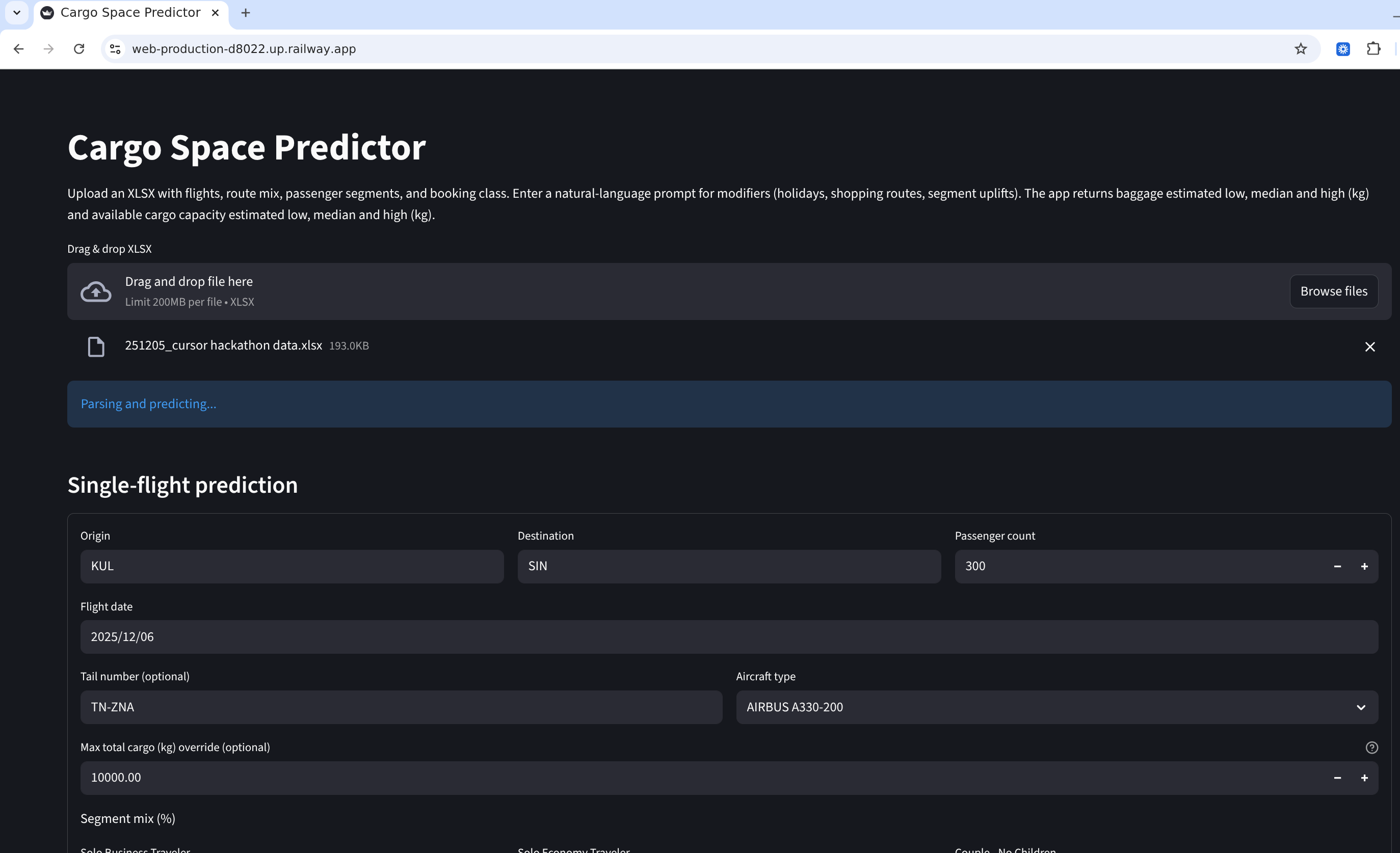
🛫 Cargo Space Predictor
Inspiration
I was inspired by a problem shared by Vercel about improving airline operations. At first, I thought the challenge was too large to approach. But after looking closely at the dataset, I noticed something important: airlines usually predict cargo space based only on routes and aircraft type, which isn’t enough.
The real issue is that passenger luggage amounts are unpredictable, and this affects how much cargo space is actually available. Once I realised this, I wondered:
“What if we model the people instead of the planes?”
That idea became the foundation for this project.
How I built my project
I built the project using as many of the sponsor's tools as I could master: I used Cursor to write and organise my Python code. I used Railway to deploy the app because it supports the Python math and statistics packages I needed. The system takes passenger data → extracts simple features → runs a prediction model → shows the result in a clean UI.
It’s simple, but it helped guide the early design of the model.
Challenges I faced
This was my first time building an end-to-end app, so I had to learn a lot very quickly:
Figuring out how to deploy a Python application with all its dependencies.
Learning how to take statistical outputs and turn them into something a user can read easily.
Trying to design a UI that is simple and not confusing, even though UI design is not my strength. Understanding how to work with passenger-level data and how it connects to luggage variation. Despite the challenges, the process taught me how to break a big problem into smaller steps.
What I learned
Real-world problems often need better data, not just better algorithms.
Predictive tools must be both accurate and easy to understand, especially for operational teams.
Using AI tools as a thinking partner helped me test ideas faster.
Building and deploying a project by myself gave me confidence to take on bigger ideas.
Most importantly, I learned that even a beginner can build something meaningful if they just start experimenting.
What’s next
I plan to continue improving the model by training it on more detailed passenger datasets. My goal is to make Cargo Space Predictor accurate enough for airlines to rely on it when planning cargo space and managing revenue.
Built With
- altair
- claude-api
- numpy
- openpyxl
- postgresql
- python-3-streamlit-(ui)-pandas
- railway
- scikit-learn
- sqlalchemy

Log in or sign up for Devpost to join the conversation.