-
-
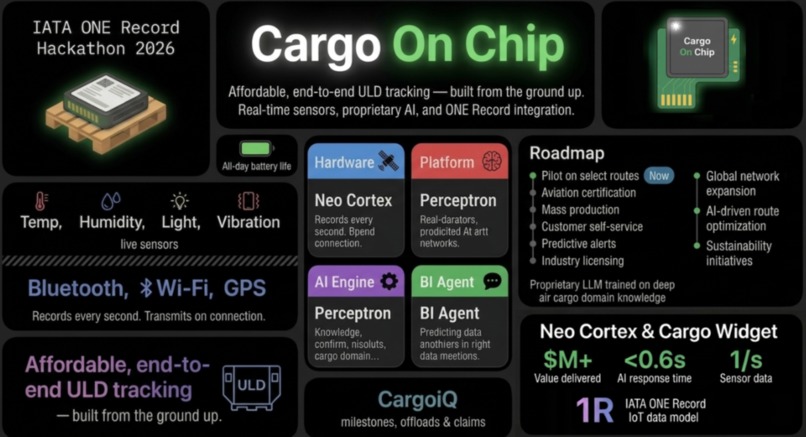
Poster
-

Circuit
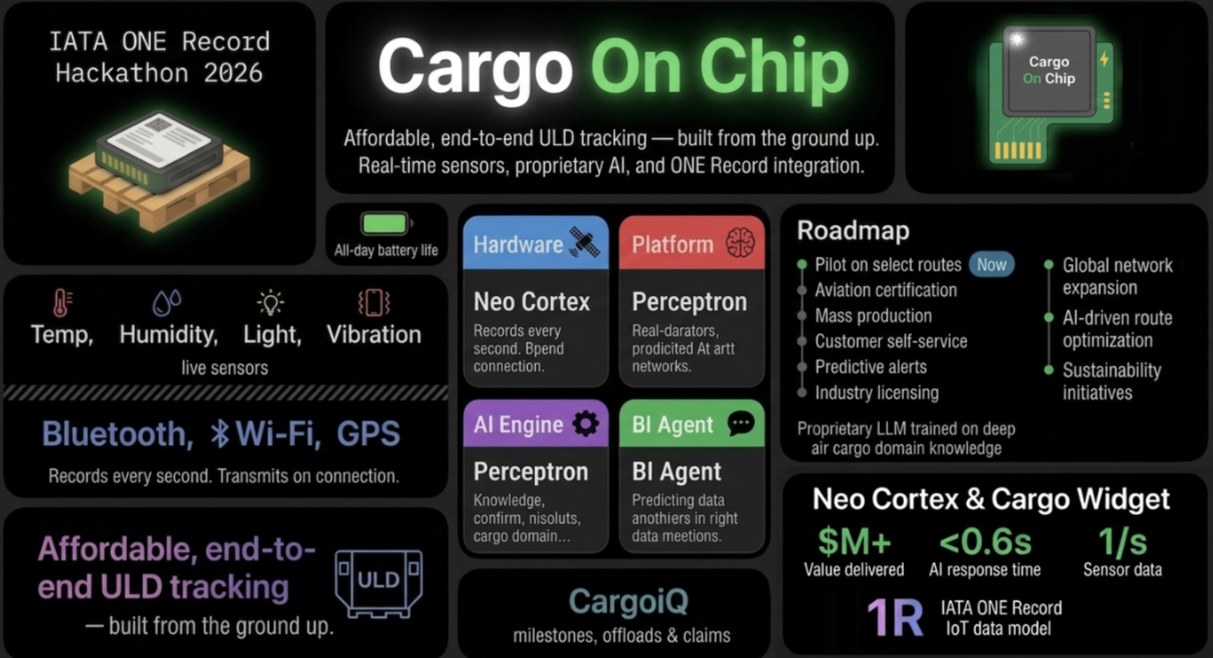

Inspiration
The growing demand for ULD tracking and real-time intelligence in the air cargo industry has driven us to develop a purpose-built solution for our customers. While existing ULD tracking solutions on the market remain prohibitively expensive, we have taken a different approach — building our own hardware device from the ground up.
Our proprietary device is equipped with a comprehensive suite of environmental sensors, including temperature, humidity, light intensity, and vibration, enabling end-to-end cargo condition monitoring. To ensure seamless connectivity and real-time data transmission, the device integrates Bluetooth, Wi-Fi, and GPS — forming a fully connected intelligence ecosystem that delivers actionable insights at every stage of the shipment journey.
To realize our purpose, we develop 3 MVP, 1POC and 1R Integration as below.
- Cargo On Chip: ULD Tracking Device
- Cargo Neo Cortex: Intelligence Platform
- Cargo Perceptron: In house Language Model
- Cargo Widget: BI Agent developed on RAG.
- One Record Connection: Used ONE Record IoT data model (GitHub - GLSHK-IATA-Hackathon/IATA-ONE-Record-Hackathon-2026-Apr-CXGLS · GitHub)
What They Do
Cargo On Chip: A compact, sensor-rich hardware device that continuously collects and stores data every second throughout the shipment journey. Upon connecting to a Wi-Fi or Bluetooth base station, the device automatically transmits all recorded data in real time — delivering complete, end-to-end visibility from origin to destination.
Cargo Neo Cortex: A unified intelligence and analytics platform that consolidates everything our customers need in a single view. Alongside ULD tracking and CargoiQ milestone data, customers gain full visibility into their commercial and operational activities — including offload events, claims, and shipment performance. The platform is also powered by Cargo Wizard, an embedded AI assistant that enables customers to effortlessly navigate and retrieve the insights they need.
Cargo Perceptron: A proprietary large language model, purpose-built and trained on deep air cargo domain knowledge. Cargo Perceptron serves as the cognitive engine behind our intelligent ecosystem — understanding industry-specific terminology, processes, and data to deliver highly accurate and contextual responses.
Cargo Widget: An AI-powered BI agent that operates on the Cargo Perceptron model within a Retrieval-Augmented Generation (RAG) framework. Cargo Wizard is capable of generating precise, context-aware responses to user inquiries in under 0.6 seconds — transforming how customers interact with their cargo data.
ONE Record Connection: We use the ONE Record IoT data model to store all sensor readings in a standardized and structured way. Based on this data, we built the Cargo Neo Cortex dashboard, which also integrates the Cargo iQ route map for end-to-end visibility.
When airline staff perform shipment acceptance in our Shipment Workspace, the system can trigger the Cargo iQ SAC milestone and publish the event to the agent system. If issues are identified during acceptance, users can raise a Verification Request to the agent. With ONE Record publish-subscribe enabled, subscribed GHAs are also notified whenever a Verification Request is pending.
How We Built Them
Our solution is the result of a multidisciplinary engineering effort, combining deep expertise across both hardware and software disciplines.
Hardware Engineering
From the ground up, we designed and developed every layer of the physical device — from circuit design and board layout to microcontroller programming and sensor integration. The outcome is a compact, sensor-rich device capable of supporting multiple communication protocols, including Bluetooth, Wi-Fi, and GPS — all within a single, purpose-built form factor.
Software Engineering
On the software side, our development spans three operating systems — Windows, Linux, and macOS — ensuring cross-platform compatibility and flexibility across our ecosystem. We leverage a diverse and modern technology stack, including:
- C++ — for low-level microcontroller and embedded systems programming
- Python — for data processing, analytics, and AI/ML model development
- Java — for backend services and system integration
- HTML, CSS & JavaScript — for building intuitive, responsive front-end interfaces and dashboards
This blend of hardware craftsmanship and full-stack software engineering enables us to deliver an end-to-end solution that is entirely built, owned, and operated in-house — reducing vendor dependency and maximising innovation velocity.
Challenges We Ran Into
Due to nature of engineering most of the codes re-write and re-runs hundreds of times; in each run we hit an obstacle, error or bugs. We had difficulty to transform sensor/device generated data into IATA one record format but eventually succeeded.
Accomplishments That We're Proud Of
The solution we have built represents millions of dollars in value for airlines striving for service and operational excellence — delivered at a fraction of the cost of existing alternatives.
We are tackling one of the industry's most well-known pain points: the lack of affordable, scalable ULD tracking. By developing our own hardware device at a significantly lower cost, we are breaking down the barrier that has long prevented airlines from extending real-time monitoring beyond a select few shipments.
Most importantly, our solution democratises cargo visibility — enabling airlines to deliver premium-grade monitoring for every customer shipment, not just high-value or special cargo. For the first time, passive pallets can be tracked and monitored with the same level of intelligence as active containers — closing the visibility gap and setting a new standard for customer service in air cargo.
What We Learned
This project has been a transformative learning journey for our team, pushing us well beyond the boundaries of our everyday roles and into entirely new disciplines.
Through the end-to-end development of our solution, we gained hands-on experience across a wide spectrum of skills:
- Multi-language software development — building proficiency across C++, Python, Java, and web technologies to deliver a full-stack platform
- Large Language Model (LLM) training — learning how to build, fine-tune, and deploy a domain-specific language model from the ground up
- Hardware engineering — acquiring practical knowledge in circuit design, sensor integration, and microcontroller programming — a completely new frontier for our team
- IATA ONE Record (1R) integration — understanding and implementing the industry's next-generation data-sharing standard, connecting our solution to the broader air cargo digital ecosystem
More than any single skill, this project taught us the power of cross-disciplinary collaboration — proving that when curiosity meets determination, a small team can engineer solutions that rival those of established industry vendors.
What Is Next
With a working prototype and a proven intelligence ecosystem in place, we are now ready to take our solution from innovation to impact. Here's our roadmap forward:
Pilot & Validate
Launch a controlled pilot programme on select routes to test the device under real-world operational conditions — validating sensor accuracy, connectivity reliability, and data transmission across the full shipment lifecycle.Aviation Certification & Compliance
Pursue the necessary regulatory approvals and aviation safety certifications to ensure our device is fully compliant for use onboard aircraft — a critical milestone for commercial deployment at scale.Scale Production
Transition from prototype to mass production, optimising the hardware design for manufacturability, cost efficiency, and durability — enabling deployment across our entire ULD fleet.Customer Integration & Onboarding
Open up Cargo NeoCortex to customers, providing them with self-service access to real-time tracking, analytics, and AI-powered insights via Cargo Wizard — transforming and digitizing the customer experience. Planning to open up APIs or gateways on the Cargo Neo Cortex platform to enable customers to retrieve data upload their own data and build their own intelligence, so that they can integrate with their own data infrastructure for further development and utilize the Cargo Neo Cortex overall BI solution.
Evolve the Intelligence Layer
Continue to train and enhance Cargo Perceptron with richer domain data, expand Cargo Wizard's capabilities, and explore advanced use cases such as predictive alerts, anomaly detection, and automated exception handling.Industry Collaboration & Standardisation
Deepen our integration with IATA ONE Record and explore partnerships with other airlines, ground handlers, and freight forwarders — positioning our solution as an open, interoperable platform that elevates the entire industry.Commercialisation
Explore opportunities to monetise the platform by offering ULD tracking and intelligence as a value-added service to customers and potentially licensing the technology to other carriers seeking affordable, best-in-class cargo visibility.


Log in or sign up for Devpost to join the conversation.