-

Landing Page
-
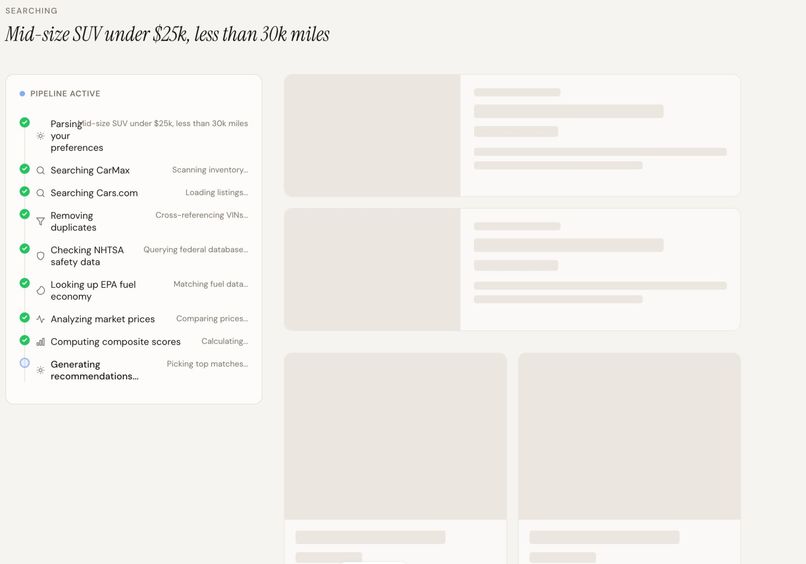
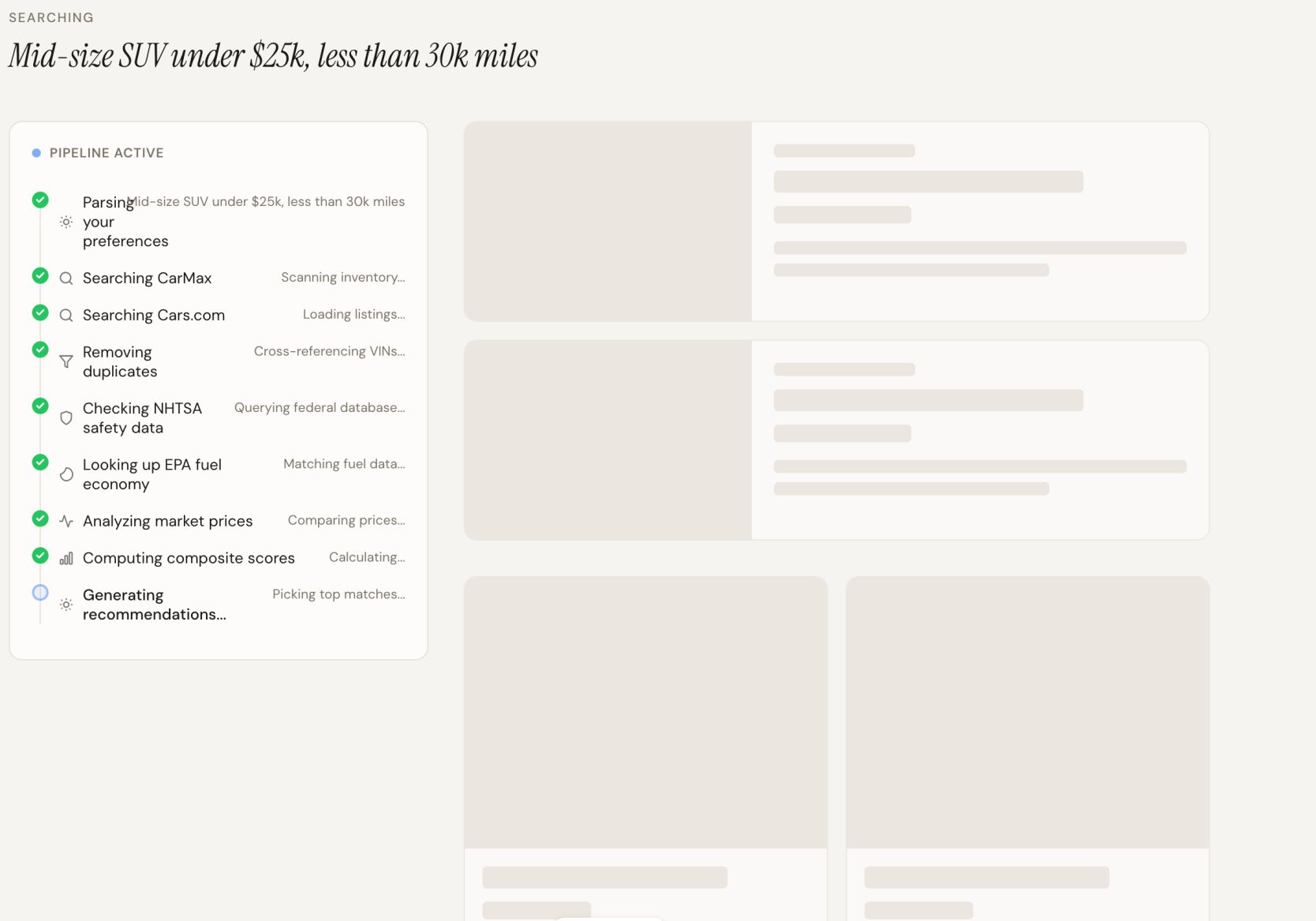
Pipeline in Action
-
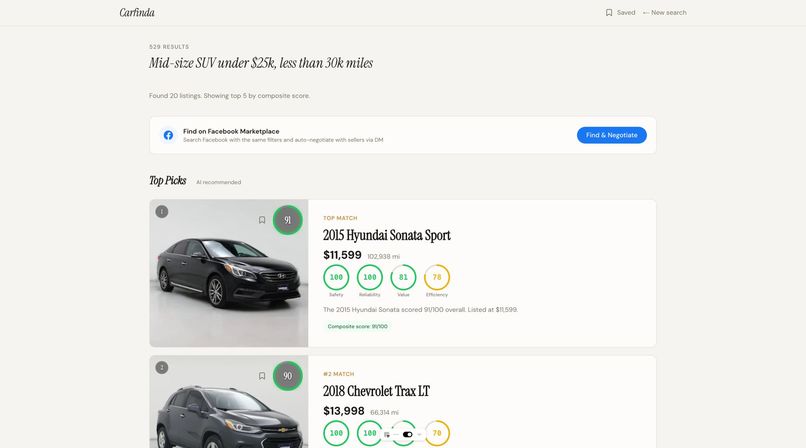
Matched Cars
-
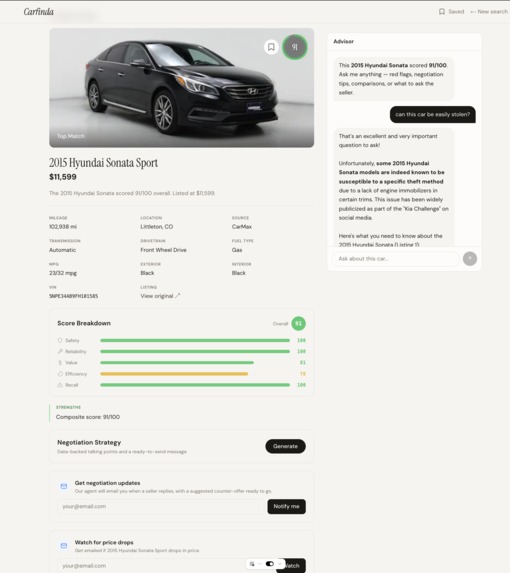
View Car

Inspiration
Buying a used car can feel overwhelming, especially for first-time buyers. That was the core inspiration behind CarFINDa.
A big problem is not just finding a car. It is finding the right car when there are hundreds of listings spread across sites like CarMax, Cars.com, and Facebook Marketplace. Every listing looks a little different, prices are inconsistent, and the information is often incomplete. Two cars can look almost identical at first glance, but one may have better safety ratings, fewer known defects, lower long-term ownership costs, or better market value. Most buyers do not have the time or knowledge to manually compare all of those factors.
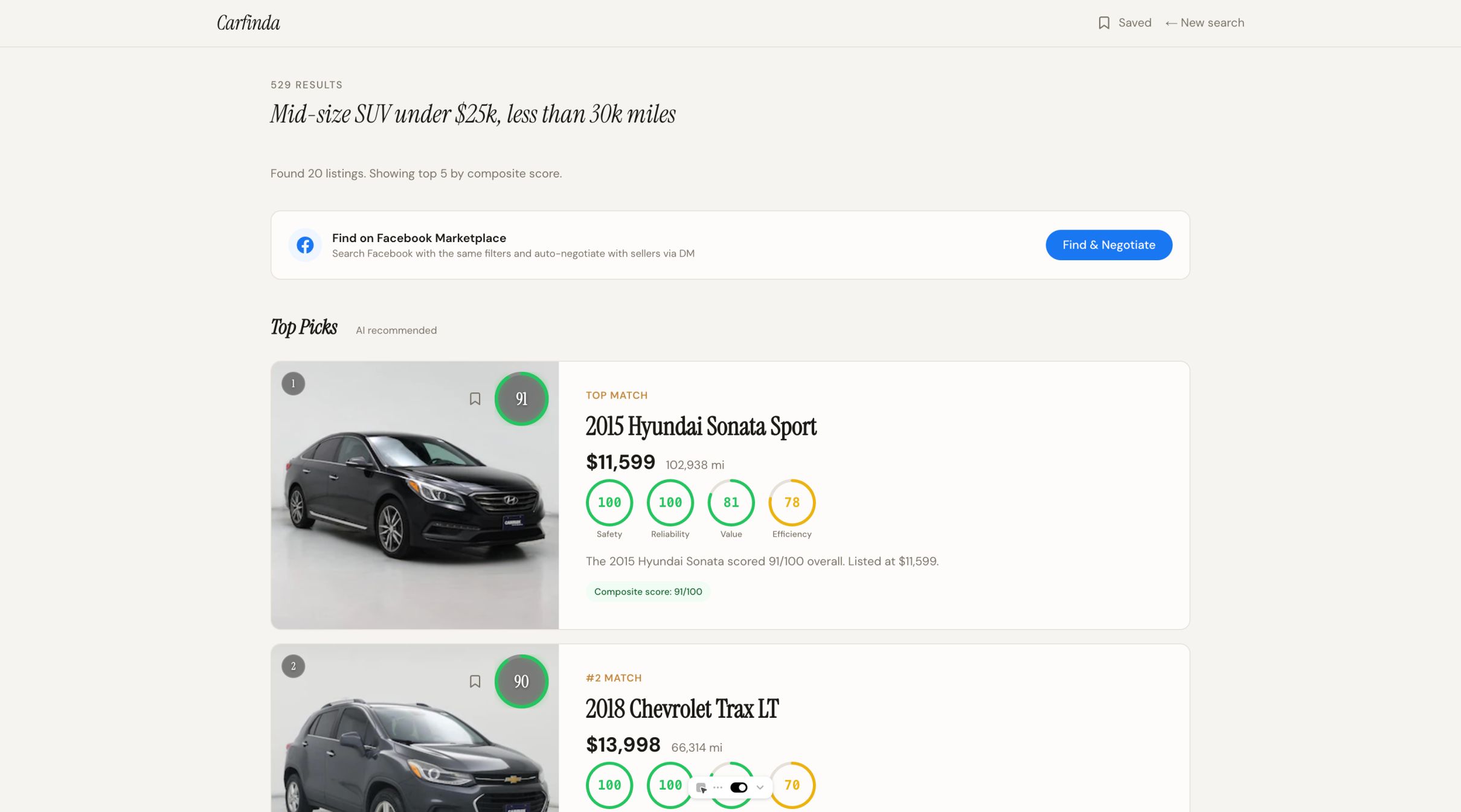
We wanted to build something that cuts through that noise. Instead of forcing users to scroll endlessly and guess, CarFINDa narrows the search down to a few strong options using an objective score. The goal is to act like a real car-buying agent that helps users go from confusion to confidence.
We were also inspired by how stressful negotiation is. There are plenty of generic “how to negotiate a car” articles online, but very few tools actually tailor negotiation advice to a specific vehicle and its real data. Dealers and private sellers often know how to frame price, urgency, and condition in ways that push buyers into paying more. Most people walk into that process underprepared. We wanted to change that by generating negotiation strategies backed by safety data, market value, recall information, and comparable listings.
Finally, Facebook Marketplace introduced another layer of frustration. It is one of the best places to find deals, but it also has a much lower response rate and more uncertainty. Messaging sellers, waiting for replies, checking conversations repeatedly, and trying to keep track of who answered is exhausting. That is why we built outreach automation into the product. If CarFINDa can help message sellers, monitor replies, and alert users when something changes, it removes a huge amount of headache from the buying process.
What it does
CarFINDa is an AI-powered used car intelligence platform that:
- aggregates listings from multiple marketplaces
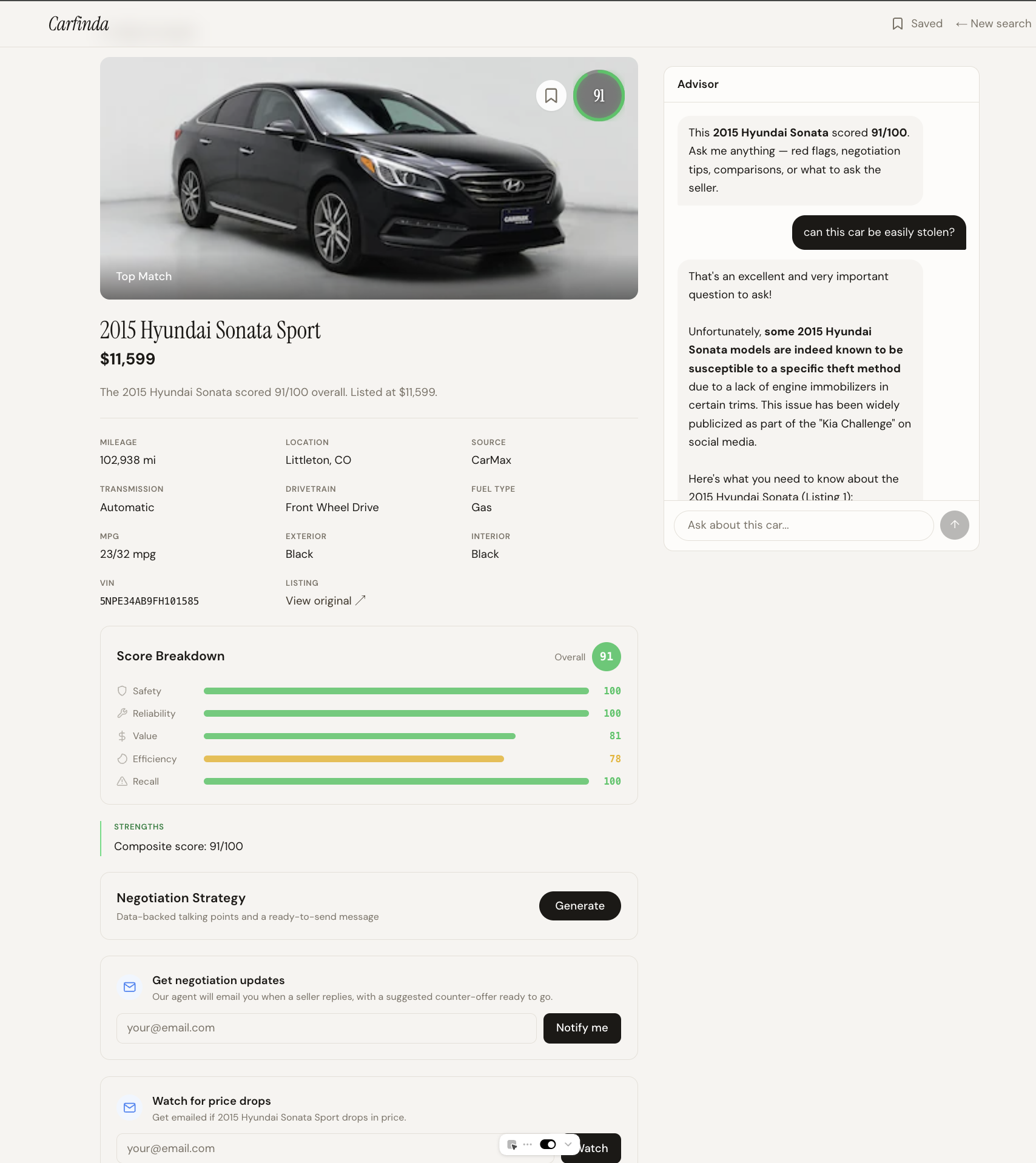
- scores vehicles using real federal safety, recall, emissions, and market data
- explains which cars are strong picks and which ones are risky
- generates negotiation strategies and opening messages tailored to each listing
- automates Facebook Marketplace outreach and tracks seller responses
Instead of just showing listings, CarFINDa helps users answer the question: "Is this actually a good car and a good deal?"
At the center of the platform is our composite scoring model:
$$ \text{Composite Score} = 0.20(\text{Safety}) + 0.20(\text{Reliability}) + 0.25(\text{Value}) + 0.15(\text{Ownership Cost}) + 0.10(\text{Efficiency}) + 0.10(\text{Recall}) $$
That score gives users a quick, standardized way to compare cars across different platforms and sellers.
How we built it
We built CarFINDa as a full-stack system with a modern web frontend, a Python backend, browser automation infrastructure, and multiple external data sources.
Frontend
The frontend was built with Next.js 14, TypeScript, and Tailwind CSS. We focused on making the search flow feel simple even though the backend logic is complex. Users can search in natural language, browse ranked results, view detailed car breakdowns, and interact with an AI chat and negotiation panel.
Backend
The backend was built with FastAPI and organized into services for scraping, scoring, LLM agents, and marketplace outreach. FastAPI made it easy to build structured APIs and keep the architecture modular.
Scraping pipeline
We built a parallel scraping pipeline that collects vehicle listings from multiple marketplaces. For sites that expose useful data directly, we use fast HTTP requests. For sites that require JavaScript rendering, we use a Playwright sidecar built in Express.js with Chromium. This allowed us to handle modern web apps, preserve sessions, and interact with Facebook Marketplace.
Scoring engine
We designed a multi-factor scoring engine that combines:
- NHTSA safety ratings
- NHTSA complaint data
- recall data
- EPA fuel economy
- market value estimates
- ownership cost projections
This lets us move beyond surface-level listing data and evaluate cars using real external signals that buyers usually do not check manually.
AI agents
We used Gemini 2.5 Flash to power several specialized agents:
- an intake agent to turn natural language into search filters
- a synthesizer to explain top picks and red flags
- a chat agent for follow-up questions
- a negotiation agent to generate data-backed offers and seller messages
Persistence and outreach
We used Supabase for authentication, persistence, conversation history, and campaign tracking. This was especially useful for Facebook Marketplace outreach, where the system needs to remember message history, seller status, and follow-up timing.
Challenges we ran into
One of the biggest challenges was that used car data is messy. Different marketplaces structure listings differently, some provide partial information, and many important details are missing or inconsistently named. A Honda CR-V might appear as "CR-V," "CRV," or "cr v," which sounds small but becomes a real issue when trying to normalize data across sources.
Another challenge was balancing speed and accuracy. A user wants results quickly, but a thorough vehicle evaluation requires live API calls, recalls, complaint lookups, market valuation, and ownership cost estimates. We solved this by building a two-tier scoring approach: a fast mode for broad search results and a full mode for detailed listing pages.
Browser automation was also difficult. Modern sites are JavaScript-heavy, dynamic, and often sensitive to scraping behavior. Building a Playwright sidecar with persistent profiles, stealth strategies, and isolated contexts was essential, especially for Facebook Marketplace.
Negotiation was another interesting challenge. We did not want the AI to produce vague advice like "offer lower" or "ask if the price is flexible." We wanted it to use real leverage. That meant connecting negotiation outputs to specific listing-level evidence such as open recalls, complaint patterns, pricing gaps, and comparable vehicles nearby.
The final challenge was Facebook Marketplace messaging and monitoring. Response rates are inconsistent, conversations are scattered, and buyers waste time checking for updates that may never come. Making the system capable of sending messages, tracking replies, and surfacing updates in one place was technically challenging, but it also became one of the most practically useful parts of the project.
What we learned
This project taught us a lot about building systems that sit at the intersection of AI, scraping, automation, and decision support.
We learned that the hardest part of a product like this is not just collecting data. It is turning messy, incomplete, multi-source information into something a user can trust. That required careful normalization, fallback logic, structured scoring, and clear explanations.
We also learned that AI is most useful when it is grounded in real data. The language model becomes much more powerful when it is not just "giving advice," but reasoning over actual recalls, complaint counts, fuel economy, market values, and competing listings.
On the product side, we learned that convenience matters just as much as intelligence. Helping users find better cars is valuable, but helping them manage outreach and negotiation stress is what makes the experience feel complete. A marketplace with low response rates creates friction, and even small automations can remove a lot of anxiety for buyers.
Why this matters
CarFINDa matters because buying a car is one of the biggest purchases many people make, yet the process is still fragmented, opaque, and intimidating. People should not need dealership expertise, hours of research, and constant app-checking just to avoid getting a bad deal.
We wanted to build a tool that gives ordinary buyers more leverage, more clarity, and more peace of mind. CarFINDa does that by combining data, scoring, AI explanation, and outreach automation into one workflow.
Instead of asking users to become experts in used cars, we built a system that works like their agent.
Looking ahead
We see this as more than a listing search engine. The long-term vision is a full AI car-buying assistant that can:
- personalize rankings even more deeply to user preferences
- expand to more marketplaces
- improve negotiation recommendations with local market patterns
- monitor listings over time for price drops
- help buyers manage the entire process from search to first message to final deal
CarFINDa started from a simple frustration: there are too many options, too many hidden factors, and too much stress in buying a used car.
Our answer was to build the kind of tool we wish we had ourselves.
Built With
- and
- and-gemini-2.5-flash
- built-with-next.js
- epa
- express.js
- fastapi
- playwright
- powered-by-data-from-nhtsa
- supabase/postgres
- tailwind
- typescript
- vinaudit


Log in or sign up for Devpost to join the conversation.