-
-
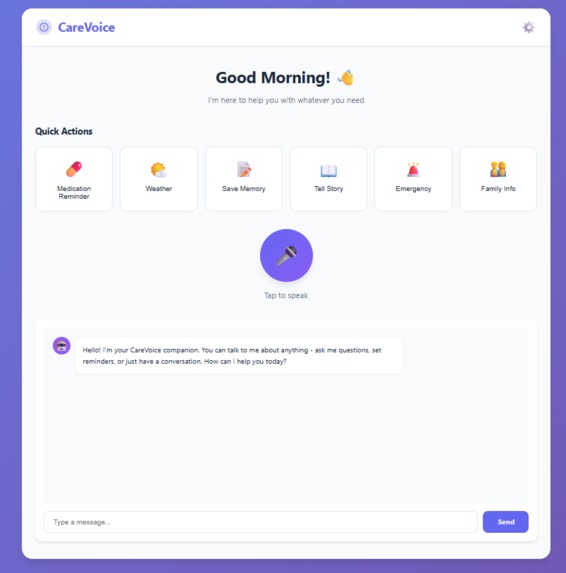
this is the outcome of our project
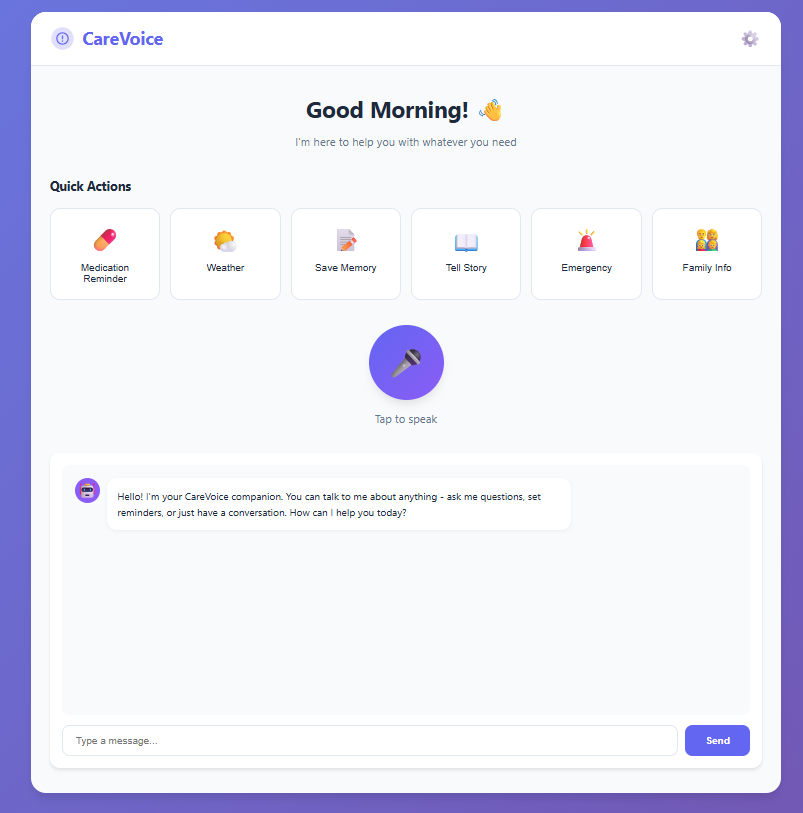
About the Project
CareVoice is an AI-powered elder companion designed to provide emotional support, conversational comfort, medication reminders, and day-to-day assistance for senior citizens. The goal is to bring warmth, safety, and independence to the elderly through human-like AI voice interactions.
Inspiration The inspiration began with a simple observation: Many elders live alone, often with limited social interaction. Loneliness is not just emotional — it has real health impacts. Studies show that prolonged loneliness increases mortality risk by nearly: Loneliness Risk Factor ≈ 1.26 × baseline health risk Loneliness Risk Factor≈1.26×baseline health risk This motivated the idea of building a companion that speaks, listens, remembers context, and supports elders in their daily routine. I wanted to create something compassionate, practical, and accessible — a digital companion that feels present.
What I Learned
While developing CareVoice, I learned to combine multiple complex technologies into one smooth experience: How to integrate Speech-to-Text, Text-to-Speech, and Conversational AI in real-time How to build a responsive UI that supports voice-based interaction How to design APIs that support continuous, human-like conversations How to use machine learning models to detect sentiment and emotional state How to architect scalable cloud-based AI services How to manage asynchronous audio streaming in mobile apps How to design a system that is simple and friendly for elders How I Built the Project
The project consists of three main layers:
Mobile Application (React Native + Expo) The mobile app handles Listening to voice input Sending text/audio to backend Receiving responses Playing back audio generated by AI Providing reminders, medication alerts, and a simple UI Technologies used: React Native Expo AV react-native-voice Context API for state management
Backend (Node.js + Express) The API handles: Conversation requests Reminder management Context storage User personalization
Technologies: Node.js Express.js JWT authentication
- AI Processing Layer (OpenAI + Python/ML) This layer generates: Human-like speech Personalized conversation Emotional understanding Wellness suggestions
Components used: OpenAI Realtime Voice API OpenAI GPT models FastAPI microservice for emotion detection HuggingFace Transformers
The emotional analysis uses a basic probability function: Predicted Emotion = arg max 𝑒∈𝐸 𝑃(𝑒 ∣ input ) Predicted Emotion= e∈E argmax P(e ∣ input) where 𝐸 E is the set of possible emotions.
Challenges I Faced
Real-Time Voice Interactions Implementing low-latency audio streaming was challenging. Mapping microphone input → STT → AI → TTS → device playback required careful orchestration.
Natural Conversation Flow Making the AI feel warm, empathetic, and safe required strong prompt design and fallback handling.
Emotion Detection Building a pipeline that detects mood and adjusts responses accordingly was technically complex.
Elder-Friendly UX Design had to balance simplicity and utility:
Large buttons Minimal text Fast responses Zero-configuration onboarding
- Deployment & Integration Deploying multiple services — mobile app, backend API, and ML microservice — required careful cloud configuration and testing.
Conclusion CareVoice was built to serve a real and growing need. Through this project, I learned the importance of merging technology with empathy, and how AI can genuinely improve quality of life when designed responsibly. The project also encouraged deep learning in areas like real-time audio, cloud services, and conversational AI architectures.
Built With
- firebase
- github
- javascript
- node.js
- openai
- react-native
- render
- vercel

Log in or sign up for Devpost to join the conversation.