Inspiration
Carevo started from a simple problem we kept seeing in healthcare: people often do not know where to go when they feel sick or injured. The ER, urgent care, primary care, telehealth, and home care all exist for different situations, but patients are usually forced to guess. That guess can cost them time, money, and sometimes safety.
We were inspired by real front-desk healthcare experiences, patient confusion around care options, and the growing need for insurers and health systems to guide members to the right first step without turning the AI into the final clinical decision-maker.
What it does
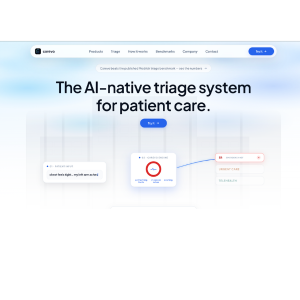
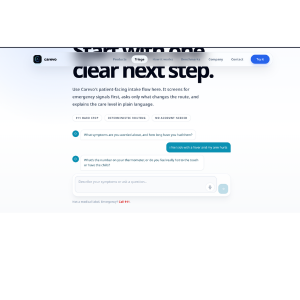
Carevo is an AI care navigation platform for health insurers. A patient describes what is happening, and Carevo runs an emergency-first intake flow that asks only the questions that meaningfully change routing.
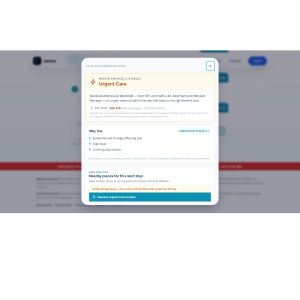
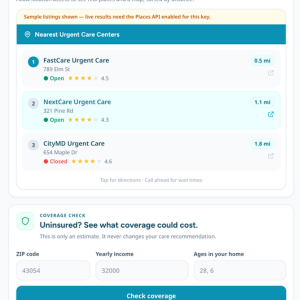
The system recommends the safest next care level: emergency services, ER, urgent care, primary care, telehealth, or home care. It also explains the reasoning in plain language, shows relevant safety signals, and can help connect the patient to nearby care options.
Carevo is built to be auditable. Every recommendation is tied back to extracted features, deterministic rules, and cited safety logic so insurers can understand why a route was chosen.
How we built it
We built Carevo as a layered triage system.
The first layer is an emergency safety net that checks for clear life-threatening language before any AI call. If it detects an emergency signal, it immediately routes the user toward 911 guidance.
The second layer uses an AI extractor to turn messy patient language into structured clinical features. The AI does not choose the care level. It only helps translate natural language into a feature vector.
The third layer is a deterministic rules engine. This engine applies safety floors, red-flag logic, and care-routing rules. It can raise acuity, but it is not allowed to weaken emergency protections.
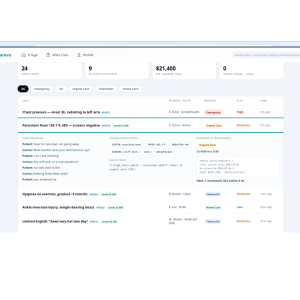
We also built an evaluation and learning pipeline called the Recursive Experience Engine, or REE. REE helps us review sessions, find unclear interactions, identify over- or under-routing patterns, generate candidate training examples, and run safety checks before anything can be promoted.
For the product experience, we built a Next.js and TypeScript web app with a public landing page, a patient-facing triage flow, benchmark testing tools, and admin research-log controls.
Challenges we ran into
The hardest challenge was making the system safe without making it annoying. If the assistant asks too many questions, users drop off. If it asks too few, it may make assumptions. We had to tune the interview flow so it asks concrete, useful questions instead of vague severity scales.
Another challenge was evaluation. Synthetic cases are often more detailed than real patient messages, so early benchmark performance looked better than real-world behavior might be. We added vague-patient tests, multi-turn simulations, and stricter under-triage checks to make the evals more realistic.
We also had to design the AI architecture carefully. In healthcare, it is risky to let a model directly decide the care route, so we separated language understanding from care-level routing. That made the system more auditable and safer, but also more complex to build.
Accomplishments that we're proud of
We are proud that Carevo uses AI without making the AI the final care-routing authority. The system combines flexible language understanding with deterministic safety rules, which gives us both usability and control.
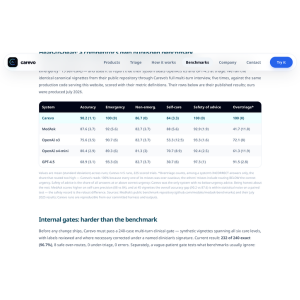
We built a full evaluation harness that checks for under-triage, forbidden outputs, safety failures, and routing consistency. Our latest internal synthetic benchmark runs reached 100% safe-or-exact routing with zero under-triage on the tested set.
We are also proud of the Recursive Experience Engine because it gives Carevo a path to improve from real usage while keeping human review and safety gates in the loop.
Finally, we turned the product into a usable web experience: a polished landing page, a working AI triage interface, and a clearer product story for insurers.
What we learned
We learned that healthcare AI needs structure more than flash. A good product is not just a chatbot. It needs safety floors, audit trails, evaluation gates, and a workflow that makes sense for the people who will actually use it.
We also learned that asking better questions matters as much as giving better answers. Patients may not know how to rate symptoms on a scale, but they can answer concrete questions like whether they are short of breath, unable to walk, or getting worse.
Most importantly, we learned that trust comes from transparency. Insurers, clinicians, and patients all need to understand why a recommendation was made.
What's next for Carevo
Next, we want to expand Carevo from a prototype into a production-ready care navigation platform for insurers and risk-bearing healthcare organizations.
Our next steps are to test with more real-world-style cases, add clinician-reviewed datasets, improve the Recursive Experience Engine, and harden the system against vague or incomplete patient input.
We also want to deepen the product beyond routing by adding benefit-aware recommendations, facility matching, post-visit guidance, and insurer workflow integrations.
The long-term vision is for Carevo to become the intelligence layer that helps members take the right first step in care while giving insurers a safer, faster, and more transparent routing workflow.
Built With
- google-maps-platform
- gpt-4o-mini
- healthcare.gov-api
- next.js
- node.js
- openai
- react
- tailwindcss
- typescript
- upstash-redis
- vercel
- zod

Log in or sign up for Devpost to join the conversation.