Inspiration
Every year, patients leave hospitals with follow-up appointments, new prescriptions, and recovery instructions. But what happens when the information needed to support their recovery is scattered across different hospital systems?
A patient might miss an appointment because they have no transportation. Another might never pick up a prescription because they cannot afford it. These problems may already be documented in clinical notes, but the people coordinating their care might never see the complete picture.
We created CareTrace to explore how artificial intelligence, knowledge graphs, and connected healthcare data could help care teams uncover overlooked barriers, understand why patients may be missing essential care, and identify actionable next steps.
Our guiding idea: A missed appointment is not just a statistic. It is the beginning of an investigation.
What it does
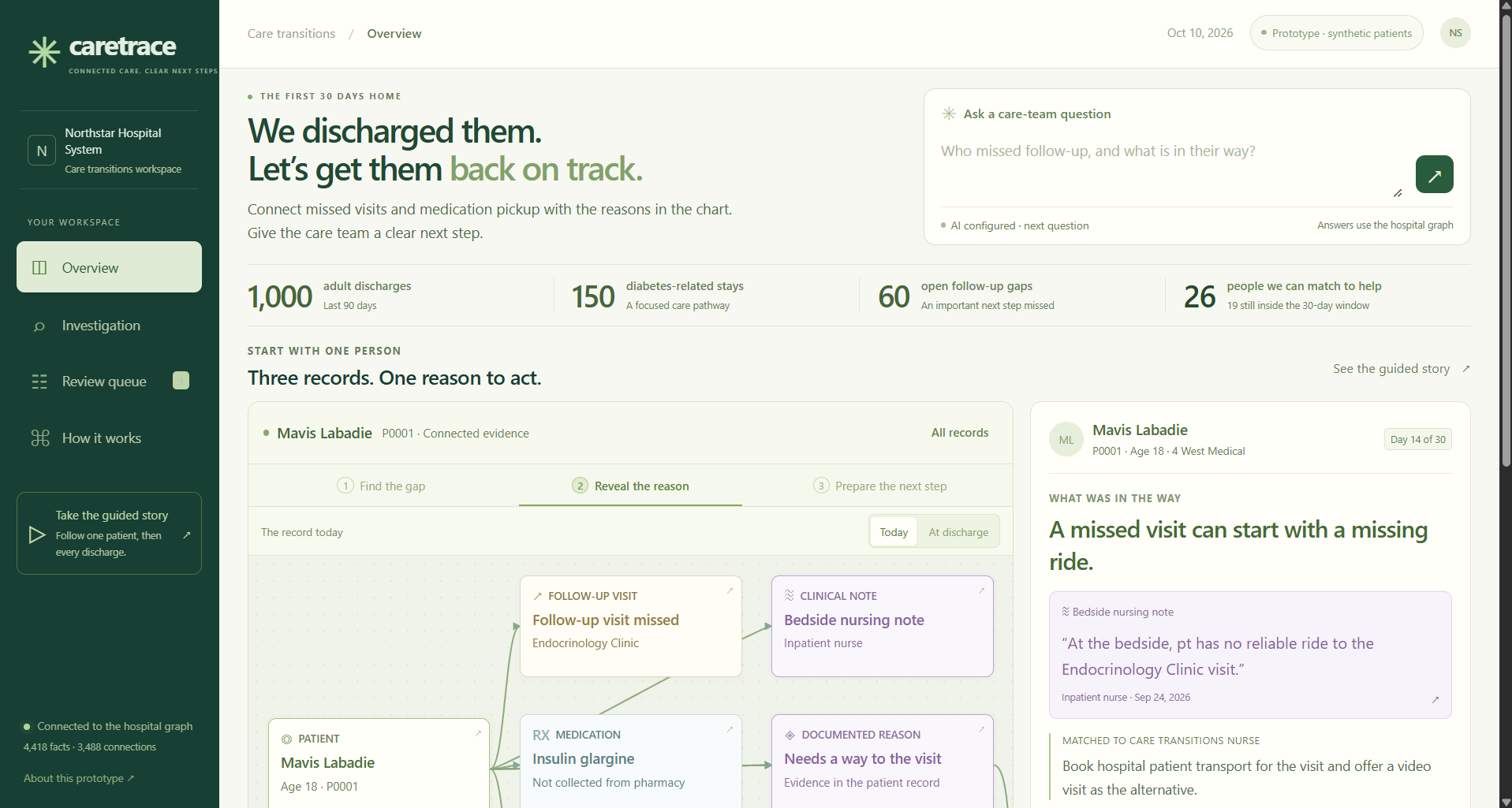
CareTrace is an AI-powered hospital care transitions platform that connects patient records, clinical notes, appointments, and medication information into an interactive knowledge graph.
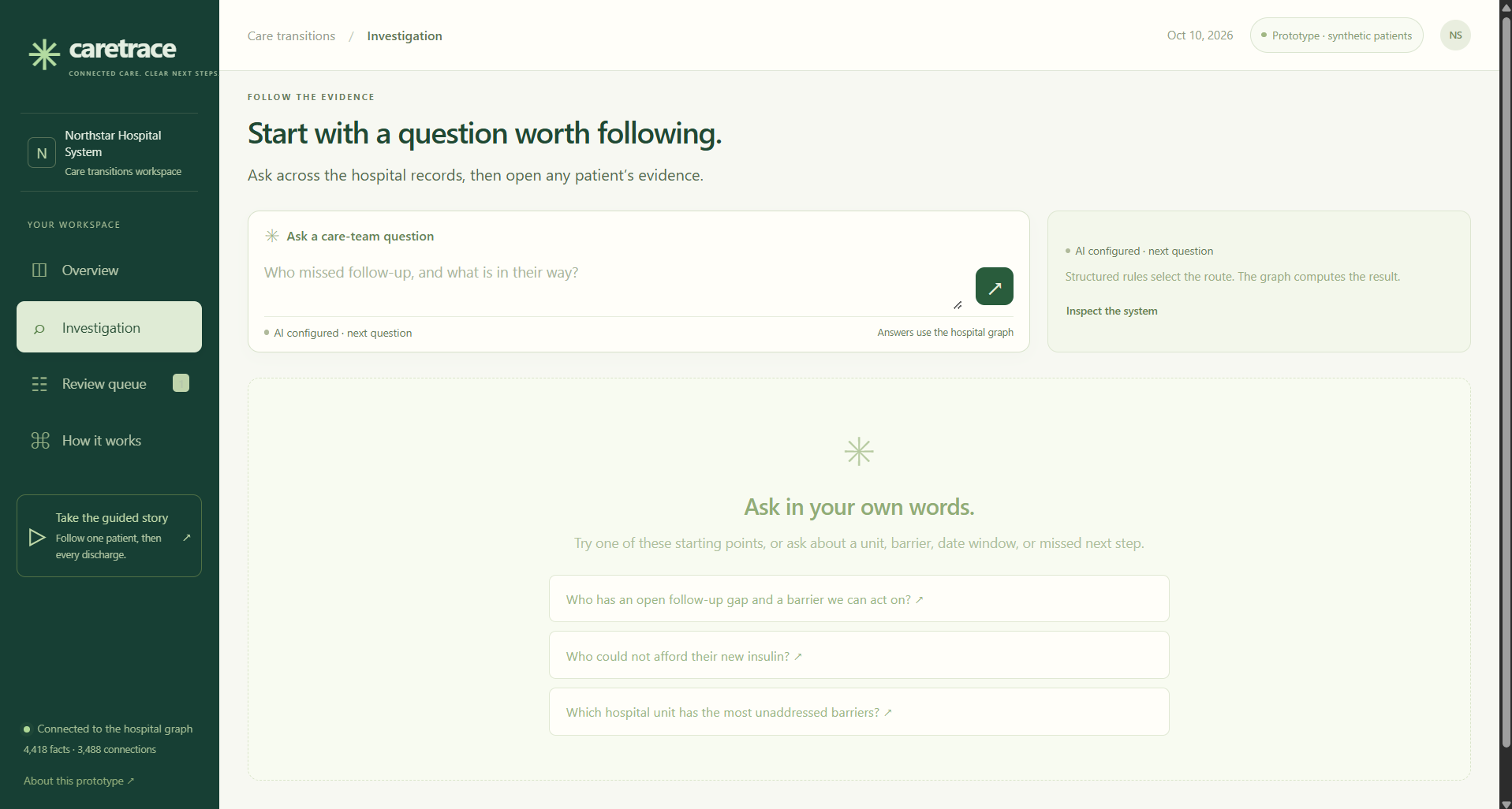
Instead of forcing healthcare workers to search through disconnected records, CareTrace allows them to investigate care gaps using natural language and trace each finding back to its original evidence.
Our platform includes:
AI-powered investigations: An OpenAI-powered agent interprets natural-language questions and executes validated tools to retrieve evidence-backed patient information.
Knowledge graph reasoning: Connects patient histories, missed appointments, medications, documented barriers, and follow-up actions.
Clinical note analysis: Detects transportation difficulties, medication affordability concerns, food insecurity, and health literacy barriers.
Evidence tracing: Allows users to inspect the exact clinical note, author, date, and source supporting each finding.
Interactive simulations: Reconstructs historical patient information and explores how resolving a barrier changes the identified patient group.
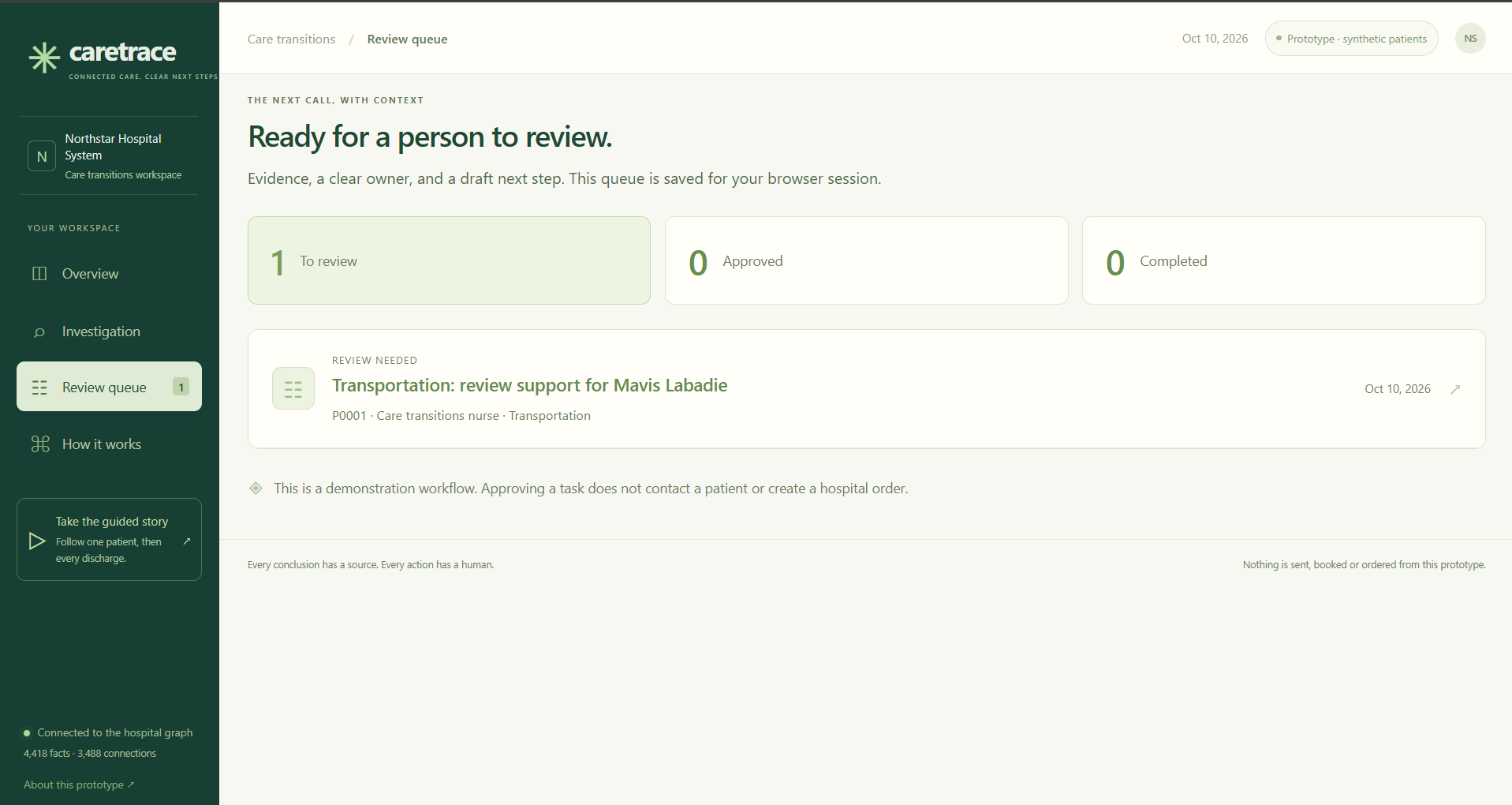
Human-reviewed care tasks: Creates evidence-linked follow-up tasks that require explicit approval before progressing.
Google Gemini integration: Organizes existing care-team actions into a structured, evidence-linked brief.
ElevenLabs integration: Converts approved care-team task summaries into playable audio.
For example, our demonstration follows a fictional patient who missed an endocrinology appointment and never collected prescribed insulin. CareTrace connects those records to a nursing note documenting transportation difficulties, helping the care team investigate the situation and prepare an appropriate follow-up task.
The goal is to turn disconnected healthcare information into clear, explainable, and actionable next steps.
How we built it
We built CareTrace using a combination of agentic AI, graph-based data analysis, natural language processing, and full-stack web development.
Our technology stack includes:
Frontend: JavaScript, HTML, CSS, and SVG for the interactive dashboard and knowledge graph.
Backend: Node.js with validated REST APIs and structured investigation workflows.
AI Agent: OpenAI Responses API with function calling to execute controlled graph operations and retrieve supporting evidence.
Google Gemini API: Generates an ordered care brief from existing permitted actions without inventing new recommendations.
ElevenLabs API: Converts approved care-team task text into speech.
Data Processing: A custom pattern-based clinical note reader extracts documented barriers and builds relationships between records.
Database: SQLite for local development and Cloudflare D1 for hosted persistence.
Deployment: Cloudflare Workers, with our public domain provided through the GoDaddy Registry hackathon offer.
Dataset: 1,000 fictional patients and 600 clinical notes, combining Synthea-derived information with reproducible synthetic healthcare scenarios.
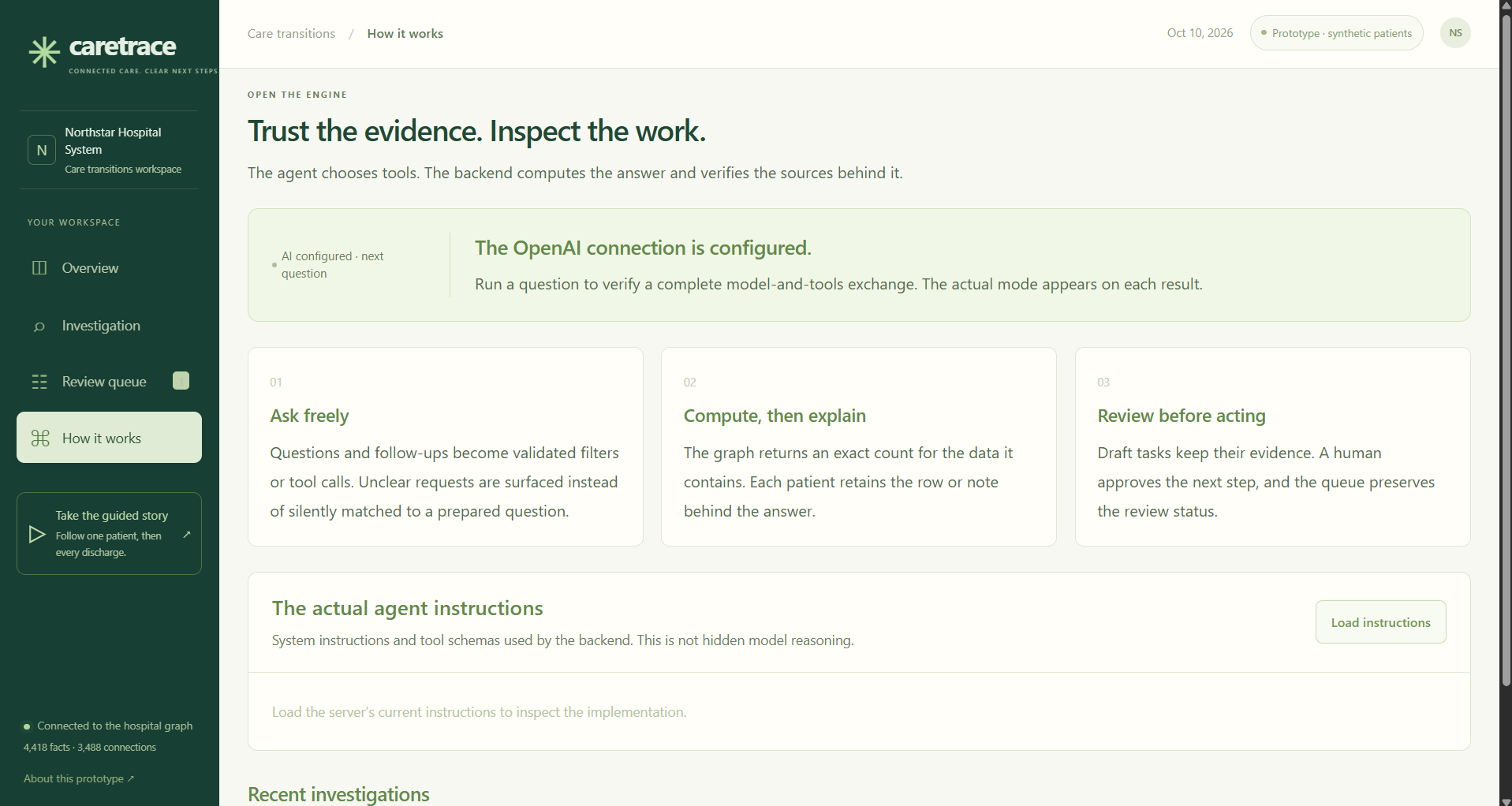
One of our most important architectural decisions was separating AI interpretation from factual computation. Rather than allowing a language model to generate unsupported patient statistics, we developed a graph-based system that computes results directly from structured records.
Our AI agent uses strictly validated tools to query patient groups, inspect individual records, retrieve original evidence, compare cohorts, and simulate hypothetical barrier resolution.
We also built a human-review workflow that stores evidence-linked tasks and tracks their progression from draft to approved to completed.
The application is publicly accessible at https://caretrace.us/.
Challenges we ran into
One of our biggest challenges was connecting structured hospital records with unstructured clinical notes while preserving accurate evidence.
Clinical language is complicated. A note mentioning transportation does not necessarily mean a patient currently lacks transportation. We had to account for negation, historical statements, resolved concerns, and misleading context to avoid incorrectly identifying barriers.
Another challenge was reducing AI hallucinations and ensuring trustworthy investigations. We addressed this by implementing strict function-calling schemas, source verification, patient-specific evidence checks, and server-calculated results.
We also encountered challenges involving API timeouts, model responses that failed citation validation, persistent task states, and coordinating multiple AI providers within one application.
Integrating OpenAI, Gemini, and ElevenLabs required us to carefully define what each model was allowed to do while maintaining consistent evidence and review requirements.
Finally, deploying a full-stack application with persistent storage, server-side AI integrations, and a custom domain required additional testing and configuration.
Accomplishments that we're proud of
Our biggest accomplishment is creating a functional AI-assisted workflow that goes beyond simply displaying healthcare information.
CareTrace connects a care gap to an investigation, links the finding to original clinical evidence, and prepares a human-reviewed next step.
Some of our key accomplishments include:
Built an interactive knowledge graph connecting fictional patient records, appointments, medications, clinical notes, and care barriers.
Implemented an agentic AI investigation system using OpenAI function calling and evidence validation.
Integrated Google Gemini to organize evidence-linked care actions.
Integrated ElevenLabs to generate playable audio from approved care-team tasks.
Developed a reproducible synthetic dataset containing 1,000 patients and 600 clinical notes.
Achieved 89.09% precision and 90.74% recall in our synthetic clinical barrier-detection evaluation.
Identified 60 open follow-up gaps and 26 patients with detected current barriers in our demonstration dataset.
Implemented persistent investigations, task approval workflows, and historical patient views.
Recorded 198 passing automated tests in our latest documented release.
Deployed a publicly accessible application at caretrace.us.
We are especially proud of making AI results inspectable. Users can see the evidence and graph relationships behind a finding rather than relying on an unexplained AI-generated response.
What we learned
Building CareTrace taught us that developing reliable AI applications requires much more than connecting a language model to a user interface.
We gained experience with AI agents, function calling, knowledge graph modeling, natural language processing, API integration, database persistence, and full-stack deployment.
We learned how to coordinate multiple AI services while keeping factual computation separate from language-model interpretation.
We also gained a deeper understanding of evaluating AI systems. Our clinical note reader produced measurable false positives and false negatives, demonstrating why accurate graph calculations alone cannot guarantee accurate underlying evidence.
Most importantly, we learned the importance of transparency, explainability, and human oversight when building technology for sensitive environments like healthcare.
An AI system should not simply provide an answer. It should help users understand where that answer came from and what they can responsibly do with it.
What's next for CareTrace
CareTrace is currently a working prototype built around synthetic healthcare data. It is not a clinically validated system or a replacement for professional medical judgment.
Our next steps include:
Improving clinical language understanding: Expanding our extraction methods and evaluating performance across more varied clinical notes.
Expanding healthcare workflows: Supporting additional conditions, care pathways, and documented barriers.
Real-world validation: Working with healthcare professionals to evaluate usability and clinical workflow relevance.
Secure healthcare integration: Exploring authorized electronic health record integrations, staff authentication, and appropriate data protection.
Advanced analytics: Investigating carefully validated predictive models that could help care teams prioritize follow-up work.
Collaboration: Developing shared review queues and role-based workflows for multidisciplinary care teams.
Our long-term vision is to make CareTrace a platform that helps healthcare teams connect fragmented information, recognize overlooked care barriers, and coordinate timely follow-up.
Built With
- agentic-ai
- ai-agents
- artificial-intelligence
- clinical-data-analysis
- cloudflare-d1
- cloudflare-workers
- css
- data-visualization
- elevenlabs-api
- function-calling
- godaddy-registry
- google-gemini-api
- graph-based-reasoning
- healthcare-technology
- html
- javascript
- knowledge-graphs
- machine-learning
- natural-language-processing
- node.js
- openai-api
- rest-api
- sqlite
- synthea


Log in or sign up for Devpost to join the conversation.