CareTrace
Your symptoms have a timeline. CareTrace makes it easier to share your story at your next appointment.
🏆 Winner, Best Use of Snowflake at Hacktoberfest x ElleHacks Hack Day 2026
🎥 Demo video: Watch on YouTube
Demo only. Every patient record in this app is synthetic (Synthea-generated). CareTrace is not a medical device. It does not diagnose, recommend treatment or give emergency advice.
Why I built it
Every time I go to the doctor, I forget my symptoms the moment I sit down. For women, the dates matter: cycles, pregnancies and losses. How many times has your doctor asked when your last period was and how long it lasted? If you can't answer correctly, your doctor can't give you the best care they can. I built CareTrace so you don't have to remember that information yourself.
What it does
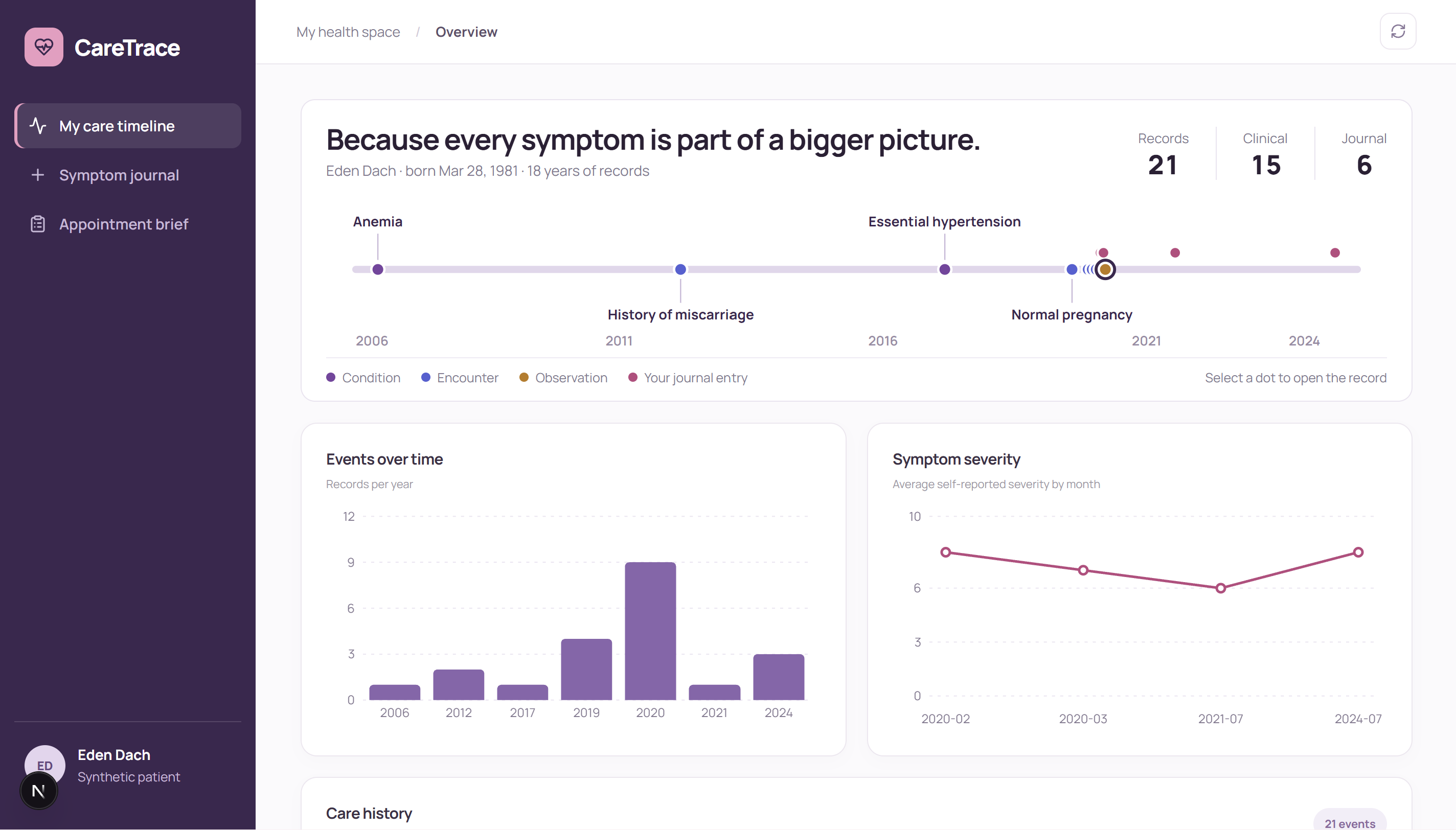
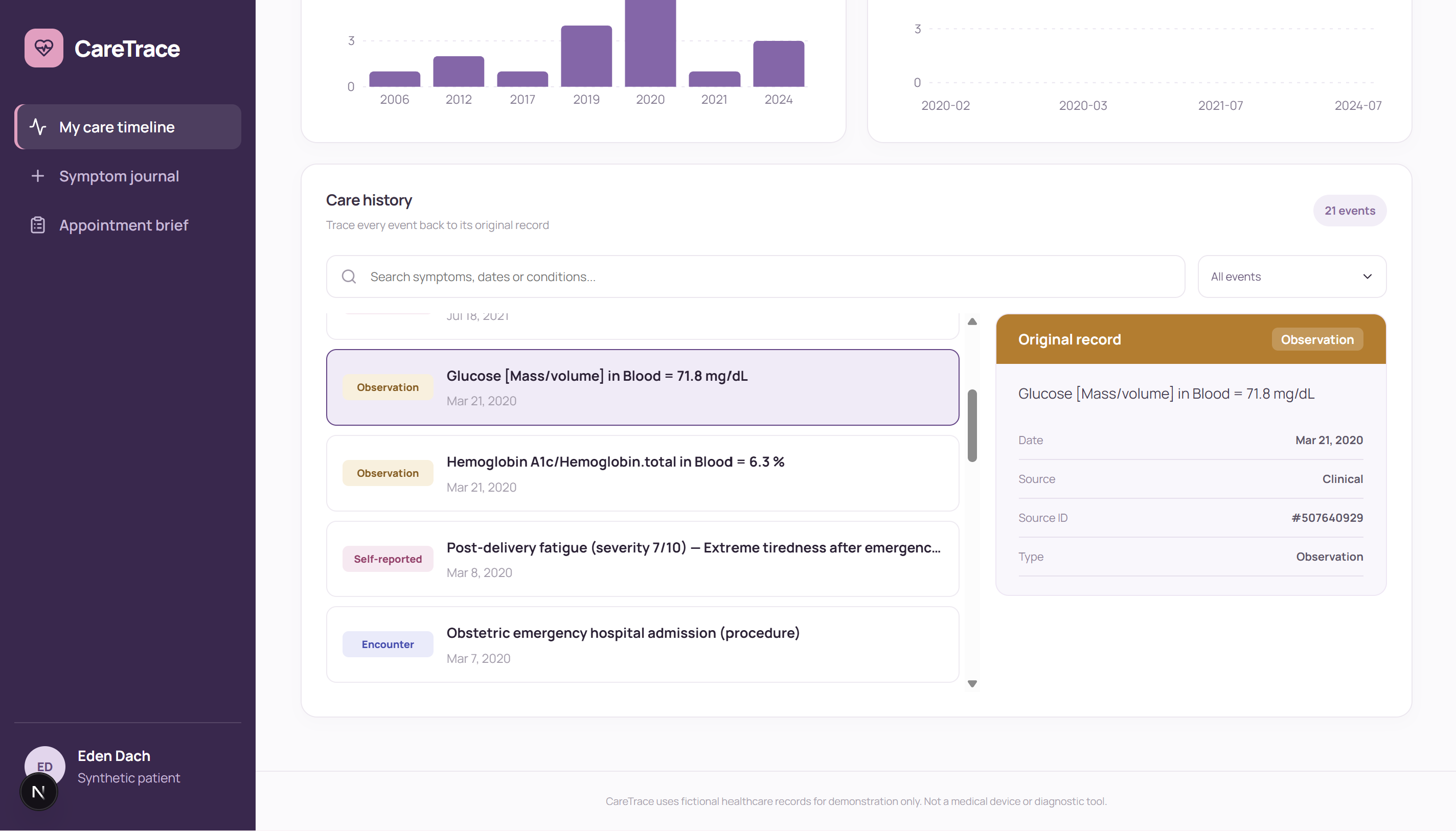
- Timeline: clinical conditions, visits and lab results from Snowflake, merged with symptoms you log yourself.
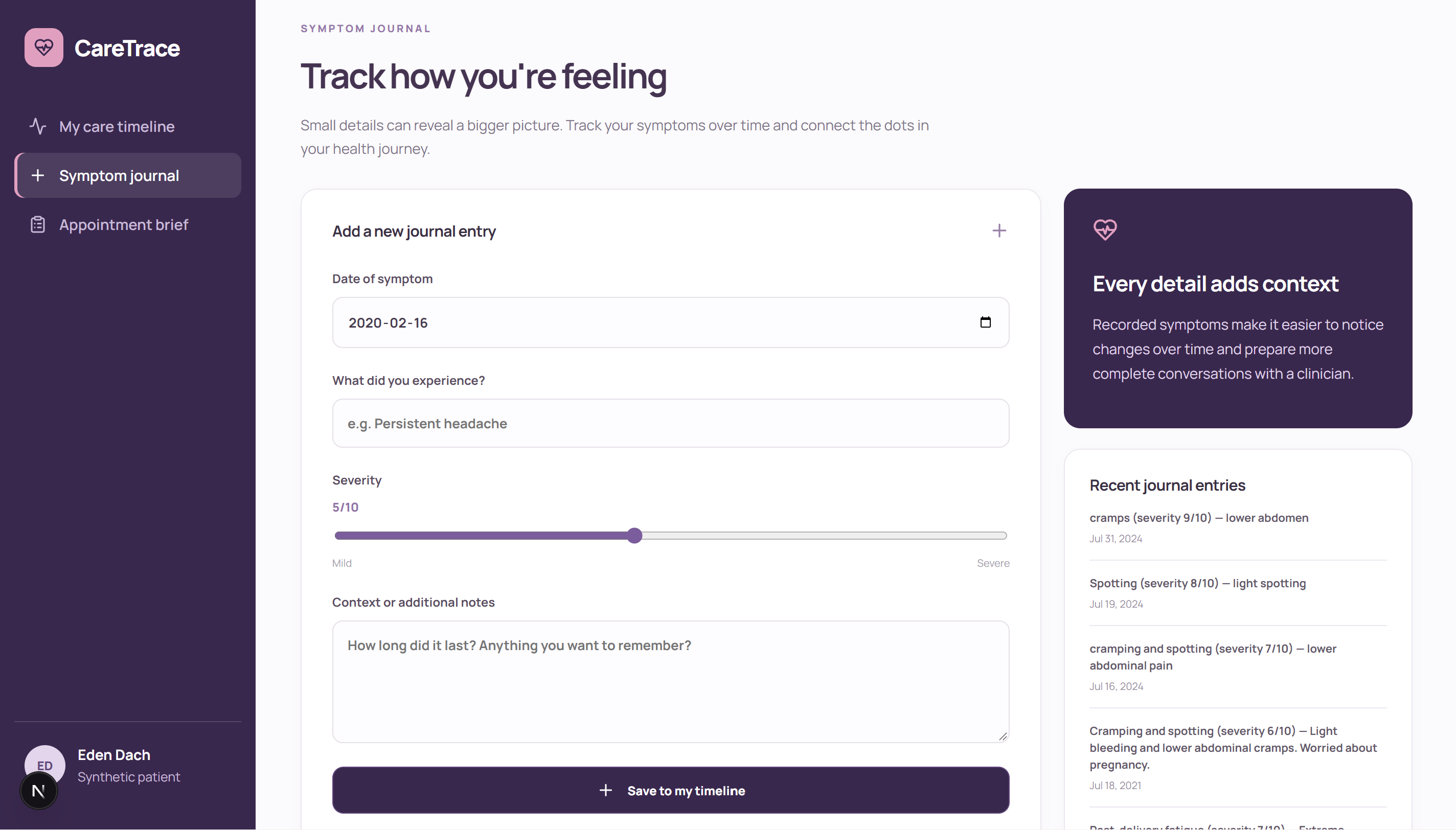
- Symptom journal: each entry is saved to Snowflake and appears on the timeline straight away.
- Trends: monthly symptom count and average severity, calculated in Snowflake SQL.
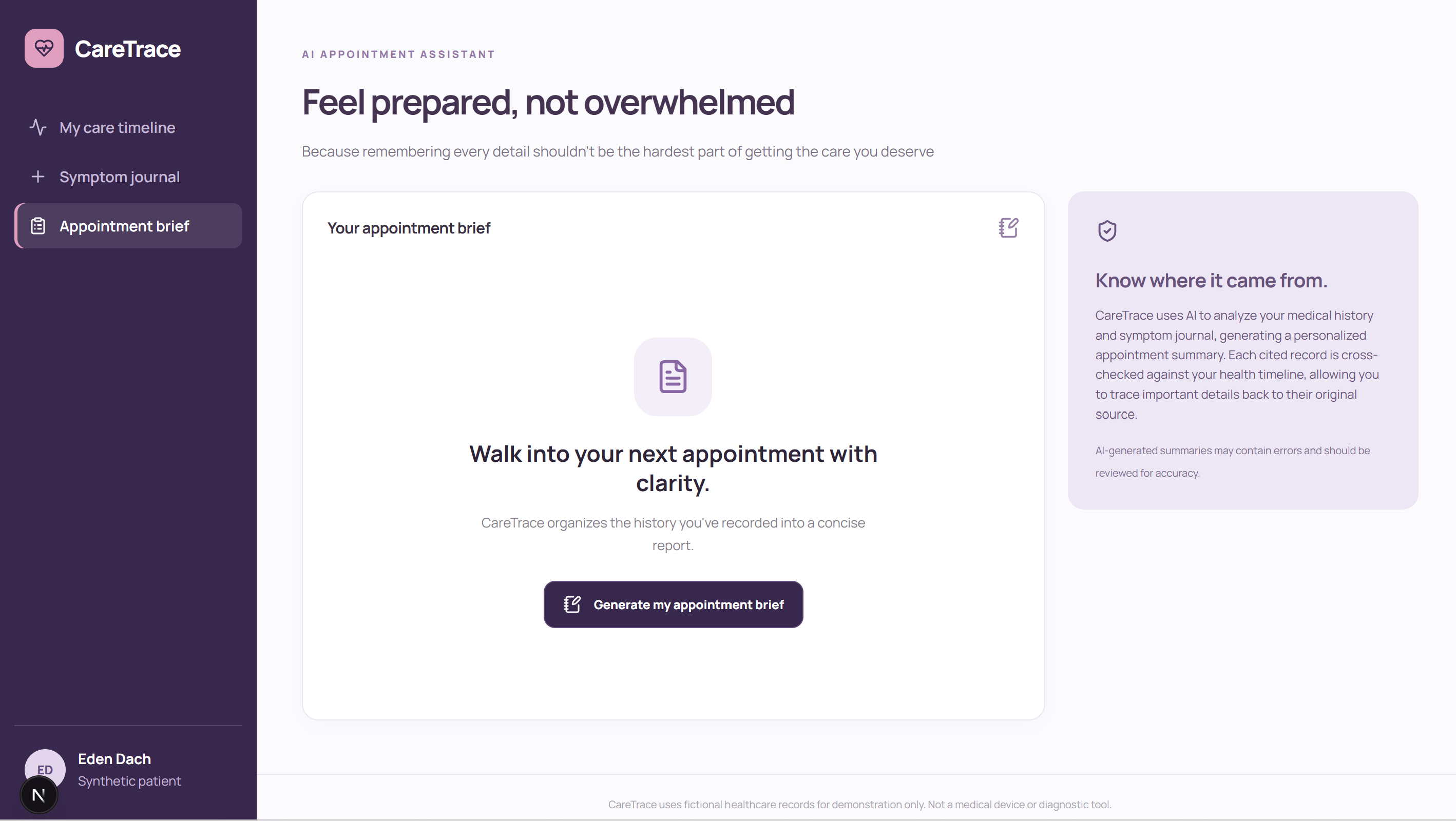
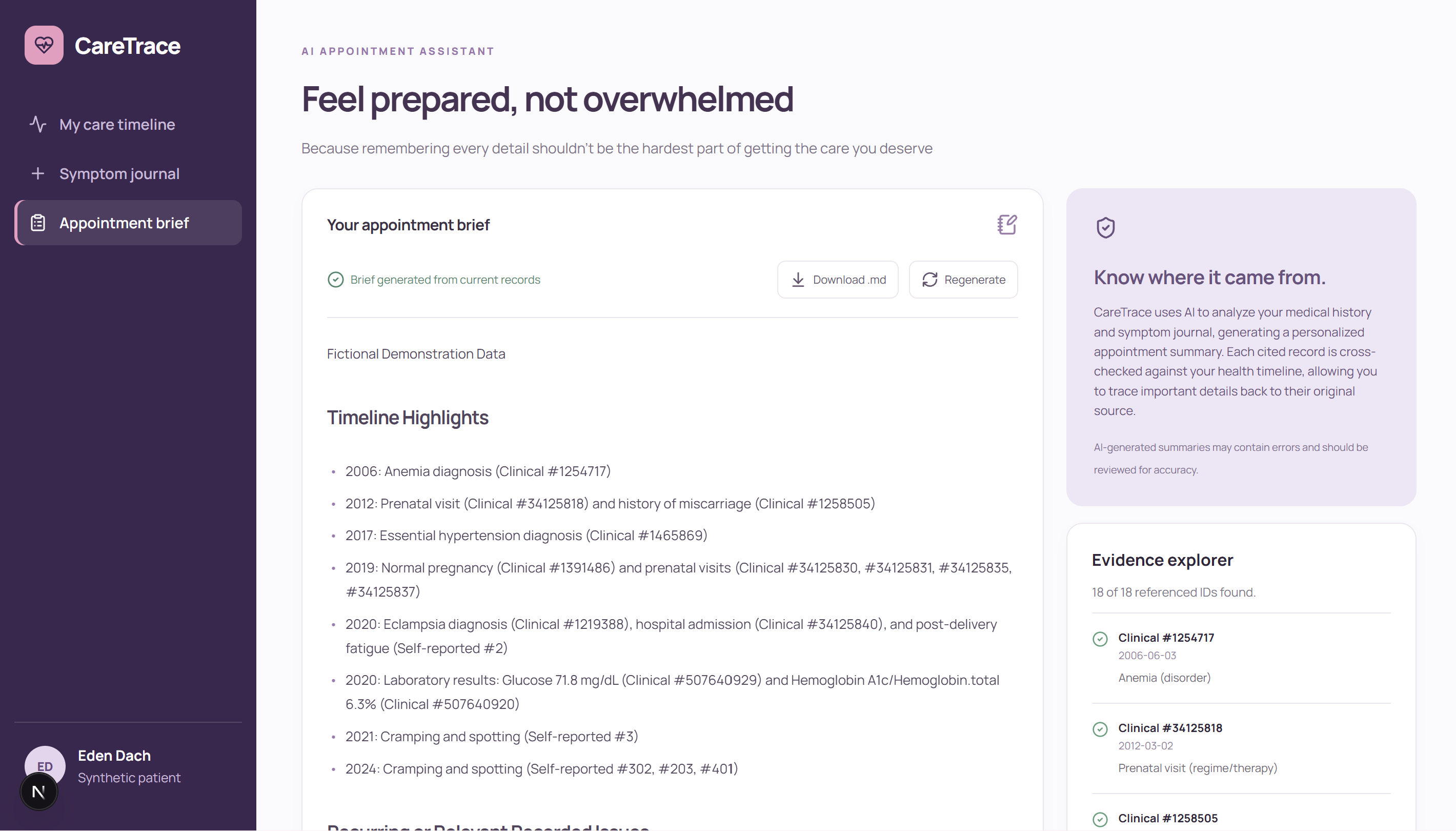
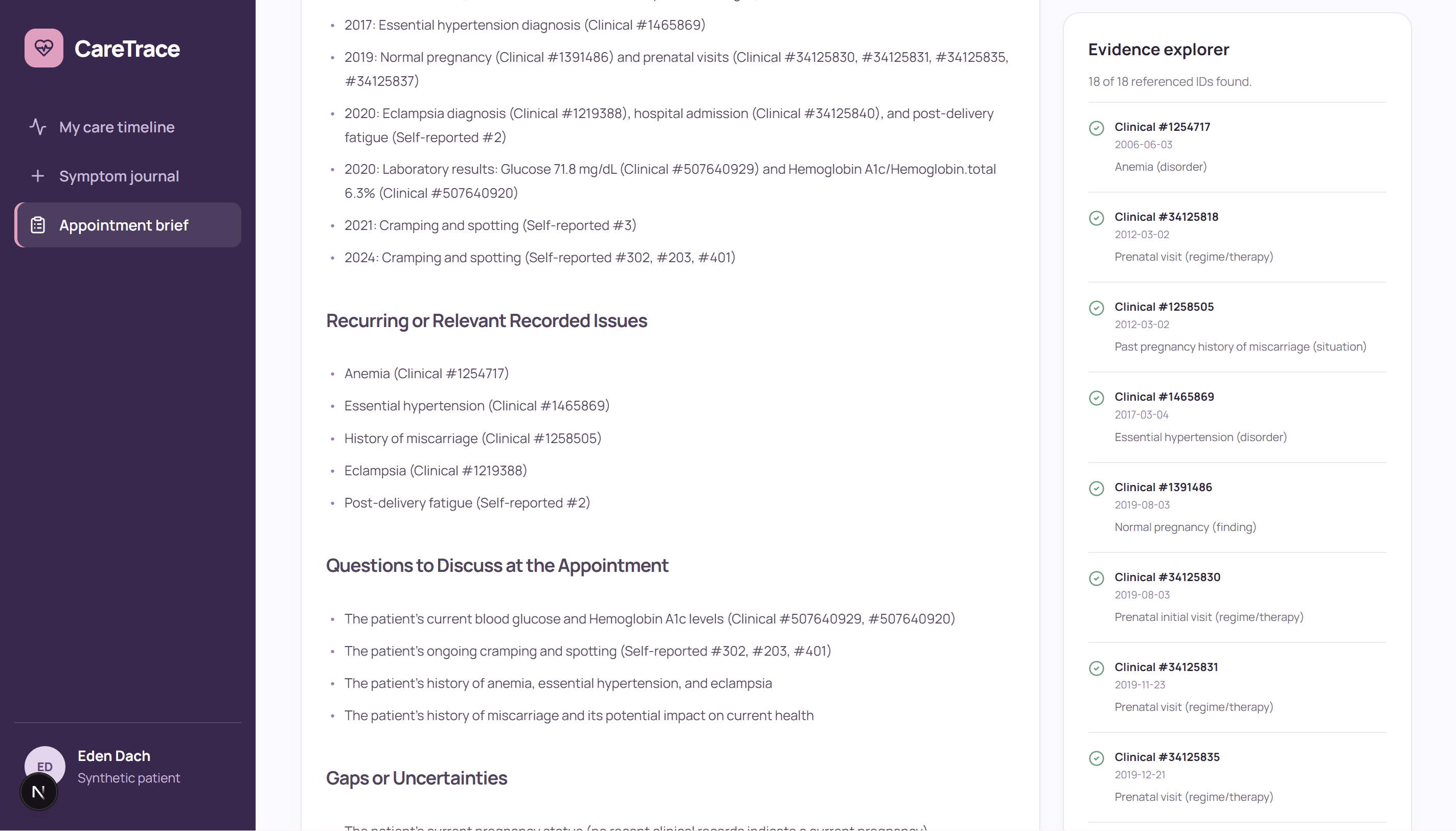
- AI appointment brief: Llama 3.1 8B, running in Snowflake Cortex, turns your records into highlights, recurring issues, questions to ask and gaps.
- Evidence explorer: every record ID the AI cites is checked against your real timeline, and any ID it made up is flagged.
Architecture
Browser (React UI)
   │  fetch
   ▼
Next.js API routes (server only, credentials never reach the browser)
   ├── GET  /api/timeline  → SQL: DEMO_TIMELINE ∪ USER_NOTES + monthly DATE_TRUNC/COUNT/AVG
   ├── POST /api/notes     → INSERT INTO USER_NOTES (validated, parameter-bound)
   └── POST /api/brief     → SNOWFLAKE.CORTEX.COMPLETE('llama3.1-8b', prompt) → citation check
   │  snowflake-sdk (Node.js)
   ▼
Snowflake: CARETRACE.PUBLIC  ←  built from the SYNTHETIC_HEALTHCARE_DATA_CLINICAL_AND_CLAIMS Marketplace share
| File | Purpose |
|---|---|
src/app/ui.tsx |
React UI: timeline, trends, symptom journal, AI brief, evidence explorer |
src/app/api/timeline/route.ts |
Reads the timeline and monthly trends from Snowflake |
src/app/api/notes/route.ts |
Validates a symptom entry and inserts it into USER_NOTES |
src/app/api/brief/route.ts |
Builds the prompt from current Snowflake rows, calls Cortex and checks cited IDs |
src/lib/caretrace.ts |
Timeline and trends SQL, and the citation checker |
src/lib/snowflake.ts |
Snowflake connection (server only) |
sql/setup.sql |
SQL CoCo helped write to build the CareTrace tables from the Marketplace dataset |
Stack: Next.js 15, React 19, TypeScript, Recharts, snowflake-sdk, Snowflake Cortex.
How the AI brief stays grounded
- The server reads the latest records from Snowflake for each brief. It never uses data sent by the browser.
- The prompt limits the model to recorded events. It may not diagnose, suggest treatment or infer causes, and it must cite a record ID beside each key claim.
- After the model replies, every cited ID is checked against the timeline. This shows that each cited record exists, not that every claim is correct, so always review the original records.
Run it locally
You need Node.js and a Snowflake account (a free trial works) with the Marketplace listing above added.
- Run
sql/setup.sqlin a Snowsight worksheet. ⚠️ It usesCREATE OR REPLACE, so it deletes any existing CareTrace notes. - Copy
.env.exampleto.env.localand fill in your Snowflake account, user, warehouse, role and programmatic access token. - Install and start the app:
bash
npm install
npm run dev
Open http://localhost:3000.
Credentials stay on the server. The API has no login or rate limiting, so don't deploy it publicly as-is.
License and credits
- Code: MIT
- Model: Meta Llama 3.1 8B, under the Llama 3.1 Community License. Built with Llama.
- Data: Synthetic Healthcare Data - Clinical and Claims, Snowflake Virtual Hands-On Labs, Snowflake Marketplace. # CareTrace
Built With
- llama
- next.js
- node.js
- react
- recharts
- snowflake
- sql
- typescript


Log in or sign up for Devpost to join the conversation.