-
-
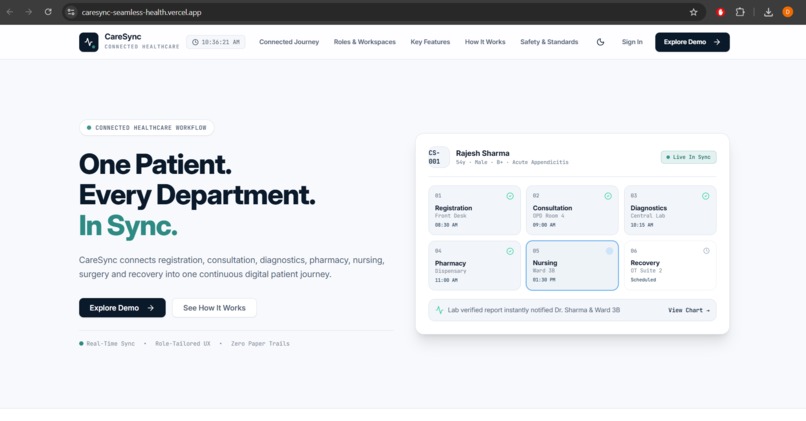
landing page
-
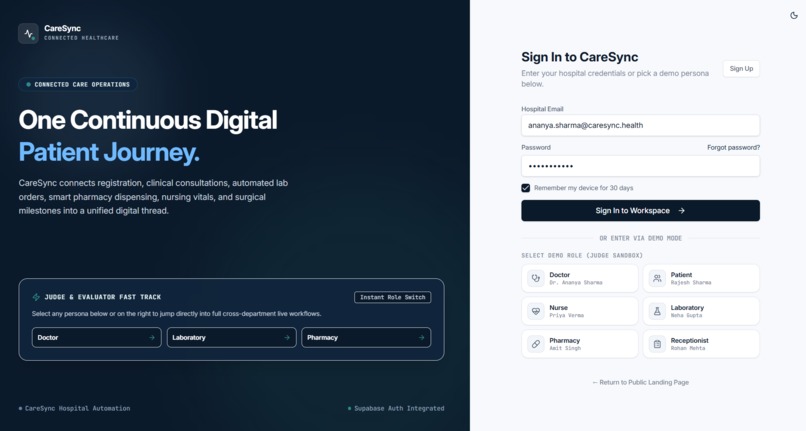
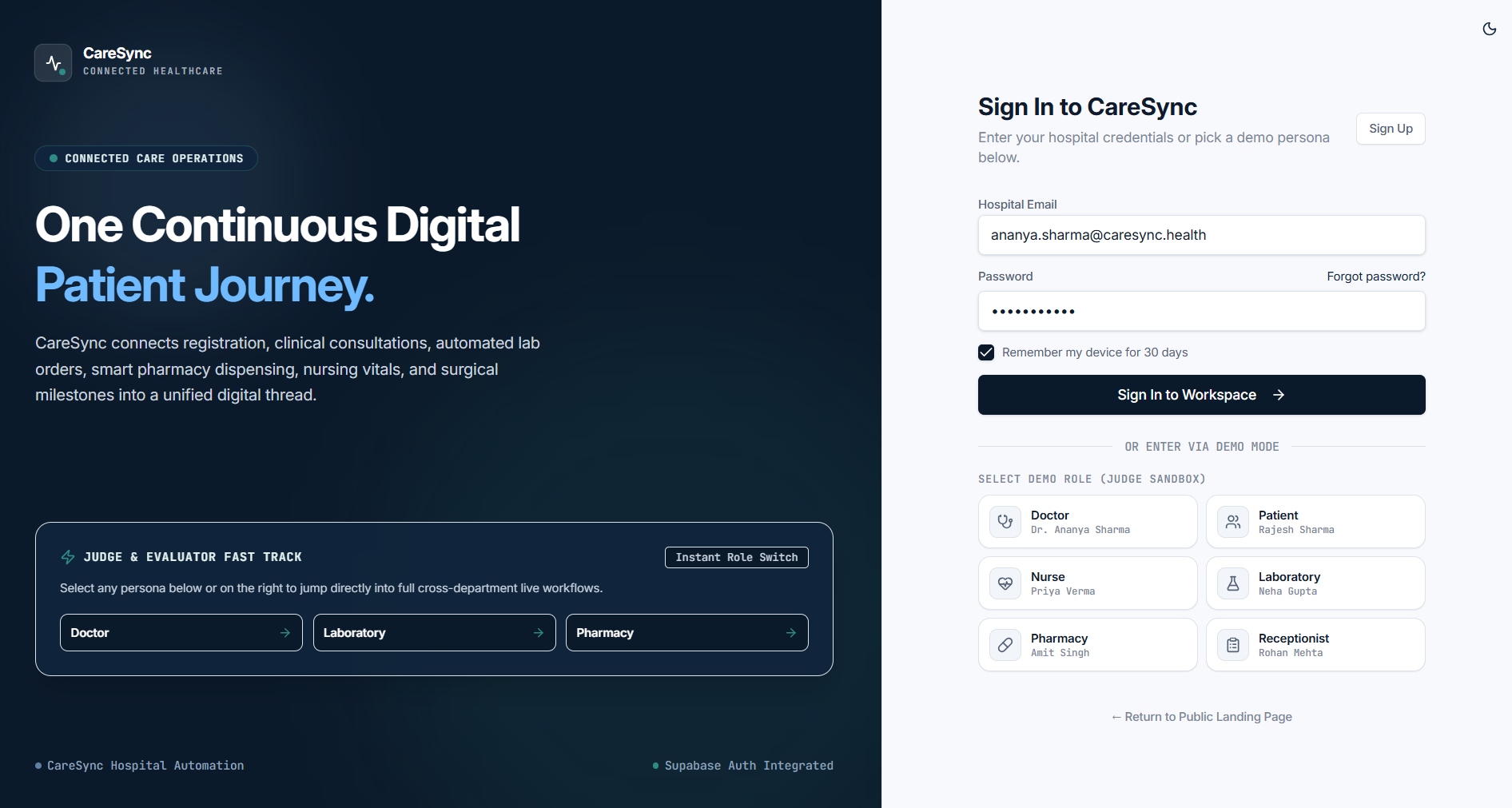
sign in page
-

roles page
-

patient workspace
-

receptioinist
-

doctor
-

nurse
-

laboratory
-

pharmacy
-

demo hub
-
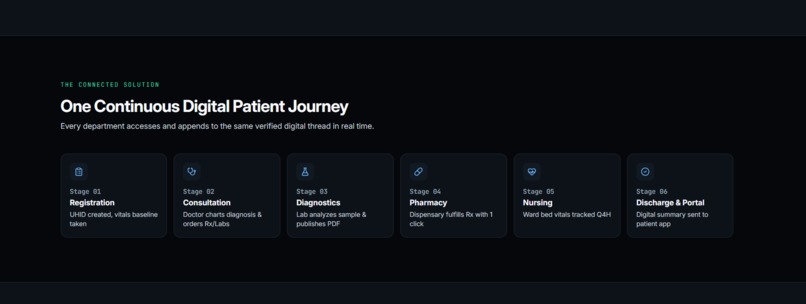
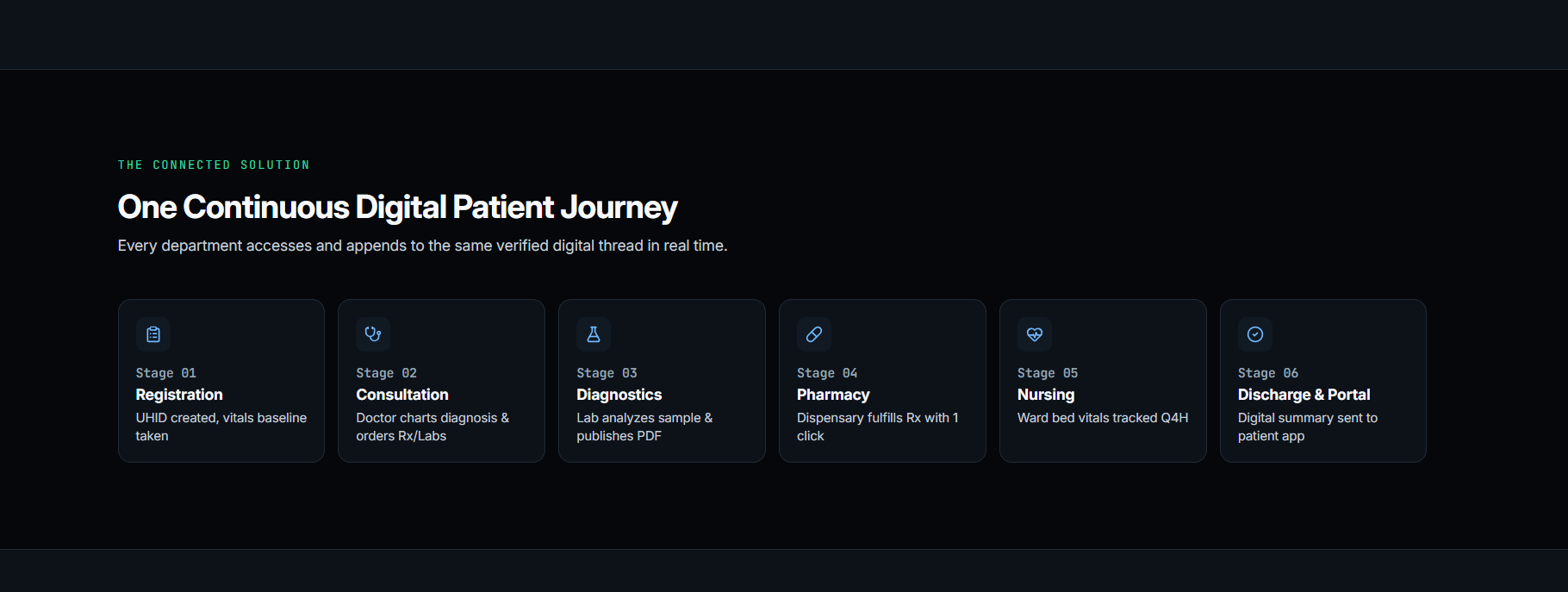
connected solution
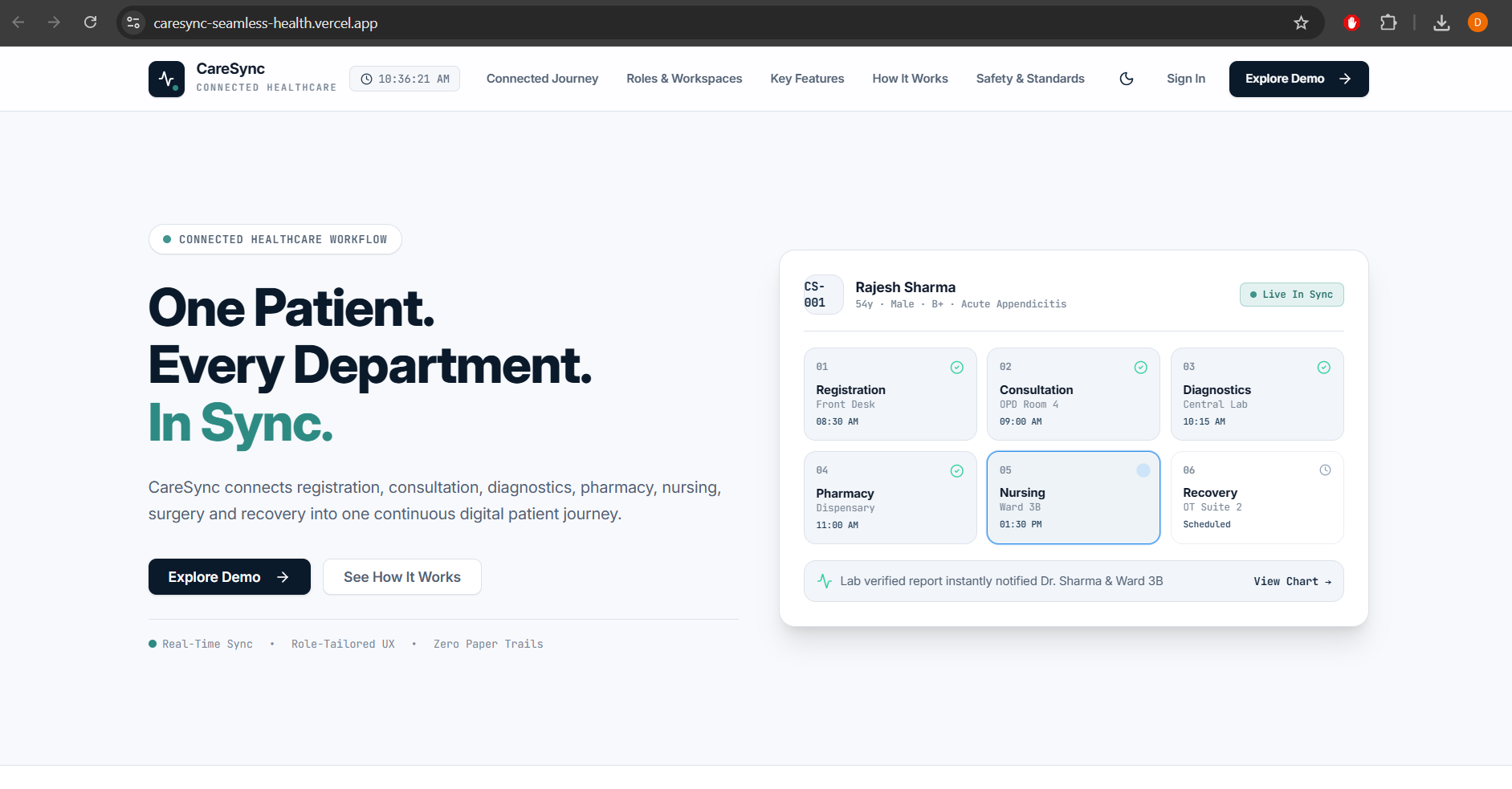








About CareSync
The Inspiration
Care is not delivered by a single person or department. A patient's journey can involve registration, doctors, diagnostics, pharmacy, nursing, admission, surgery, recovery, and discharge. However, these departments often work with disconnected information, paper records, manual communication, and repeated data entry.
We were inspired by a simple question:
What if the entire patient journey could stay connected from registration to recovery?
That idea became CareSync — Seamless Health, a digital hospital workflow prototype designed to connect departments around one continuously updated patient record.
Our goal was not to replace doctors, nurses, or hospital staff. Instead, we wanted to build technology that reduces repetitive paperwork, improves information flow, and gives every department the context they need to do their work more efficiently.
What We Built
CareSync brings multiple hospital workflows into one platform:
Patient Registration → Doctor Consultation → Diagnostics → Pharmacy → Nursing → Admission/Surgery → Recovery → Discharge
The prototype includes role-based workspaces for:
- Patient — appointments, prescriptions, reports, notifications, and health journey
- Receptionist — registration, appointments, patient records, and billing-related workflows
- Doctor — consultations, diagnoses/clinical notes, prescriptions, test orders, and patient history
- Nurse — vitals, nursing updates, admissions, and patient-care information
- Laboratory — test orders, report entry, and diagnostic workflow
- Pharmacy — prescriptions, medicine inventory, and dispensing workflow
Instead of maintaining isolated departmental records, CareSync creates a connected patient journey where updates made by one department can become useful information for the next.
AI-Powered Assistance
We also integrated AI capabilities to make the system easier to use.
Features such as Ask CareSync, report summarization, prescription explanation, patient summaries, and workflow insights are designed to help users understand existing information faster.
AI is implemented through a secure backend flow using a Supabase Edge Function, rather than exposing API keys in the frontend.
AI is used as an assistance layer — not as a replacement for medical professionals. The system does not claim to independently diagnose patients, prescribe treatment, or make clinical decisions.
How We Built It
CareSync was developed as a full-stack web application using modern web technologies.
Core Technologies
- Frontend: React, TypeScript, modern responsive UI
- Backend & Database: Supabase, PostgreSQL
- Authentication: Supabase Auth
- Authorization: Role-based access and Row Level Security (RLS)
- AI: Supabase Edge Functions connected to an AI model
- Storage: Supabase Storage for protected medical documents
- PDF Generation: Dynamic reports, prescriptions, invoices, and patient summaries
- Deployment: Web-based deployment with GitHub-based development workflow
A major design decision was to keep the patient record at the center of the system. Instead of building completely independent dashboards, different roles interact with the same underlying workflow and database.
What We Learned
Building CareSync taught us that creating a useful healthcare application is much more than designing a dashboard.
We learned how important it is to think about:
1. End-to-end workflows
A feature can work perfectly on one page and still fail if it does not connect properly to the next department.
Designing the complete patient journey helped us understand how frontend, database, authentication, authorization, and business logic need to work together.
2. Database design matters
Connecting patients, visits, prescriptions, test orders, test results, medicines, pharmacy orders, vitals, admissions, surgeries, invoices, notifications, and timelines required careful relational database design.
We learned that a good database structure can make complex workflows much easier to manage.
3. Security cannot be an afterthought
Because healthcare information is sensitive, we focused on authentication, role-based access, RLS policies, protected storage, and keeping API secrets on the backend.
Even though CareSync is only a hackathon prototype, designing it with these principles helped us understand how production-oriented systems should approach sensitive data.
4. AI integration is more than sending a prompt
Reliable AI functionality requires the correct context.
We had to think about what information an AI assistant should receive, which user is requesting it, what that user is authorized to access, and how the response should be presented safely.
Challenges We Faced
The biggest challenge was connecting many moving parts into one stable application.
During development, we encountered issues involving:
- Authentication and role-based routing
- Supabase queries and database relationships
- Row Level Security policies
- Shared application state
- AI context construction
- Undefined store functions and runtime errors
- Redirect loops during authentication
- PDF generation from dynamically loaded records
- Keeping the interface responsive while AI and database requests were running
- Making the application work consistently across desktop and mobile layouts
One particularly important lesson was that fixing an individual feature is not enough. A change in one part of a connected system can affect authentication, routing, state management, AI context, or another dashboard.
This pushed us toward a more systematic approach: shared utilities, centralized workflows, reusable components, stronger error handling, and testing across every user role.
What Makes CareSync Different
CareSync is built around the idea of a connected patient journey, rather than treating each hospital department as a separate application.
The goal is simple:
One Patient. Every Department. In Sync.
A receptionist starts the journey.
A doctor continues it.
The laboratory adds diagnostic information.
The pharmacy processes medicines.
Nurses maintain care information.
Admissions and surgery continue the workflow.
And the patient's complete history stays connected throughout the process.
Hackathon Scope
CareSync is a hackathon prototype created to demonstrate how hospital workflows could be digitally connected.
The project uses fictional/demo data and is not intended for real-world clinical use without extensive validation, compliance, security, infrastructure, and professional oversight.
We focused on building a functional end-to-end demonstration rather than claiming to provide a production-ready hospital information system.
AI-Assisted Development
AI-assisted tools were used during development for brainstorming, UI/UX exploration, code generation, debugging, refactoring, documentation, and development guidance.
The architecture, feature decisions, integration work, testing, debugging, and final project direction were iterated throughout the hackathon.
The Biggest Takeaway
The most important thing we learned is that healthcare technology is fundamentally about people, processes, and information working together.
CareSync started as an idea to reduce paperwork.
It evolved into a broader vision:
Connect the workflow, connect the information, and help people focus more on care.
Built With
- access
- ai
- api
- application
- authentication
- cloud
- computing
- control
- css
- database
- full
- generative
- github
- healthcare
- healthtech
- javascript
- openai
- postgresql
- react
- responsive
- rest
- stack
- supabase
- typescript
- web


Log in or sign up for Devpost to join the conversation.