-
-
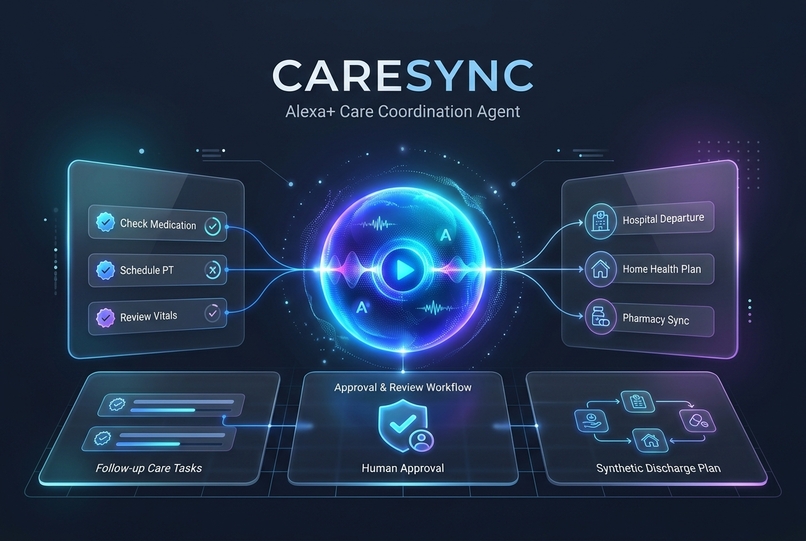
CareSync: Alexa+ Care Coordination Agent powered by Streamable HTTP FastMCP and human approval gating.
-
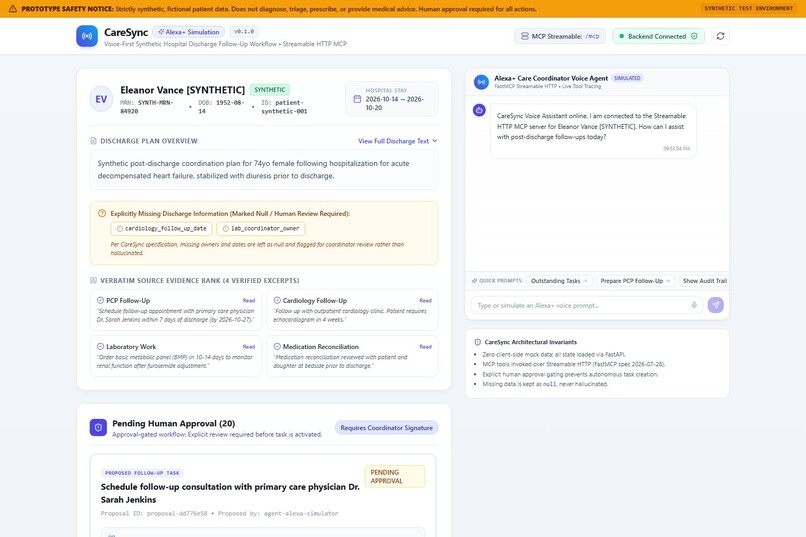
CareSync Unified Clinical Cockpit: Real-time Streamable HTTP FastMCP tool tracing and approval-gated follow-up coordination.
-
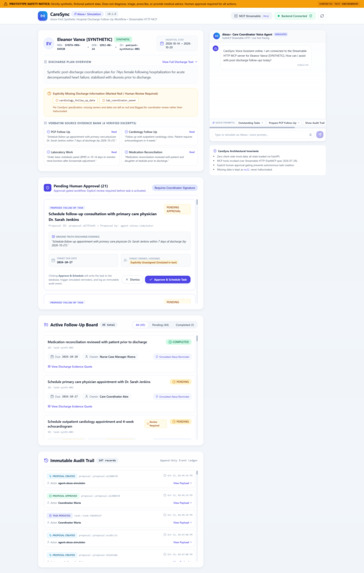
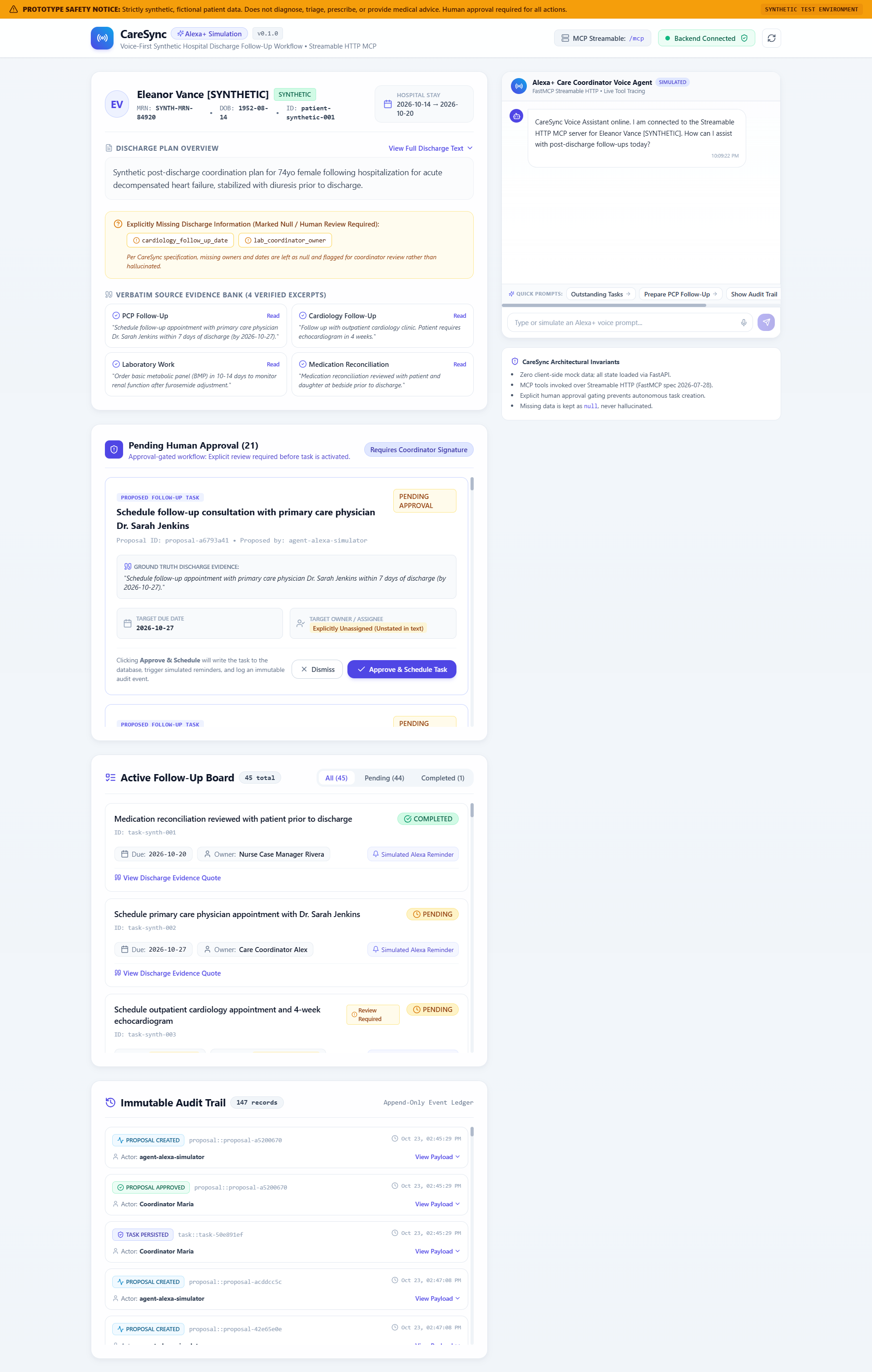
End-to-end CareSync workspace: Synthetic patient context, Alexa+ voice simulation, approval-gated task proposals, and immutable audit trail.
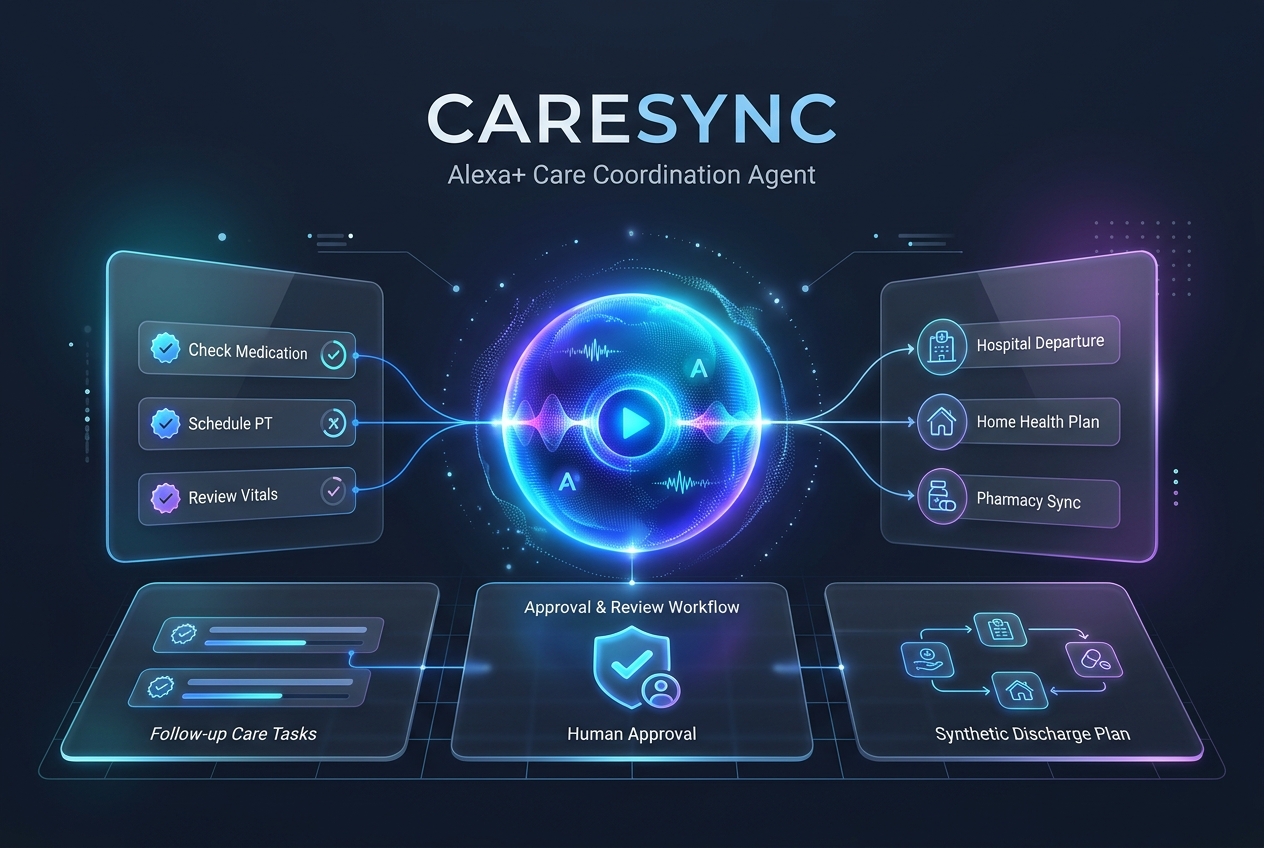
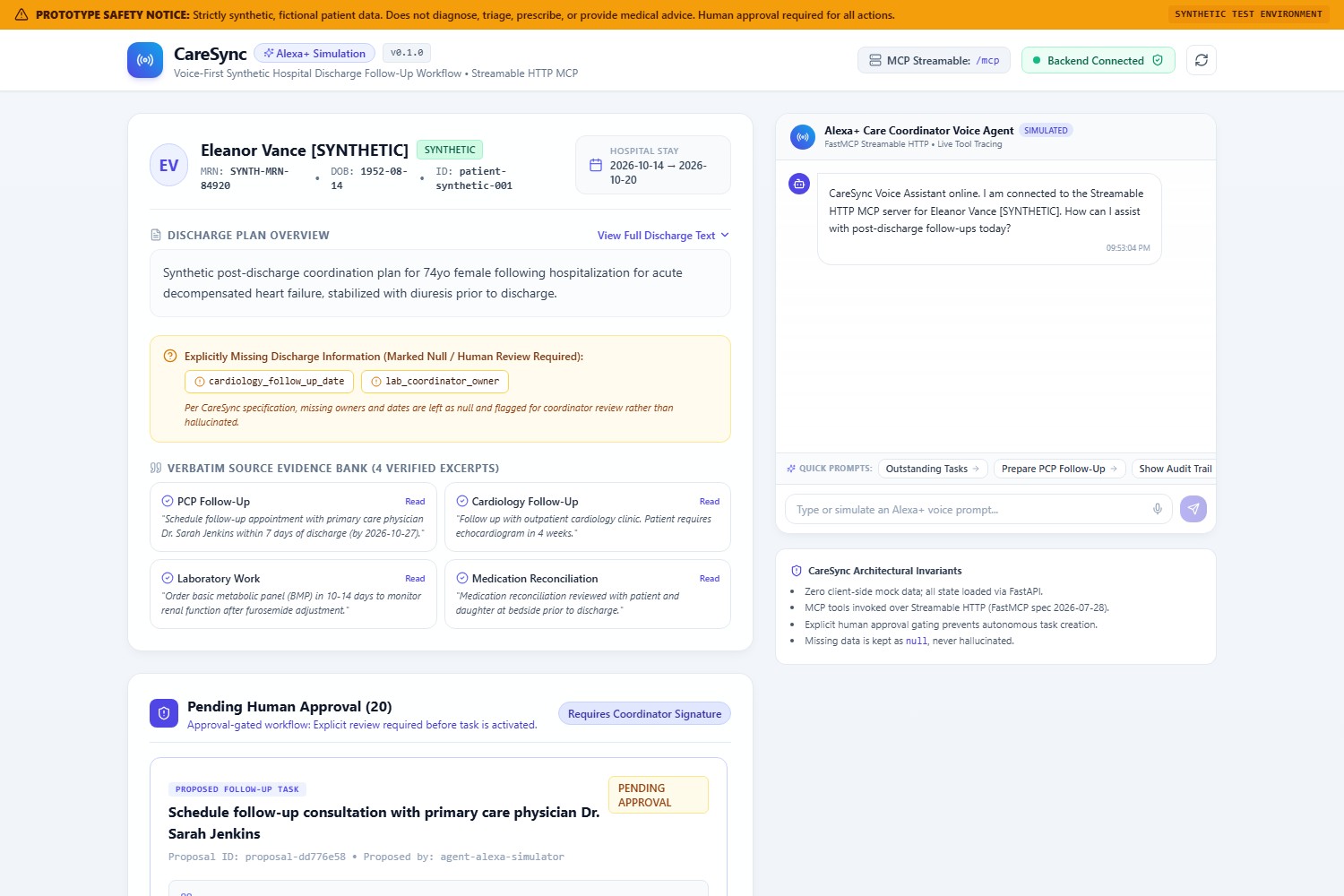
Inspiration: Hospital discharge is not always the end of a patient's care journey. Follow-up appointments, pending tasks, and coordination responsibilities can be overlooked when information must move between discharge documents and care teams. We wanted to explore how a voice-first assistant inspired by Alexa+ could help care coordinators turn discharge information into structured, evidence-backed follow-up tasks without allowing AI to make unapproved decisions. That idea became CareSync: a human-in-the-loop care coordination simulation built around synthetic hospital data.
What it does: CareSync demonstrates how an AI-assisted workflow can help a care coordinator: • Retrieve a synthetic hospital discharge plan and inspect its source evidence. • Review existing follow-up tasks and identify missing information. • Propose follow-up tasks linked to supporting discharge text. • Require explicit human approval before a proposed task becomes an active task. • Inspect an audit trail of proposals, approvals, rejections, and task creation. CareSync is a simulation, not a medical product. It uses synthetic data and does not diagnose, provide treatment recommendations, modify medications, contact patients, or connect to a real electronic health record. Missing dates and owners remain unset rather than being guessed.
How we built it: We built CareSync with a Next.js and TypeScript frontend, a Python FastAPI backend, SQLite persistence, and an MCP server using the official Python MCP SDK with Streamable HTTP transport. The application exposes five MCP tools for retrieving discharge plans, listing follow-up tasks, proposing tasks, approving proposals, and inspecting audit events. The workflow separates proposing an action from executing it. A proposal remains pending until a human explicitly approves it. The backend enforces valid state transitions and uses SQLite transaction locking and compare-and-swap updates to prevent concurrent approval requests from creating duplicate tasks. We also implemented source-reference validation, synthetic-data boundaries, deterministic agent behavior for reproducible demonstrations, and automated tests for API behavior, MCP tool execution, audit integrity, safety refusals, and concurrency. The conversational agent uses a deterministic adapter for the current demo. The interface simulates an Alexa+-style experience; this submission does not claim a live Alexa+ device integration or a live LLM-powered voice service.
Challenges we ran into: Reliable approval under concurrency: Multiple approval requests must not create duplicate tasks. We hardened the repository with transaction locking and conditional state updates, then tested concurrent approvals. Evidence and missing information: A proposed task must reference genuine discharge-plan evidence. When the source does not specify a date or owner, CareSync preserves the missing value instead of inventing one. MCP integration: Integrating Streamable HTTP MCP tools with the application required us to verify the protocol workflow and ensure the tools could be exercised through the running backend. Safety and scope: We had to distinguish task coordination from clinical decision-making. We kept the project limited to synthetic records, explicit human approval, and a clearly labeled simulation. Time constraints: With a limited hackathon window, we prioritized a complete, testable end-to-end workflow over adding unverified integrations or unnecessary features.
Accomplishments that we're proud of: • Built a working end-to-end care coordination simulation with a real backend and persistent task state. • Implemented five MCP tools over Streamable HTTP. • Added human approval gates and safeguards against duplicate concurrent approvals. • Preserved source evidence and recorded workflow events in an audit trail. • Created a dashboard that brings patient context, pending proposals, active tasks, and audit history into one workspace. • Reported 50 passing backend tests across the primary and clean virtual environments, along with a successful frontend production build. These results demonstrate the tested behavior of the current prototype, not clinical validation or production healthcare readiness.
What we learned: We learned that useful agentic systems require more than generating plausible responses. They need constrained tools, reliable state transitions, source-grounded actions, explicit approval boundaries, and observable outcomes. We also learned that MCP integration is most valuable when it exposes clear, testable capabilities rather than simply adding another technology to the stack. Finally, deterministic behavior and automated tests make a prototype easier to reproduce, debug, and evaluate during a live demonstration.
What's next for CareSync — Alexa+ Care Coordination Agent: Next, we would explore a genuine Alexa+ integration where supported, improve voice interaction, and evaluate the workflow with care-coordination professionals using approved synthetic scenarios. Further work would include stronger authentication and authorization, deployment hardening, richer observability and evaluation, and more comprehensive validation of source evidence and failure cases. Any future real-world healthcare use would require appropriate privacy, security, clinical, regulatory, and human-factors review before handling real patient data or influencing patient care.
Built With
- aiosqlite
- fastapi
- fastmcp
- mcp
- next.js
- pydantic
- pytest
- python
- react
- restapi
- sqlite
- streamablehttp
- tailwindcss
- typescript
- uvicorn

Log in or sign up for Devpost to join the conversation.