-
-
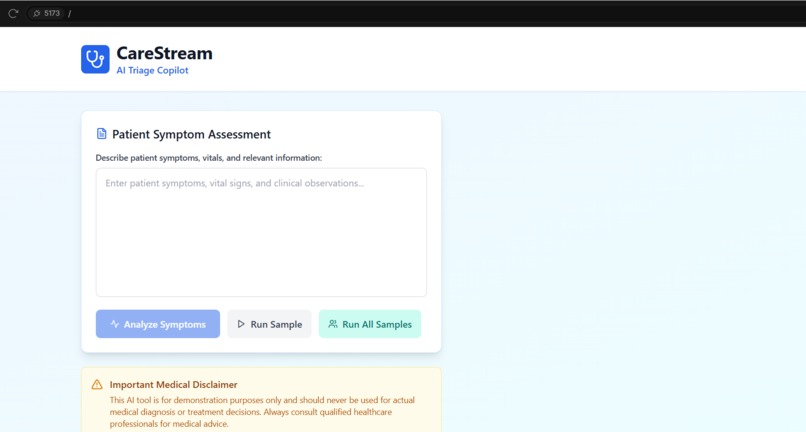
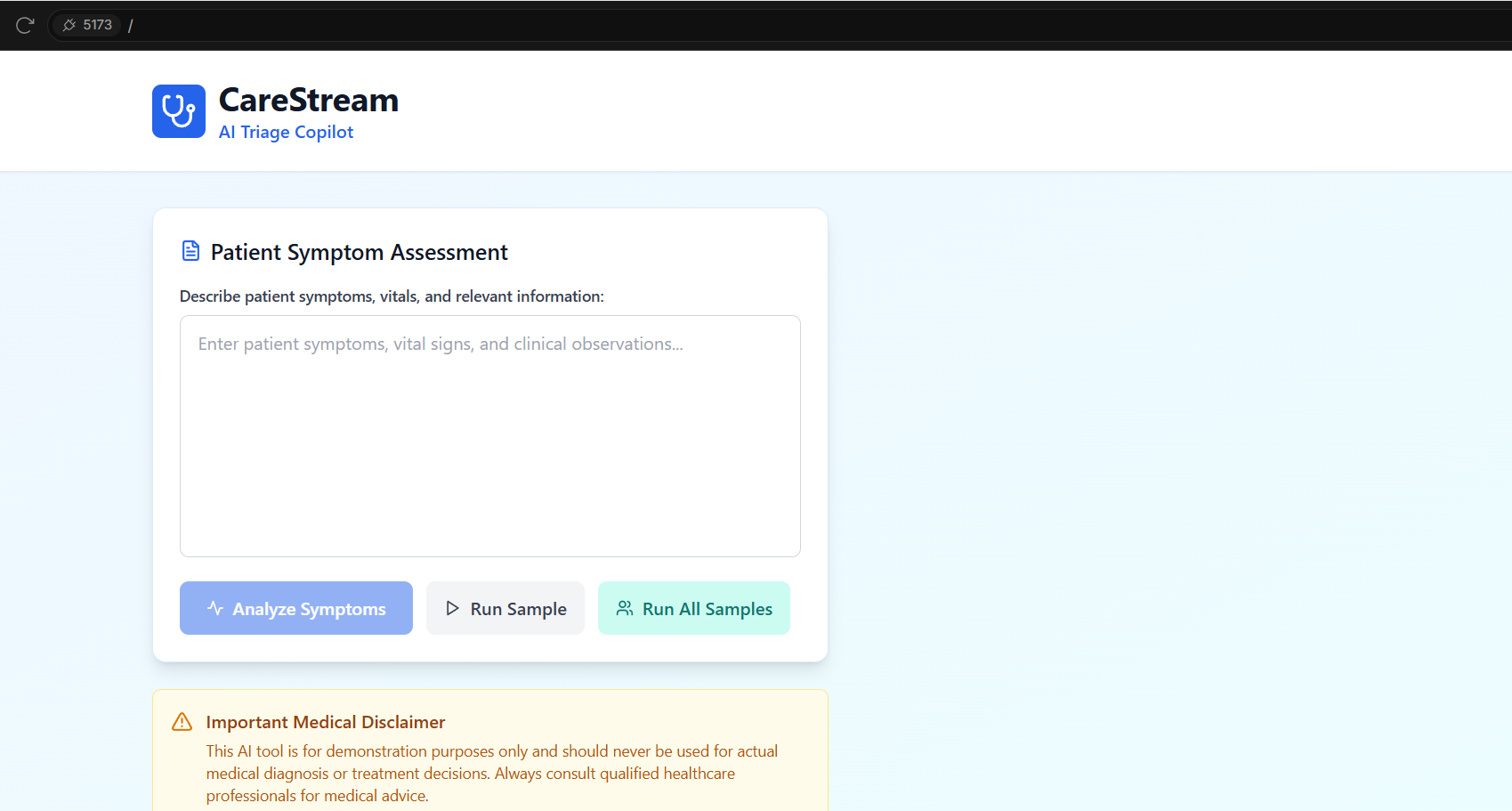
Web Interface
-
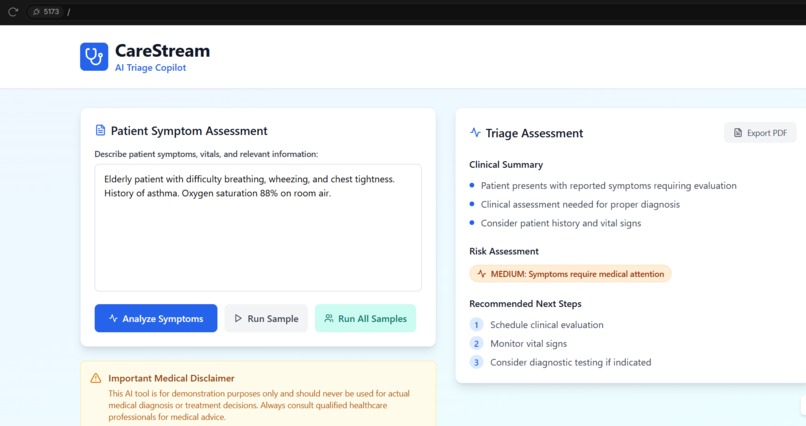
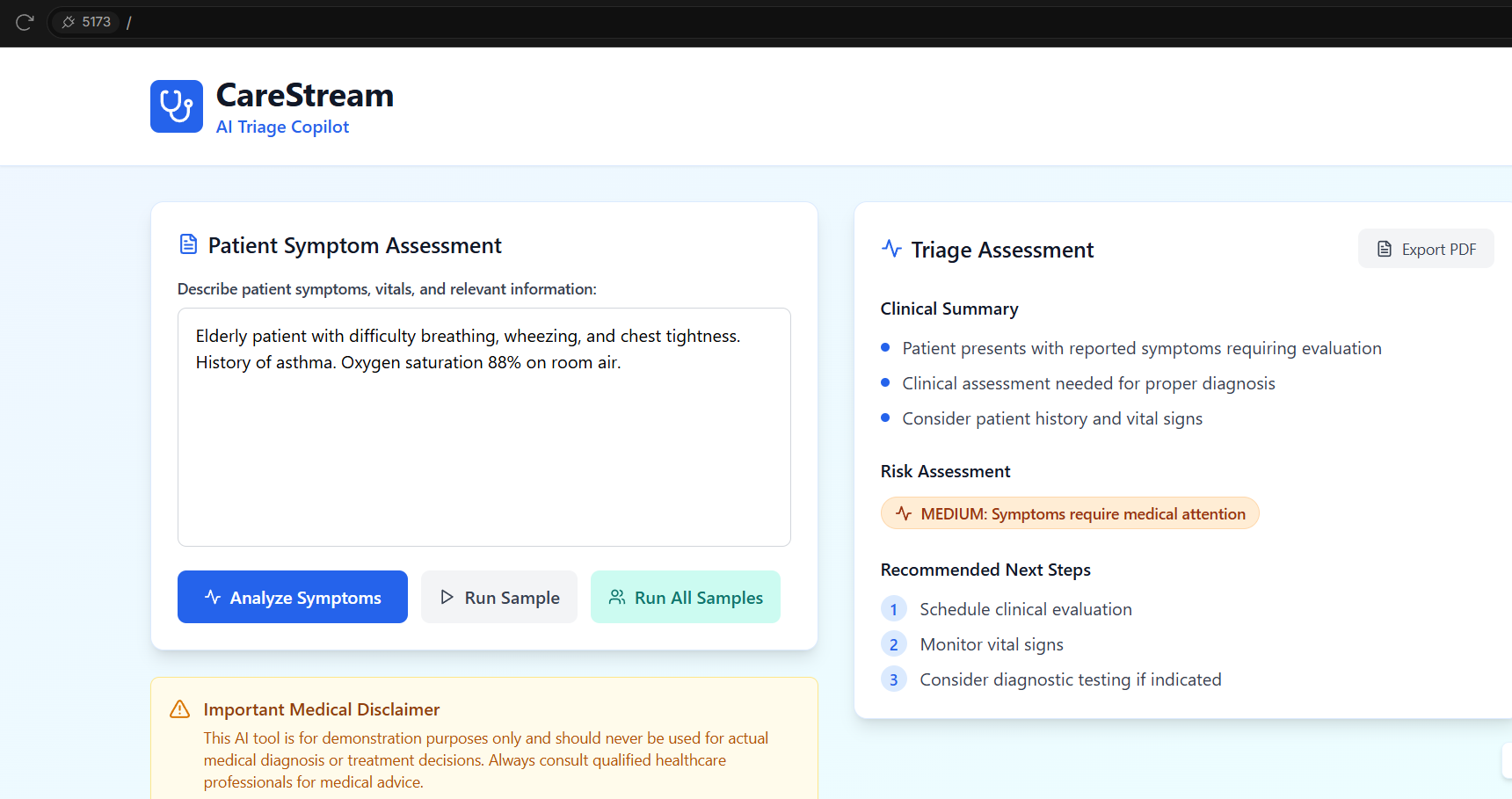
Sample Analysis
-
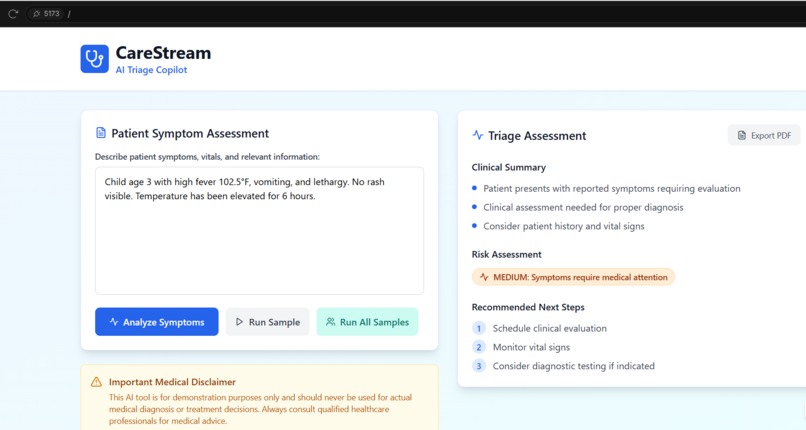
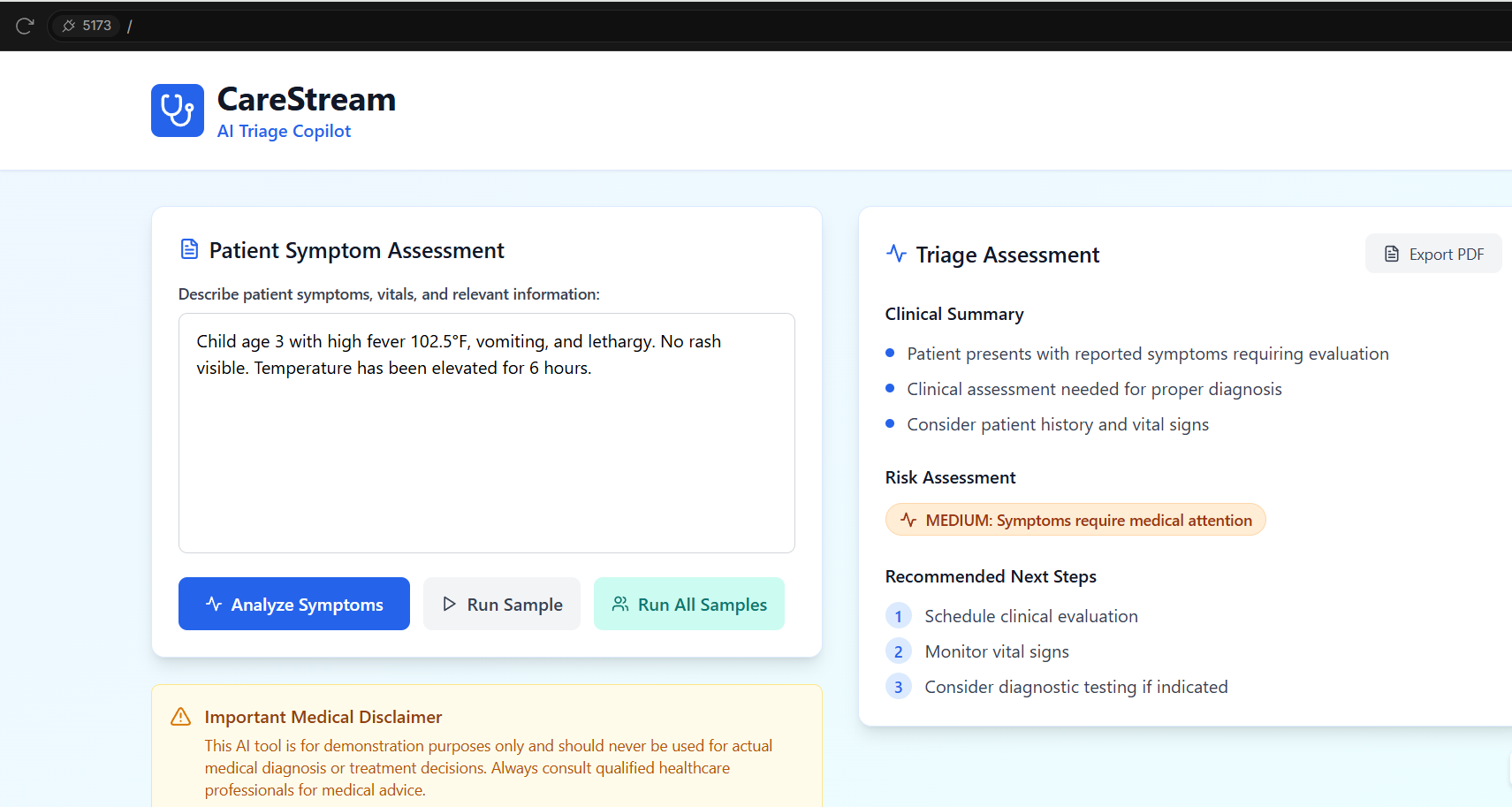
Sample Analysis 2
-
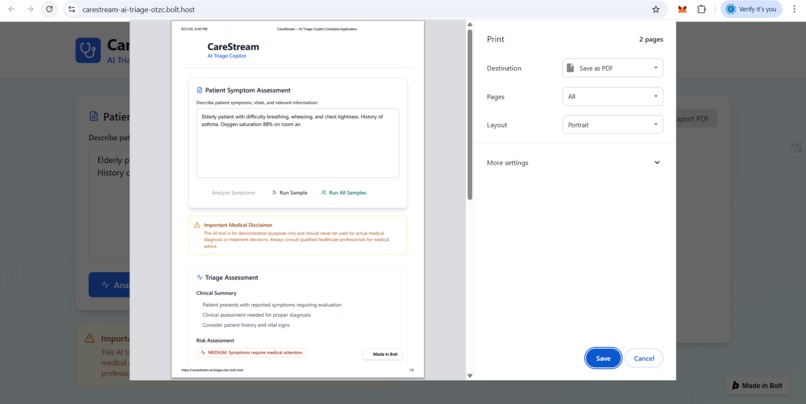
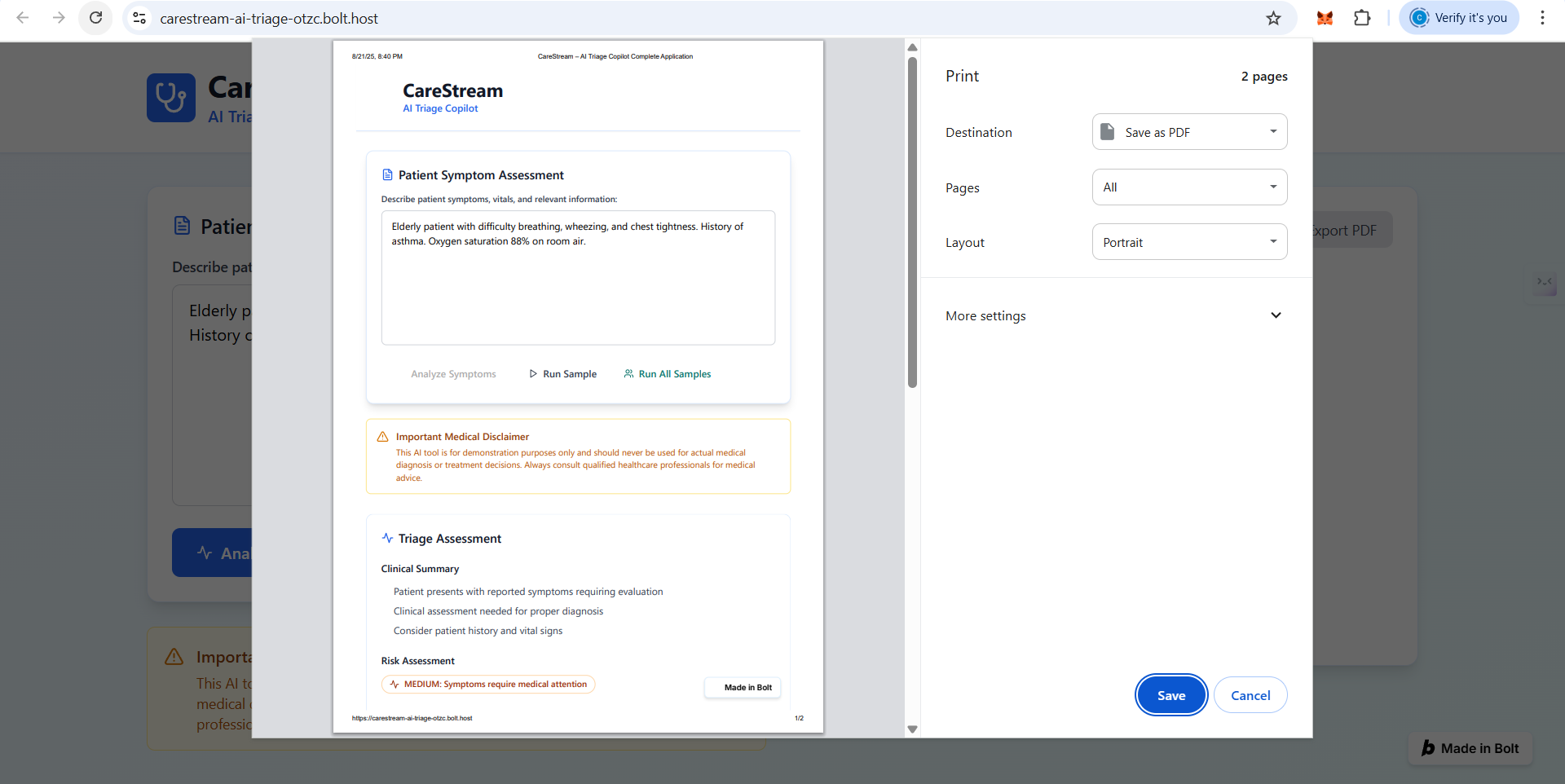
PDF Export
Inspiration
Emergency departments and telehealth systems often rely on unstructured patient symptom descriptions. This creates bottlenecks, risks missed red flags, and wastes valuable time when every second matters. We wanted to build an AI copilot that instantly transforms messy notes into structured, risk-aware triage guidance—while protecting patient privacy.
What it does
1.CareStream is an AI triage assistant that:
2.Accepts free-text symptom descriptions.
3.Extracts and summarizes the key clinical details.
4.Flags high-risk symptoms (e.g., chest pain, shortness of breath).
5.Recommends next steps in a clear, structured format.
6.Redacts any personally identifiable information (PII).
7.Exports a PDF triage report for easy sharing.
8.Supports batch processing with sample cases for fast demonstrations.
How we built it
1.Frontend: React + Tailwind for a clean, responsive, healthcare-grade UI.
2.Backend: Python FastAPI with a single POST /analyze endpoint.
3.Risk Detection: Regex and rule-based system stored in rules.yaml.
4.Safety: Automatic PII redaction (emails/phone numbers).
5.Extras: PDF export, evaluation script (/eval/run.py), and five sample cases for testing.
6.Deployment: Lightweight architecture that can run locally or on the cloud.
Challenges we ran into
1.Designing a system that is both lightweight for hackathon demo and robust for medical relevance.
2.Creating risk detection rules that are simple but clinically meaningful.
3.Balancing innovation with ethics—ensuring disclaimers, PII protection, and responsible AI use.
4.Keeping the app demo-ready while handling both individual and batch inputs.
Accomplishments that we're proud of
1.Built a fully working end-to-end app in just a few days.
2.Integrated safety guardrails like automatic PII redaction.
3.Created a professional UI that looks like real medical software.
4.Developed a batch testing mode with evaluation scripts for credibility.
5.Delivered a tool that is both impressive to demo and clinically relevant.
What we learned
1.The importance of combining AI with rules for safety-critical domains like healthcare.
2.How crucial UX design is for building trust in medical tools.
3.That even lightweight demos benefit from evaluation scripts to validate outputs.
4.The need for strong ethics disclaimers to responsibly present AI in healthcare.
What's next for CareStream – AI Triage Copilot
1.Integrating vital signs and structured patient data.
2.Expanding the risk detection rules with clinician input.
3.Incorporating LLM-based summarization for patient-friendly explanations.
4.Testing with de-identified real-world data to refine accuracy.
5.Exploring pilot integrations with telehealth platforms and hospital intake systems.

Log in or sign up for Devpost to join the conversation.