-
-
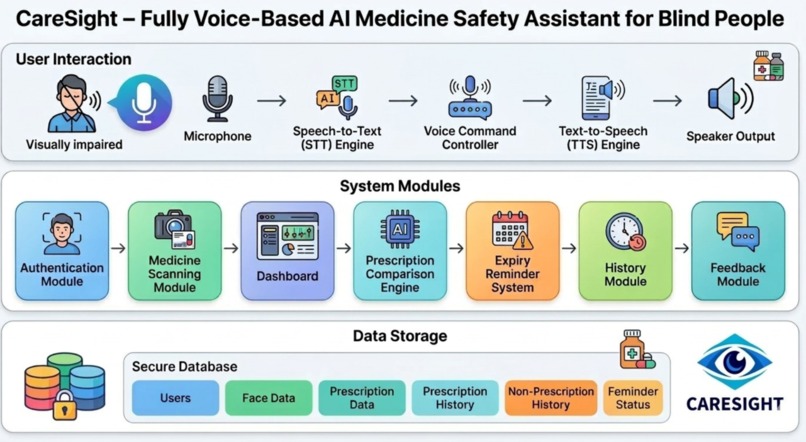
Flowchart
Inspiration
CareSight was inspired by the real-life challenges faced by visually impaired individuals in managing medicines and accessing healthcare independently. Many people struggle to identify medicines, read prescriptions, and follow proper dosage without assistance. This motivated us to develop an accessible, technology-driven solution.
What it does
CareSight is an AI-powered, voice-enabled healthcare assistant designed for visually impaired users. It helps users identify medicines, read prescriptions, and access healthcare information using voice commands, ensuring safety and independence.
How we built it
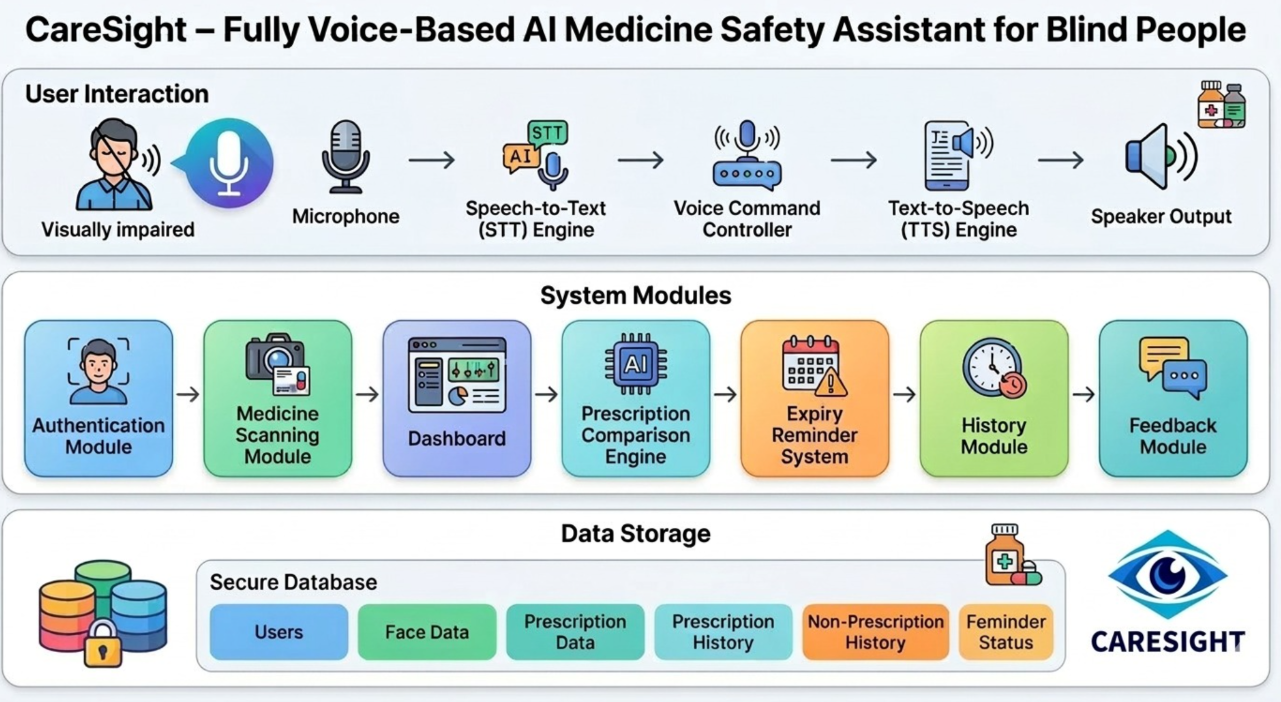
The system is built using a combination of frontend and backend technologies. The frontend interface is developed using HTML, CSS, and JavaScript, enabling voice interaction and camera access. The backend is implemented in Python, integrating face recognition, liveness detection, and image processing models. A database is used to securely store user data and face embeddings. Machine learning techniques are used for face recognition and medicine identification.
Challenges we ran into
We faced challenges in achieving accurate face recognition under varying lighting conditions and ensuring reliable liveness detection. Integrating voice commands seamlessly with the system and optimizing real-time performance were also key challenges.
What we learned
This project helped us gain hands-on experience in AI integration, face recognition systems, and full-stack development. We also learned the importance of building accessible and user-friendly solutions for real-world problems.
Future scope
In the future, CareSight can be enhanced with multilingual voice support, real-time navigation assistance, and integration with healthcare services for a more comprehensive user experience.
Built With
- css
- face-recognition-(facenet/mtcnn)
- html
- javascript
- machine-learning
- opencv
- python
- recognition
- sqlite-(face-auth.db)
- voice

Log in or sign up for Devpost to join the conversation.