-
-
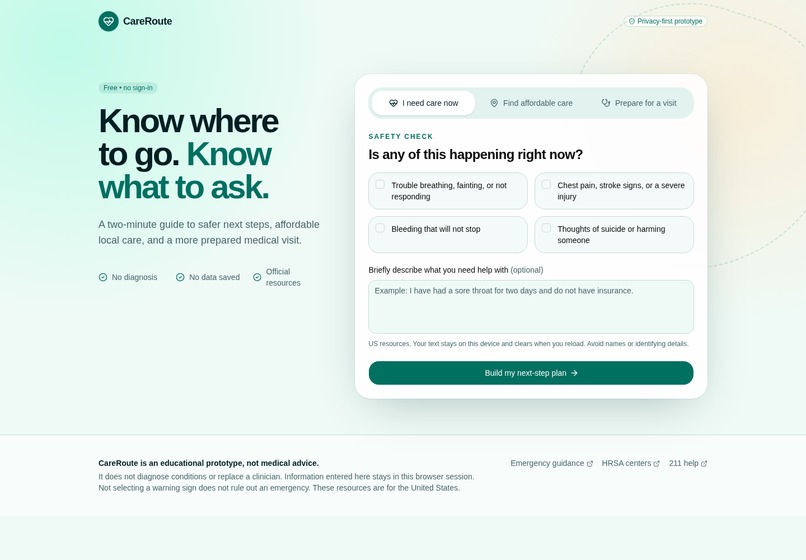
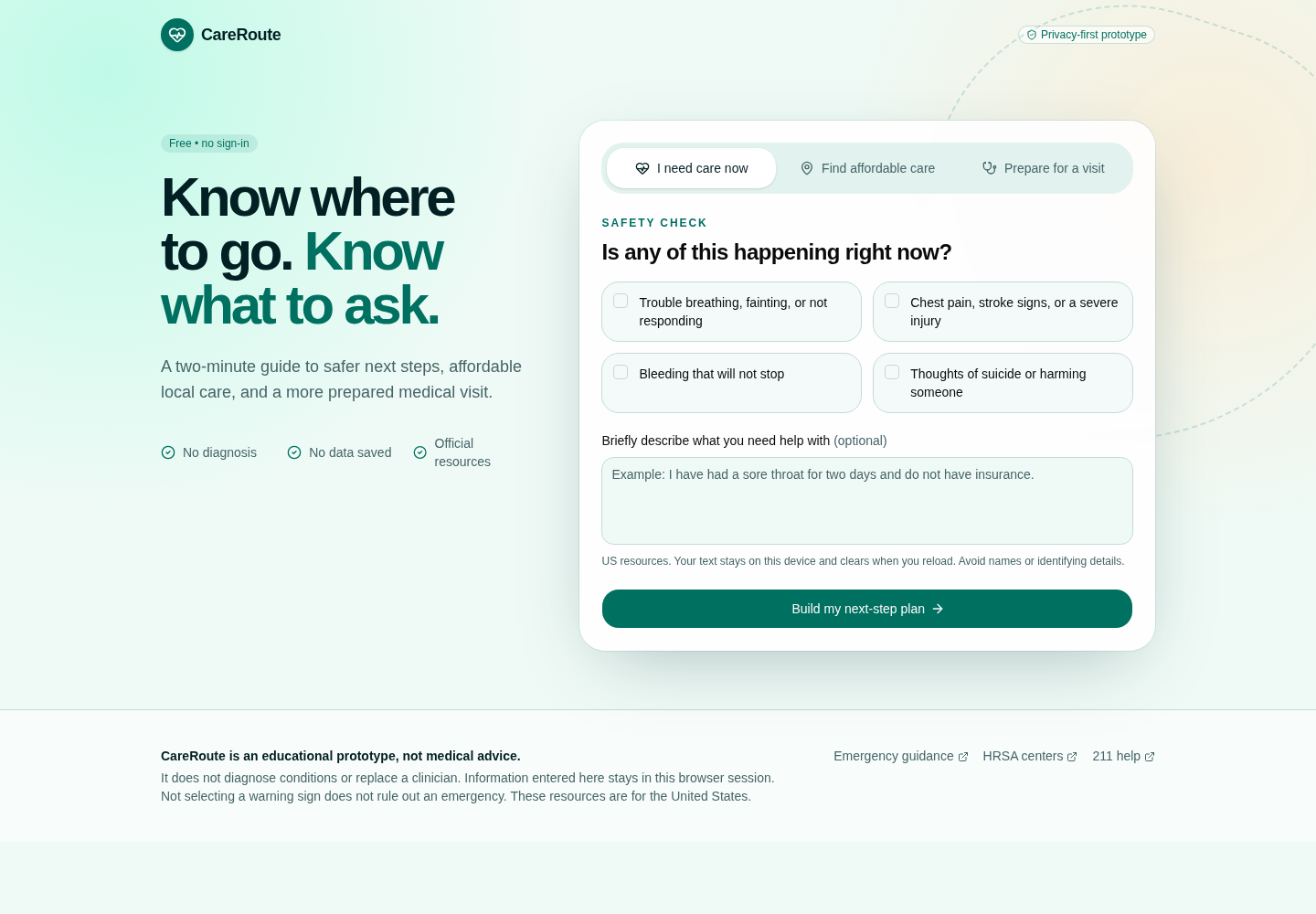
Actual Vercel app: private, account-free care tools. Synthetic demonstration; no clinical claims.
-
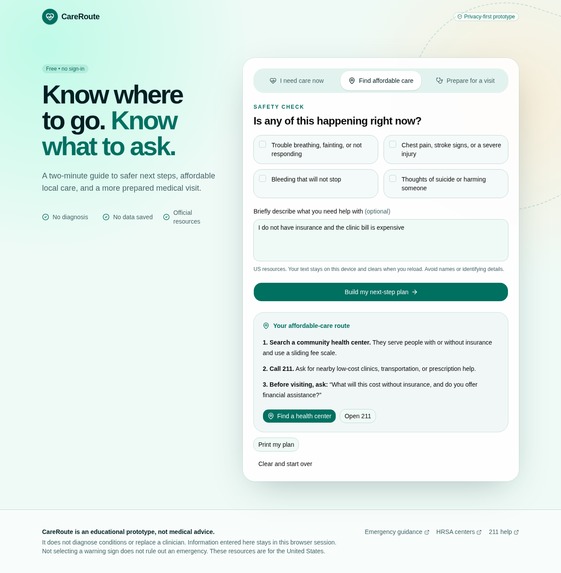
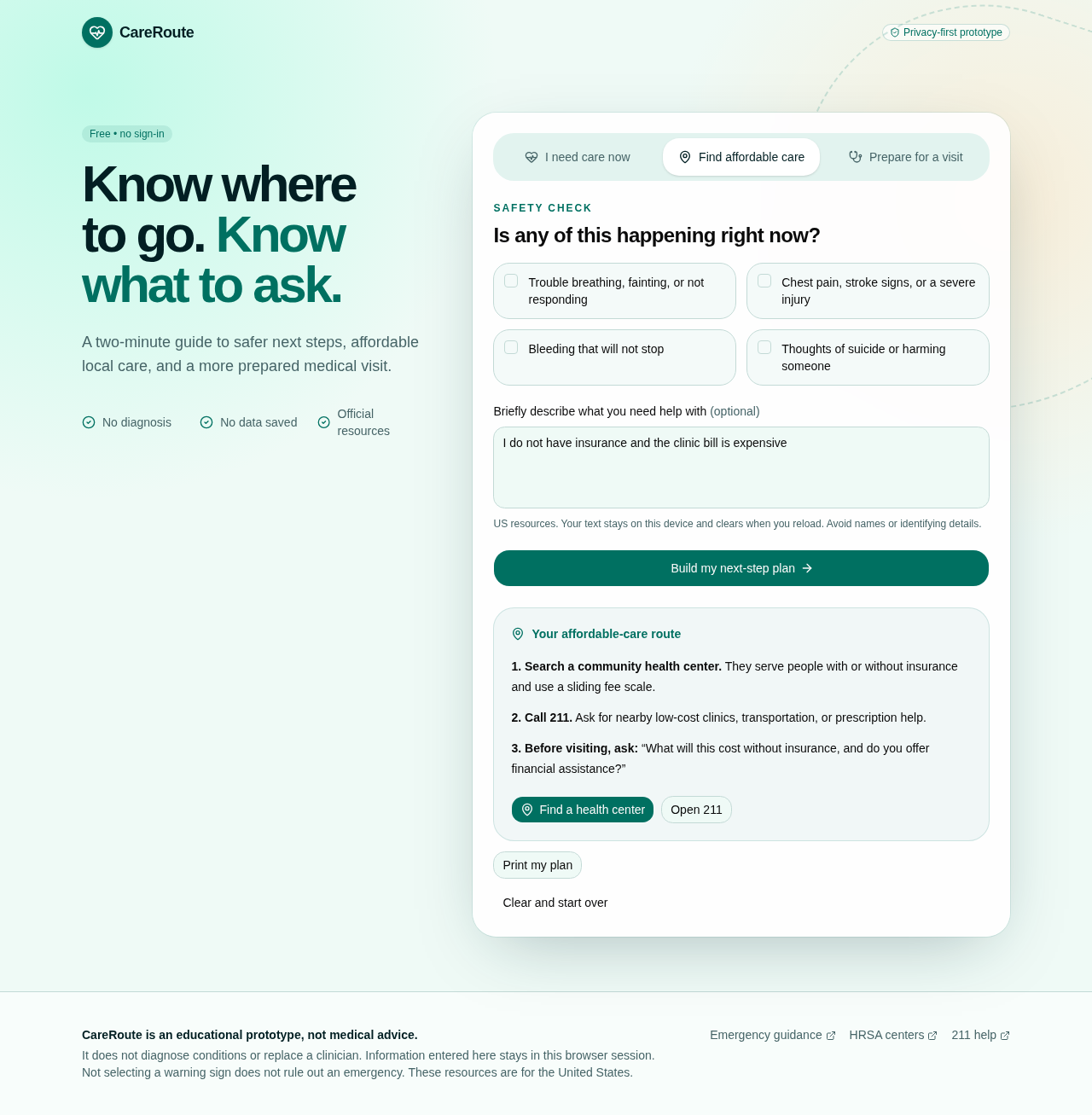
Synthetic cost concern: official HRSA and 211 resources, with a question about fees.
-
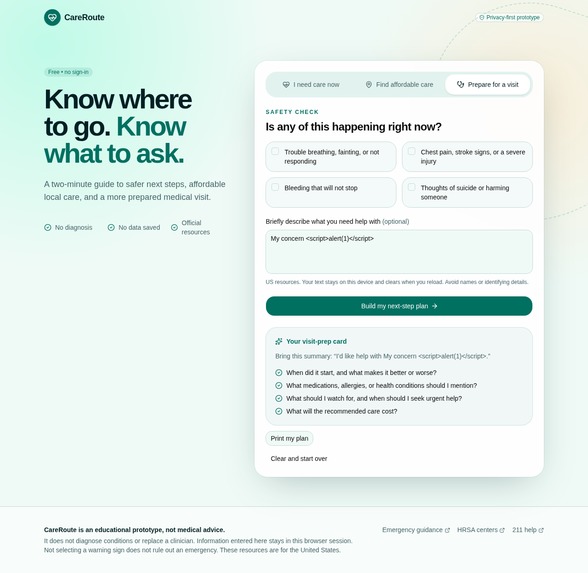
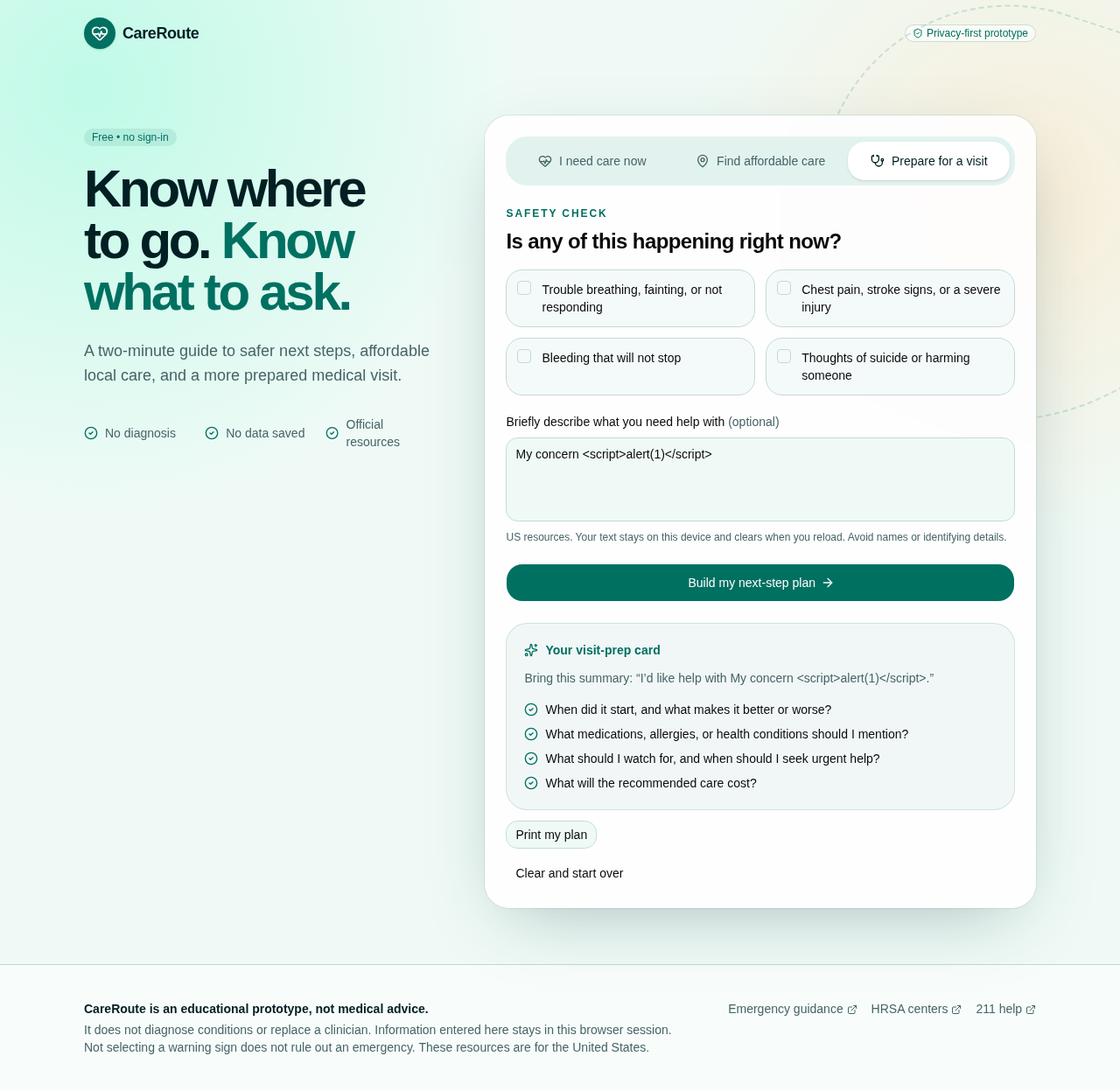
Synthetic visit card: user text is escaped, with questions about timing, medicines, follow-up and cost.
-

Mobile flow tested at 320, 390, 768 and 1440 pixels.
-
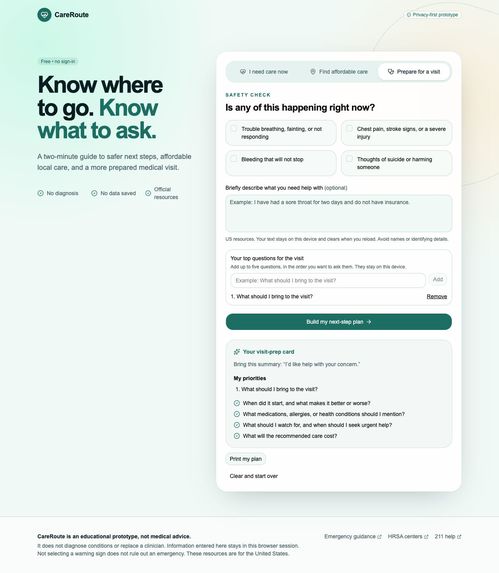
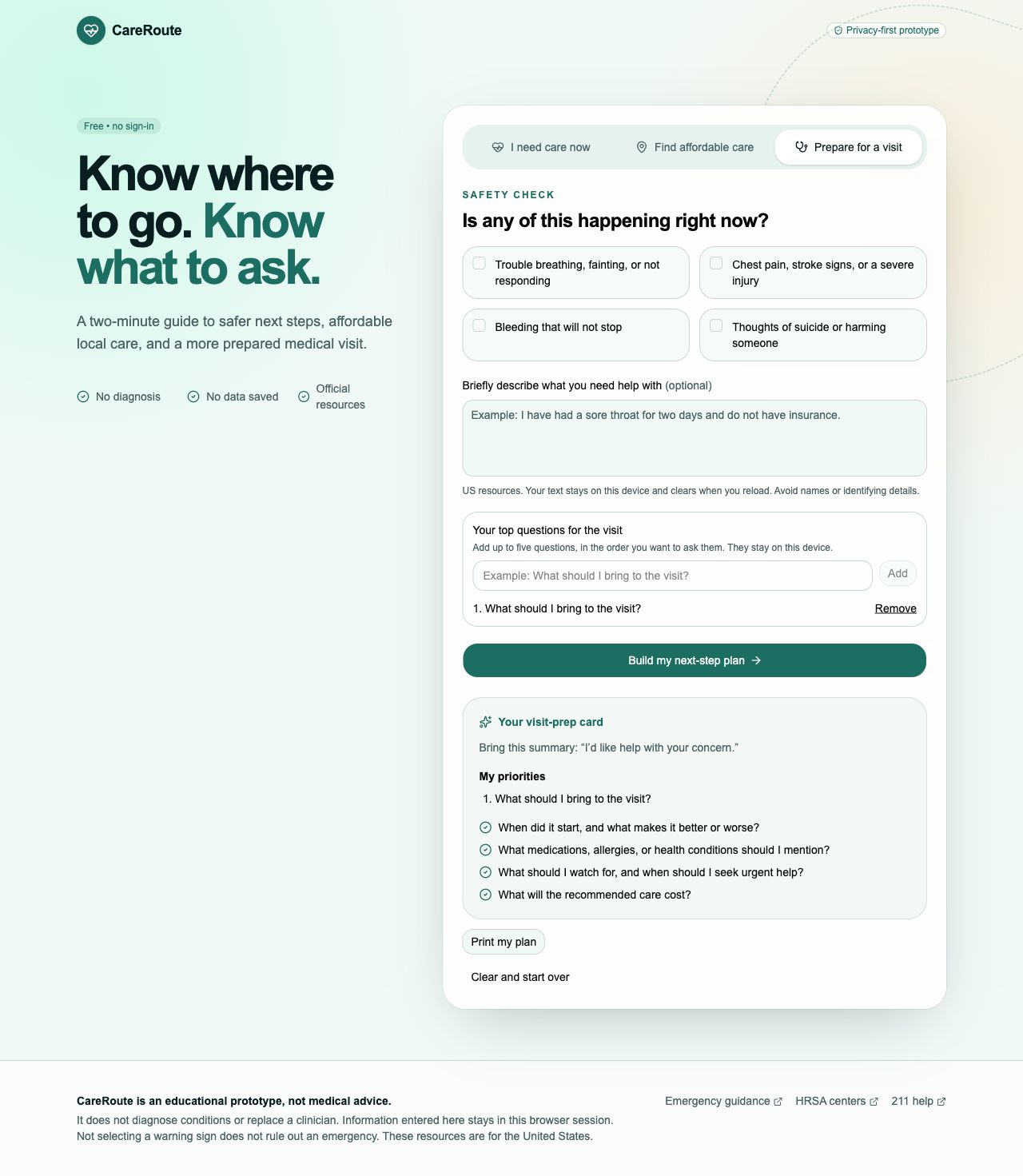
October 7: private visit-question priorities on the printable card.

CareRoute — clearer next steps, privately
Inspiration
Finding care can involve more than finding a doctor. Cost, uncertainty about where to start, and not knowing what to ask can make the next step harder. CareRoute brings a few practical tools into one place: affordable-care resources, general next-step guidance, and a card to prepare for a visit.
What it does
Choose a tool, optionally describe what you need, and build a short plan. A small model running on your device can suggest affordable-care or visit-preparation tools from your wording. You apply the suggestion yourself. The affordable-care plan links to HRSA health centers and 211 and includes a specific question about fees and financial assistance. The visit card includes your concern and questions about timing, medicines, allergies, follow-up and cost. You can print a plan or clear the draft.
The warning-sign checklist takes priority over every tool and over the model. Physical emergency warnings show a 911 action immediately. Crisis-only warnings show 988 with instructions to call 911 for immediate danger. If both are selected, 911 remains the main action and 988 appears as additional support. These are US resources. Leaving the checklist blank does not establish that a condition is safe.
How I built it
React and TypeScript manage browser state, Vite creates the static build, and Vercel hosts it. The interface uses Tailwind, Base UI, shadcn components and Lucide icons. No application database or external model API is needed; entered text stays on the device and clears on reload or reset.
The model is multinomial naive Bayes trained on 24 hand-written synthetic administrative phrases. It uses token counts and smoothing, abstains on weak or unknown matches, and surfaces only cost-help or preparation suggestions. It does not make clinical predictions, classify symptoms, or determine urgency. The tiny English-only dataset is a demonstrative model, not a validated language system.
What changed during this build
CareRoute's interface existed before this entry. The October 6 work moved it to Vercel, added local intent suggestions, fixed a mixed-warning priority bug, made warnings immediate, added print/reset actions and accessibility states, and tested the complete flow. The original interface came from source revision b9fc7ed621e491ab6372deb40a572a194433b597. This entry discloses that foundation and the previous healthcare submission; it does not claim the whole project was newly created for every event.
Codex assisted with implementation, debugging, testing, documentation and submission preparation. The project is a solo entry by Suhas Beemineni. Third-party components and dependencies are identified in package.json. HRSA, 211 and MedlinePlus supply linked resources; there is no claimed affiliation with them.
Challenges and testing
The most important bug was warning priority: selecting a crisis warning together with a physical emergency could hide the primary emergency response. The fix separates those checks and preserves the 911 action. I also kept administrative suggestions separate from safety guidance so an uncertain model result cannot override the checklist.
The release passed 56 browser checks locally and again on the public Vercel app. That includes all 15 non-empty warning combinations in all three modes, mobile widths from 320 to 1440 pixels, escaped text, selected states, result focus, reset, stale-plan removal, links, browser errors, outgoing requests and browser storage. The model tests covered six held-out administrative phrases and six abstention inputs. Only synthetic text was used. These tests verify software behavior; they are not clinical validation.
What is finished and what comes next
The three tools, local suggestions, warning behavior, print/reset controls, public demo and downloadable source work today. The next useful step is to test whether people find the plans clear and helpful, review the wording with qualified professionals, improve accessibility, evaluate more varied language, and keep resource links current. The app does not diagnose, verify provider availability, or replace professional care. No patient outcomes, customer adoption or revenue are claimed.
Target users and a possible business model
The current prototype is for people in the US facing care costs or preparing for a visit. It is free and requires no account. A possible later model is an institution-funded resource directory or embedding license for school clinics and nonprofits, while keeping access free to individuals. That is a proposal rather than an active paid service. User interviews, a professionally reviewed partner pilot and evidence of demand would come before prices, billing or expansion.
Static delivery avoids per-request AI inference, but operational scale also requires verified local resources, language support, accessibility review and responsible partnerships. Technical hosting alone does not establish medical usefulness.
Try it and review the build
Live app: https://careroute-access.vercel.app Project and business notes: https://careroute-access.vercel.app/about.html One-page PDF: https://careroute-access.vercel.app/docs/CareRoute-one-page.pdf Full source-code PDF: https://careroute-access.vercel.app/docs/CareRoute-code.pdf Runnable source ZIP: https://careroute-access.vercel.app/docs/CareRoute-source.zip Actual model source: https://careroute-access.vercel.app/model.html
To run the source locally: extract the ZIP, use Node 22.13+ or 24, then run npm ci, npm run dev, npm run build, and npm test. No keys are needed. For judging, try an uninsured cost concern, a visit-preparation request, and both a physical and crisis warning together.
October 7 release: DSH healthcare build
Visit preparation now includes a private organizer for up to five user-authored questions. Questions retain the chosen order, appear on the printable card, and can be removed. Edits hide stale cards; Clear and start over removes both questions and drafts. No question is sent to an API or written to browser storage.
The October 7 release passed TypeScript checking, the production build and both model-test suites (six held-out phrases and six abstention inputs). Browser checks verified adding, removing, the five-question limit, escaped synthetic text, stale-card removal, complete reset and mixed-warning priority. The live Vercel app was checked again, including a 375-pixel layout with no horizontal overflow. The public source ZIP and one-page PDF match the locally verified files byte for byte.
The existing video demonstrates the core October 6 workflow; it predates the new question organizer. The live app and new screenshot show that addition. This extends the disclosed earlier project rather than claiming an entirely new interface.
Public source and setup: https://github.com/suhaslord/blob/tree/main/careroute DSH judge walkthrough: https://careroute-access.vercel.app/about.html Updated one-page brief: https://careroute-access.vercel.app/docs/CareRoute-one-page.pdf Updated runnable source ZIP: https://careroute-access.vercel.app/docs/CareRoute-source.zip
Question prioritization and STEMergent preparation — October 7
The visit organizer now has labeled Up and Down controls for prioritizing the five user-authored questions. The first/last controls are disabled at the boundary. Reordering hides the old card until rebuilt; the new printable card follows the chosen order. Reset clears every question and draft.
This extension passed TypeScript checking and the production build. Held-out model and abstention tests passed. Browser verification checked reordering, stale-card removal, printable ordering, reset and a 375-pixel layout without horizontal overflow, then verified the public Vercel release.
STEMergent guide: https://careroute-access.vercel.app/stemergent.html The project is registered for that upcoming event. October 7 work is dated honestly and is not presented as work performed in a future submission window. Existing source and prior entries remain disclosed.
Built With
- codex
- naive-bayes
- react
- tailwind-css
- typescript
- vercel
- vite

Log in or sign up for Devpost to join the conversation.