-
-
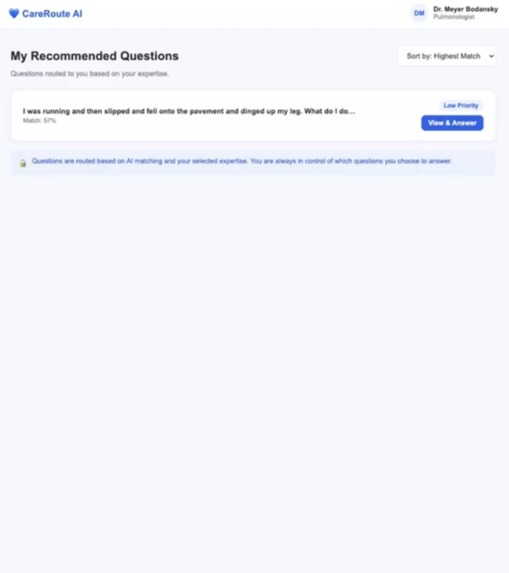
Doctor Dashboard to see all available patient queries
-
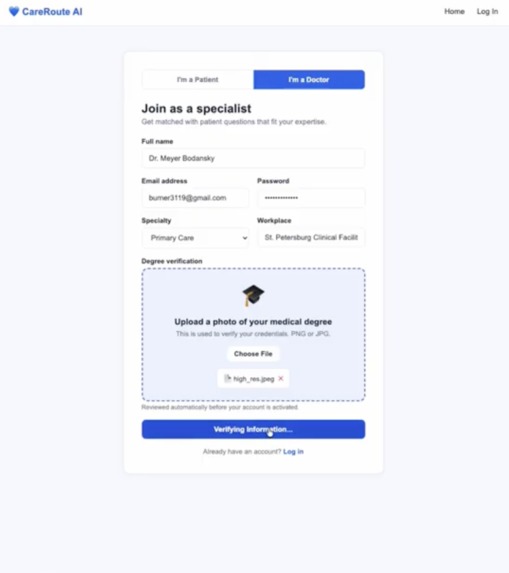
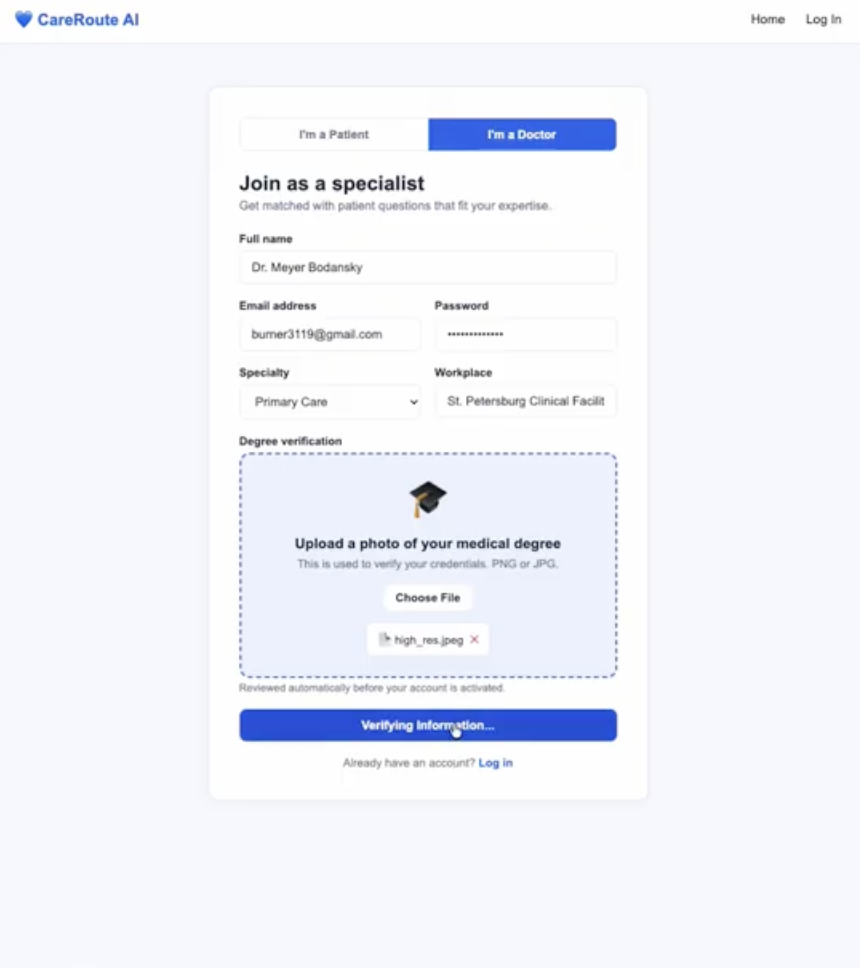
Doctor signup form
-
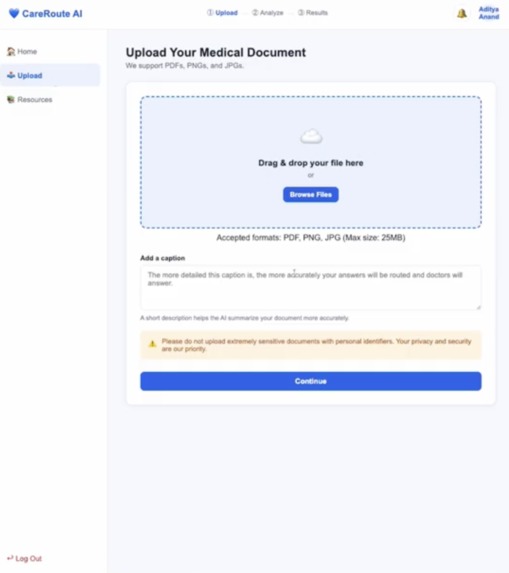
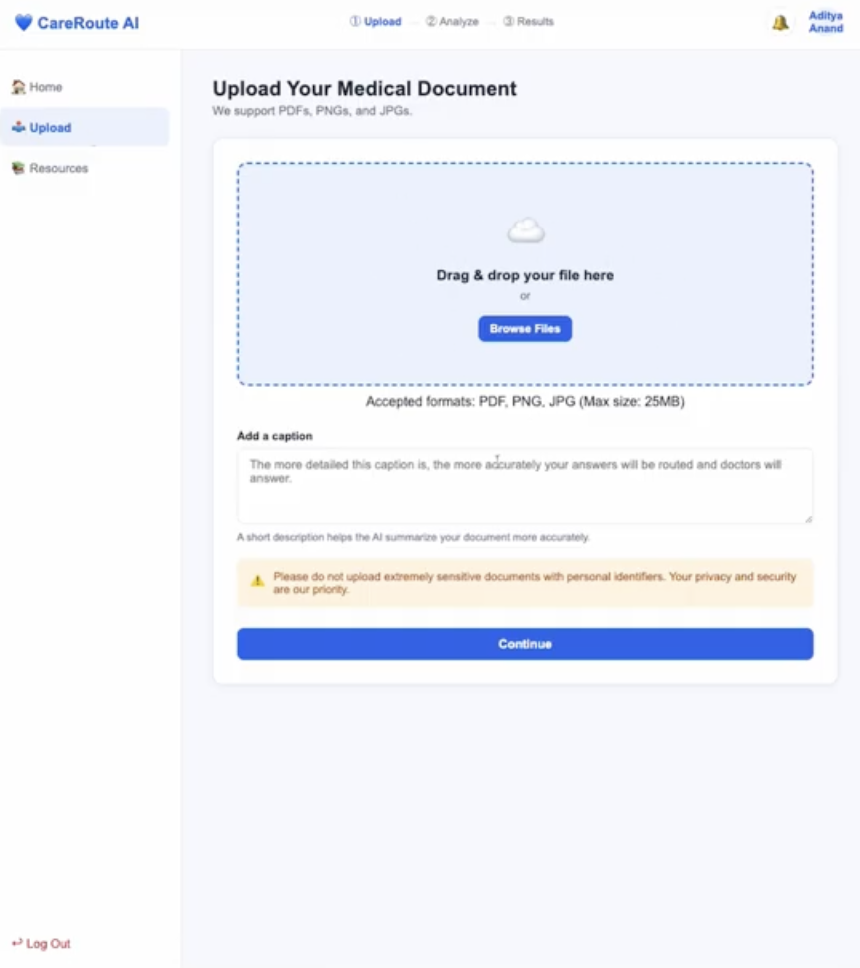
Medical document upload page
Inspiration
Our Inspiration was public medical forums that had many questions unanswered. Public forums are a very accessible method for people to get information from, and the barrier of medical forums being untrustworthy and not all questions being answered is the reason why people don’t use this easy method. Then we thought it would be much better if we could make it trustworthy and efficient so that every question is answered. Then we thought of this idea of matching the certified doctors through AI so that it is efficient on the doctor’s end.
What it does
On the patient's end, they can create their account by putting in basic information, and they can then start asking their questions. To explain their problem better, they can upload a picture, and they can write a description of their problem. Then, an AI will scan the image and read through the description, and it will scan what the topic is, so it can decide which doctor will be appropriate to answer this question. On the doctor’s end, a doctor can create an account by putting in their information, certificate, and place of work to verify that they are indeed a professional. Then, they will see the questions their patients asked, and the questions that the AI thinks the doctor can diagnose and answer the best will show up as priority for that specific doctor. What AI does not do is diagnose the problem itself. They just sort the case, so the medical professional is able to diagnose and answer it for the patients, as they can give more reliable answers than an AI. Furthermore, even if the AI mismarks the question, it won’t stay unanswered the entire time. Rather, it will still be discoverable by the doctors. By doing this, we are able to make sure that all the questions are answered with the most accurate information from the professionals
How we built it
We built CareRoute AI using a privacy-first AI pipeline that runs entirely on local hardware. First, verified doctors create profiles by uploading proof of their credentials, which is then processed by our Flask backend and local models from HuggingFace. Specifically, Qwen 2.5 analyses these documents and creates a concise summary of each doctor’s specialties. When a patient submits a medical document, the same model extracts the key medical concepts and expertise required to solve this problem. We then convert both the doctor’s expertise profile and the patient’s case summary into embeddings using a local embedding model. Then, we use cosine similarity to create similarity scores that act as match rankings. All data is stored in a local SQL server run with sqlite3.
Challenges we ran into
Throughout the creation of the code, the backend posed the most challenges with regard to making sure that the backend worked properly. However, our biggest challenge was an ethical one - how can we make sure that AI does not provide false analyses? In order to solve these issues, we were looking at better models, more detailed technical specs, but we almost didn’t realise our final answer. And then, the solution hit us like a big bullet: Instead of attempting to answer medical questions directly, we chose to focus on routing cases to qualified doctors. This allowed us to use AI where it is most reliable while keeping medical decision-making in the hands of healthcare professionals.
Accomplishments that we're proud of
We are proud of how well we worked together and got this project done. We were well synchronized and had great communication within the team. We are very proud of our idea, we believe that this idea can actually save lives and answer people’s general questions for a cheap fare. This is also very helpful for resident doctors as they can get more experience, which can help them become better doctors.
What we learned
Throughout this project, we learned about how embedding models were learned. Before this project, our team had little experience working with embedding models. We had to learn how to analyse their metrics and learn how to evaluate the performance of these models. We also learned how to run local LLMs effectively with quantization, allowing us to run models efficiently on-device.
What's next for CareRoute AI
Right now, CareRoute AI is all about making it easier for people to find the medical help they need. Next, I think it would be awesome if CareRoute could better match people with doctors by using more types of documents and making it easier to connect people's needs with the right specialists. And we are also hoping that our website can work with healthcare providers someday, as this will ease the doctor’s work and the response that they need in a big time. We are also going to work on making it more supportable to other languages so people around the world can use it as well without having any language barriers. Our main goal is to make CareRoute AI feel less like a search tool and more like a discussion bridge that helps people to reach the right expertise when they need it most and have less time.
Built With
- css
- flask
- html
- huggingface
- javascript
- sequel

Log in or sign up for Devpost to join the conversation.