Inspiration
Caregiving responsibilities can get lost during shift changes—not because people forget to communicate, but because nobody clearly accepts ownership.
A message like "Someone needs to collect the library books" identifies a task, but not who will complete it.
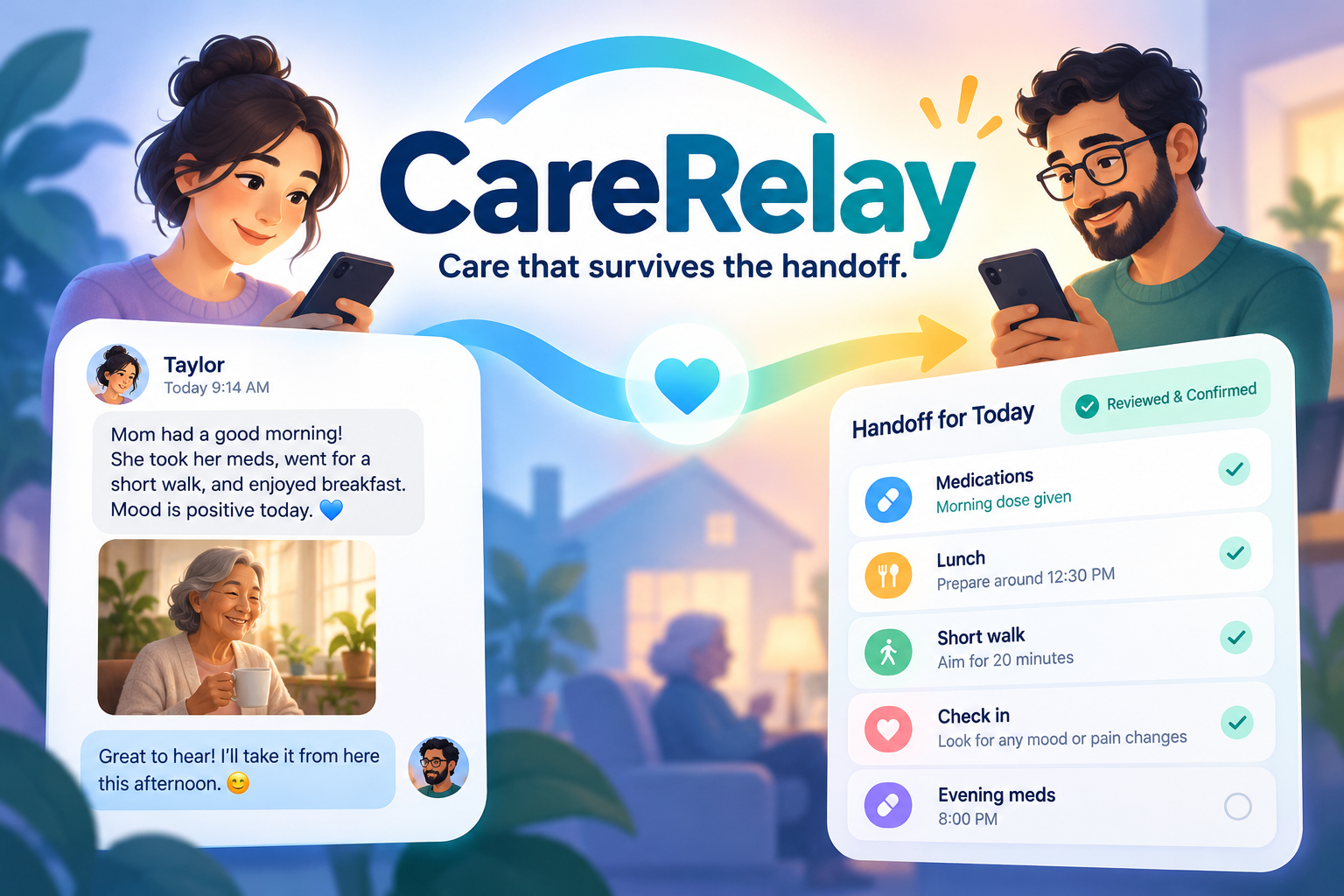
We built CareRelay — Care that survives the handoff to solve this problem.
What it does
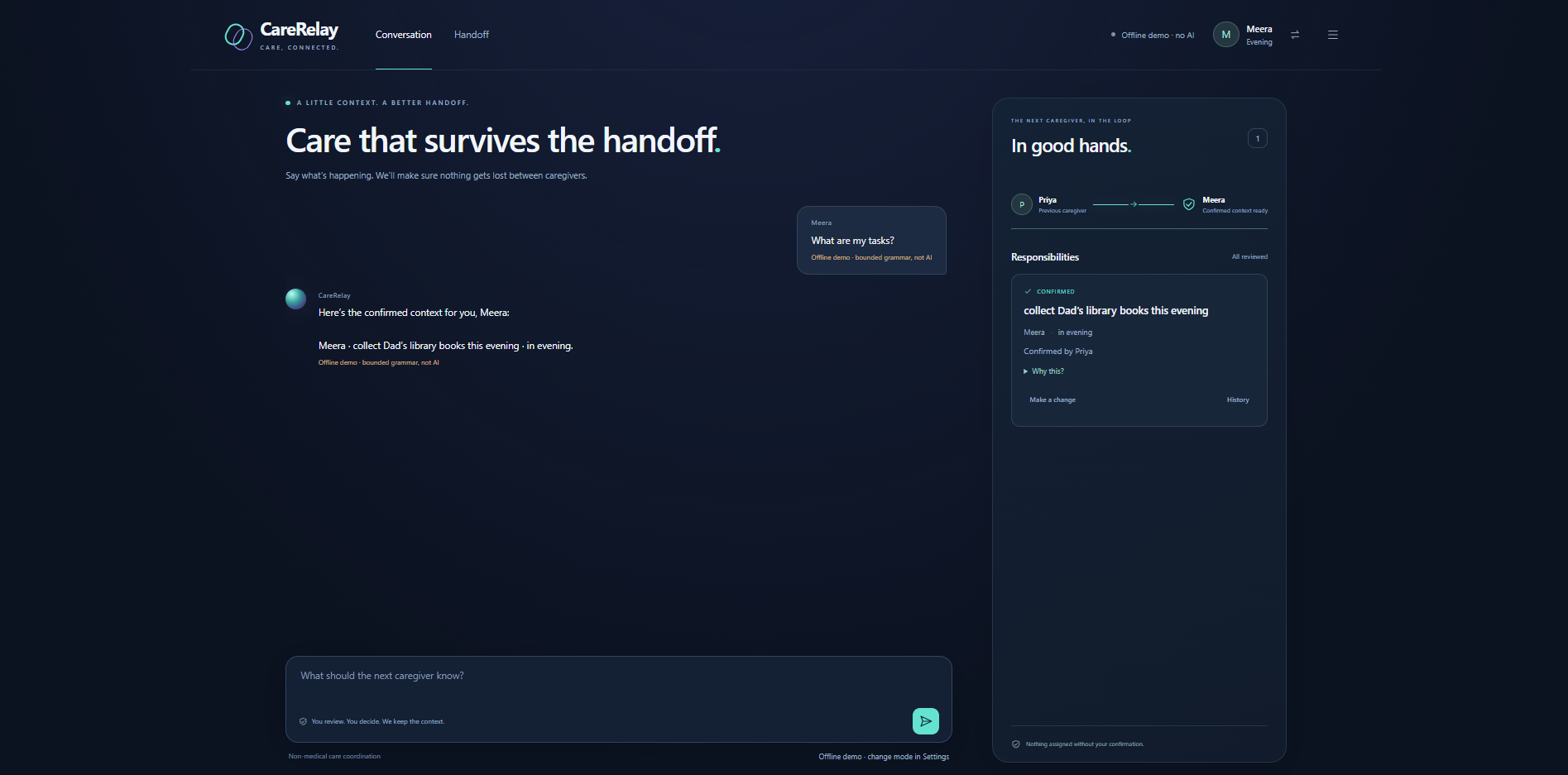
CareRelay is a conversational caregiver coordination assistant that turns updates into reviewed, accountable handoffs.
Caregivers can:
- Share natural-language updates.
- Identify responsibilities without confirmed owners.
- Clarify uncertain assignments.
- Review, edit, confirm or dismiss proposed actions.
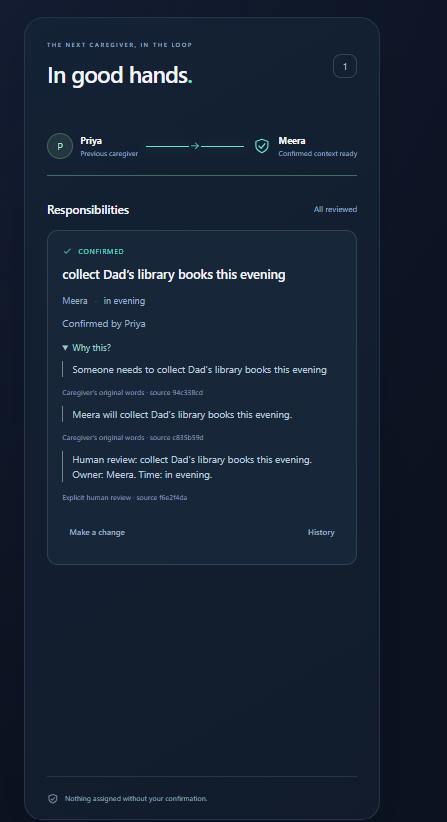
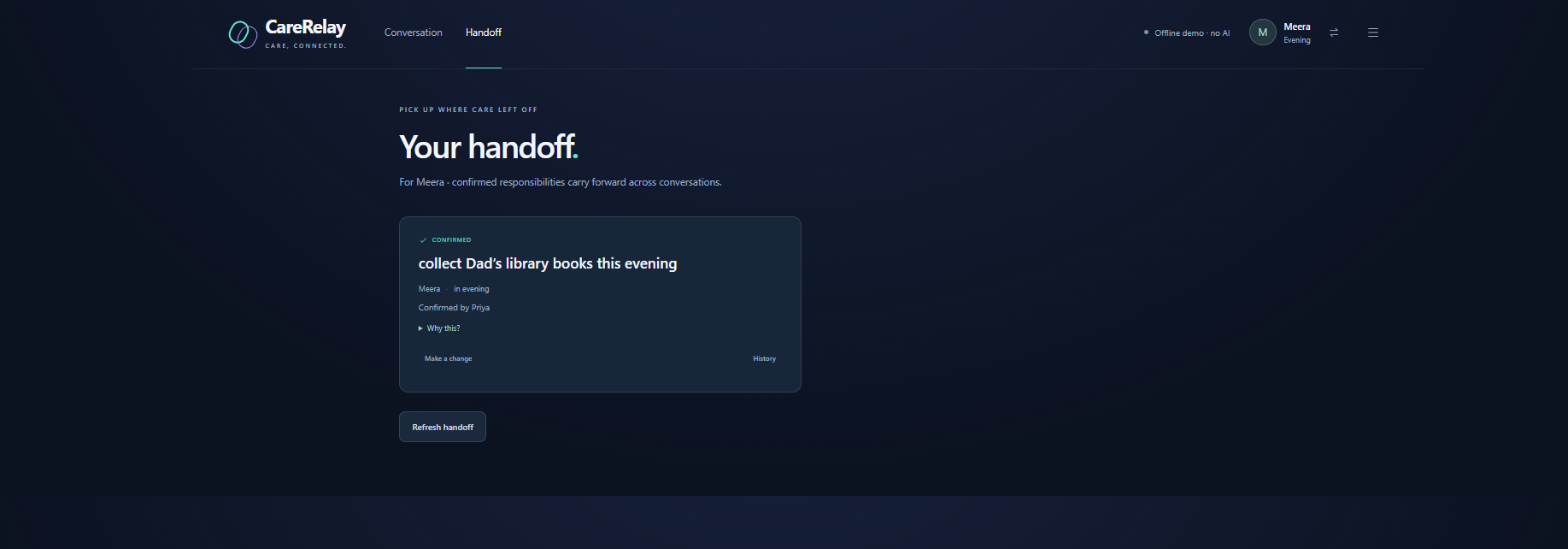
- Transfer confirmed responsibilities between caregivers.
- Reopen conversations and retrieve previous handoffs.
- Inspect supporting evidence through "Why this?".
- Track confirmed changes through persistent history.
The system never silently assigns a responsibility based on an uncertain interpretation.
How we built it
CareRelay uses Node.js, JavaScript and Model Context Protocol (MCP) with Streamable HTTP.
Its architecture includes a conversation interface, responsibility extraction, evidence validation, explicit consent, persistent state and an auditable history.
We developed an optional dynamic AI integration using Amazon Bedrock and Kimi K3.
The default demonstration uses a clearly identified offline simulator that requires no AWS credentials or paid API calls. Historical live-model tests demonstrated genuine interpretation, but the current release has not been fully validated with fresh live inference.
The product demonstrates an Alexa+-style workflow through a web-based simulation rather than a direct private Alexa+ integration.
Challenges we faced
Our biggest challenges were reliably interpreting uncertain language, distinguishing shifts from tasks, preventing unsupported ownership assignments and preserving evidence across caregiver sessions.
We also addressed model-output truncation, stale confirmations, duplicate actions, persistence and safe spending controls.
These challenges shaped our central principle:
AI can suggest, but caregivers must confirm.
Accomplishments
- One-screen conversation and handoff experience.
- Visual identification and closure of ownership gaps.
- Explicit consent before authoritative changes.
- Persistent handoffs between separate caregiver sessions.
- Evidence-backed explanations and auditable history.
- A reproducible offline demonstration without paid infrastructure.
- Automated regression tests and browser workflow verification.
What we learned
Reliable caregiving coordination requires more than generating summaries. It requires clarity about responsibility, evidence, consent and continuity.
What's next
Future work includes broader live-AI reliability testing, stronger authenticated caregiver identities, mobile accessibility, privacy safeguards and real-world usability studies.
CareRelay is currently a non-medical prototype, not a clinical or emergency-care system.
AI usage
AI-assisted development tools were used extensively during implementation, testing and documentation. Amazon Bedrock/Kimi was evaluated separately from the offline demonstration. Simulated and saved responses are not represented as fresh live-model inference.
Built With
- amazon-bedrock
- css
- html
- javascript
- json
- kimi-k3
- mcp
- node.js
- rest-api

Log in or sign up for Devpost to join the conversation.