-
-
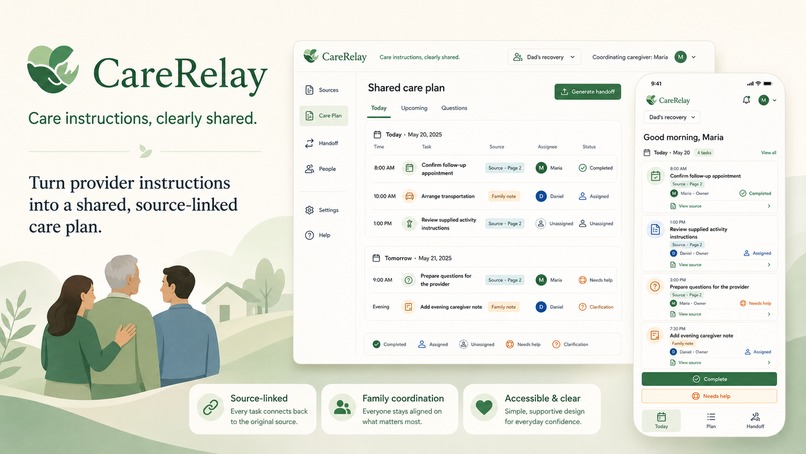
Promo
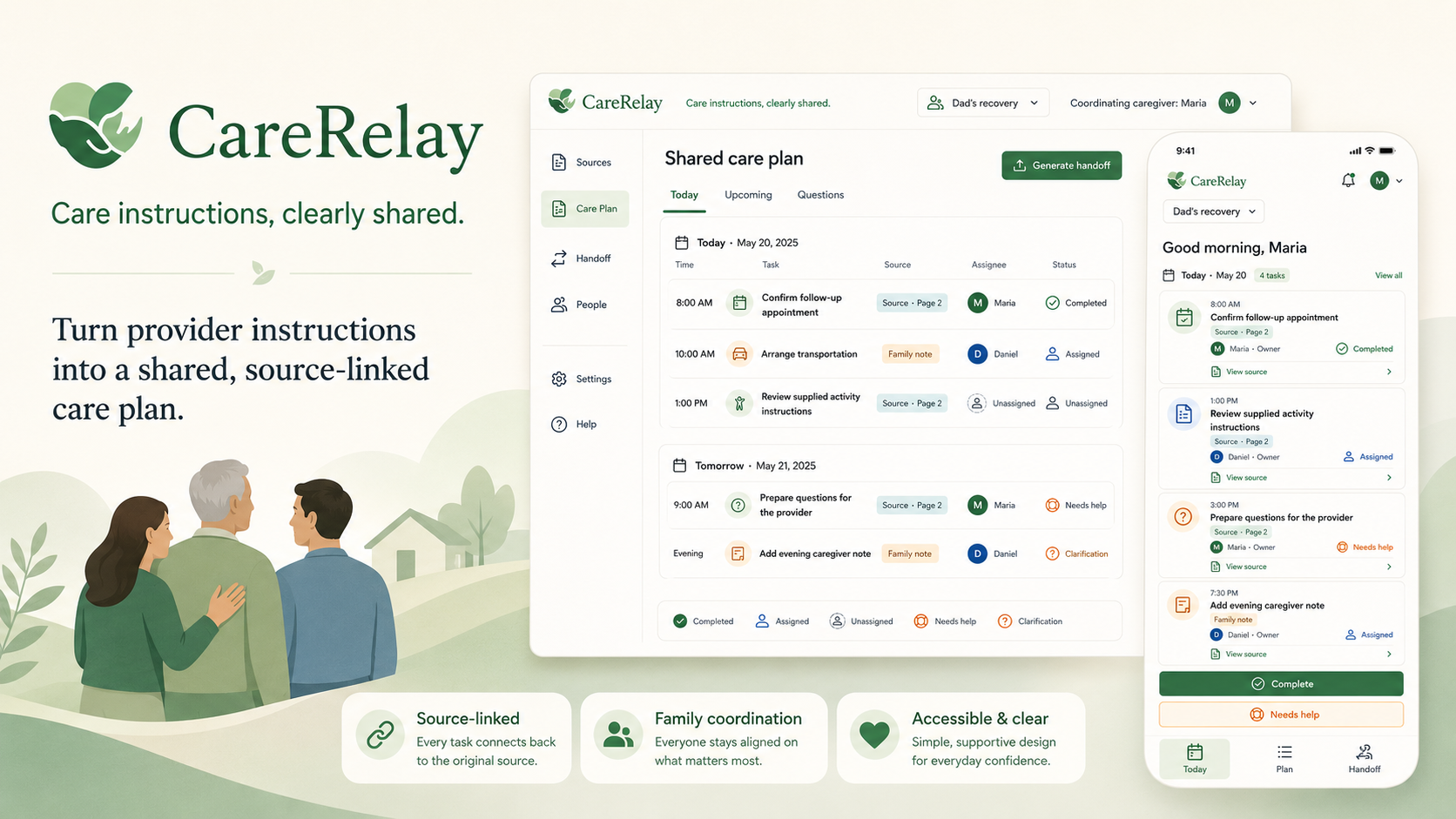
Inspiration
This project is based on a true story from my family’s experience. My mother-in-law was admitted to the emergency room because of gallbladder complications and later underwent surgery. After spending a week and a half in the hospital, she was discharged with an overwhelming set of instructions explaining what to do, what to avoid, and which daily tasks needed to be completed step by step.
Families often leave an appointment with a packet of instructions but no shared operating picture. Important actions are spread across pages, dates can be easy to miss, different caregivers may assume someone else is handling a task, and unclear or contradictory details can disappear into text messages.
CareRelay was inspired by a simple question: Can AI reduce coordination burden without making medical decisions for the family?
What it does
CareRelay turns provider-issued care instructions into a source-linked, human-confirmed family coordination plan.
A caregiver can:
- Load the bundled six-page fictional PDF or upload a fictional PDF, PNG, or JPEG.
- Let GPT-5.6 extract explicit actions, schedules, appointments, restrictions, warning signs, and clarification needs.
- Review every draft beside its exact document page and verbatim source excerpt.
- Confirm, edit, or reject each draft before it can enter the shared plan.
- Keep missing information and cross-page contradictions visible as questions for the provider.
- Assign confirmed tasks to family members and record completed, needs-help, or not-completed check-ins.
- Add family coordination notes without changing provider-supplied text.
- Generate a current caregiver handoff with completed work, upcoming items, attention needs, open questions, notes, and one-tap source links.
- Review the complete flow in a plain-language audit history.
The public demo needs no account and uses fictional information only.
How we built it
CareRelay is a responsive Next.js and TypeScript web application deployed on Vercel.
GPT-5.6 runs through the OpenAI Responses API. The server sends PDF files at high detail, supports uploaded images, and requires a strict Zod-backed structured response. Every proposed item includes a document, page, stable fragment ID, and verbatim excerpt.
The model creates unconfirmed drafts. Deterministic application code then enforces the safety boundaries:
- no source reference means no confirmation;
- no human confirmation means no shared task;
- contradicted or insufficiently supported output cannot be published;
- source text is immutable;
- family notes and user edits remain visibly separate;
- missing details remain missing;
- contradictions remain unresolved and visible.
For the bundled synthetic case, CareRelay validates the live GPT-5.6 response and normalizes it to a stable canonical review set. This keeps the public three-minute demo reliable without hiding whether the live model path ran. The Responses API request uses store: false, and the app does not log document content or health-related model output.
Codex served as the implementation lead. It inspected the PRD, design concepts, existing Next.js foundation, and safety boundaries; implemented the complete responsive source-review-to-handoff flow; created the synthetic six-page packet; added typed contracts and deterministic gates; wrote invariant tests; ran production and browser acceptance checks; and prepared the architecture, demo, and submission documentation.
Primary Codex session ID: 019f787a-bc24-7f31-90ee-b8235cc05aff.
Challenges we ran into
The hardest challenge was not extraction—it was trust. A polished AI summary can hide uncertainty, so we designed the product around evidence and explicit human decisions. Every model draft stays linked to its source, one seeded wrong date cannot be confirmed, and missing or contradictory details become provider questions instead of invented answers.
We also needed a demo that was both realistic and safe. We created a fully fictional six-page source packet with known actions, appointments, an incomplete schedule, and a cross-page contradiction. That made the complete workflow judgeable without using real health information.
Accomplishments that we're proud of
- A complete, responsive golden path from source packet to caregiver handoff.
- Live GPT-5.6 document understanding with schema-validated structured output.
- Evidence and human-review gates enforced in deterministic code.
- A deliberately unsupported date that the interface prevents users from confirming.
- Missing information and contradictions that remain visible throughout the plan and handoff.
- A calm mobile experience for everyday caregiver check-ins.
- Seven automated safety-invariant tests plus desktop and mobile browser acceptance coverage.
- A no-login, one-click synthetic demo that judges can complete in under three minutes.
What we learned
The most useful role for AI in a sensitive workflow is often not autonomous decision-making. It is turning unstructured material into a reviewable draft, making evidence easy to inspect, and reducing the effort required for people to coordinate responsibly.
We also learned that provenance should not be a footnote. When the source is always one tap away, uncertainty becomes an explicit product state rather than an invisible model limitation.
What's next
The hackathon MVP intentionally excludes real patient accounts, EHR connections, messaging, calendar sync, and medical reasoning. A production version would first add authentication, consent-aware multi-user persistence, access and retention controls, invitation-based family collaboration, notifications, and carefully scoped calendar or messaging integrations.
CareRelay organizes supplied instructions. It does not diagnose, prescribe, assess urgency, recommend treatment changes, or replace a healthcare professional.
Built With
- codex
- gpt-5.6
- next.js
- openai-responses-api
- react
- tailwind-css
- typescript
- vercel
- zod