Inspiration
CareRelay was inspired by someone close to us, a grandparent who was having difficulty keeping track of appointments, documents, transportation, and the different instructions coming from family members and healthcare providers.
We saw how quickly care coordination could become overwhelming. Information was spread across phone calls, messages, pieces of paper, and people’s memories. Everyone was trying to help, but it was still easy to miss an update, forget a task, or be unsure which appointment detail was correct.
That experience made us realize that the problem was not a lack of care. The problem was that the care information had nowhere reliable to come together.
We built CareRelay to make that process easier: one shared place where families can see what is known, identify what does not match, assign responsibilities, and decide together what needs to happen next.
What We Built
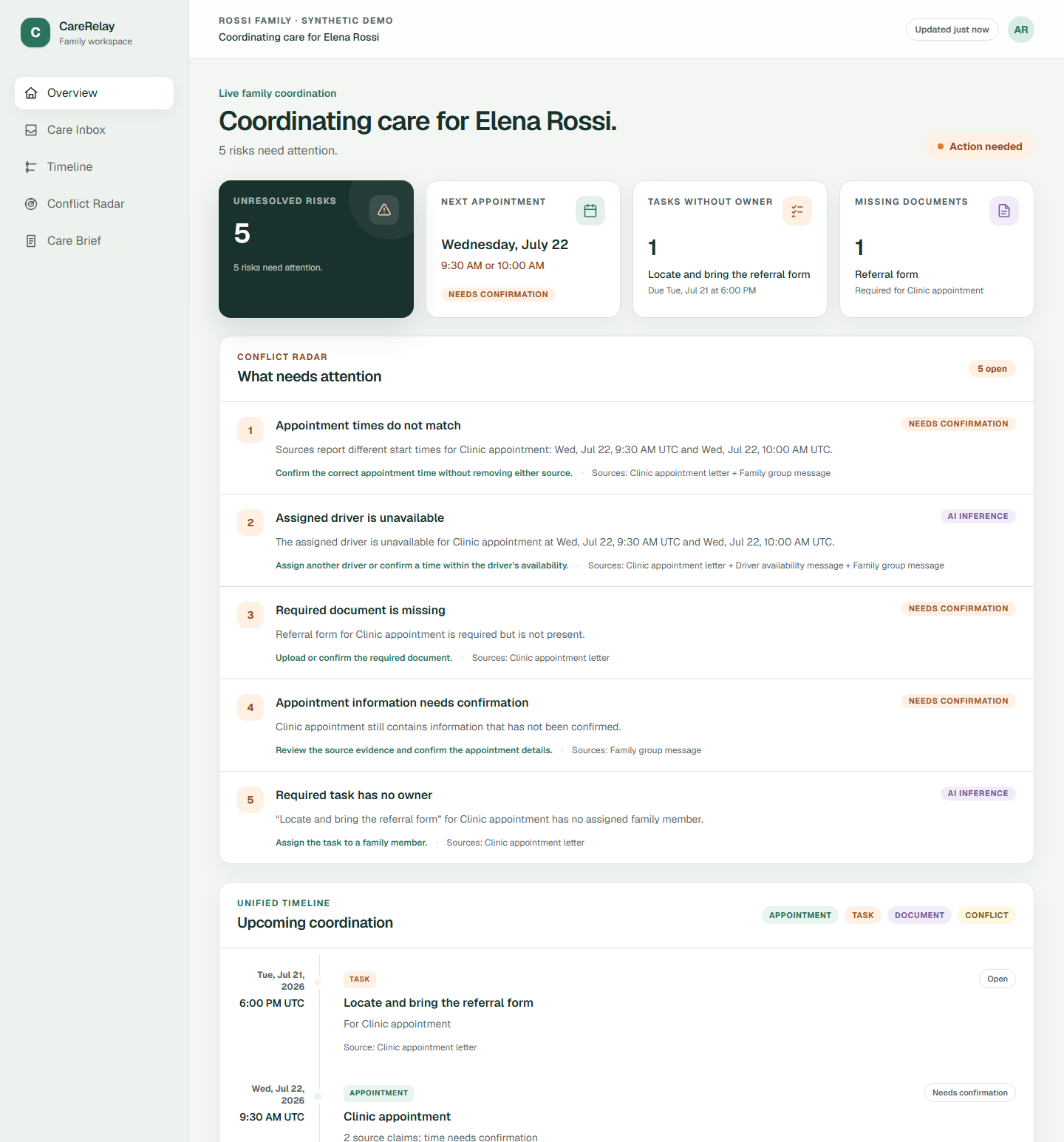
CareRelay turns scattered care information into a shared, traceable plan. It keeps the original sources visible, identifies information that does not match, highlights missing details, and makes responsibilities easier to assign.
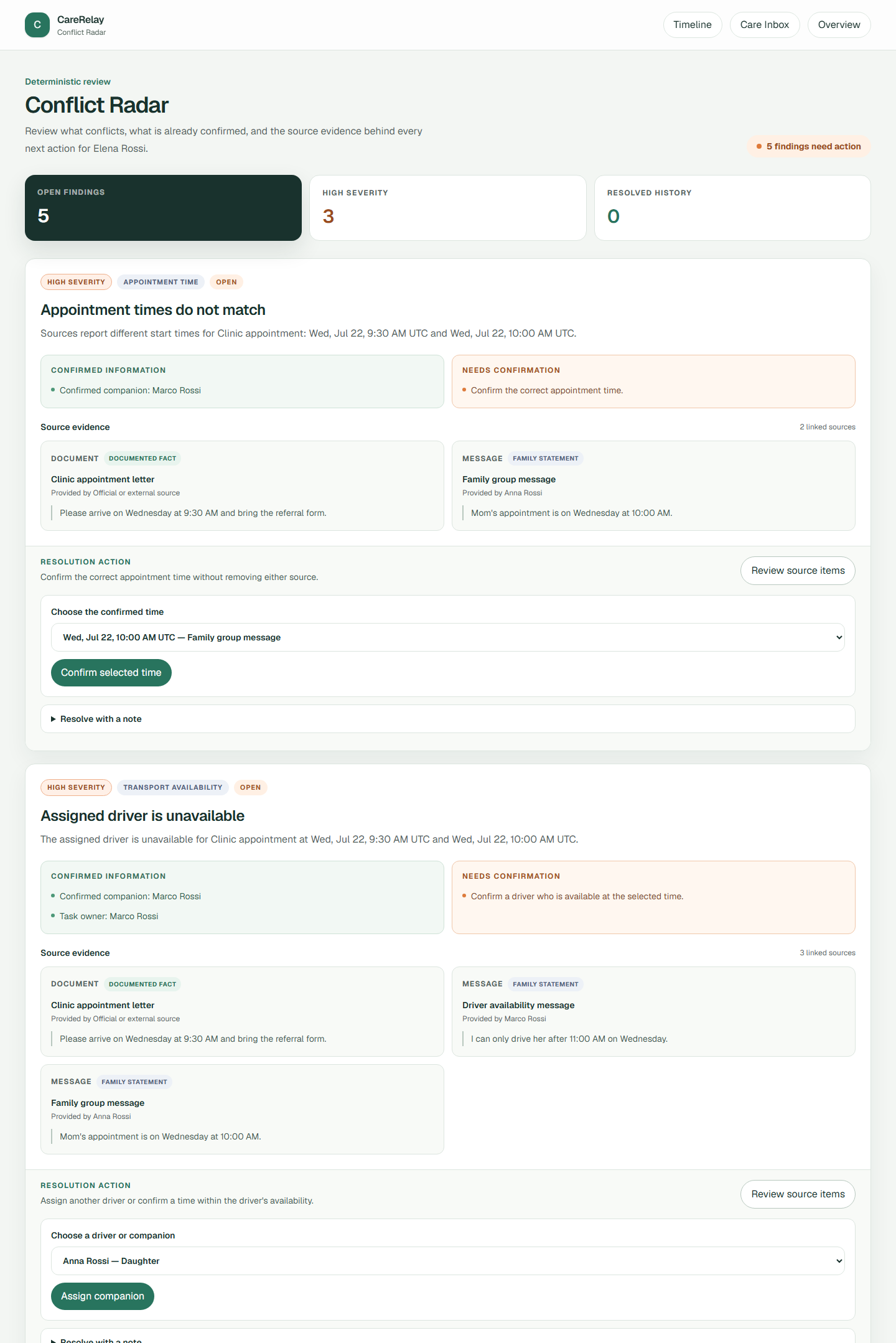
The demo follows a realistic family scenario: two different appointment times, a missing referral form, an unassigned task, and a transportation plan that may not leave enough time.
CareRelay does not simply produce an answer and ask people to trust it. It shows what is known, what still needs confirmation, and why a potential issue was identified. The final decision always stays with the people coordinating the care.
We also added simple role-based views for the demo so the same plan can be understood from the perspective of a family coordinator, patient, or caregiver. These views are intentionally presented as a preview, not as real authentication or permissions.
How We Used Codex
Codex was part of the development process from the beginning, not just a tool we used to generate isolated code snippets.
We used Codex as an engineering partner to explore the product idea, break the problem into smaller pieces, design the application architecture, and iterate on the user experience. It helped us move from the initial concept to a working Next.js application with a database, API routes, structured validation, deterministic conflict rules, AI reasoning, persistence, and a complete demo workflow.
We also used Codex to:
- build the source-first Care Inbox and document-processing flow;
- implement the Conflict Radar and human resolution controls;
- design the evidence and inference boundaries for AI Plan Review;
- add the keyless precomputed analysis used by the public demo;
- create the Care Brief and export workflow;
- improve responsive behavior and accessibility;
- model failure states and privacy boundaries;
- write unit, integration, accessibility, and Playwright tests;
- debug implementation issues and verify the production build;
- create a repeatable demo scenario and replay controls;
- update the README, architecture notes, safety review, and video script.
The important part was the iteration. We would ask Codex to inspect the current state, propose a focused change, implement it, run the relevant tests, and then review the result again from the perspective of a real user. This helped us keep the project moving quickly without treating generated code as automatically correct.
What We Learned
We learned that the hardest part is not collecting more information. It is helping people understand which information matters right now.
A useful care tool needs to be calm and direct. It should not bury the important detail under technical language or make a family member feel that they need to become an expert before they can use it.
We also learned that transparency matters more than making AI look impressive. In the keyless demo, the Plan Review uses a clearly labelled precomputed analysis based on synthetic data. We never present it as a live model response, and we keep the evidence and the inference visibly separate.
Working with Codex also reinforced that fast generation is only useful when combined with review, testing, and human judgment. The most valuable part was not producing code quickly, but being able to explore, build, test, question, and refine the product in a continuous loop.
How We Built It
We began with the smallest moments that create confusion: comparing two appointment times, checking whether a document is ready, assigning a task, and figuring out whether someone can actually make the journey.
From there, we built the experience around a source-first inbox, deterministic conflict checks, a human review workflow, and a Care Brief that reflects the current confirmed state of the plan.
The application uses Next.js, React, TypeScript, Prisma, SQLite, Zod, OpenAI Structured Outputs, Vitest, Playwright, and Docker. The AI layer is kept behind server-side boundaries, while deterministic checks remain available even when no external model is configured.
We tested the complete journey repeatedly, including empty states, failed processing, accessibility, responsive layouts, model-unavailable scenarios, and the keyless demo path. We also added replayable demo controls so the same story can be shown consistently to reviewers without manual database setup.
Challenges
The biggest challenge was keeping the product simple without pretending that real-life care is simple.
Different people need different information. Some details are confirmed, others come from a family message, and some are only possible conclusions that need to be checked. We had to make those differences clear without overwhelming the user.
We also had to be honest about the limits of the project. CareRelay currently uses synthetic data, does not provide medical advice, and is not a production healthcare system. Authentication, consent, encryption, and real-world integrations would all be required before using it with sensitive patient information.
CareRelay is our attempt to make care coordination feel less like detective work. It helps families see what is happening, what is missing, and what needs to happen next—without taking the human decision out of the process.
Built With
- accessibility
- care-coordination
- caregiving
- collaboration
- communication
- community
- digital-health
- healthcare
- healthtech
- patient-support
- user-experience
- web-app

Log in or sign up for Devpost to join the conversation.