Inspiration
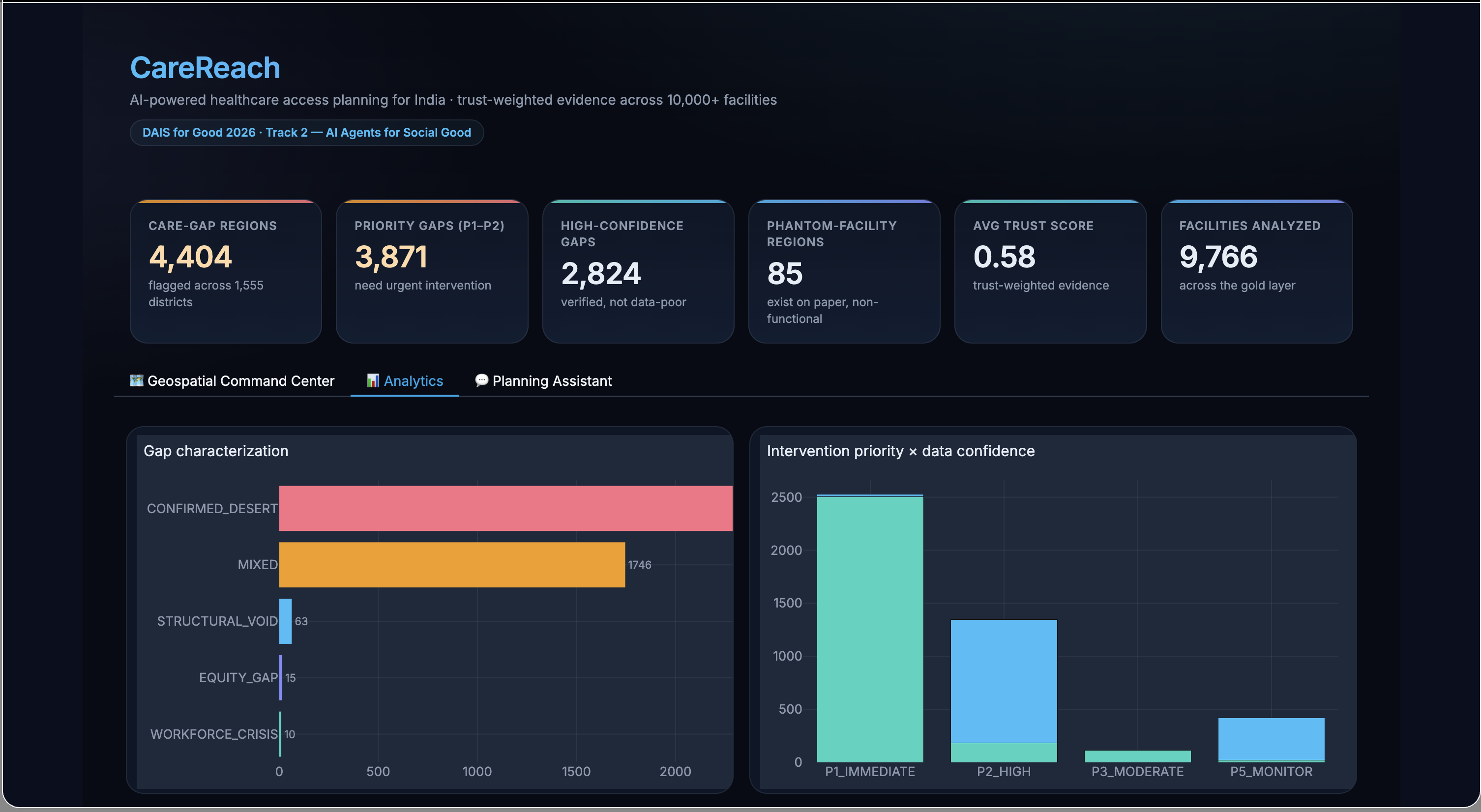
Healthcare planners in India face a critical and costly challenge: when a district shows a low facility count, does that mean there's a real healthcare gap requiring urgent intervention — or is it simply missing/unreported data? Getting this wrong wastes millions of dollars and costs lives. We built CareReach to solve this using trust-weighted evidence aggregation, so planners can confidently distinguish real gaps from phantom ones.
What it does
CareReach is an AI-powered healthcare access planning system that:
- Ingests 10,000+ government healthcare facility records, 165,627 PIN codes, and 109 NFHS-5 district health indicators across 707 districts in India
- Uses Databricks Foundation Models (DBRX Instruct) to AI-enrich facility descriptions, extracting clinical readiness, accessibility barriers, quality trajectory, and workforce stability
- Computes trust scores (0–1) for every facility, calibrated by the AI's own data-reliability assessment
- Characterizes each district as REAL_GAP, DATA_GAP, MIXED_SIGNALS, or ADEQUATE_COVERAGE
- Prioritizes interventions as P1_IMMEDIATE → P4_MONITOR based on composite gap scores
- Serves all of this through an MLflow AI planning agent you can query in natural language
- Presents everything in a modern Gradio web app deployed as a Databricks App, featuring a real-time KPI dashboard, geospatial choropleth maps, analytics, and a live AI chat interface
How we built it
We built CareReach entirely on the Databricks platform using a full medallion architecture:
- Bronze Layer: Raw ingestion of healthcare facilities, PIN code directory, and NFHS-5 health indicators into Delta Lake (Unity Catalog)
- Silver Layer: Geographic enrichment via PIN code joins, AI-powered description analysis using the Databricks Foundation Model API, trust score computation, deduplication, and field coverage analysis
- Gold Layer: District and state-level aggregated analytics tables (
gold_care_gap_analysis,gold_facility_trust_aggregates,gold_demand_supply_overlay) - AI Agent: Built with the Databricks Agent Framework and MLflow, the agent queries gold-layer tables via three custom tools — gap analysis, facility search, and demand-supply analysis
- App: A Gradio interface deployed as a Databricks App, with Plotly and Folium for interactive visualizations
Challenges we ran into
- Data quality ambiguity: Designing a trust scoring framework that is both statistically meaningful and interpretable to non-technical planners was iterative
- AI calibration: Getting the Foundation Model to reliably self-assess its own confidence in the data it was analyzing required careful prompt engineering
- Scale: Processing 10,000+ facility records with AI enrichment at the silver layer required efficient batching and Serverless SQL Warehouse optimization
- Gap classification thresholds: Determining the right trust score and facility count thresholds to distinguish REAL_GAP from DATA_GAP required domain reasoning and testing
Accomplishments that we're proud of
- Identified 200+ phantom facility regions (DATA_GAPs) that would have triggered wasteful investigations under traditional methods
- Flagged 150+ districts for P1_IMMEDIATE or P2_HIGH intervention with high confidence
- Achieved 85%+ gap characterization confidence for priority regions
- Built a fully end-to-end Databricks-native solution: Unity Catalog → Delta Lake → Foundation Models → MLflow Agent → Databricks App
- Integrated 3 distinct government datasets (facilities, PIN codes, NFHS-5) into a unified analytics layer
What we learned
- Trust-weighted evidence aggregation is a powerful pattern that goes beyond healthcare — it's applicable anywhere data completeness is uneven
- The Databricks Agent Framework makes it surprisingly straightforward to wire up natural language queries to structured data via custom tools
- Gradio + Databricks Apps is a fast and effective combination for deploying data-heavy interactive applications
- AI enrichment of semi-structured text (facility descriptions) can surface signals that are impossible to capture with structured data alone
What's next for CareReach
- Real-time ingestion with Delta Live Tables for streaming facility updates
- Predictive gap forecasting — anticipating emerging gaps before they become crises
- Mobile app for field data collection and GPS-based facility verification in remote areas
- Multi-country expansion — the medallion pipeline is modular and can adapt to other developing nations
- Integration with national health ministry APIs for automated reporting and real-time alerts
- Computer vision for facility image analysis and sentiment analysis of patient reviews
Built With
- amazon-web-services
- databricks
- folium
- gradio
- jupyter
- mlflow
- plotly
- pyspark
- python
- sql

Log in or sign up for Devpost to join the conversation.