-
-
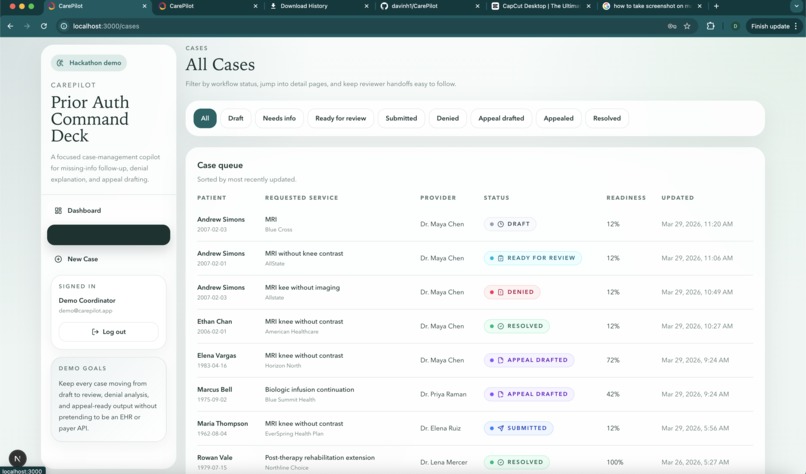
All cases
-
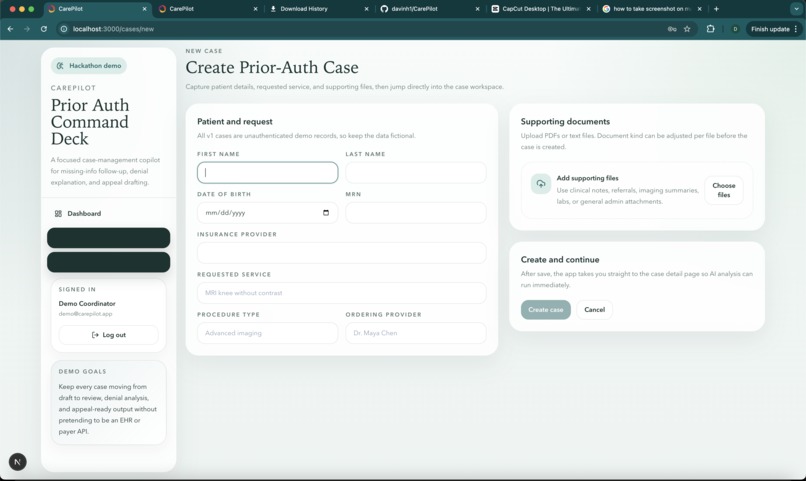
Home
-
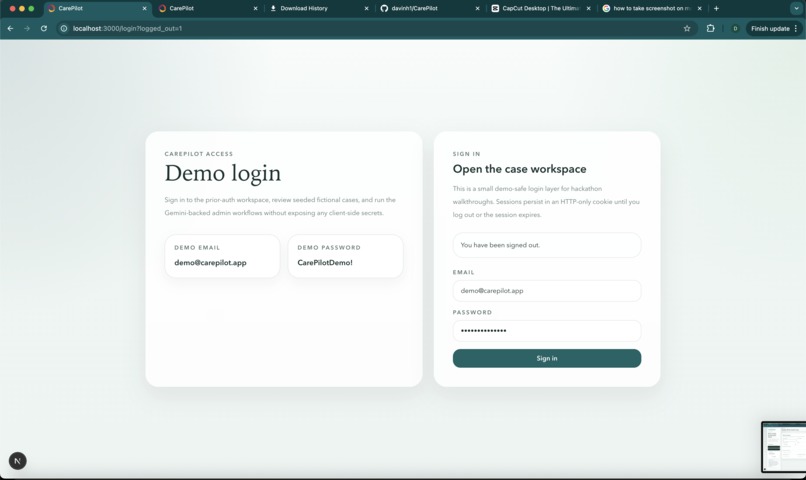
Login
-
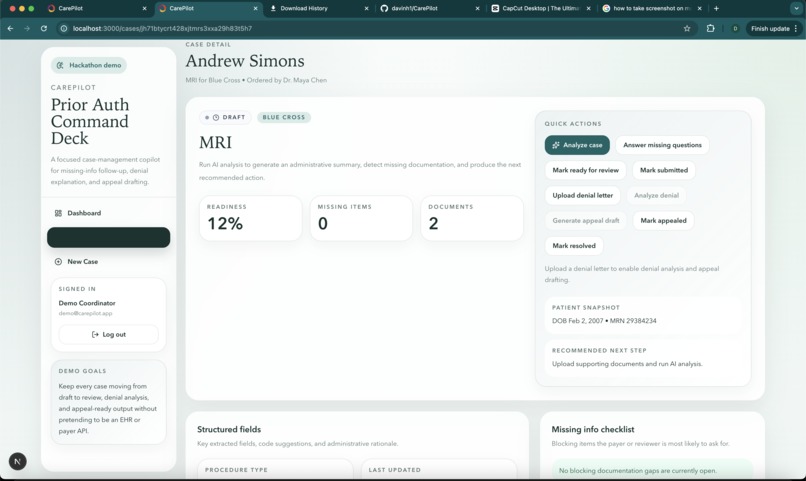
AI tools


Inspiration
Healthcare is collapsing under its own administrative weight. Doctors are spending more time on paperwork than with patients, and in rural communities, this inefficiency is forcing hospitals to shut down — cutting off access to care for millions. We wanted to build something that directly gives time back to clinicians and helps keep healthcare systems alive where they’re needed most. We've personally seen this in global (not only national!) systems ranging from rural Montana to the impoverished regions of Ninh Binh, Vietnam and Kwa-Zulu Natal Province, South Africa.
What it does
CarePilot is an AI-powered healthcare copilot that transforms unstructured patient input into structured, actionable workflows in seconds. It automates intake, documentation, and routing — turning what used to take 45 minutes into under 10 seconds — so providers can focus on care, not clerical work.
How we built it
We built CarePilot as a full-stack application using a React/Next.js frontend and a Node.js/Express backend, with MongoDB for flexible data storage. At its core, we integrated advanced language models to parse free-text patient input, extract key medical details, and generate structured outputs that drive automated workflows. The system connects intake, processing, and routing into a seamless pipeline.
Challenges we ran into
One of the biggest challenges was reliably converting messy, unstructured medical input into consistent, structured data. Edge cases in language and ambiguity required many, many iterations of system design and validation logic. We also had to balance speed with accuracy while building an end-to-end system in the limited time allotted in the hackathon.
Accomplishments that we're proud of Since this is both of our first hackathon's we found it difficult in the beginning to establish a strong sense of direction, but through continually bouncing ideas off each other and working through an excruciating amount of bugs, we were successfully built a working system that reduces administrative processing time from minutes to seconds. More importantly, we created something that directly addresses clinician burnout and healthcare accessibility, a pervasive problem that affects the lives of billions around the globe.
What we learned
We learned how powerful AI can be when applied to real-world bottlenecks, especially in high-stakes environments like healthcare. We also gained experience in building end-to-end systems quickly, from frontend UX to backend orchestration and database storage. In the end, we learned so much and we're really glad that we got the opportunity to build something meaningful here at Yale.
What's next for CarePilot
Next, we want to integrate with real EHR systems, improve clinical accuracy with domain-specific tuning, and pilot CarePilot in underserved hospitals. Our long-term goal is to become the infrastructure layer that keeps healthcare systems efficient, sustainable, and accessible for everyone.
Snapchat Filters: Memory Suite Inspiration
Growing up, some of our most meaningful memories come from simple, playful things that today’s fast-paced digital world often overlooks and maybe call redundant or mundane. We wanted to recreate that feeling of childhood nostalgia and make it accessible in a format that resonates with Gen Z: interactive, social, and shareable. Through this perspective, we created a suite of highly interactive lens that targets the younger audience that makes up the vast majority of the SnapChat user base.
What it does
Memory Suite is a collection of three Snapchat lenses that transport users back to their childhood through playful, nostalgic experiences. Each lens captures a different aspect of growing up — turning everyday snaps into immersive, emotional moments that spark connection, creativity, and joy.
How we built it
We built Memory Suite using Lens Studio, combining face tracking, interactive scripting, and custom visual assets to create engaging experiences. Each lens was designed with intuitive interactions and dynamic effects to encourage users to play, explore, and share.
Challenges we ran into
Designing for both nostalgia and engagement was a challenge — we had to ensure the lenses felt meaningful without sacrificing fun and usability. We also worked within performance constraints to keep the lenses smooth and responsive on mobile devices.
Accomplishments that we're proud of
We created a cohesive set of lenses that not only look visually engaging but also evoke genuine emotion. The suite aligns closely with Snapchat’s user base and demonstrates strong potential for virality and user engagement.
What we learned
We learned how to design for emotional impact in a short-form, interactive medium. We also gained experience balancing creativity with technical constraints in AR development.
What's next for Memory Suite
Next, we plan to expand Memory Suite with more lenses, incorporate user-personalized experiences, and explore deeper interactivity to make nostalgia even more immersive and shareable.

Log in or sign up for Devpost to join the conversation.