-
-
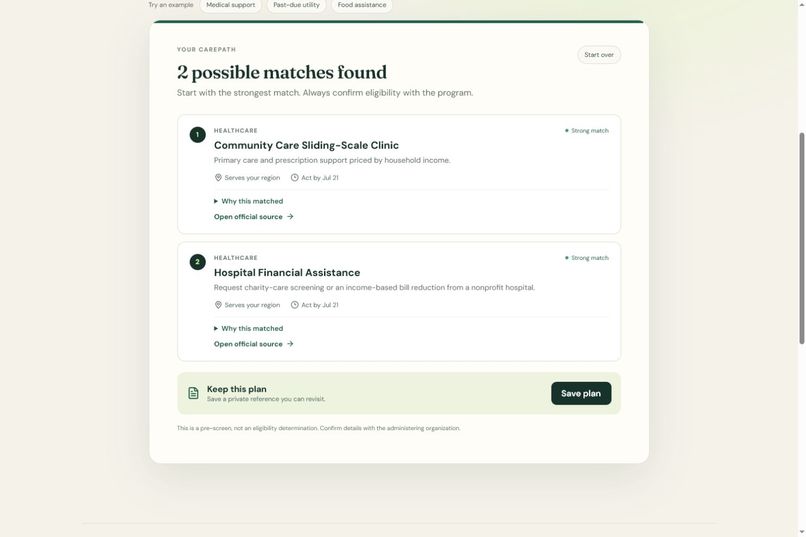
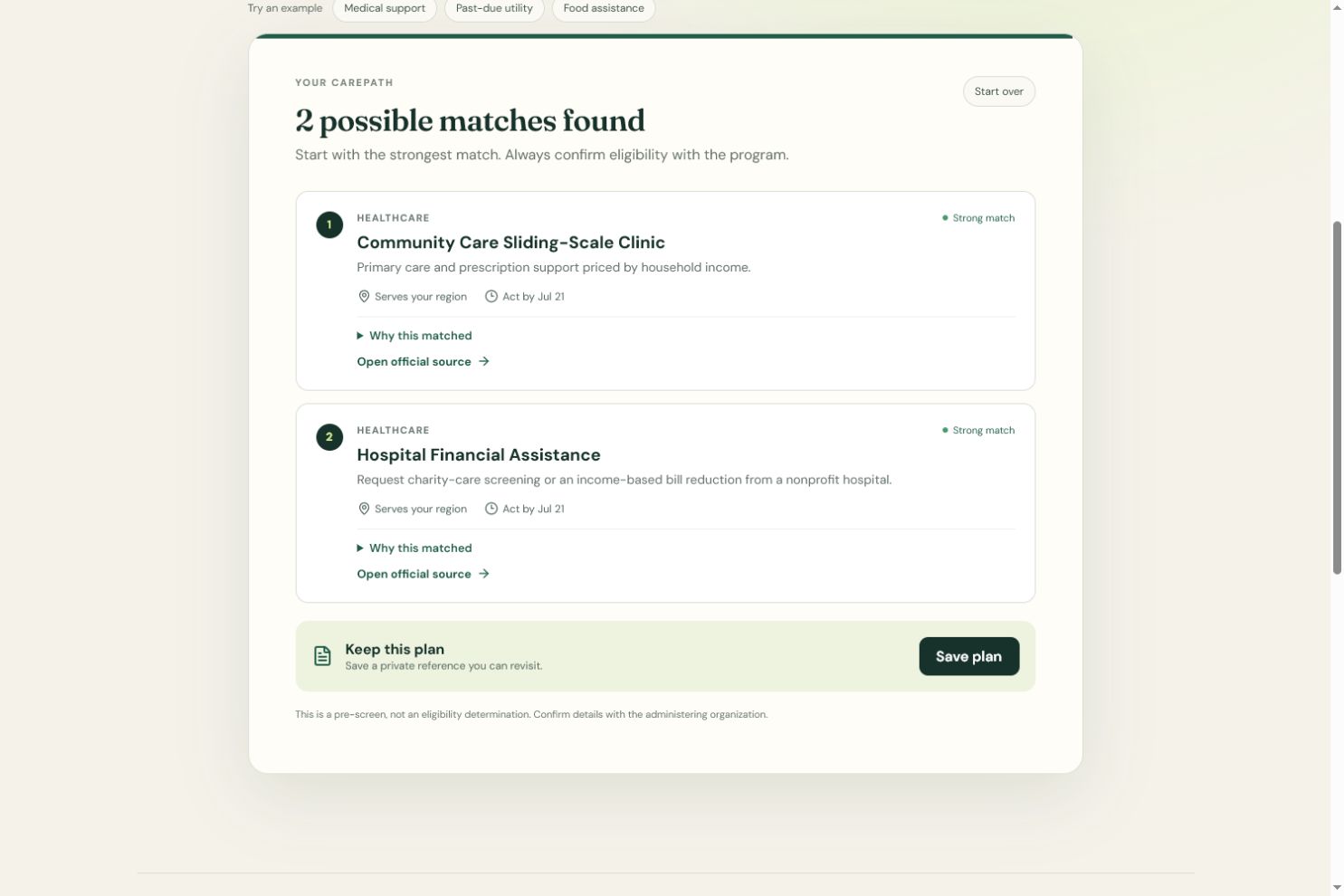
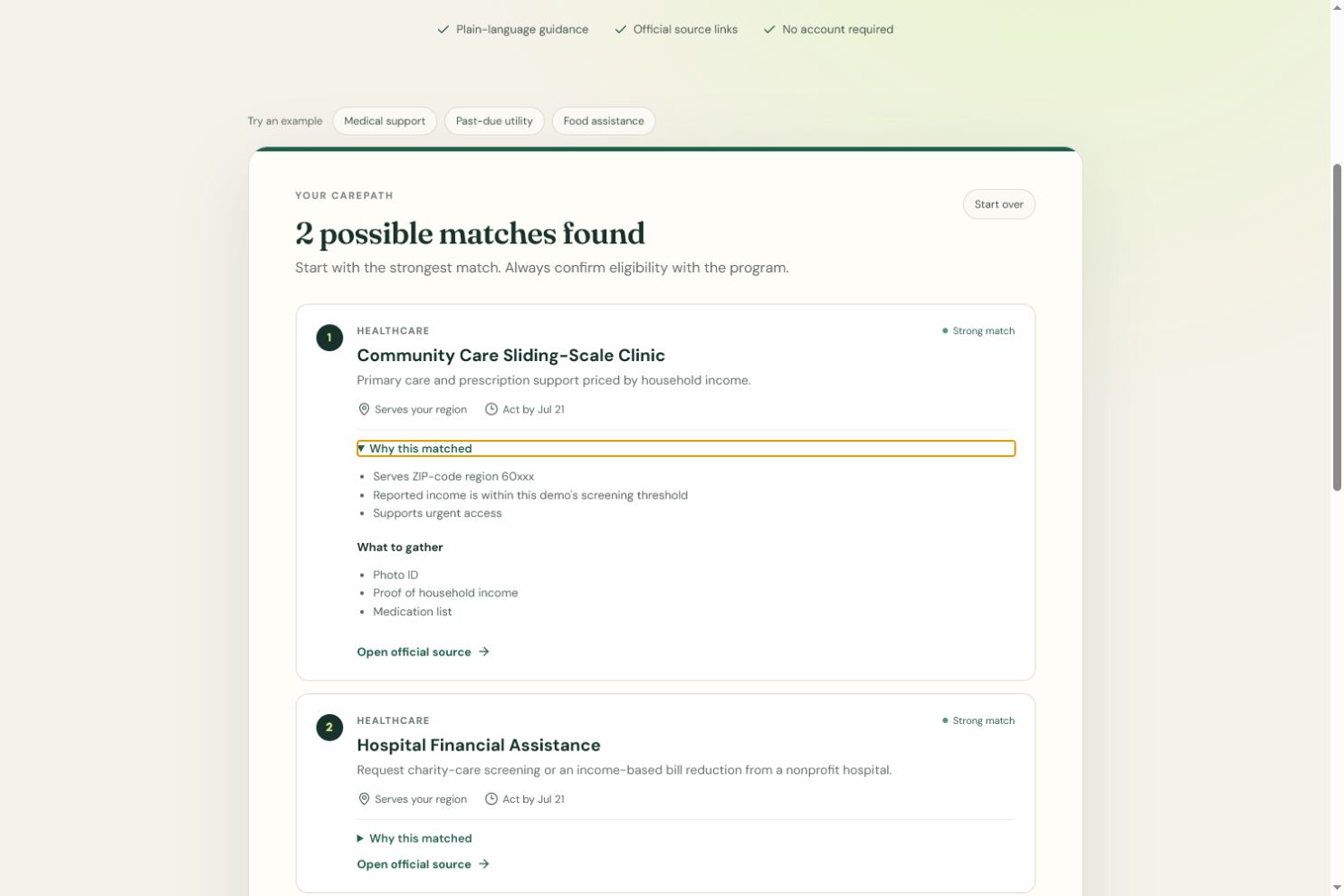
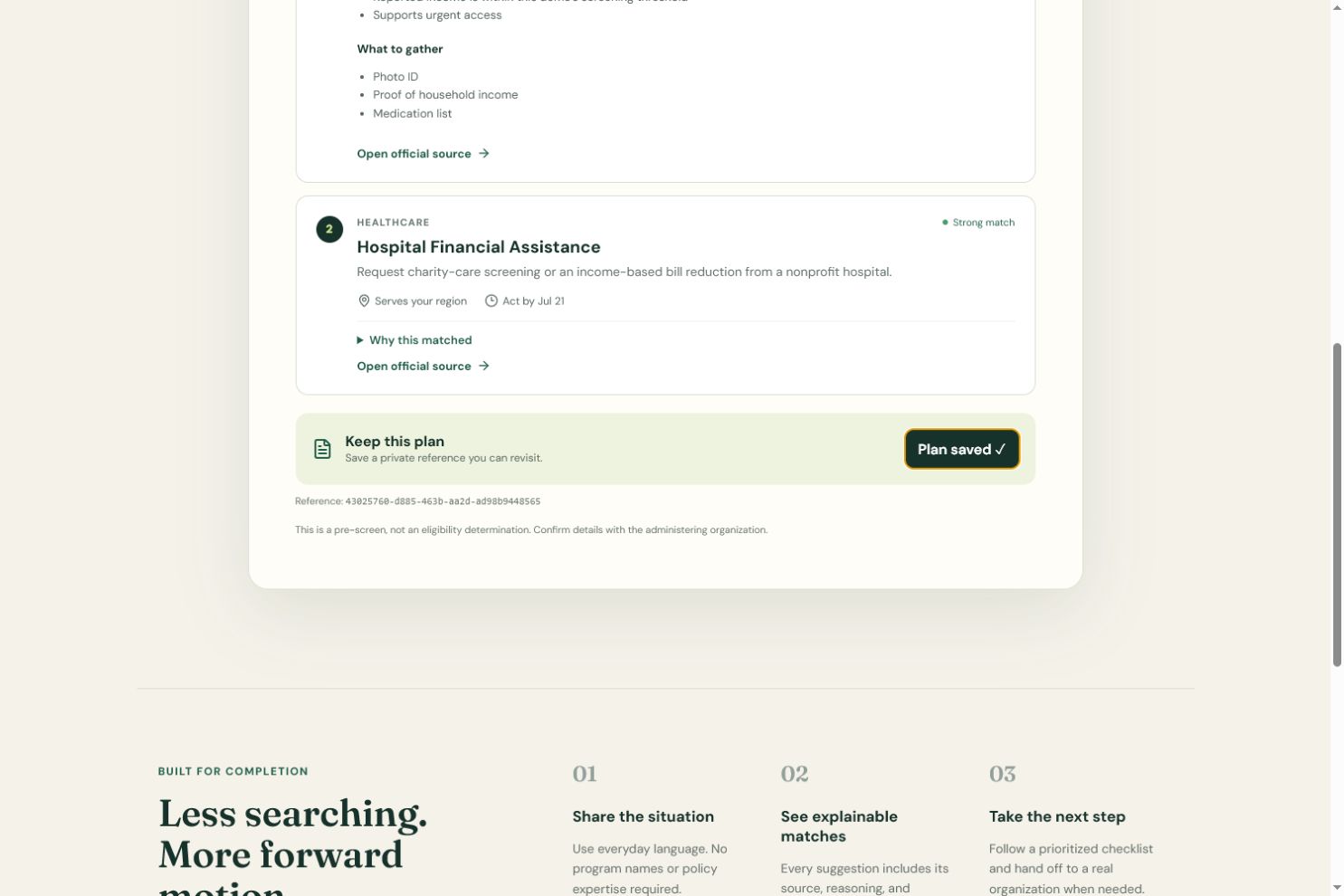
CarePath ranks relevant programs and shows their source, urgency, match strength, and next action.
-
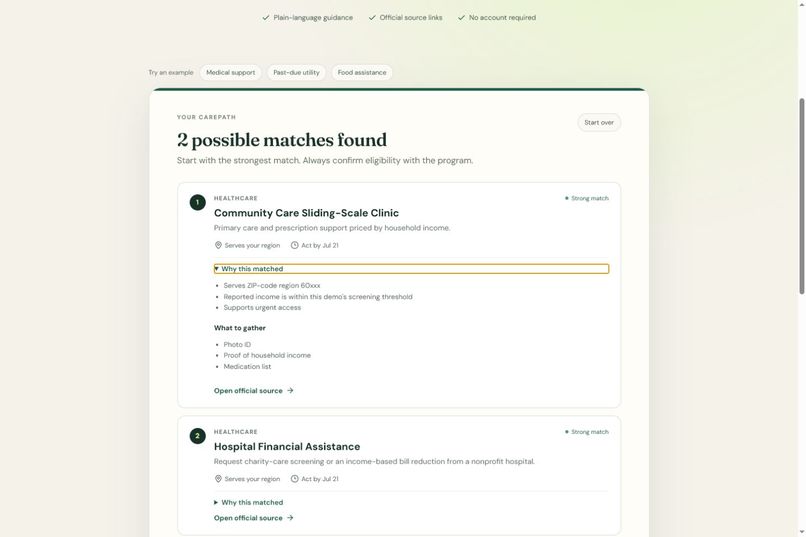
Every recommendation explains why it matched and identifies the documents a user should gather.
-
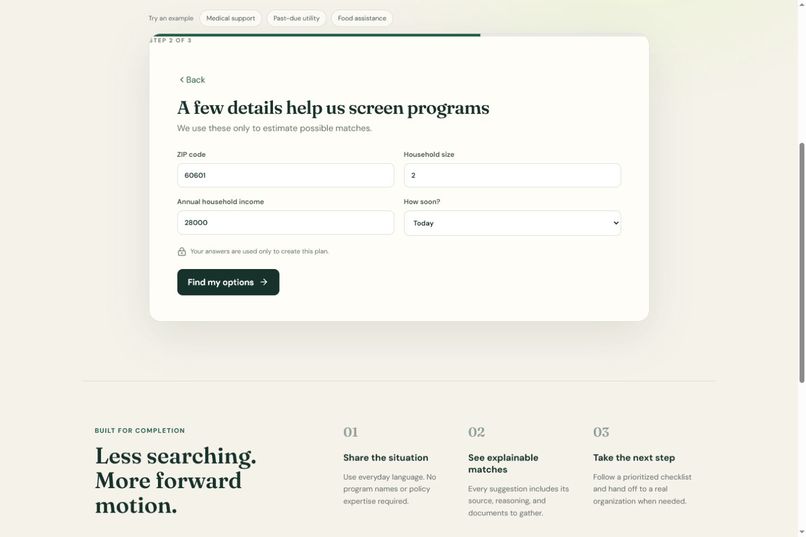
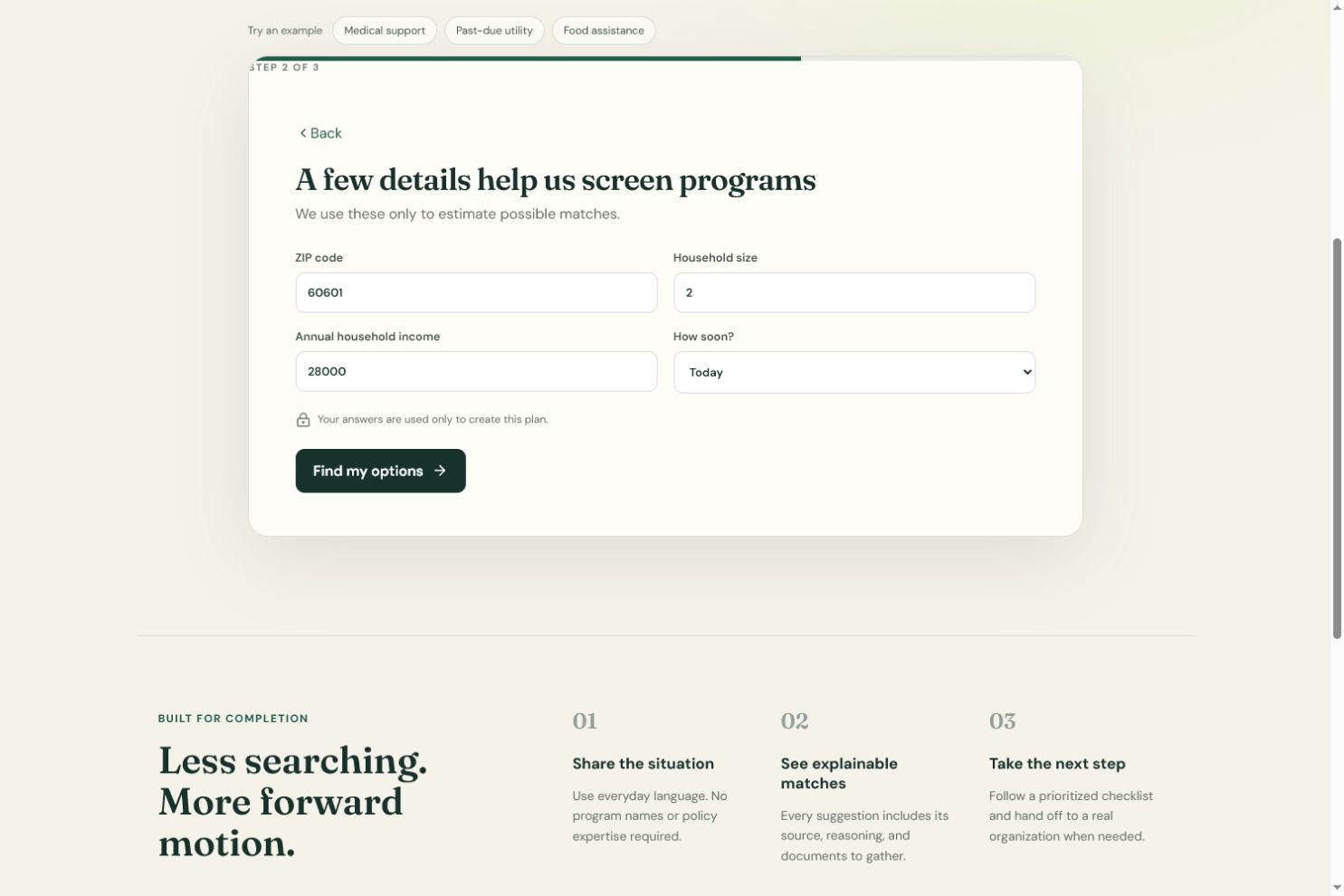
A minimal, privacy-conscious intake collects only the information required to estimate possible program matches.
-
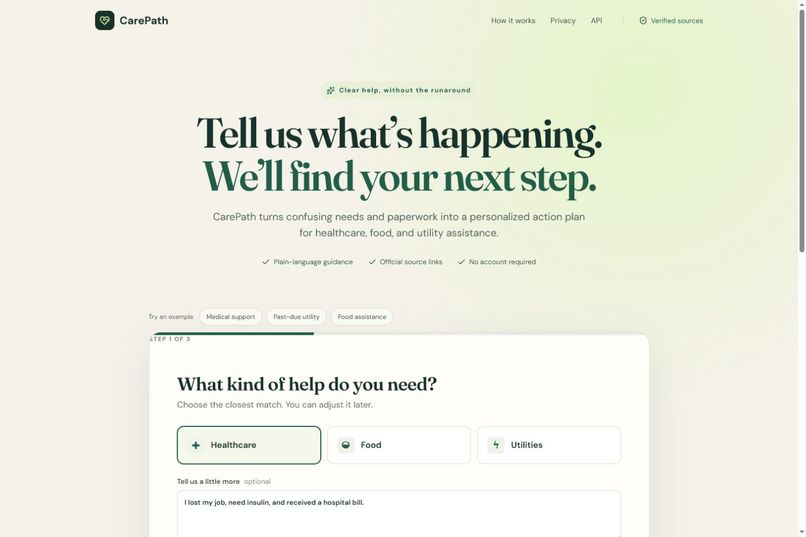
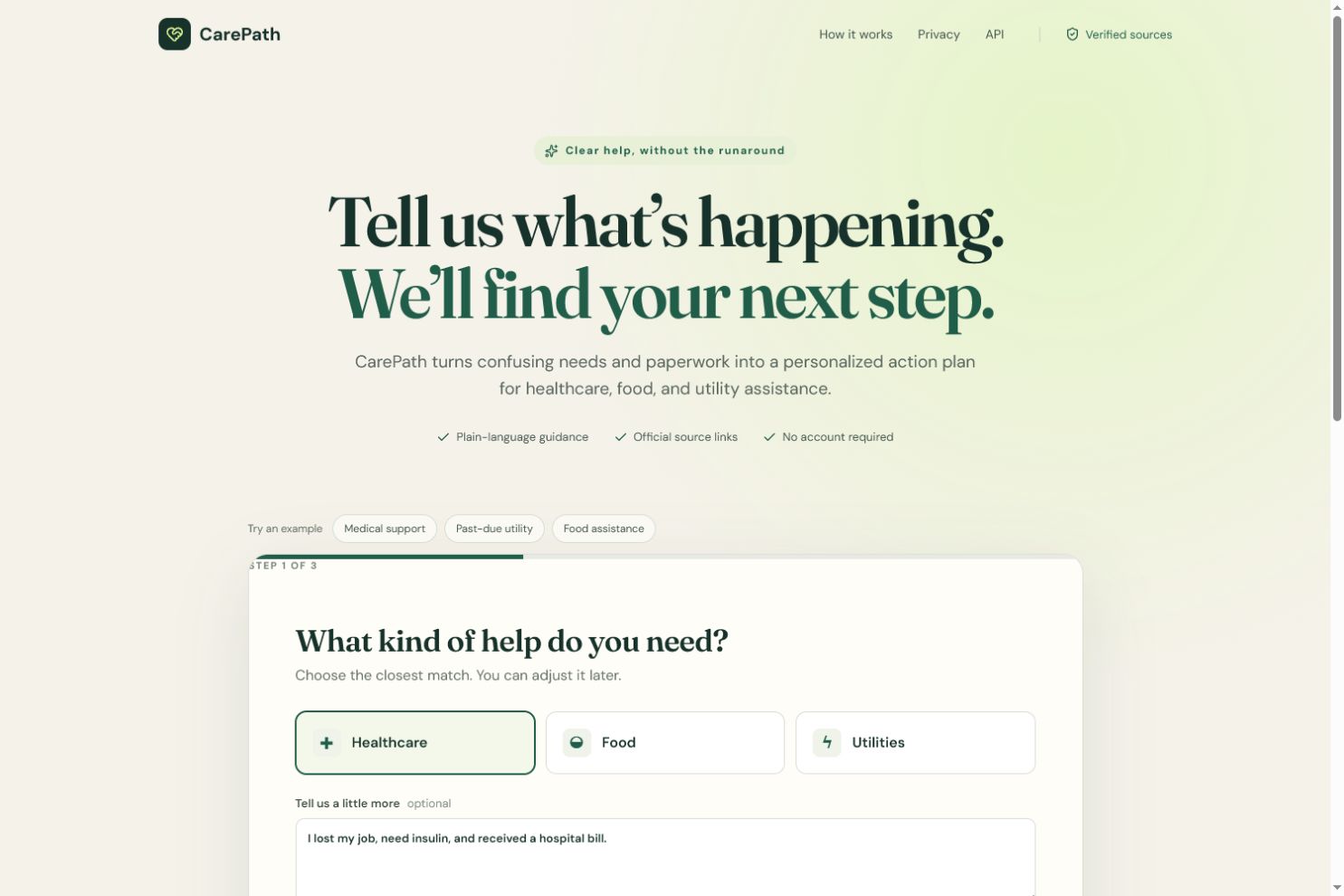
CarePath transforms confusing needs and paperwork into a clear, personalized path to essential assistance.
-
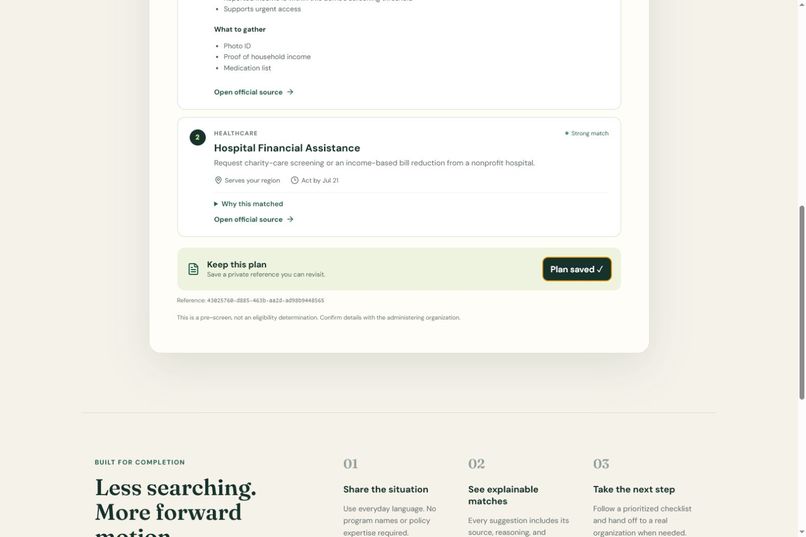
Users can explicitly save their personalized action plan and receive a private reference for returning later.
-

CarePath includes a FastAPI backend with interactive OpenAPI documentation for assessments, programs, document analysis, and saved plans.

Inspiration
Essential assistance often exists, but reaching it can be unnecessarily difficult. Someone facing a medical bill, food insecurity, or a utility disconnection may need to search across multiple agencies, interpret complicated eligibility rules, repeat the same information, and meet urgent deadlines.
Most resource directories return a collection of links. We wanted to create something more useful: a clear path from “I need help” to “I know what to do next.”
CarePath was inspired by the idea that technology should reduce the administrative burden placed on people during their most stressful moments.
What it does
CarePath is a privacy-first assistance navigator for healthcare, food, and utility-support programs.
Users describe their situation in everyday language and provide a few details needed for an initial screening. CarePath then produces a prioritized action plan containing:
- Potentially relevant assistance programs
- An explanation of why each program matched
- Documents the user may need
- A suggested action date
- Direct links to authoritative sources
- A private reference for saving and revisiting the plan
The current demonstration includes three repeatable scenarios:
- A recently unemployed person who needs insulin and has received a hospital bill
- A household facing a utility-disconnection notice
- A family whose grocery budget no longer lasts through the month
CarePath can also analyze the text of a notice to identify a likely category of assistance. This text is processed in memory and is not stored.
CarePath does not make final eligibility, medical, or legal decisions. It provides an explainable preliminary screen and directs users to the qualified organization responsible for the final determination.
How we built it
We created CarePath as a full-stack web application.
The responsive frontend was built with:
- React
- Vite
- Lucide icons
- Accessible HTML and responsive CSS
The backend was built with:
- FastAPI
- Pydantic validation
- REST and OpenAPI
- SQLite persistence
- Pytest and HTTPX
The matching system uses a hybrid architecture. Flexible language intake helps CarePath understand the user’s situation, while deterministic rules produce the actual match status. This separation makes recommendations testable and explainable.
Every result includes visible reasons, supporting document requirements, an authoritative source, and a reminder that the result is only a preliminary screen.
SQLite makes the demonstration easy to run locally. The persistence layer can later be migrated to PostgreSQL for production deployment. The project also includes Docker configuration, automated API tests, interactive documentation, seeded examples, and a dedicated local server launcher.
Challenges we ran into
Our biggest challenge was balancing usefulness with safety.
A service navigator must not falsely imply that someone is officially eligible. It must communicate uncertainty without becoming so cautious that it is no longer helpful. We addressed this by using deterministic screening rules, exposing the reasons behind every match, and keeping final authority with the administering organization.
Privacy created another important design challenge. Information about medical needs, financial hardship, and household circumstances can be extremely sensitive. CarePath therefore minimizes data collection, supports anonymous screening, analyzes notice text without storing it, and saves a plan only after the user explicitly requests it.
We also had to design for people experiencing stress. The interface needed to avoid policy jargon, excessive questions, and overwhelming result lists. We focused the experience on one decision at a time and converted each result into concrete next steps.
Finally, combining a modern frontend with a portable local backend required careful routing and packaging so that both parts could run together as one demonstration application.
Accomplishments that we're proud of
We are proud that CarePath provides a complete journey instead of stopping at search results.
Key accomplishments include:
- A polished, responsive experience for desktop and mobile
- Plain-language intake with no account requirement
- Explainable program matching rather than opaque recommendations
- Three realistic, repeatable demonstration journeys
- Official-source links and document checklists
- Explicit user control over saved information
- A typed and documented API
- Persistent action plans
- Automated backend tests
- Docker and local installation support
- A submission-ready presentation and demonstration narrative
Most importantly, privacy and responsible decision-making are part of the product experience rather than hidden in a policy document.
What we learned
We learned that access to assistance is fundamentally a completion problem.
Finding a program is only the beginning. People also need to understand why it may apply, what information to gather, which action comes first, and where to complete the official process.
We also learned that unrestricted generative AI is not appropriate for every part of a high-stakes workflow. A hybrid approach is stronger: language technology can interpret what a person means, while reviewed and testable rules should control eligibility-related recommendations.
Another lesson was that success should not be measured only by searches or clicks. The most meaningful outcomes are:
- Applications successfully submitted
- Assistance actually received
- Time saved finding the correct program
- Reduced application abandonment
- Low incorrect-match rates
- Improved user understanding
What's next for CarePath
The next step is to validate CarePath with a local service network and real community partners.
Future development would include:
- Locally reviewed and versioned program rule packs
- Multilingual and voice-based intake
- Accessibility testing with community members
- Consent-based collaboration with caseworkers
- Encrypted document storage
- Automatic extraction of form fields from uploaded documents
- Deadline reminders and application-progress tracking
- Secure PostgreSQL-backed production persistence
- Administrative tools for verifying program information
- Outcome measurement based on completed assistance
- Expansion into housing, transportation, childcare, and employment support
Our goal is to help people move from “Where do I start?” to “I submitted it.”


Log in or sign up for Devpost to join the conversation.