-
-
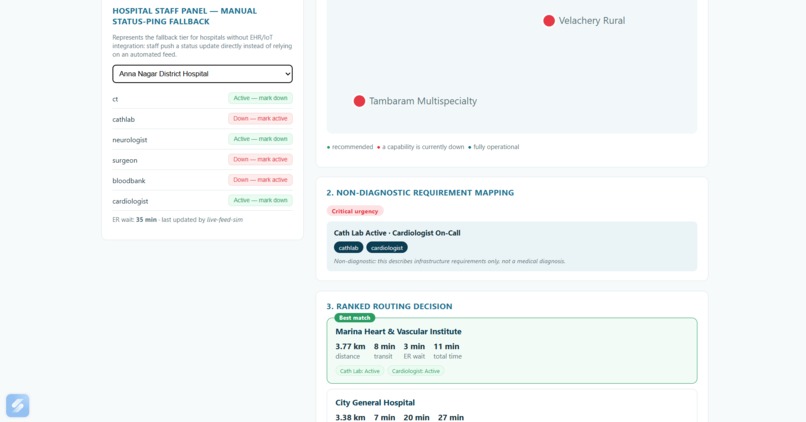
routing to hospitals
-
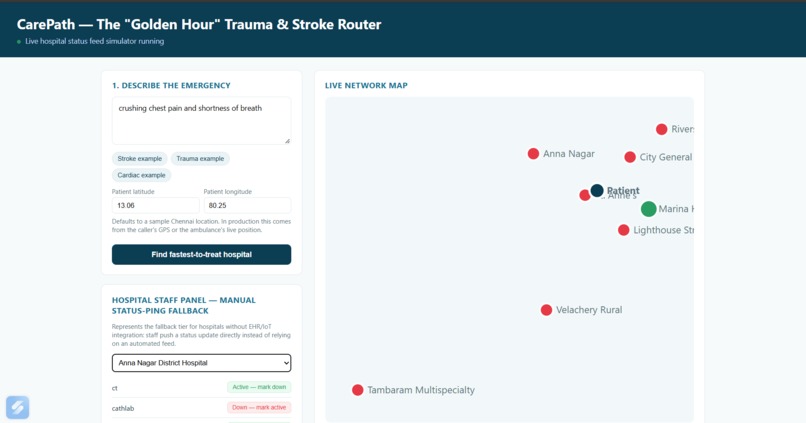
landing page
-
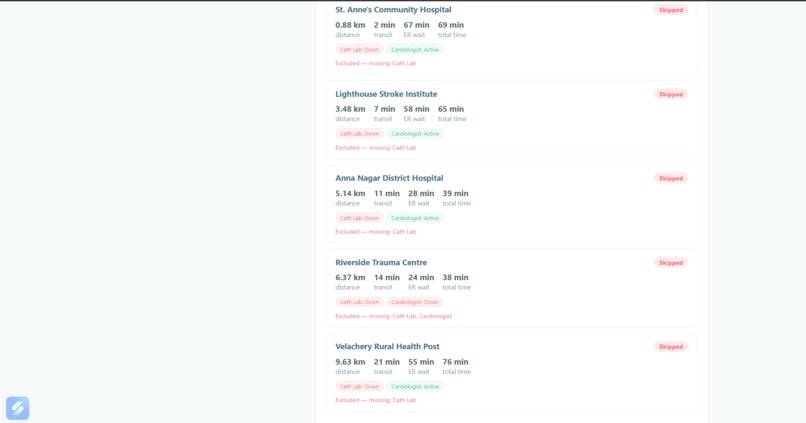
availability
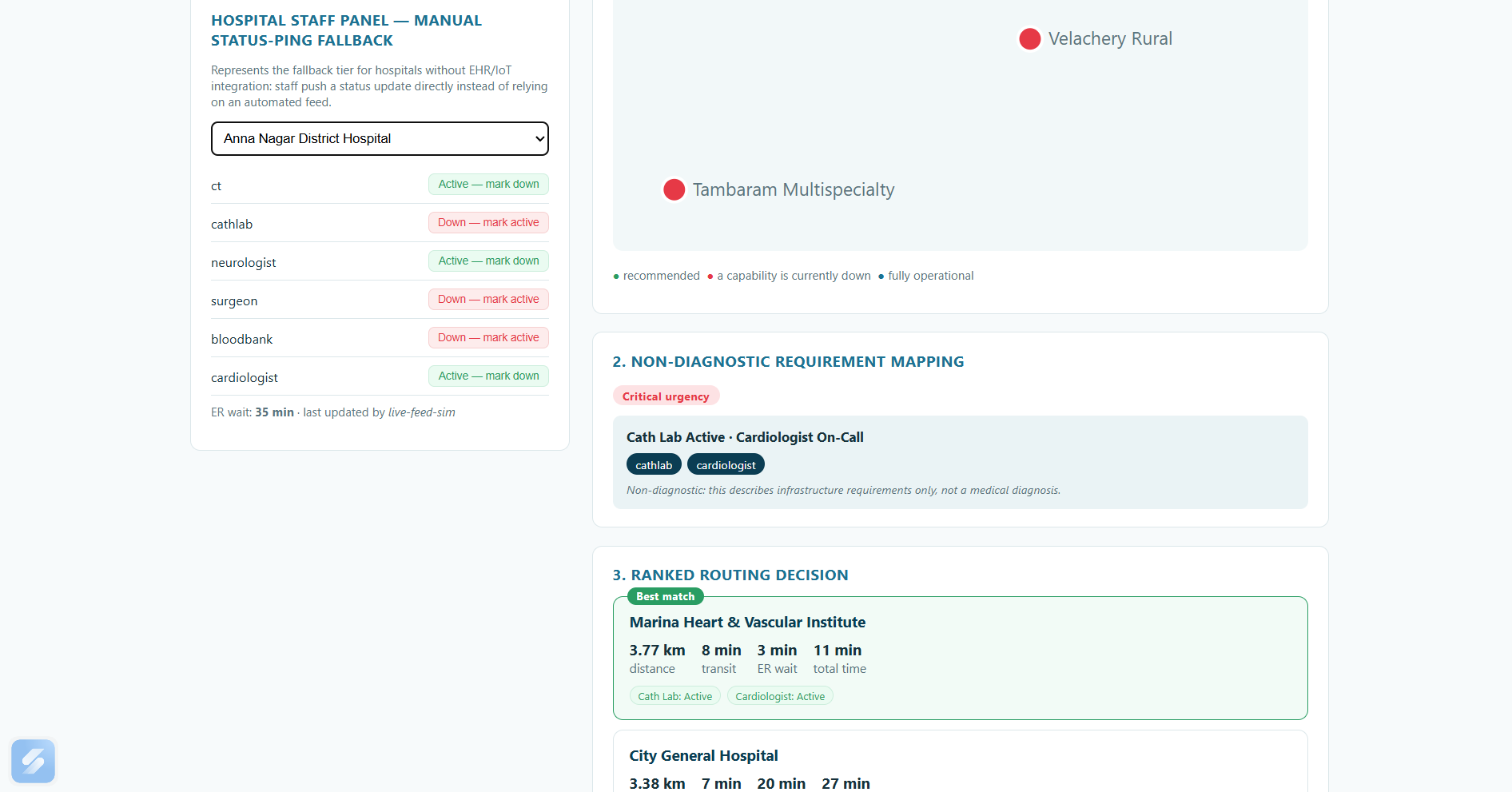
Inspiration
The idea started from one statistic that wouldn't leave us alone: during an untreated ischemic stroke, a patient loses roughly
$$ 1.9 \times 10^{6} \text{ neurons per minute.} $$
That's the clinical basis for "Time is Brain." Yet when we looked at how emergency routing actually works today, we found a strange gap: ambulances and caregivers are almost always sent to the nearest hospital, not the one that can actually treat the patient. On arrival, it's common to discover the CT scanner is down, the cath lab is full, or no neurologist is on call — triggering a secondary transfer that costs 45–90 additional minutes. Google Maps can tell you a hospital is 2 km away. It has no idea whether that hospital can save your life right now. We wanted to build the layer that does.
What it does
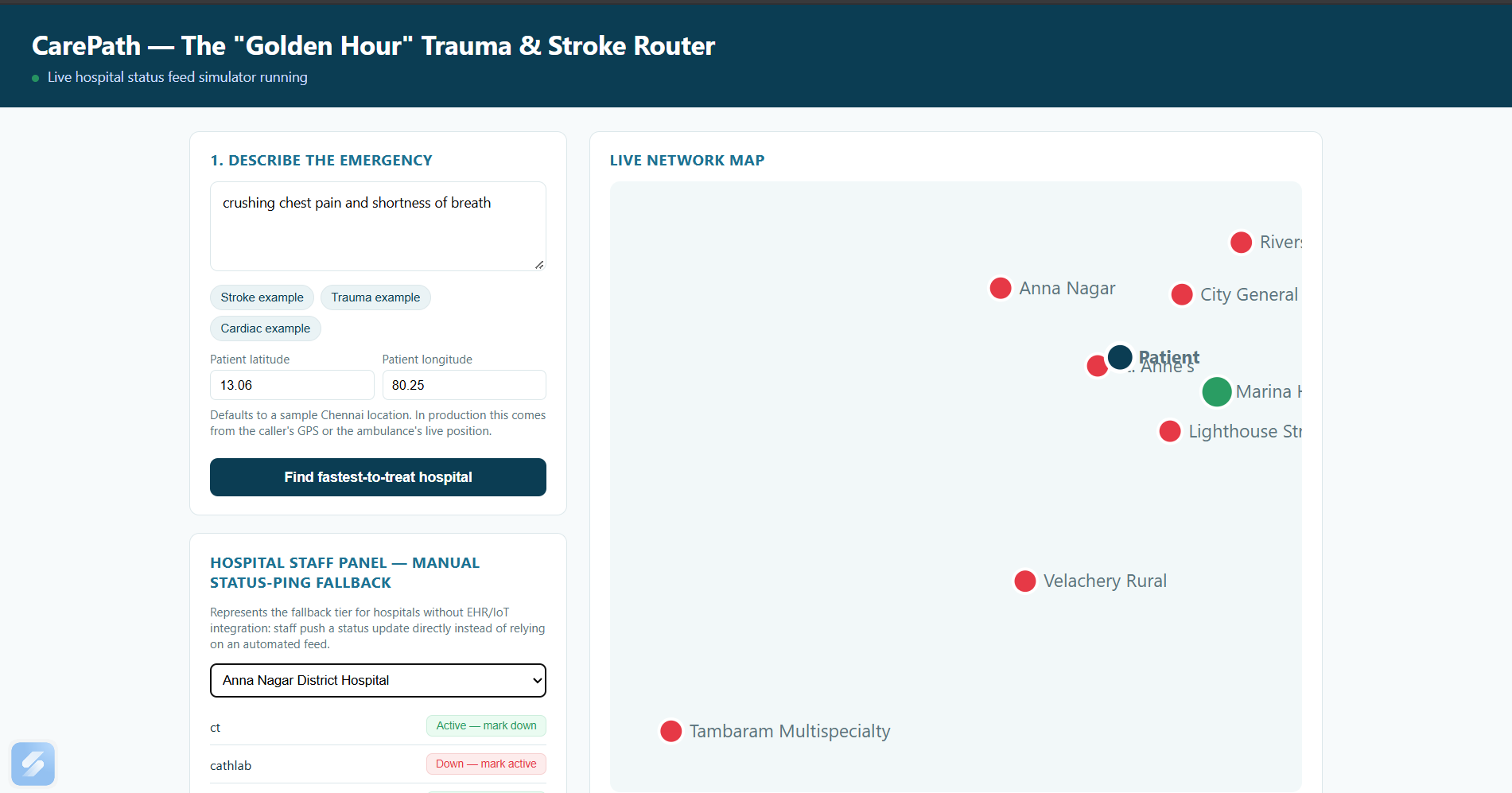
CarePath is a non-diagnostic, live-resource routing platform for stroke and trauma emergencies. It:
- Takes a plain-language symptom description ("sudden facial drooping, can't
lift right arm, slurred speech") and maps it — without ever diagnosing the
patient — to concrete facility requirements like `Stroke Centre + Active CT
- On-call Neurologist`.
- Pulls live hospital status (equipment up/down, specialist on-call, ER wait time) from a simulated real-time feed, with a manual staff status-ping fallback for hospitals that don't have EHR/IoT integration.
- Computes
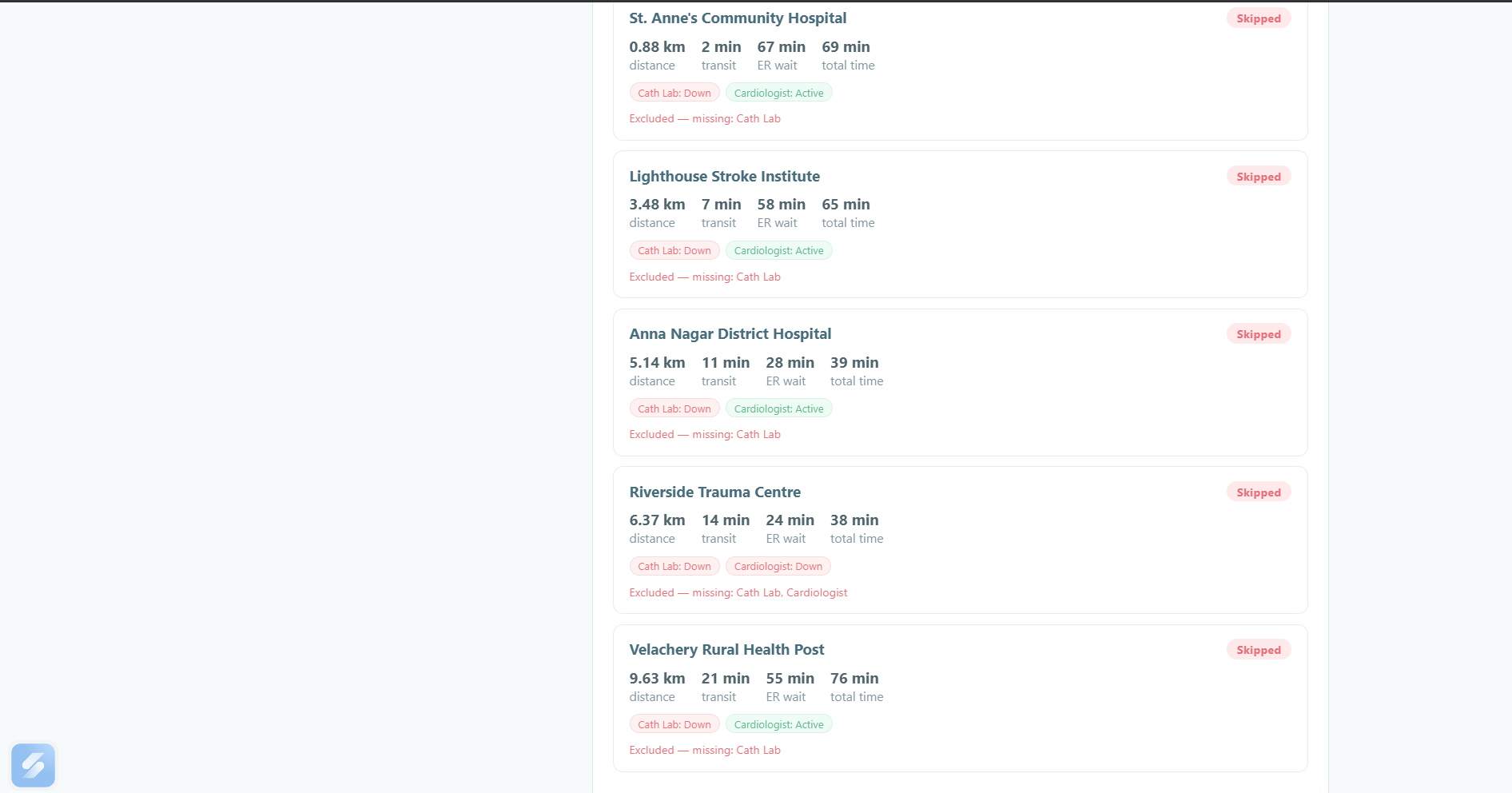
Total Time = Transit Time + Live ER Wait Timefor every hospital in the network and routes to whichever one can deliver treatment fastest — even if that means skipping a hospital that's physically closer. - Shows why a hospital was skipped, so paramedics and dispatchers can trust and override the decision, not just follow it blindly.
How we built it
We researched the problem space first — reading up on existing efforts like Apollo's 1066 connected-ambulance network and Telangana's Project Sanjeevani highway trauma protocol — to make sure we weren't rebuilding something that already existed, and to find the specific gap: nobody was fusing live, per-hospital operational status with symptom-based urgency across an entire city's hospital network, public and private, regardless of how tech-equipped each facility was.
From there:
- Backend — a Node.js/Express API with three core pieces: a rule-based non-diagnostic symptom-to-requirement mapper, an in-memory hospital store simulating a live HL7 FHIR/IoT feed, and a routing engine that ranks hospitals by total time-to-treatment.
- Frontend — a React + Vite interface where you can type a symptom, see it mapped to requirements in real time, and watch the ranked hospital list update — including a lightweight SVG network map built without any paid maps API, and a "Hospital Staff" panel that demonstrates the manual fallback tier live.
- Design — we deliberately kept the routing logic transparent: instead of a black-box recommendation, the UI shows every hospital, including the ones it skipped and exactly which requirement they were missing.
Challenges we ran into
- Staying non-diagnostic. It was tempting to make the symptom mapper smarter by inferring severity or likely conditions — but that crosses into medical-device territory (FDA SaMD boundaries) and clinical liability we explicitly wanted to avoid. We kept re-scoping the mapper back to infrastructure requirements only.
- Designing for hospitals with no data feed at all. Most of India's hospitals, especially Tier-2/3 and rural ones, don't expose live EHR data. A system that only works for well-integrated hospitals isn't actually solving the problem for the people who need it most — so the manual status-ping fallback became as important as the "real" FHIR integration path, not an afterthought.
- Making the demo trustworthy, not just impressive. It's easy to build a demo that looks like it's routing intelligently. We spent real effort making sure the "closest hospital gets skipped because it lacks a neurologist" moment was driven by actual computed logic, not scripted — so it holds up under a judge poking at it live.
What we learned
We came in thinking the hard problem was the routing algorithm. It wasn't —
transit time + ER wait is a straightforward optimization. The hard problem
was data availability and trust: designing a system that degrades
gracefully when the "live" data isn't live, stays honest about what it
doesn't know, and always leaves a human able to override it. That shaped
almost every design decision more than the algorithm did.
What's next
- Replacing the simulated hospital feed with real HL7 FHIR integration, piloted with a small cluster of hospitals in one city.
- Swapping the keyword-based mapper for a lightweight trained NLP model, kept within the same non-diagnostic scope.
- Replacing straight-line transit time with a live traffic/maps ETA API.
- User testing the "Hospital Staff" manual-update flow with actual ER staff to see if a 30-second status ping is realistic during a busy shift.
Built With
- css3
- express.js
- fastapi
- git
- google-maps
- hl7-fhir
- html5
- iot
- javascript
- natural-language-processing
- node.js
- npm
- postgresql
- python
- react
- redis
- rest-api
- vite


Log in or sign up for Devpost to join the conversation.