-
-
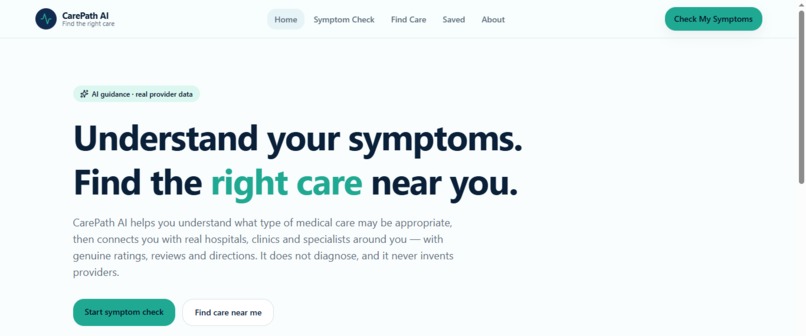
HomePage | Understood the System
-
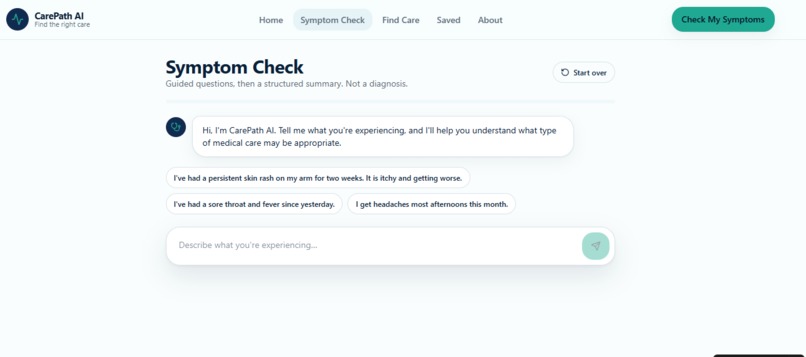
Asks the symptoms you are having and suggest related doctors !
-
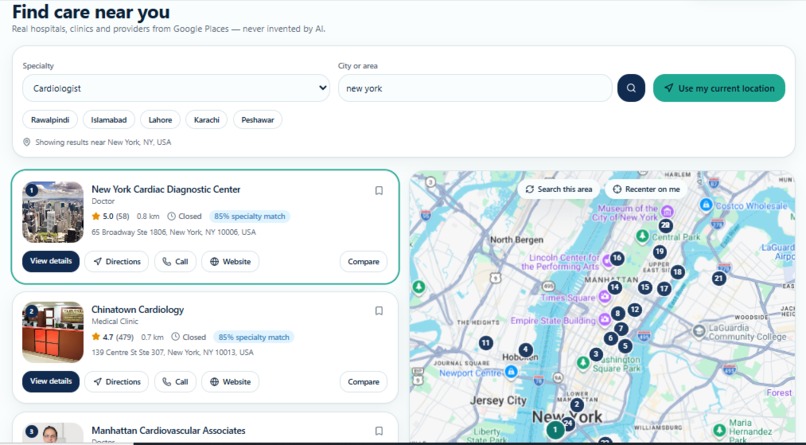
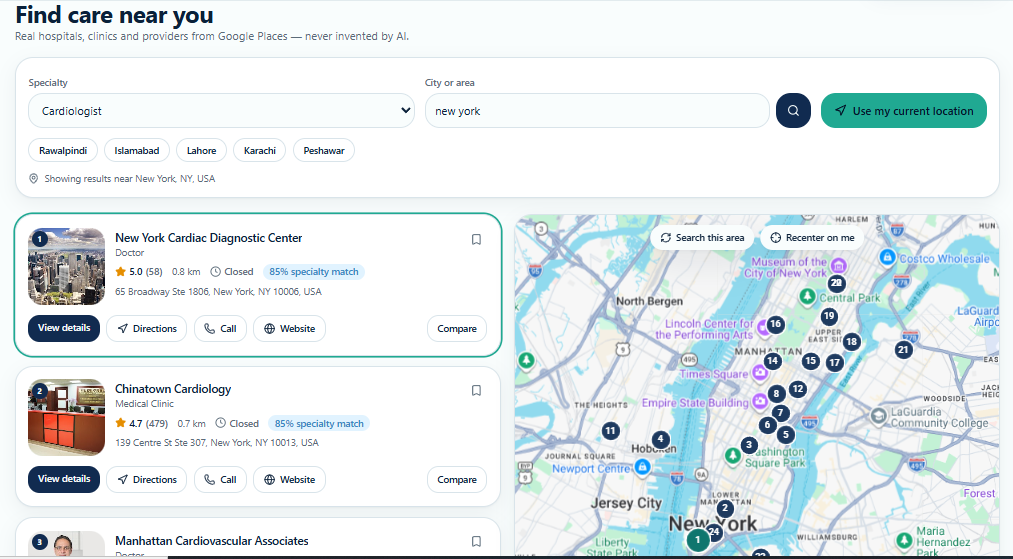
Real Map Data to find related Doctors nearby or any city/country along with their ratings and compare options to choose whose best
-
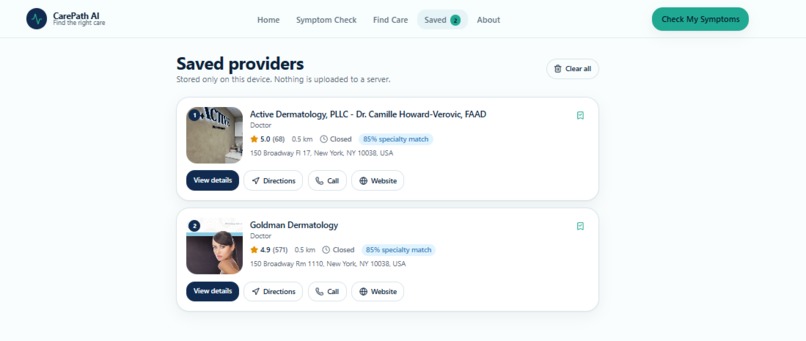
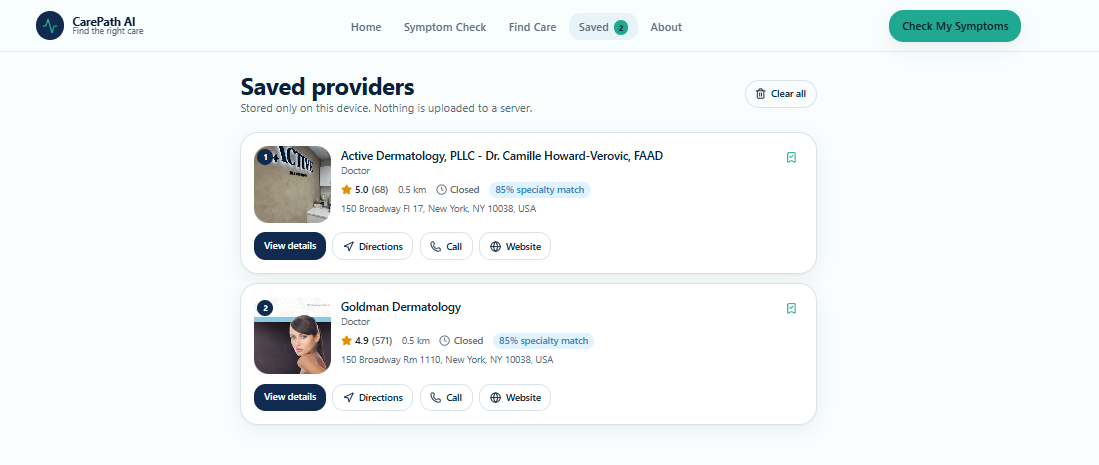
Save Doctors/hospitals and check them later
CarePath AI
Inspiration
Healthcare can be difficult to navigate, especially when someone is experiencing symptoms but does not know what type of doctor they should see or where to find appropriate care nearby. A person may search randomly online, struggle to understand medical terminology, or choose a healthcare provider without knowing what other patients have experienced.
We built CarePath AI to make this first step simpler.
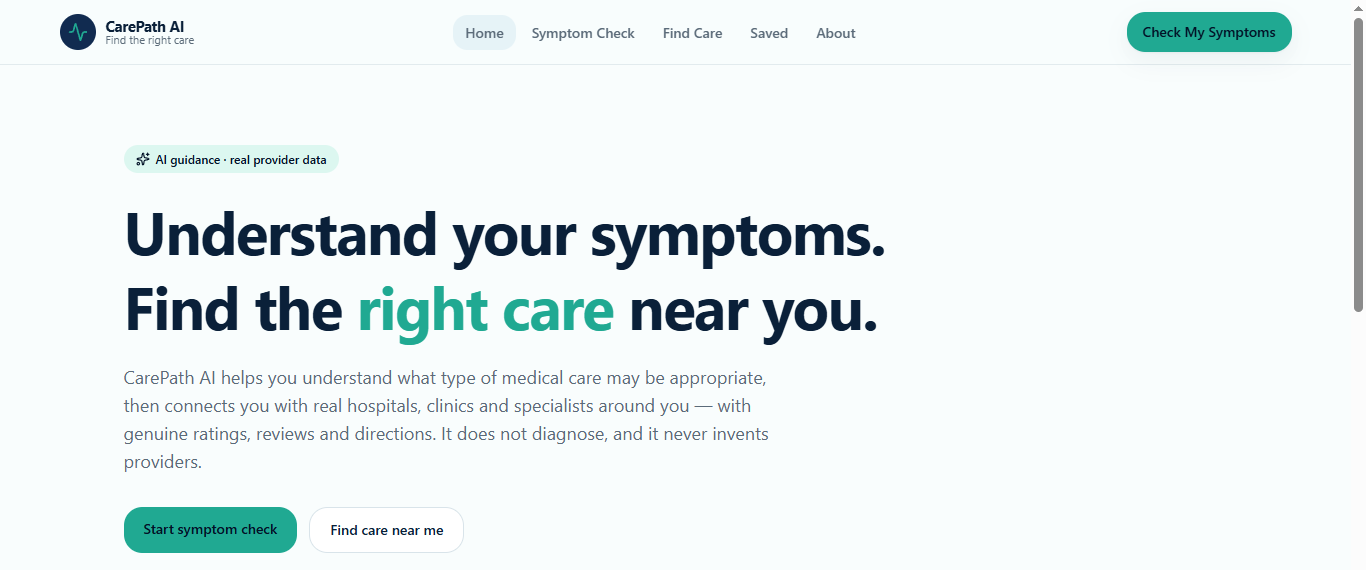
CarePath AI is a healthcare navigation and symptom guidance platform that connects symptom understanding with real local healthcare discovery. Instead of acting as a generic chatbot, it guides users through their symptoms, identifies possible health concerns, recommends an appropriate medical specialty, assesses urgency, and then helps users discover healthcare providers based on their location.
What it does
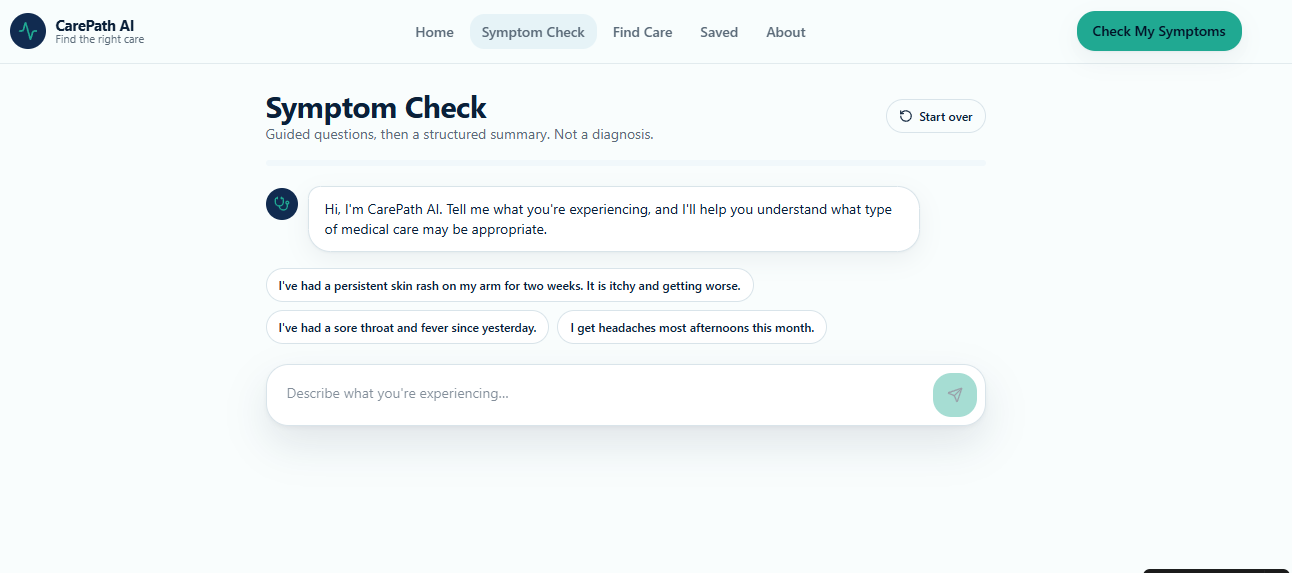
A user can start by describing their symptoms in a conversational interface. CarePath AI asks relevant follow-up questions and creates a structured symptom summary.
The system then provides:
- Possible health concerns associated with the symptoms
- A recommended medical specialty
- An urgency level: Emergency, Urgent, or Routine
- Safety guidance and emergency red-flag detection
The system does not provide a confirmed diagnosis or replace a healthcare professional.
After the symptom assessment, users can use their current location or manually search for a city or area. CarePath AI can then connect the recommended specialty with healthcare provider discovery.
The provider experience is designed to show real external healthcare information where available, including:
- Provider name
- Provider type
- Address
- Phone number
- Distance
- Rating
- Review count
- Opening hours
- Website
- Maps directions
- Photos
- Available reviews
Missing information is not invented. If external data does not provide a particular field, CarePath AI does not fabricate it.
Patient Review Insights
One of the key features of CarePath AI is its review intelligence.
When review information is available from the external provider source, the application can analyze those reviews and present an AI-generated summary of common themes.
Users can see what patients commonly mentioned positively, what negative themes appeared, and the overall sentiment of the available reviews.
The review analysis is clearly presented as an AI-generated interpretation of available reviews. CarePath AI does not create or fabricate patient reviews.
Provider Comparison
Users can compare up to three healthcare providers using information available from the external provider data.
The comparison can include rating, review count, distance, opening hours, contact information, specialty relevance, and review themes.
Where a CarePath Match score is used, it is an application-generated ranking based on available data and is not presented as a medical quality certification.
How we built it
CarePath AI was designed as a full healthcare navigation product rather than a simple chatbot.
The application combines a conversational AI symptom assessment experience with structured health guidance, location-based provider discovery, maps, provider details, reviews, review analysis, comparison, and saved providers.
The AI assessment is designed around structured outputs so that the frontend can turn the result into dedicated interface components rather than displaying an unstructured chatbot response.
The architecture also separates AI-generated interpretation from externally sourced provider information. This allows users to distinguish between information retrieved from an external provider source and information generated by the AI.
Safety
Healthcare requires careful handling of uncertainty.
CarePath AI never presents an AI response as a confirmed medical diagnosis. The system uses language such as "possible health concerns" and recommends evaluation by a qualified healthcare professional.
Emergency red flags receive priority. If a user's symptoms indicate a potentially life-threatening situation, the interface prioritizes emergency guidance rather than delaying the user with normal provider discovery.
The system does not provide personalized medication prescriptions or dosages.
Challenges
One of the biggest challenges was designing a healthcare experience that is useful without pretending that an AI system can replace a doctor.
Another challenge was connecting symptom guidance with real-world healthcare discovery. Provider information needs to come from external location and place data rather than generated placeholders.
We also focused on handling real-world situations such as unavailable location access, missing provider information, empty search results, API failures, and limited review data.
What we learned
Building CarePath AI taught us that a useful health-tech product needs more than an AI model. The surrounding product experience matters just as much.
We learned how symptom conversations can be converted into structured guidance, how healthcare discovery can be connected to location-based data, and why data provenance and safety communication are especially important in healthcare applications.
What's next
Future versions of CarePath AI could expand provider coverage, improve specialty matching, provide stronger review analysis, support additional healthcare services, and improve personalization while continuing to minimize unnecessary storage of sensitive health information.
CarePath AI is designed as a healthcare navigation and symptom guidance assistant, not a diagnostic medical device.
Built With
- ai
- api
- lovable
- maps
- places
- react
- supabase
- tailwind
- typescript

Log in or sign up for Devpost to join the conversation.