Inspiration
Hospital readmission models are often presented as a single accuracy number. That misses the harder problem: a probability can influence real decisions, so teams also need leakage-aware evaluation, calibration, subgroup auditing, operating-policy controls, clear limitations, and accountable human review.
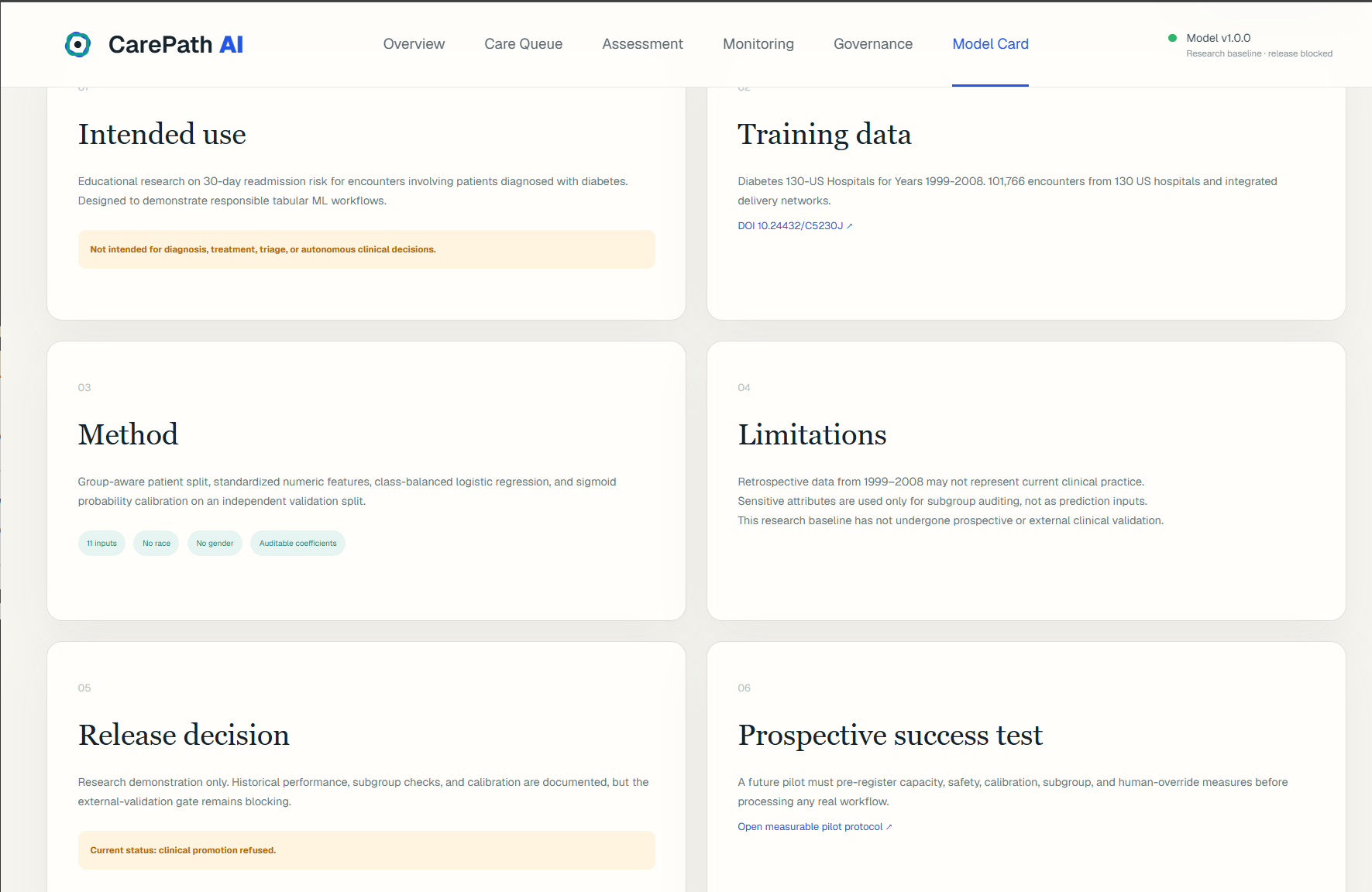
CarePath AI was built to show that complete path. It is an educational research system, not a medical device, and it uses only public training data and synthetic workflow cases.
What it does
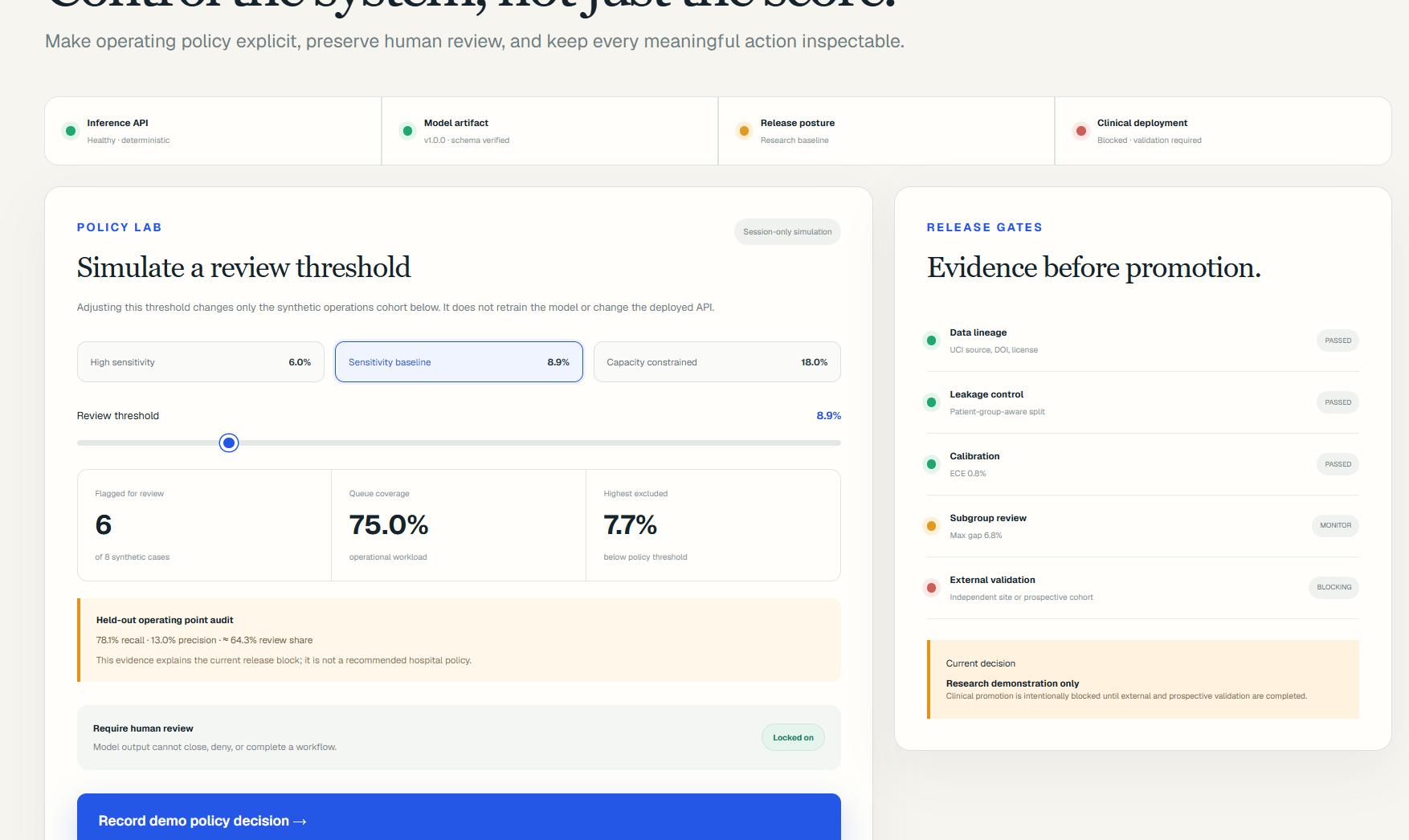
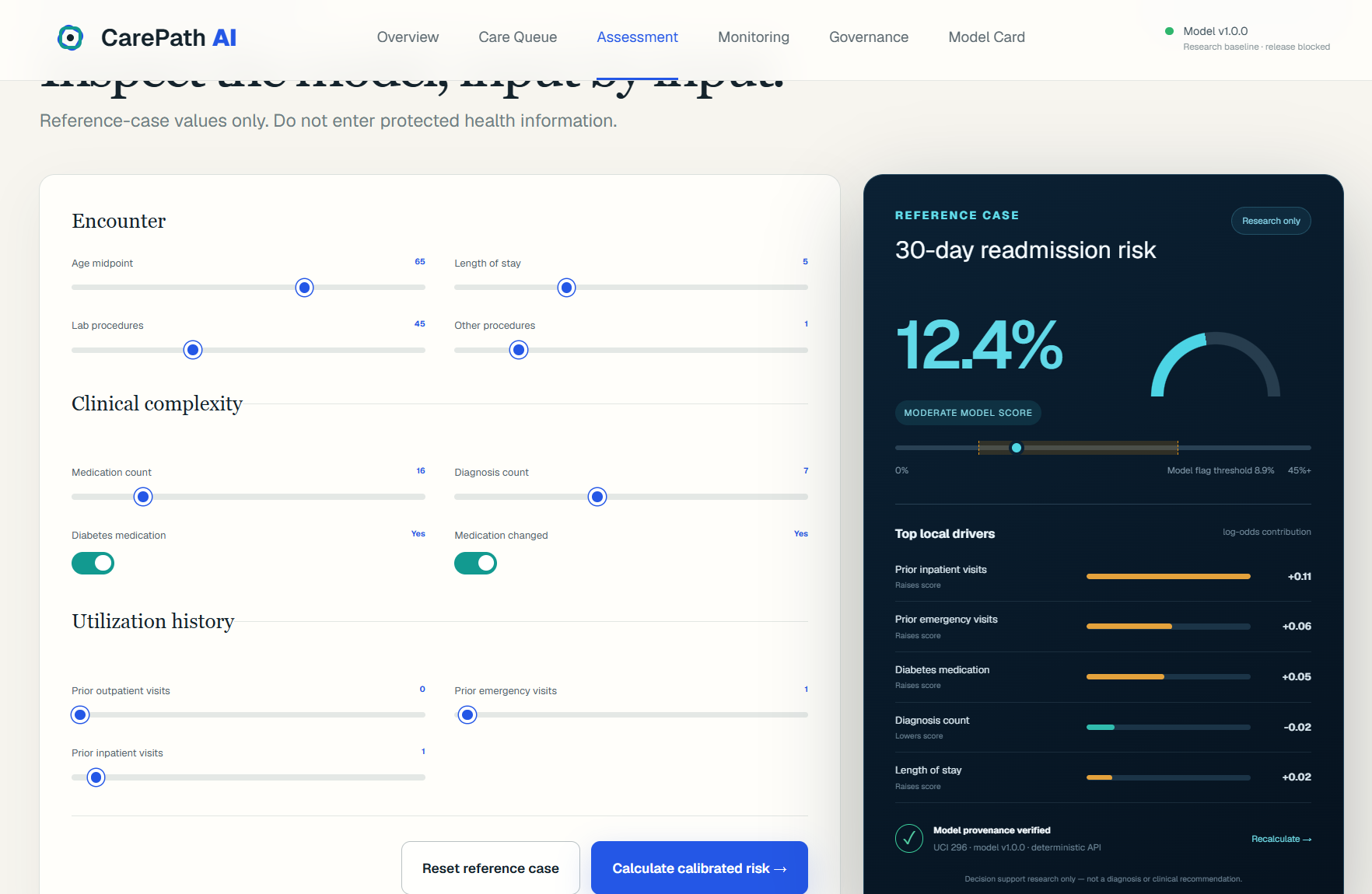
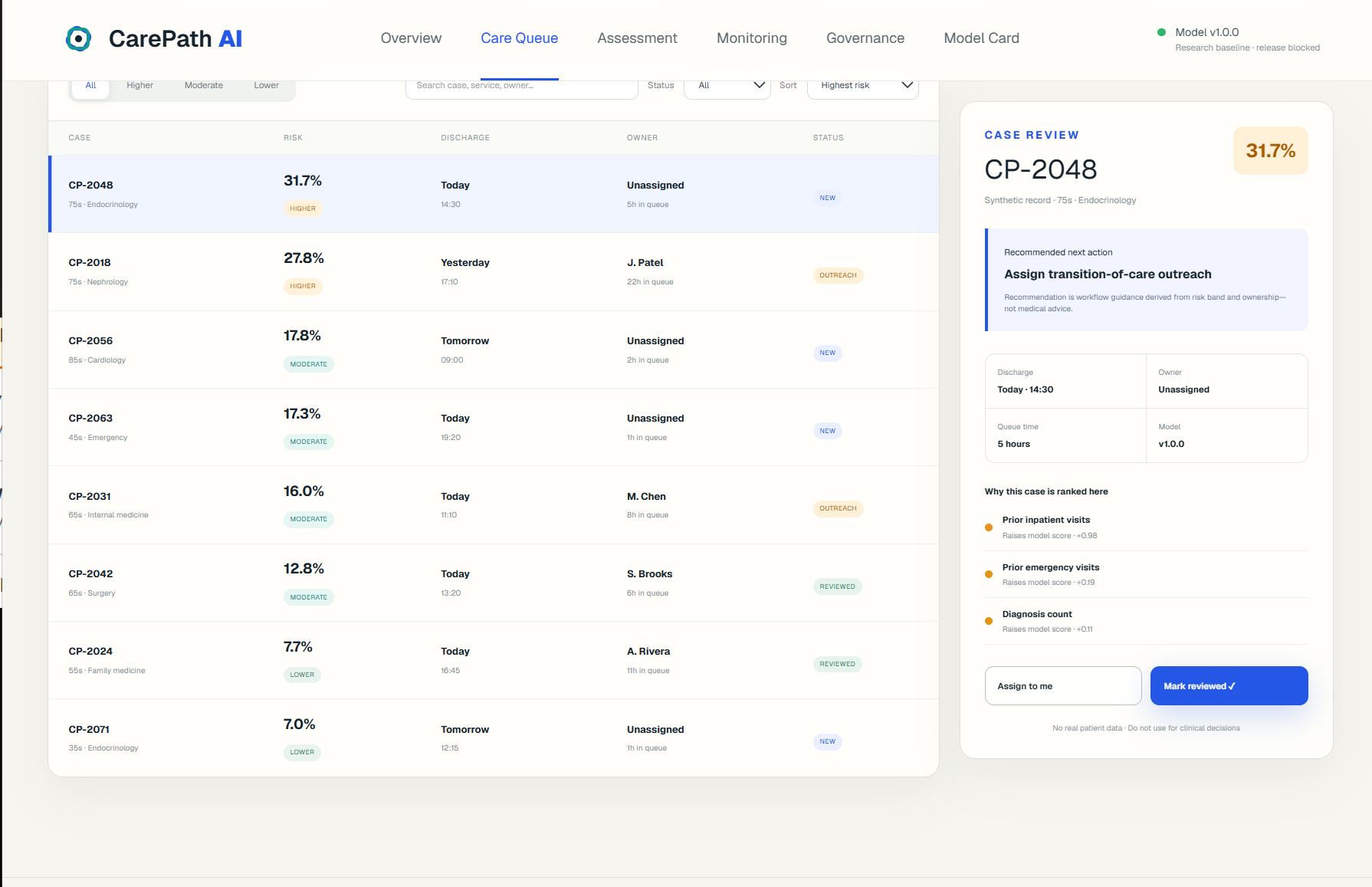
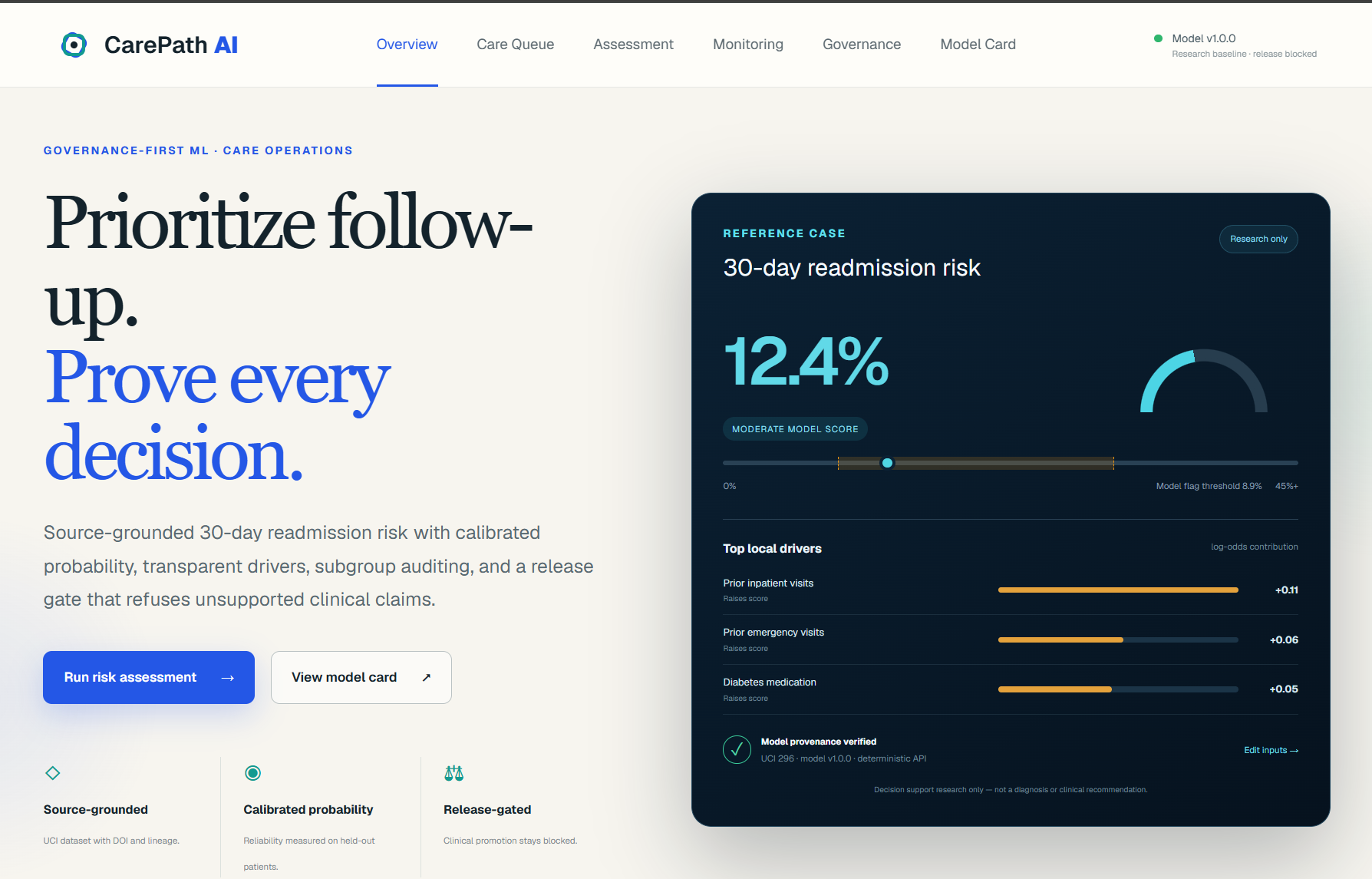
CarePath AI scores a validated reference encounter using a calibrated logistic regression model, explains the largest local log-odds contributions, and turns the result into a synthetic care-operations workflow. Users can prioritize a queue, assign ownership, document review status, export the current view, inspect held-out performance and subgroup audits, simulate operating thresholds, and review a versioned model card and release gates.
The system deliberately blocks any claim of clinical readiness because external and prospective validation have not been completed.
Why it matters
Average precision is 17.9% against 10.7% prevalence—a 1.67× lift. Yet recall of 78.1% and precision of 13.0% imply that roughly 64.3% of the held-out cohort, about 12,954 of 20,153 encounters, would be flagged for review. CarePath makes that burden visible, locks human review on, and keeps clinical promotion blocked until capacity, safety, calibration, and subgroup behavior are tested.
How we built it
-Python, pandas, NumPy, and scikit-learn for preprocessing, patient-grouped train/validation/test splits, calibrated logistic regression, evaluation, and model-artifact export. -A versioned JSON bundle containing features, scaler statistics, coefficients, calibration parameters, metrics, and subgroup results. -Next.js, React, and TypeScript for the interactive workspace and deterministic inference API. -Contract tests for input validation, the documented reference score, artifact shape, bounded metrics, operating-point consistency, and sensitive-feature exclusion. -Docker and GitHub Actions for reproducible packaging and automated quality gates.
Technical results
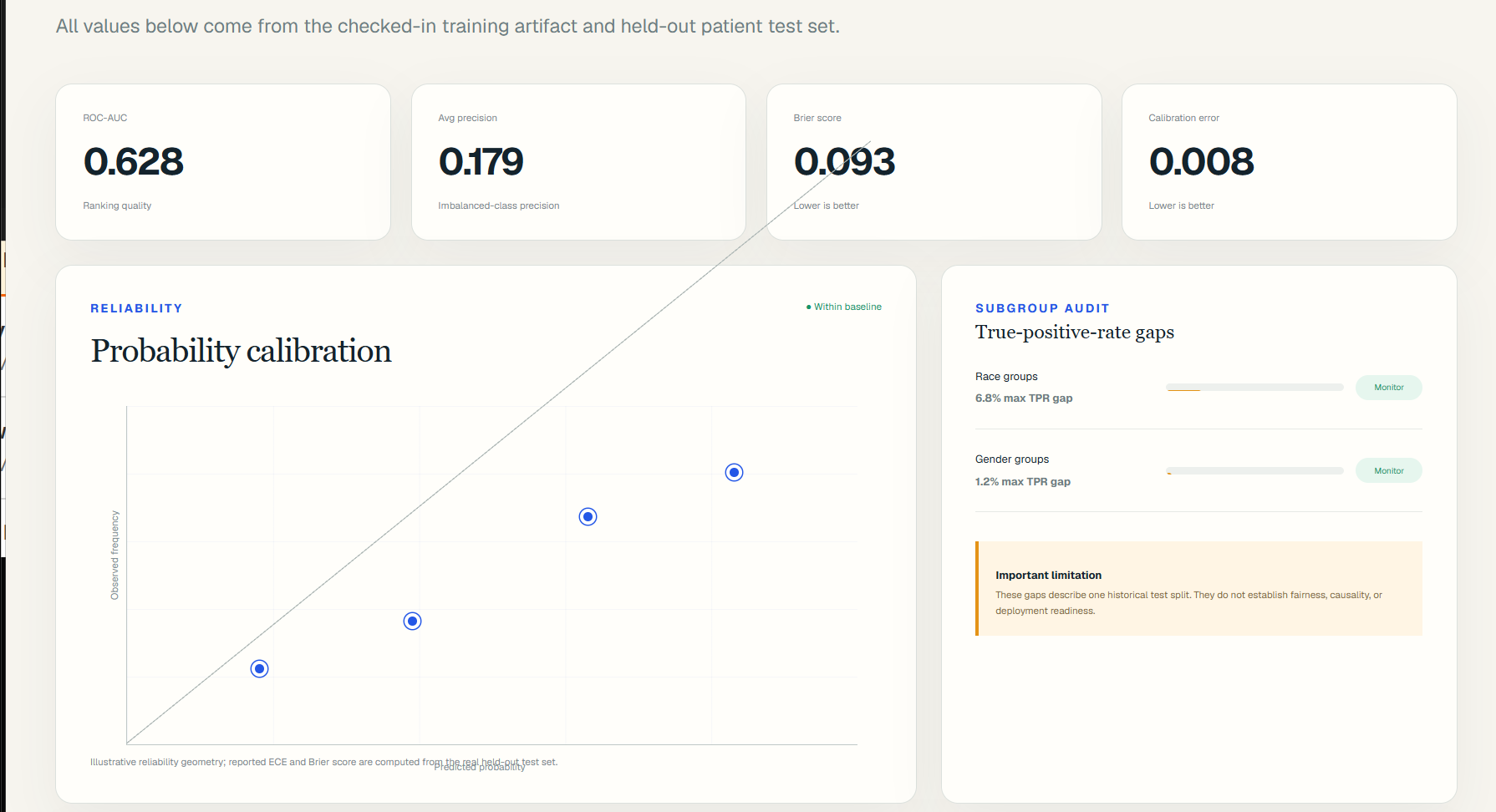
The public UCI dataset contains 101,766 encounters from 130 US hospitals. The historical held-out test split contains 20,153 encounters. Model artifact v1.0.0 records ROC-AUC 0.628, average precision 0.179, Brier score 0.093, expected calibration error 0.008, recall 78.1%, and precision 13.0% at the selected 8.93% operating threshold.
These measurements describe one historical split. They do not prove clinical utility, causality, fairness, or deployment readiness.
Challenges we ran into
The hardest challenge was resisting the temptation to optimize only a headline metric. The positive class is imbalanced, so accuracy is misleading. Patient encounters also create leakage risk, and a healthcare prediction can become harmful when uncertainty and governance are hidden. We therefore treated calibration, group-aware splitting, subgroup auditing, honest limitations, workload disclosure, and human review as product features rather than appendix material.
Accomplishments that we're proud of
-An end-to-end reproducible ML pipeline rather than a notebook-only demo. -Portable deterministic inference that matches a versioned trained artifact. -A product workflow connecting risk, explanation, ownership, and review. -Offline subgroup auditing without using race or gender for prediction. -A visible decision-quality audit exposing 1.67× AP lift and 64.3% implied review workload. -Human review locked on and external validation preserved as a blocking release gate. -A measurable prospective pilot protocol with explicit stop conditions. -Green build, lint, API, model-contract, governance-invariant, and CI checks.
What we learned
Responsible ML is not a disclaimer added after training. It changes data splitting, metric selection, API contracts, interface language, workflow design, and release policy. A modest, calibrated, and well-governed model can be more honest and useful than a stronger-looking model wrapped in unsupported claims.
What's next for CarePath AI
The next step is not autonomous deployment. It is external and prospective validation with clinical and patient stakeholders, followed by threshold selection based on capacity and harms, drift monitoring, and formal change control. Only after those gates are satisfied should a real integration be considered.
Safety boundary
CarePath AI is an educational research project, not a medical device. It must not be used for diagnosis, treatment, triage, resource denial, or autonomous clinical decisions. Every displayed queue case is synthetic and contains no protected health information.
Built With
- actions
- ai
- docker
- github
- learning
- machine
- next.js
- node.js
- numpy
- pandas
- python
- react
- responsible
- scikit-learn
- typescript
- uci

Log in or sign up for Devpost to join the conversation.