-
-
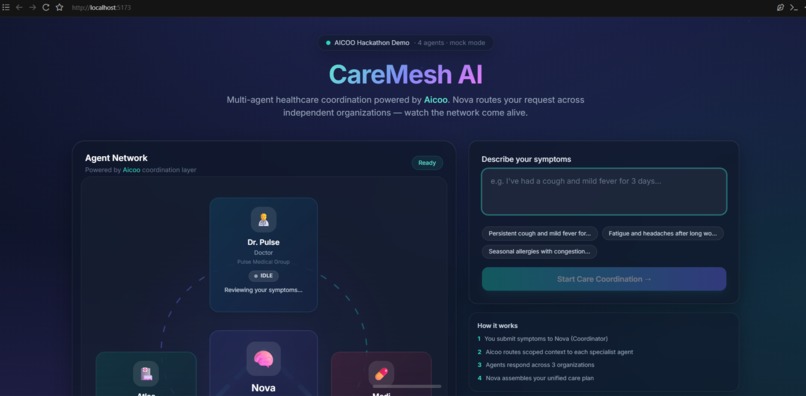
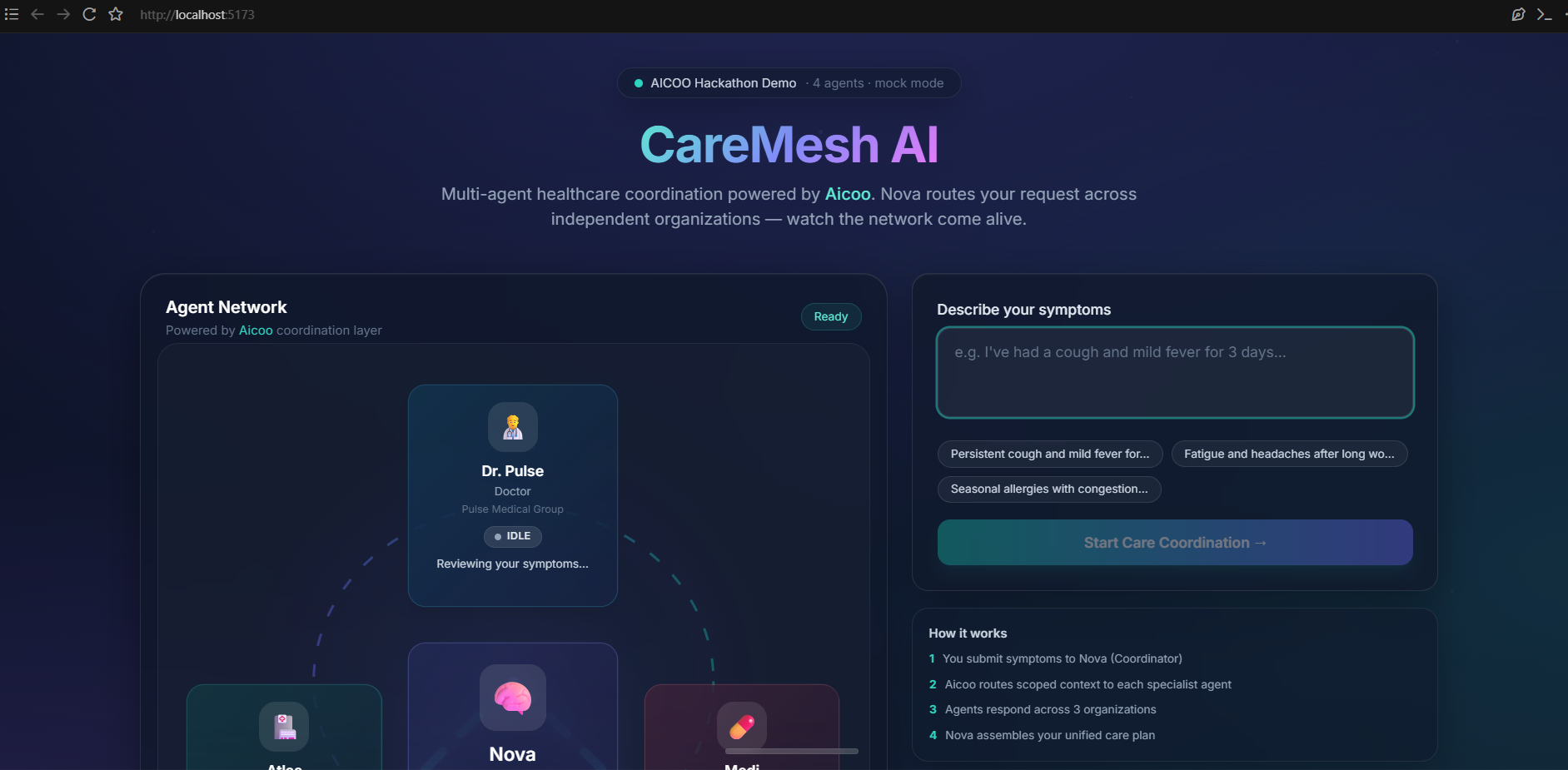
this is the homepage
-
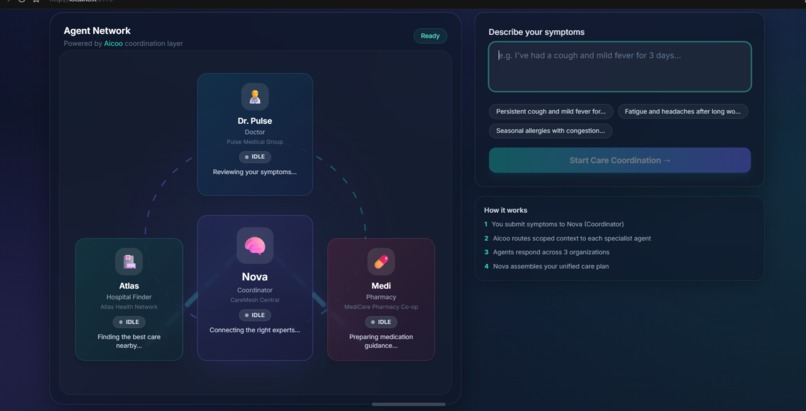
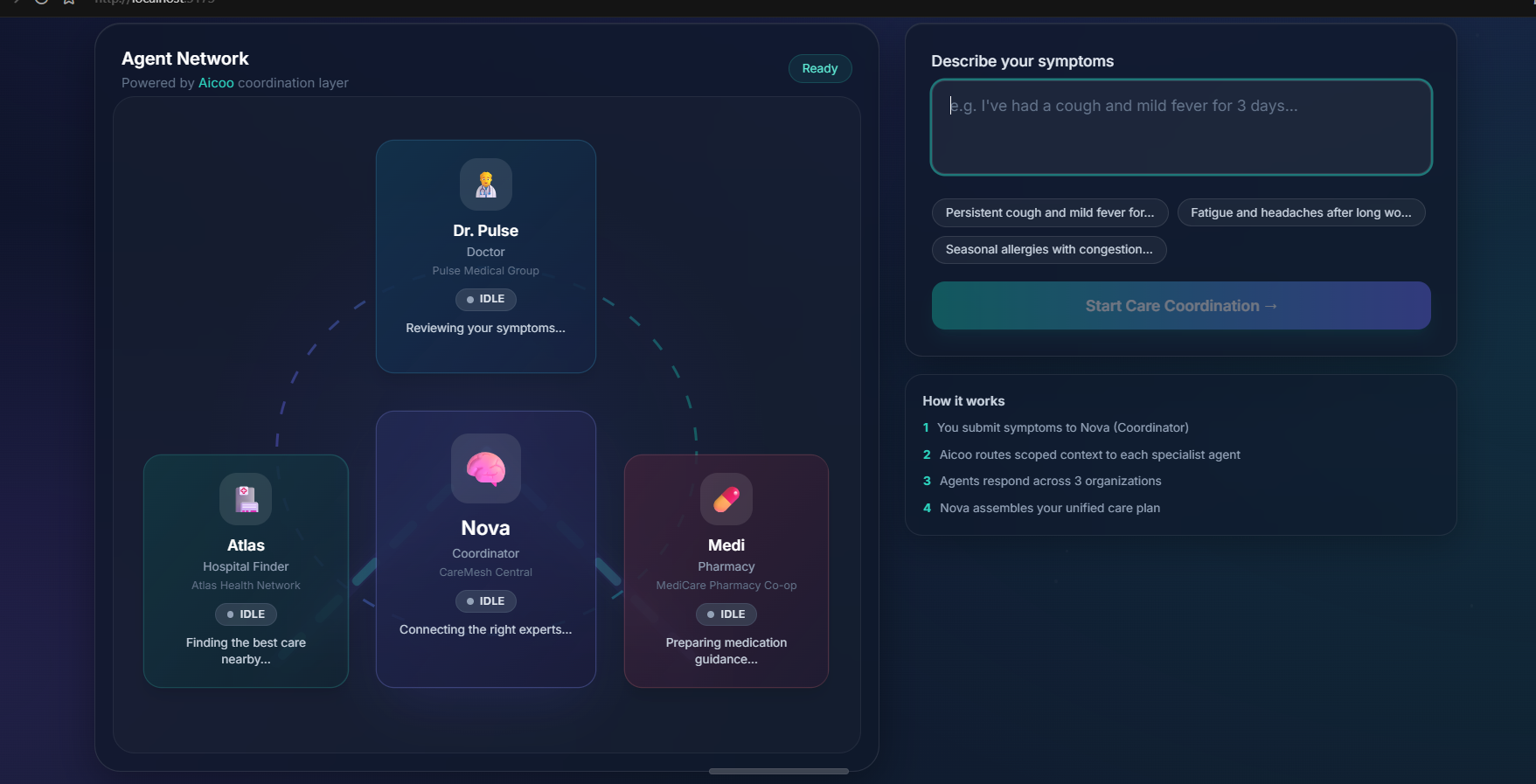
here is the Aicoo coordination layer, all the 4 ai agents working together
-
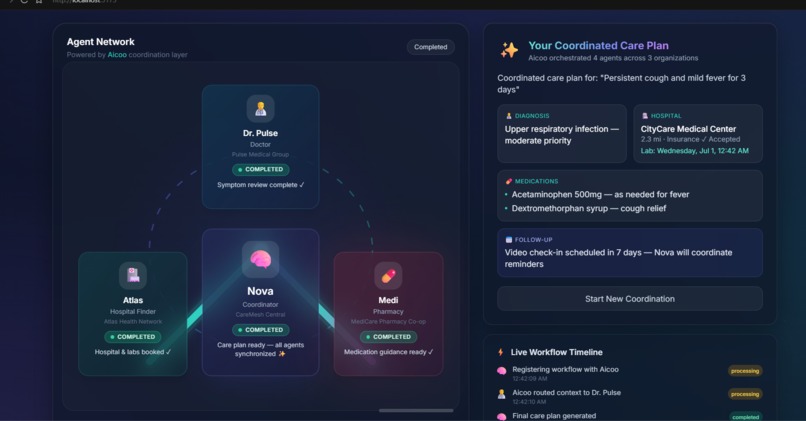
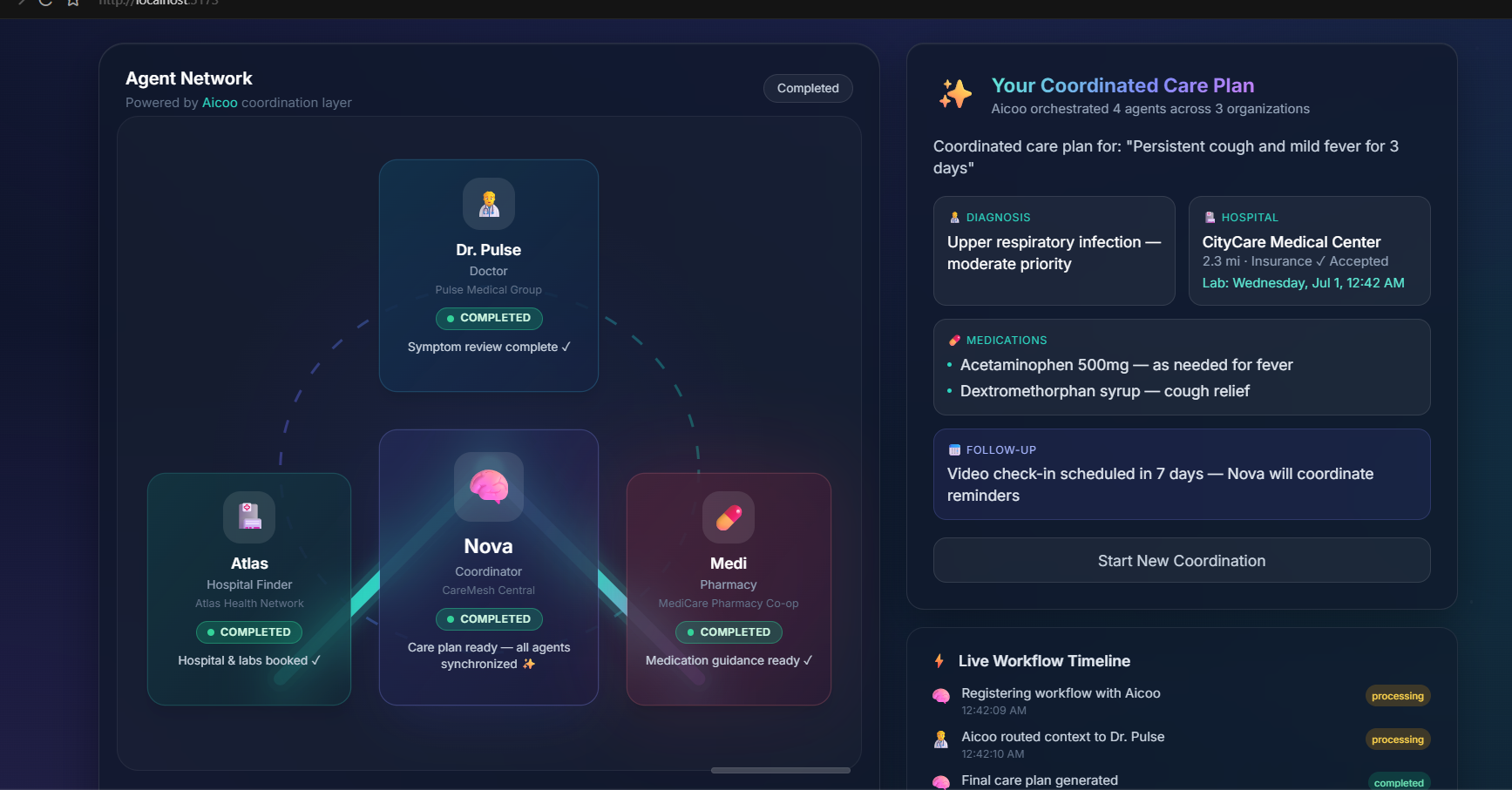
here comes a demo of how it works
-
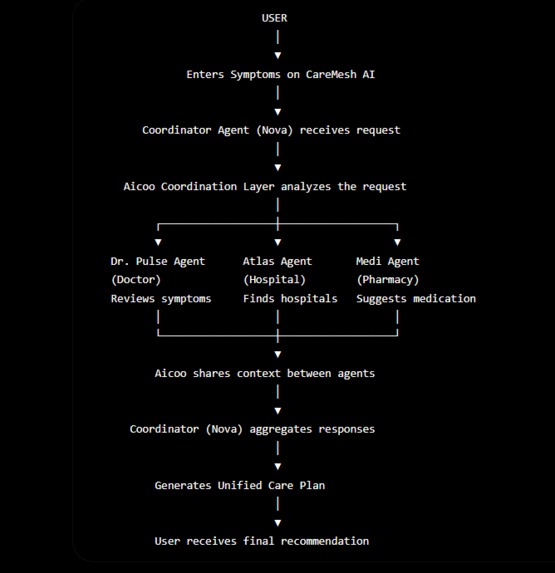
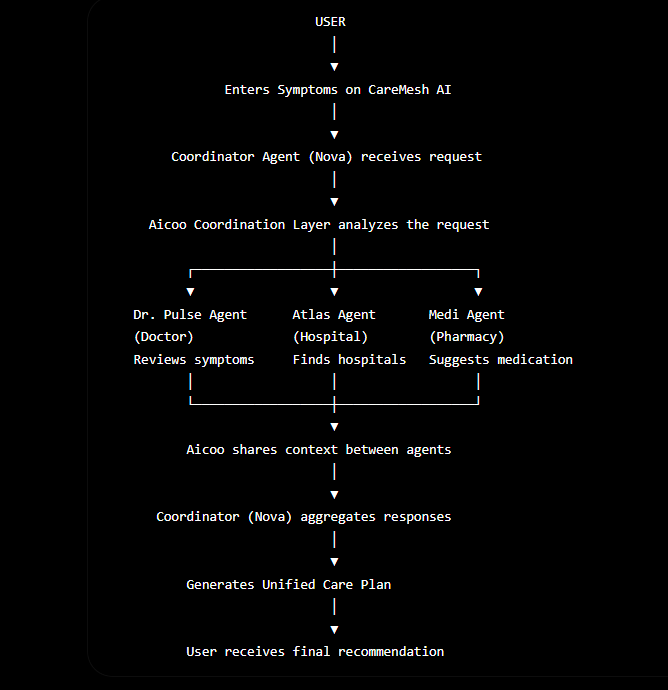
this is the complete user flow
What problem my product solves and who it is for:-
CareMesh AI helps patients quickly navigate healthcare by coordinating multiple specialized AI agents instead of relying on a single chatbot. It is designed for patients seeking medical guidance, healthcare providers, and hospitals that need faster, more organized care coordination.
Which Aicoo API / infrastructure capabilities is used:-
CareMesh AI uses Aicoo's agent infrastructure to create independent AI agents with unique identities, coordinate communication between them, route requests based on responsibilities, and share context throughout the workflow. Aicoo enables seamless multi-agent collaboration instead of isolated AI responses.
What key role Aicoo plays in my product:-
Aicoo acts as the orchestration layer of CareMesh AI. It coordinates interactions between the Coordinator Agent, Doctor Agent, Hospital Agent, and Pharmacy Agent, ensuring that requests, context, and responses flow between agents to generate a unified care plan.
inspiration
Healthcare often requires patients to interact with multiple providers, pharmacies, and hospitals separately, leading to fragmented communication and delays. We wanted to explore how multiple AI agents could collaborate instead of working independently. This inspired us to build CareMesh AI, a platform where specialized healthcare agents communicate through Aicoo's coordination infrastructure to deliver a unified care experience. Our goal was to demonstrate the future of multi-agent AI collaboration in healthcare.
What it does
CareMesh-AI is a multi-agent healthcare coordination platform that transforms a patient's symptoms into a collaborative workflow. A central Coordinator Agent (Nova) routes requests to specialized agents including the Doctor, Hospital, and Pharmacy agents using Aicoo's orchestration layer. Each agent processes only the context relevant to its responsibility and returns its findings to the coordinator. The user receives a single, unified care plan instead of disconnected AI responses, while the animated Agent Network visualizes the entire coordination process in real time.
More about it
How different users or agents have their own identities:- Each AI agent has a unique identity, role, and organization, such as Coordinator, Doctor, Hospital, and Pharmacy. This allows every agent to specialize in a specific healthcare responsibility.
How agents from different people connect or communicate:- The agents communicate through Aicoo's coordination layer instead of interacting directly. This enables secure collaboration and seamless information exchange across organizations.
How a request is routed to the right person, agent, or team:- The Coordinator Agent receives the patient's symptoms and uses Aicoo to route the request to the appropriate specialist agents. Each agent processes only the tasks relevant to its expertise.
How project, user, or task context is saved and reused:- Aicoo preserves workflow context using Mountable Context Cells (MCCs), ensuring all agents work with consistent information. This prevents data loss as the request moves through the workflow.
How people and AI COO work together to move a workflow forward:- The patient provides symptoms, while AI COO coordinates the agents, manages context, and orchestrates the entire workflow. Together, they produce a unified care plan efficiently.
How your product supports cross-person, cross-team, or cross-agent coordination through Aicoo:- CareMesh AI demonstrates multiple independent AI agents collaborating across different healthcare organizations. Aicoo acts as the coordination layer that connects agents, shares context, and delivers a single coordinated response.
How we built it
We built the frontend using React, TypeScript, Tailwind CSS, Framer Motion, and Vite to create an interactive Agent Network with smooth animations. The backend was developed with Node.js, Express, and TypeScript, exposing REST APIs and Server-Sent Events for real-time workflow updates. We integrated Aicoo's coordination concepts, including agent identities, request routing, shared context through Mountable Context Cells (MCCs), and workflow orchestration. The application supports both mock and live Aicoo modes, making it easy to demonstrate while remaining production-ready.
Challenges we ran into
One of our biggest challenges was designing a workflow that clearly demonstrated multi-agent coordination rather than simply chaining API calls. We also spent significant time creating an intuitive visualization that showed requests flowing between agents in a way that judges could immediately understand. Synchronizing agent states, routing animations, and live workflow updates required careful orchestration. Balancing technical accuracy with a clean, engaging user experience was another important challenge throughout development.
Accomplishments that we're proud of
We're proud of building a polished multi-agent healthcare experience that showcases Aicoo as the core coordination layer instead of treating it as an add-on. The interactive Agent Network clearly visualizes context sharing, request routing, and collaboration between independent AI agents. We successfully combined real-time animations, workflow orchestration, and modern UI design into a cohesive product. Most importantly, we demonstrated how specialized AI agents can work together to solve real-world coordination problems.
What we learned
This project helped us better understand multi-agent architectures and the importance of orchestration in AI systems. We learned how shared context, agent identities, and intelligent routing create far more capable workflows than isolated AI assistants. On the technical side, we gained experience building real-time applications using Server-Sent Events and coordinating frontend animations with backend workflow states. We also learned how thoughtful visualization can make complex AI interactions easy to understand.
What's next for CareMesh-AI
Our vision is to evolve CareMesh AI into a complete healthcare coordination platform. Future plans include integrating real hospital directories, appointment scheduling, insurance verification, laboratory services, emergency response agents, and secure electronic health records. We also plan to enable live Aicoo integration with persistent workflows and cross-organization collaboration, allowing healthcare providers, pharmacies, and hospitals to coordinate seamlessly through a shared AI agent network.
Built With
- aicoo
- express.js
- node.js
- react
- sqlite
- tailwind
- typescript
- vite

Log in or sign up for Devpost to join the conversation.