-
emergency_care_jaipur
-
emergency_care_jaipur_2
-
map_jaipur_orthopedics
-
genie_dentist
Inspiration
When you need information, it has to be quick, snappy, and clear. We took inspiration from popular apps like TripAdvisor and Zocdoc, which have simple UIs that anyone can use fast. What we love about them is how they give you a clean overview at a glance, while still letting you drill down into tons of detail when you want it.
What it does
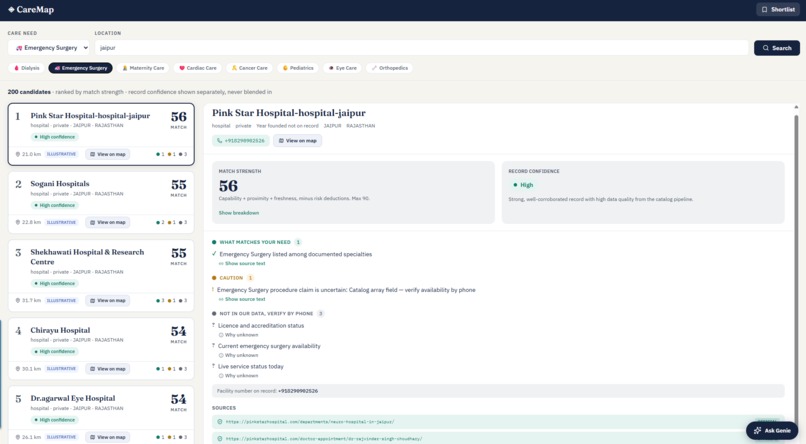
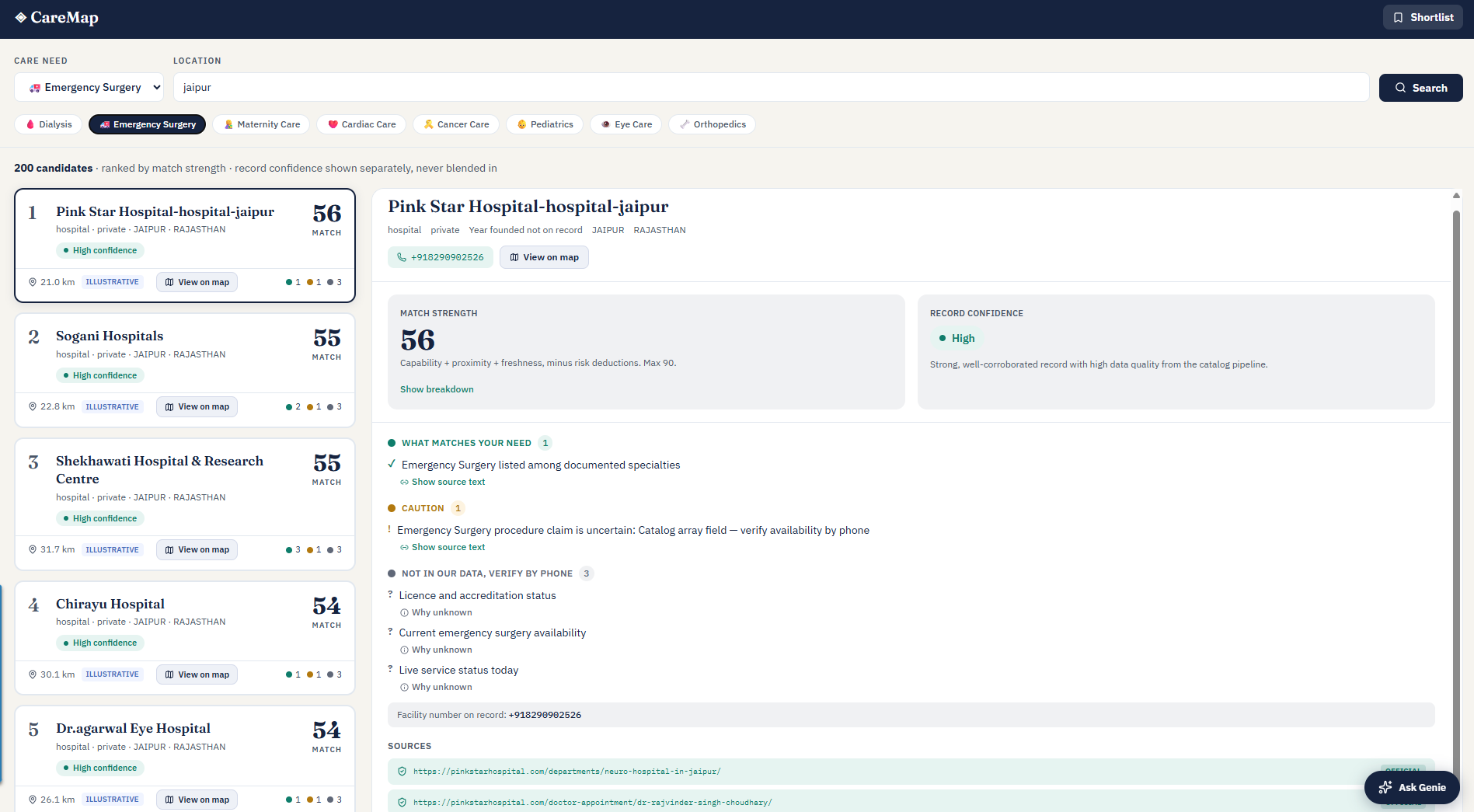
Caremap is simple by design. You start with a search bar to tell the app where you are. From there, you pick from 8 core care categories. Once you enter your location and the type of care you need, you immediately get an overview of the hospitals and clinics around you, sorted from best to worst based on our weighted matching score.
How the matching score works: Our score answers one question: "How well does this facility match what you need, right now?" We calculate it by combining a few different signals:
- Care match – Does this facility actually offer the type of care you searched for? This is the heaviest factor.
- Trust signals – We pull from our source data to check how reliable a facility is (things like accreditation, official registration, and reported service quality).
- Distance – How far you'd have to travel to get there.
- Data completeness – How much we actually know about the facility. A place with missing info gets scored more cautiously than one we have full data on.
Each of these signals gets a weight, and we blend them into a single score so you can compare facilities at a glance, without having to read everything yourself first.
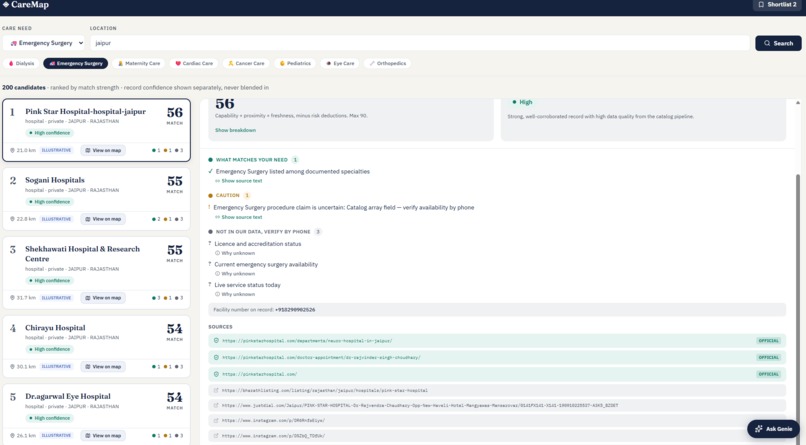
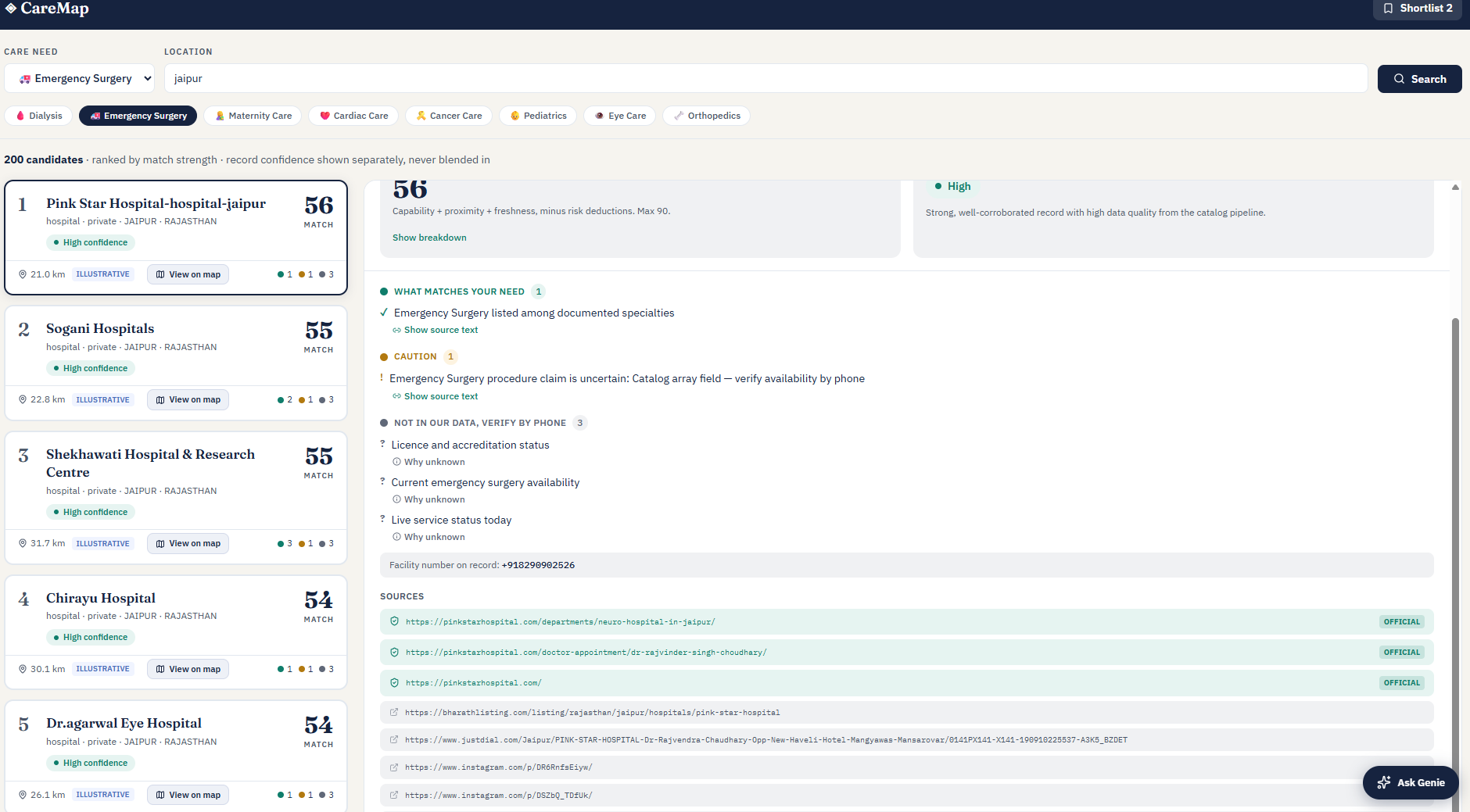
To keep things transparent, when you click on a facility we break the score down into three colored indicators:
- 🟢 Green (trust) – reasons this clinic can be trusted
- 🟠 Orange (caution) – things worth a second look
- ⚪ Grey (missing info) – data we don't have
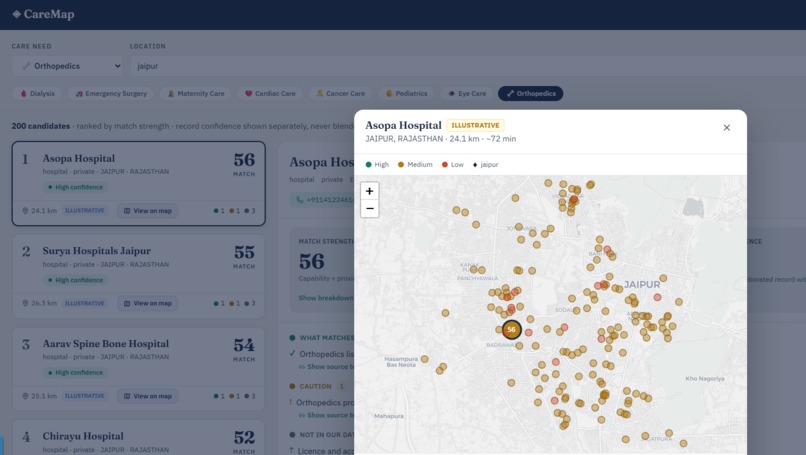
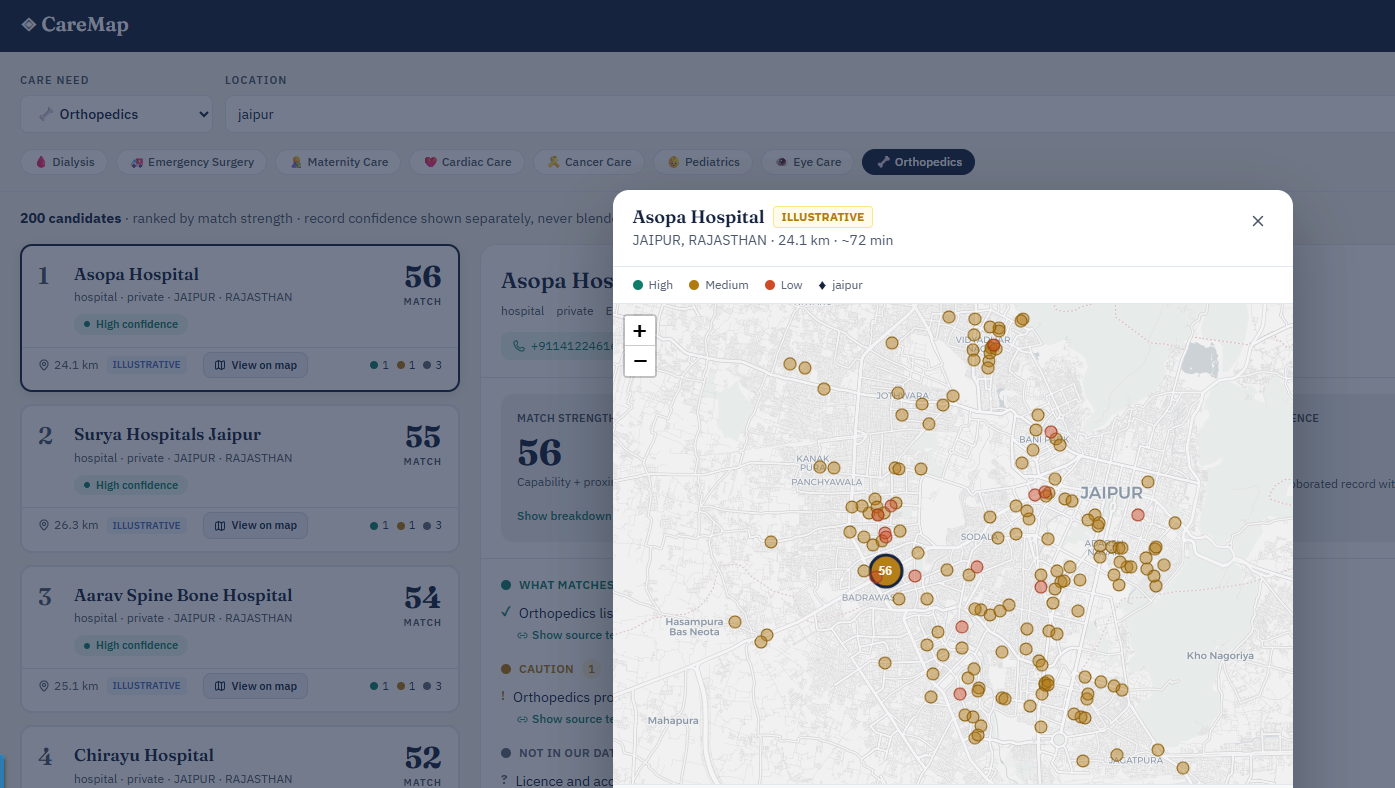
Every single claim behind these indicators is backed by our source data, and you can click "show source" to see exactly where it came from. We also list all the sources that feed our matching algorithm, so you can visit those sites yourself and make an even more informed decision. And of course, there's a map so you can easily find the facility.
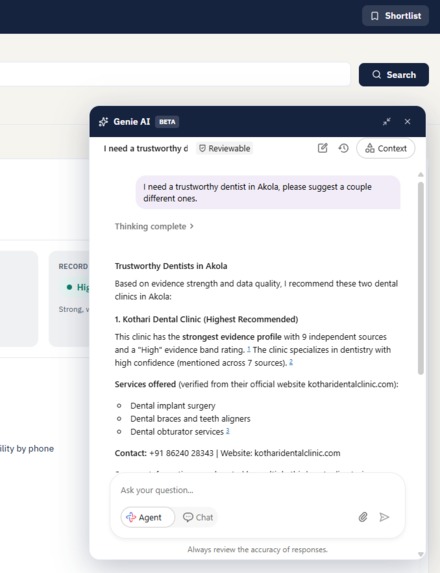
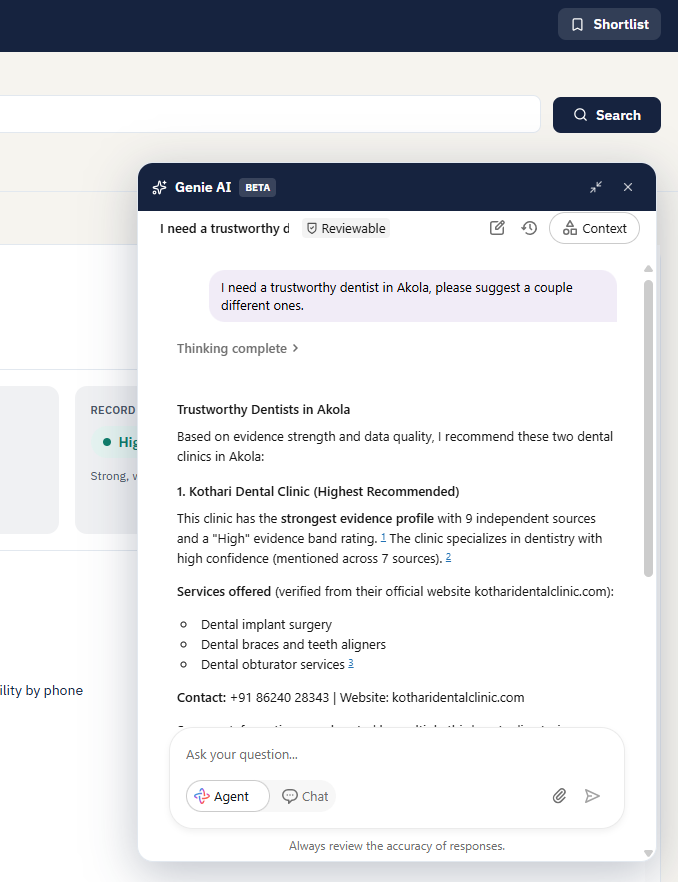
On top of that, we built an integrated knowledge agent that dives into our semantic data model and can handle long, complex conversations. Say you need specialized care in a small town and you're willing to drive far, our Caremap Genie will run a deeper analysis and surface multiple suggestions, always grounded in real data and citing its sources.
How we built it
We followed a best-practice chain:
- Clean the data – we used a medallion architecture for good traceability.
- Model the data into a star schema, so it can be analyzed efficiently.
- Move the data into Lakebase to serve tens of thousands of concurrent reads.
- Serve it over an autoscaling Databricks app, relying on Databricks' horizontal scaling to handle anywhere from 10 to hundreds of thousands of concurrent users.
- Integrate a Databricks Genie working on the same semantic model.
Most of the app was vibecoded in under 6 hours, using a combination of OpenAI Codex and the Databricks AI Dev Kit, kicked off with an extremely detailed project plan in markdown.
Challenges we ran into
Blank page paralysis. Faced with a big task and little time, where do you even begin? It was also hard to collaborate without our usual CI/CD processes and existing infra. So we split into 4 groups:
- Frontend builder – builds a frontend wireframe
- Data engineer/scientist – cleans the dataset and builds the star schema
- Product lead – builds out the business case and does exploratory data analysis
- All-rounder – sits across the other three and steers them based on each other's findings
Once the product lead delivered, we came back together to make the final touches as a group.
Accomplishments that we're proud of
A great-looking frontend, snappy sub-second reads, a working agent implementation, and a clear, helpful UI. Most of all, an honest representation of the data, where users can make up their own minds.
What we learned
We were amazed at how fast we could deliver something this helpful. In 6 hours, we turned a messy dataset into something that could help thousands of people. It's incredible how much the field has changed, and how powerful LLM-assisted development becomes when it's backed by a solid platform like Databricks.
What's next for Caremap
More tools for controllers:
- Let them control the model weights
- Write data back from the application, e.g. call a facility and verify that certain care is actually available
- Identify underrepresented parts of the dataset that need improving
For users:
- Additional language support (India is home to hundreds of languages)
- A voice assistant that speaks different Indian languages, especially for the elderly
- Better explanations of how we got our matching score, with an optional in-depth breakdown when you hover over the number
- User reviews from Caremap and third parties like Google Maps
Built With
- databricks
- lakebase
- medaillon
- semantic-model
- star-schema

Log in or sign up for Devpost to join the conversation.