Inspiration
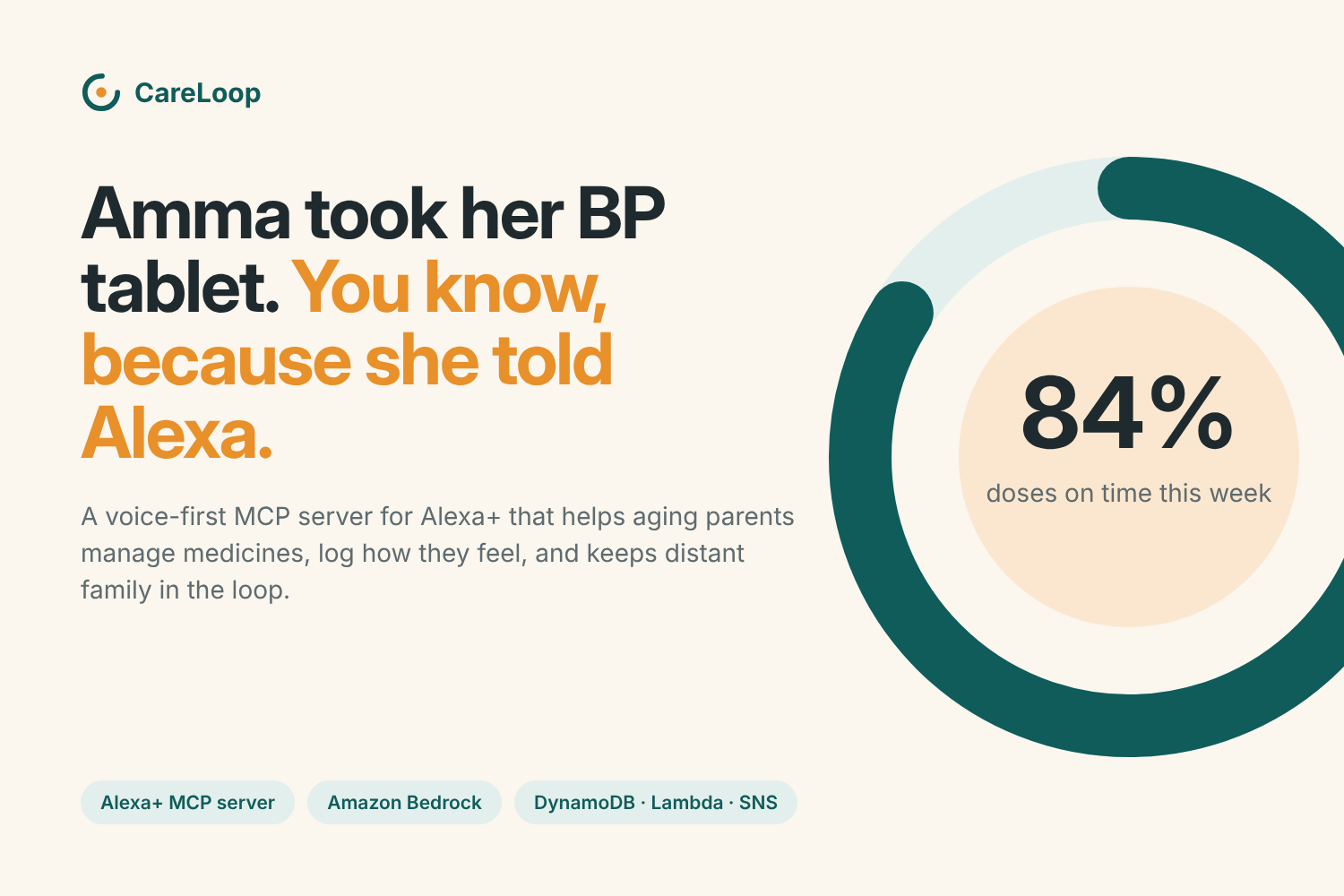
Millions of families live apart. In India alone, a huge number of parents grow old in their hometowns while their children work in other cities or abroad. The daily worry is always the same: Did Amma take her BP tablet? Is Appa feeling okay? Phone calls catch some of it, but missed doses and slowly worsening symptoms often go unnoticed until they become emergencies.
Older adults often find apps, tiny buttons, and notifications frustrating, but they're comfortable talking. Alexa+ already lives in their homes, so we asked: what if caring for a parent's health could happen through a simple conversation?
What it does
CareLoop is a self-hosted MCP server that gives Alexa+ the skills of a gentle, reliable care assistant:
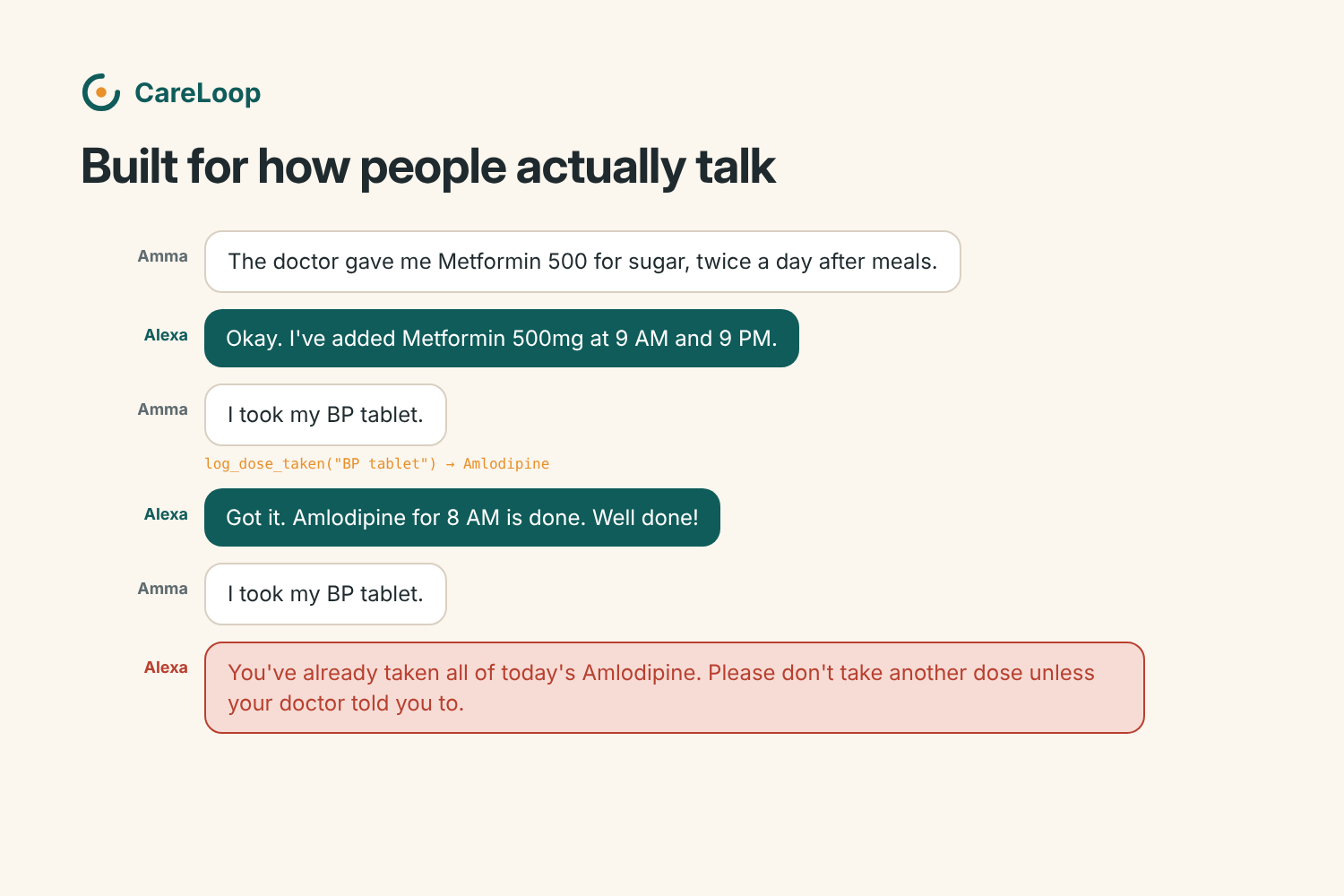
- 💊 Medication schedule: "Alexa, add my sugar tablet, twice a day after meals."
- ✅ Dose logging: "I took my BP tablet." CareLoop records the time and checks it against the schedule.
- ⏰ What's due: "What medicines do I need now?"
- 🩺 Symptom journal: "I'm feeling dizzy today." Symptoms are logged with severity and time.
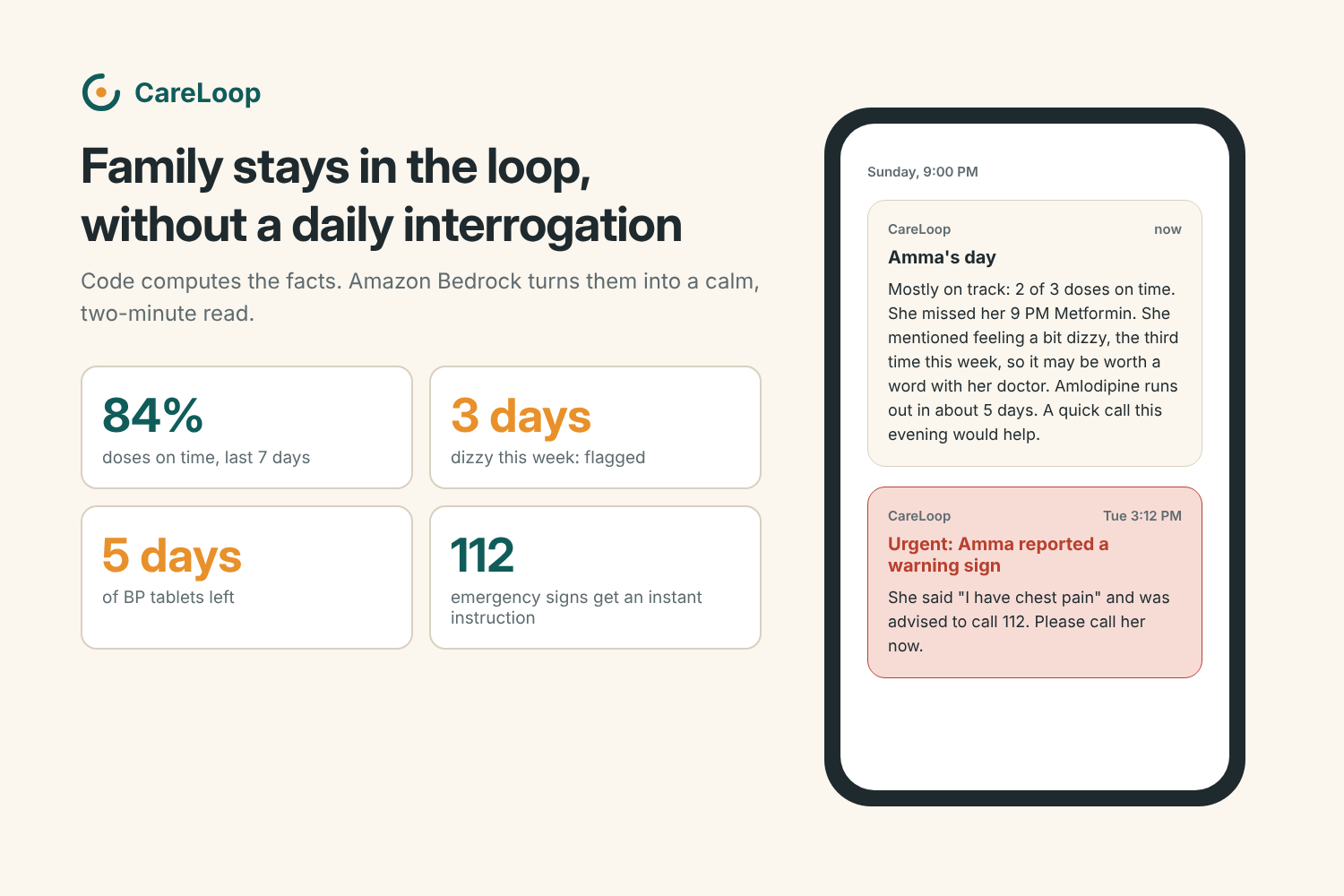
- 📦 Refill alerts: CareLoop warns when a medicine is about to run out.
- 👨👩👧 Family summary: every evening, Amazon Bedrock turns the day's data into a short, warm, plain-language summary for family members, and flags patterns like repeated missed doses or recurring symptoms.
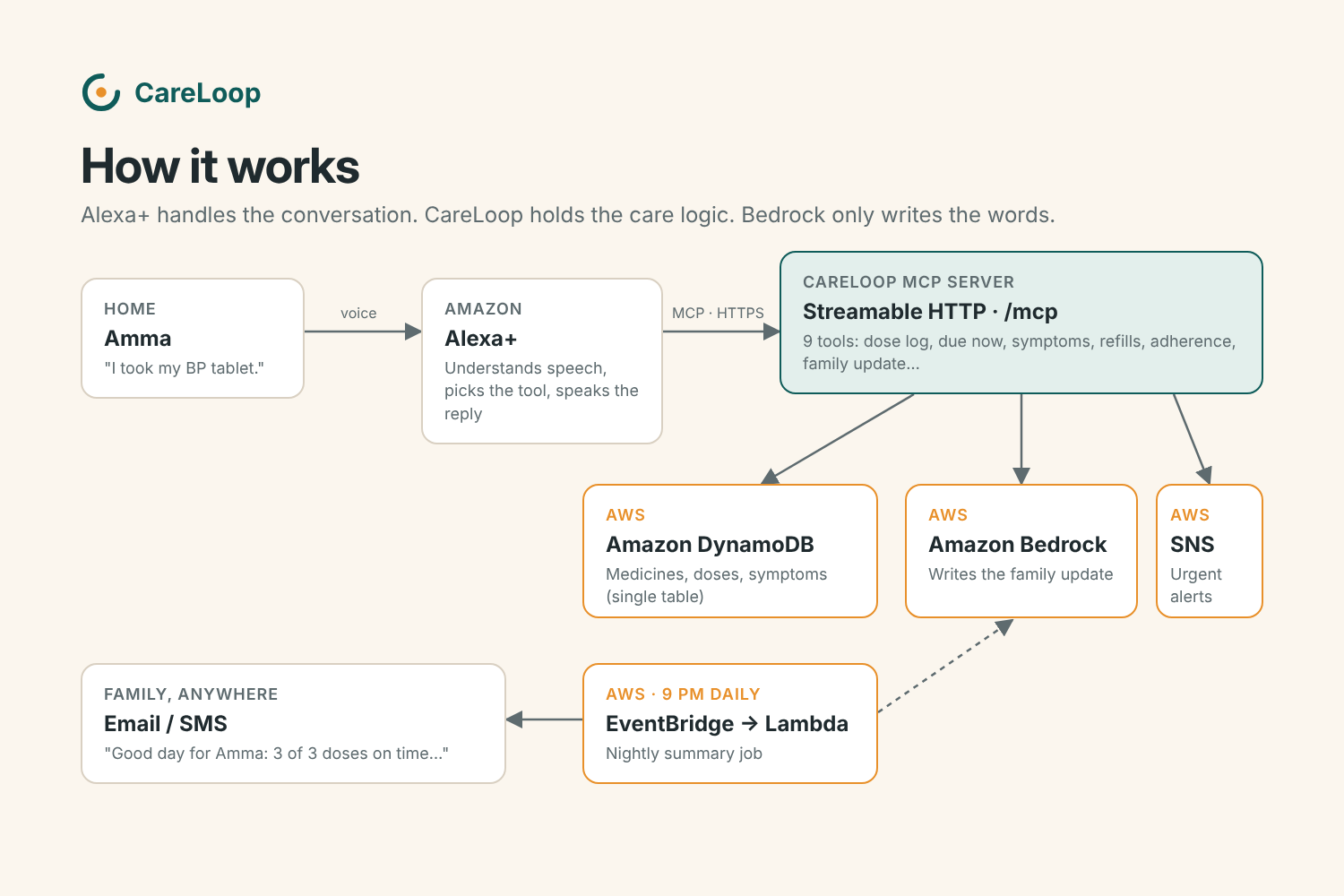
Alexa+ handles the natural conversation. CareLoop supplies the structured, trustworthy care logic.
How we built it
- MCP server built with the official MCP SDK, following the 2025-11-25 spec over Streamable HTTP, exposing tools:
add_medication,log_dose_taken,whats_due_now,log_symptom,refill_alert,daily_summary_for_family - Amazon DynamoDB stores medication schedules, dose logs, and symptom entries
- Amazon Bedrock generates the family summaries and detects patterns across days
- AWS Lambda runs the scheduled daily summary job
- Deployed on AWS so it's reachable by Alexa+
Adherence is computed as:
$$\text{Adherence} = \frac{\text{doses logged on time}}{\text{doses scheduled}} \times 100\%$$
Challenges we ran into
- Designing tools for voice, not screens: tool names, parameters, and descriptions had to be clear enough for Alexa+ to pick the right one from casual speech like "I already had my morning pill."
- Fuzzy time: "after breakfast" and "in the evening" don't map neatly to timestamps, so we built tolerance windows for dose matching.
- Tone: summaries had to inform the family without causing panic, so we iterated on prompts to stay calm and factual while still flagging real concerns.
- Learning the latest MCP spec and Streamable HTTP transport in a short hackathon window.
Accomplishments we're proud of
- A complete voice-first loop: the parent speaks, CareLoop records it, and the family stays informed.
- Clean, reusable MCP tools that any MCP-compatible assistant could use, not just ours.
What we learned
- How MCP separates conversation (Alexa+) from domain logic (our server), which makes integrations far simpler to build and reason about.
- Writing good tool descriptions is as important as writing good code when an AI agent is the caller.
- Accessibility for older users is mostly about removing steps.
What's next for CareLoop
- Multilingual support (Telugu, Hindi, Tamil) for parents more comfortable in their mother tongue
- Pharmacy integration for automatic refills
- Shareable reports for doctors before appointments
- Ring integration to notice if a parent hasn't moved around the house by mid-morning
Built With
- alexa-plus
- amazon-bedrock
- amazon-dynamodb
- amazon-web-services
- aws-lambda
- fastapi
- mcp
- model-context-protocol
- python
- streamlit

Log in or sign up for Devpost to join the conversation.