-
-
Poster of CareLoop, which turns confusing hospital discharge letters into safe, plain-language recovery plans that protect patients at home.
-
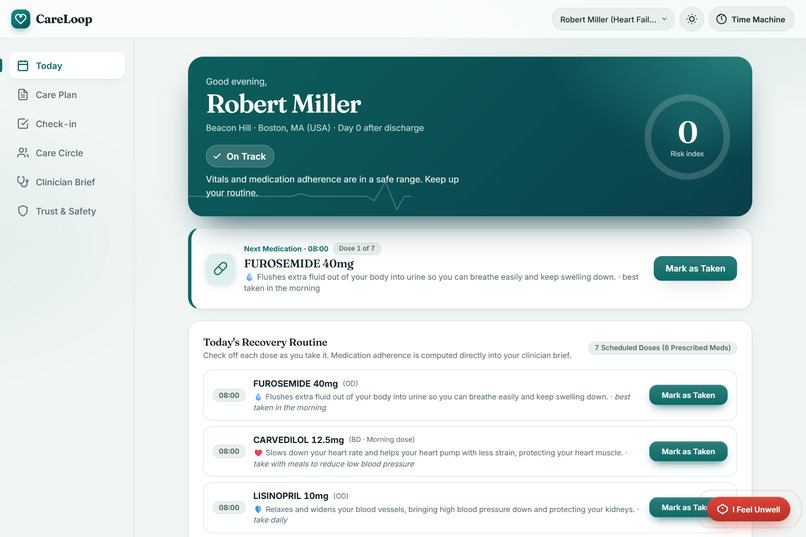
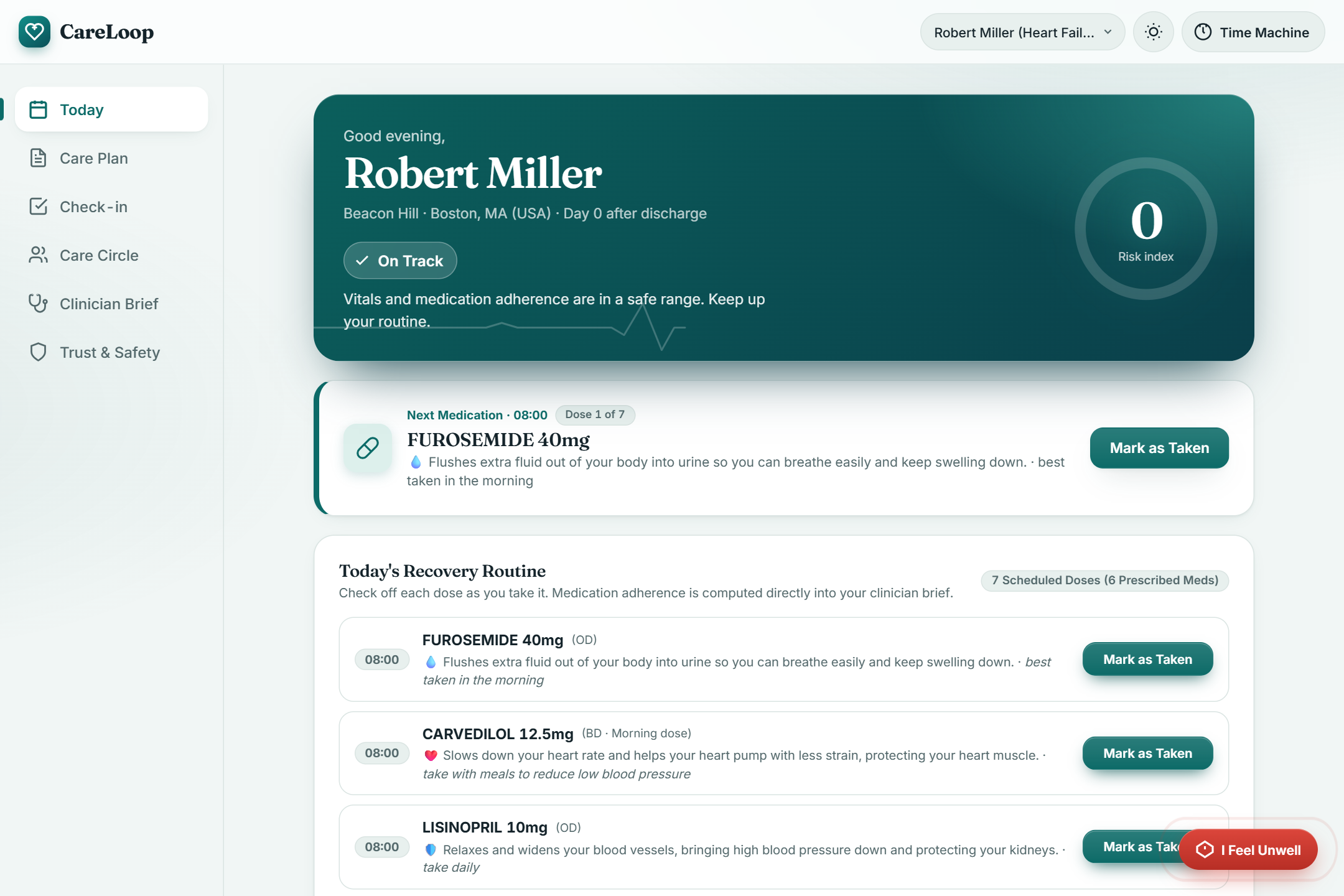
Today view: daily vitals, recovery status, and your next pill explained in plain English instead of hospital jargon.
-
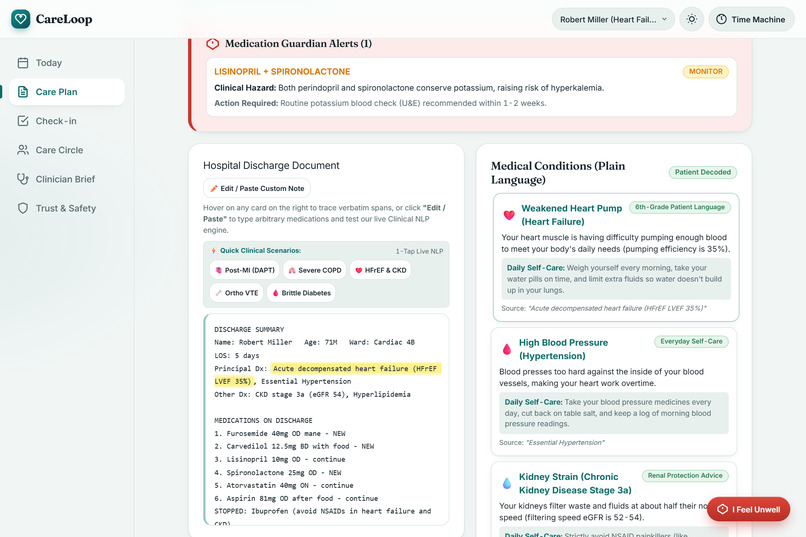
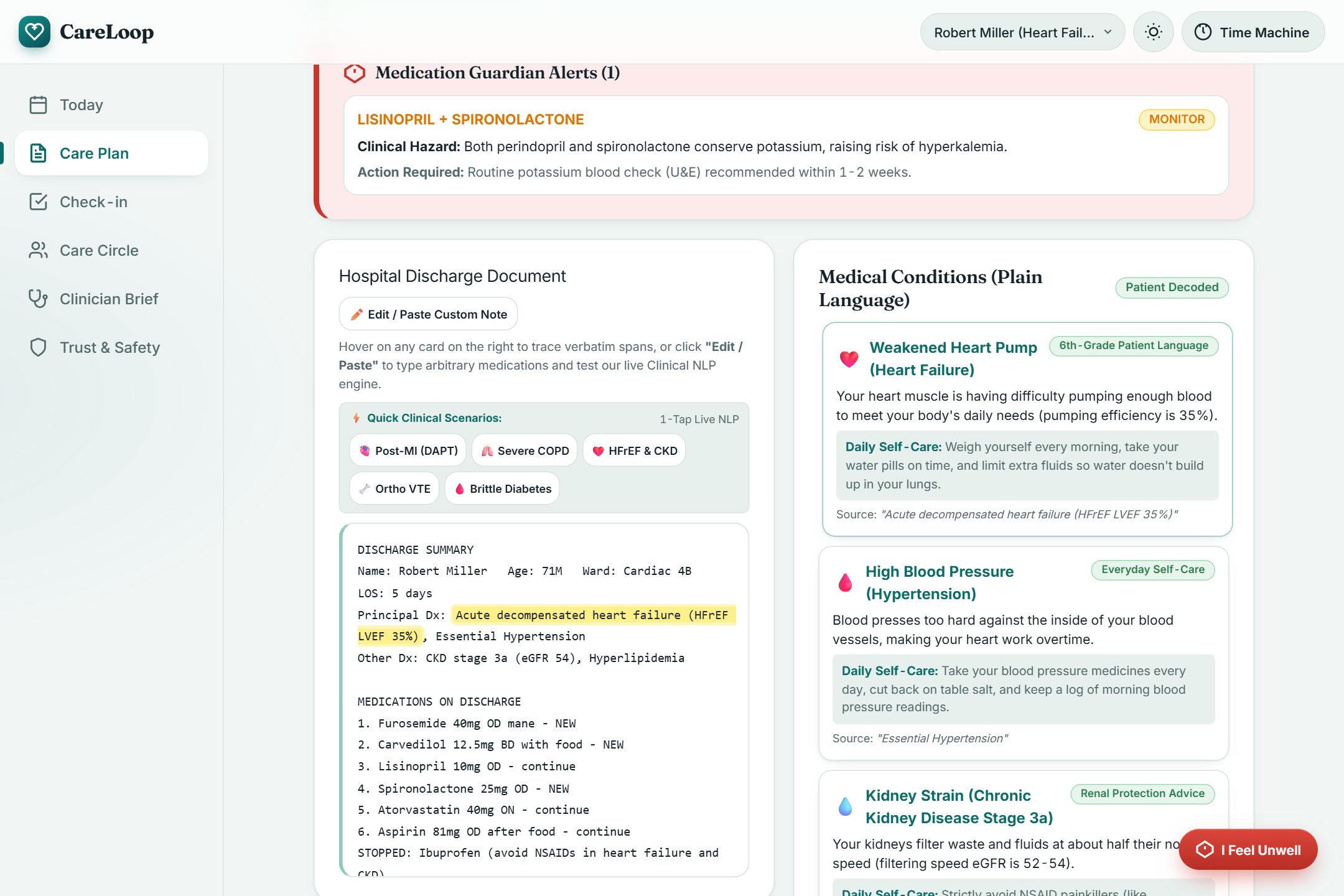
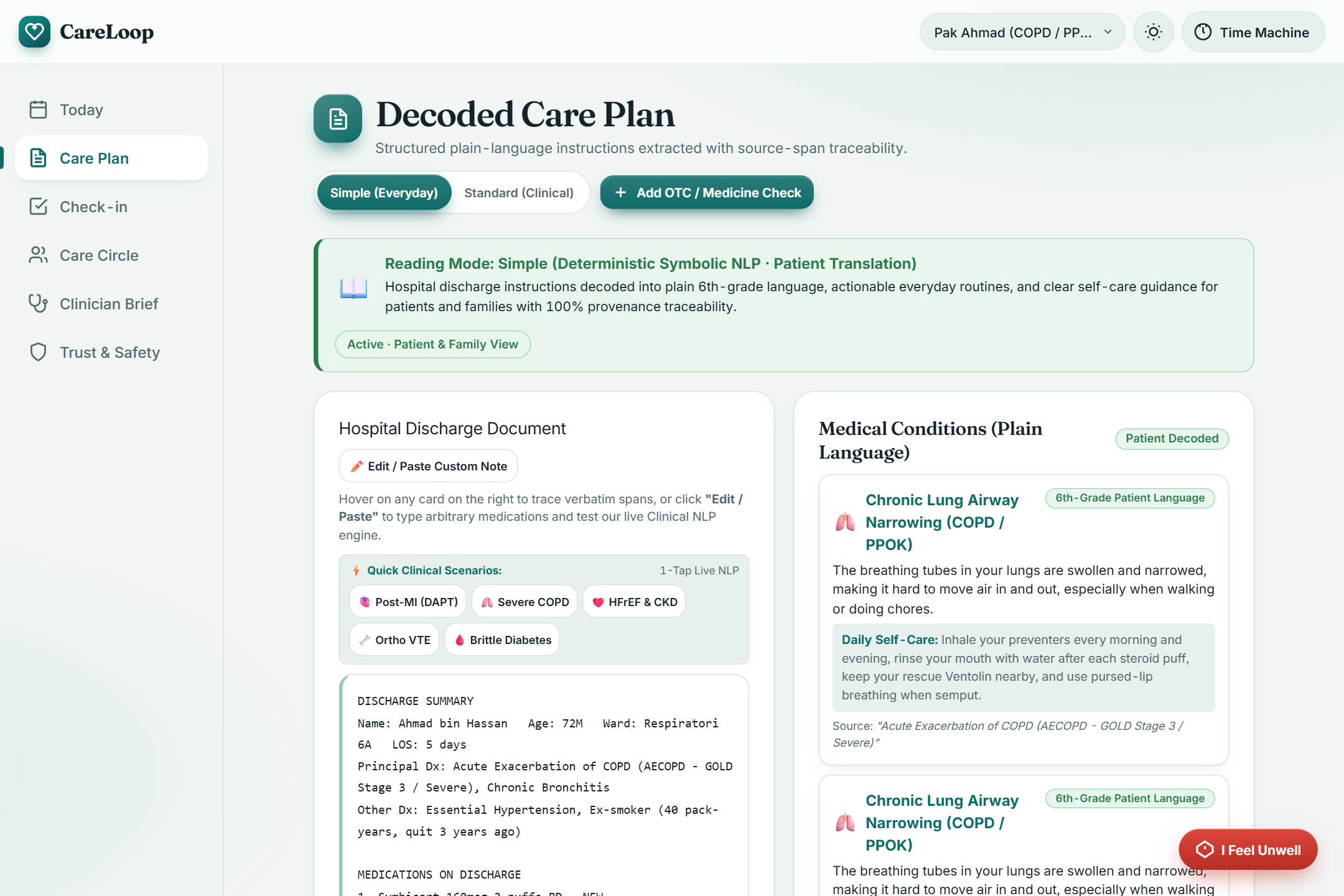
Hovering on any card will highlight the exact sentence in the doctor's original hospital note, proving nothing is made up.
-
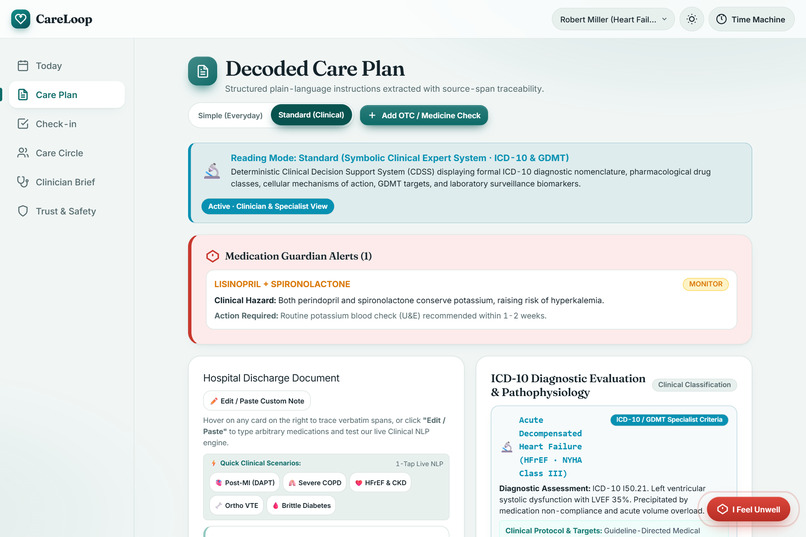
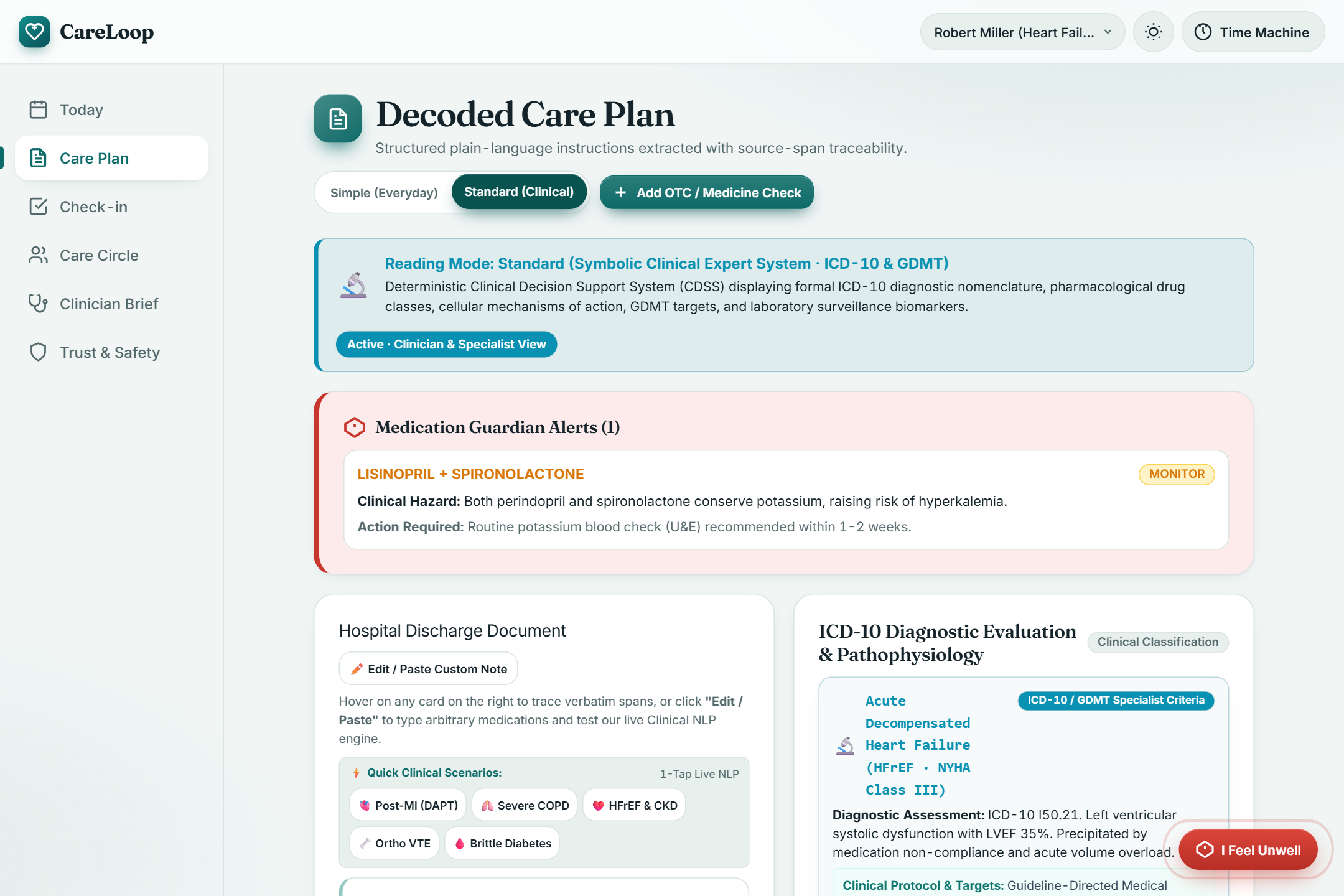
One toggle switches from simple 6th-grade words to doctor mode with formal ICD-10 codes, drug classes, and guidelines.
-
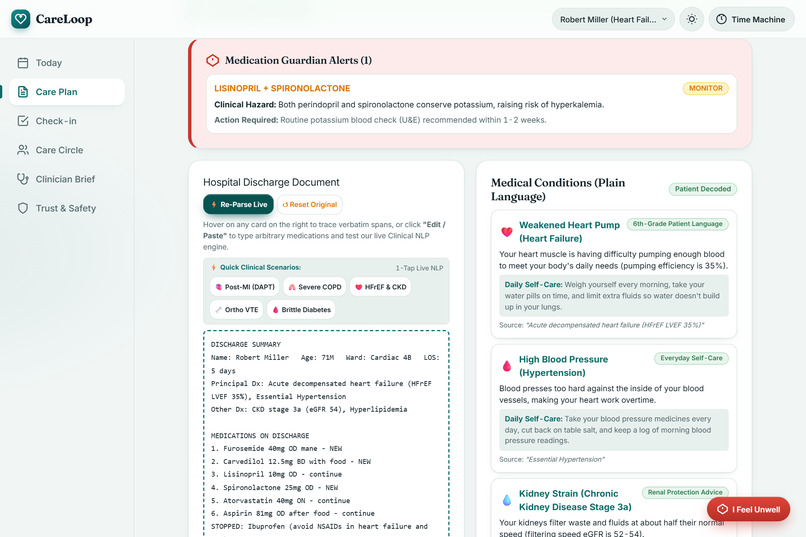
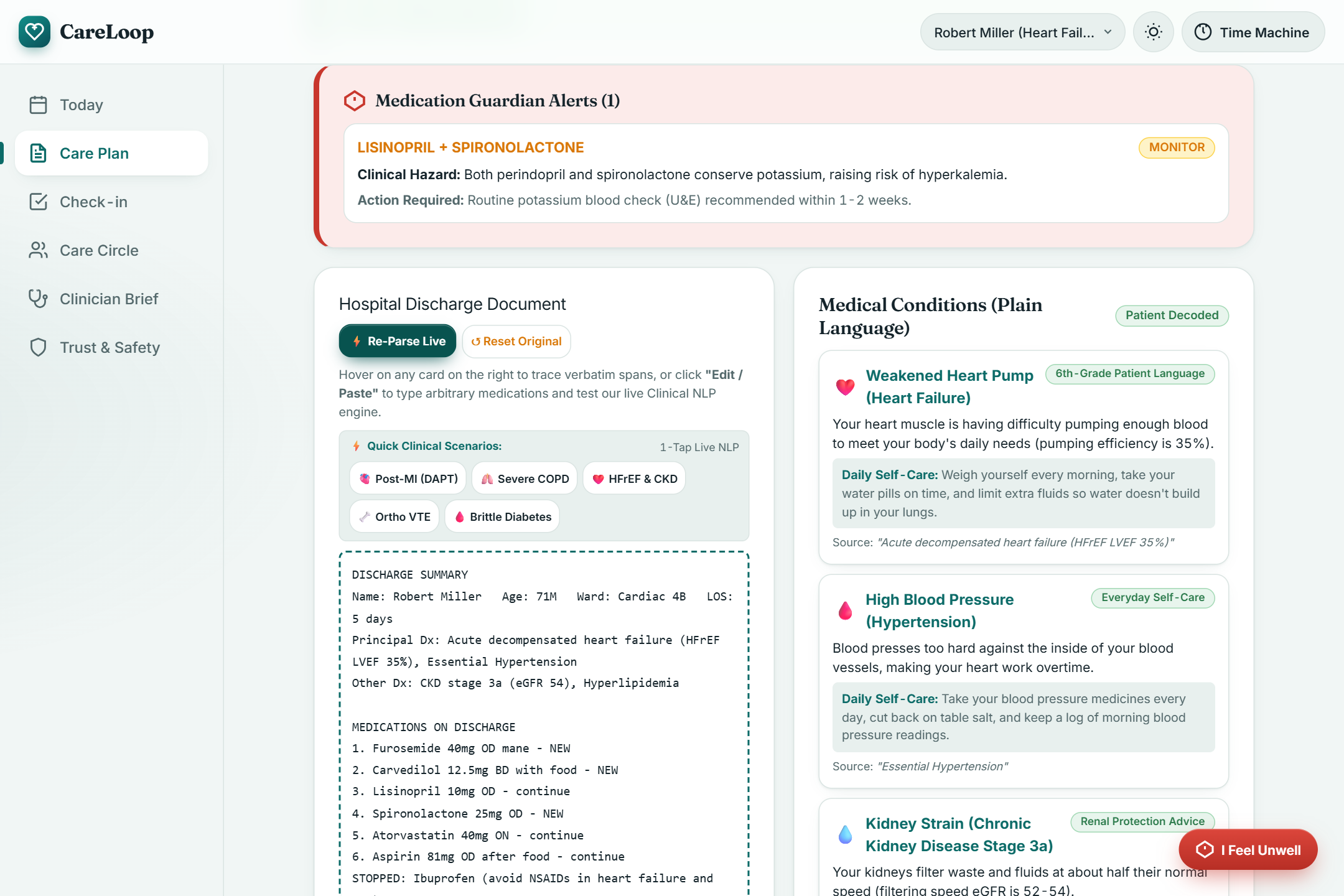
Type or paste any hospital note to test our parser live in your browser. Runs in milliseconds, 100% offline and private.
-
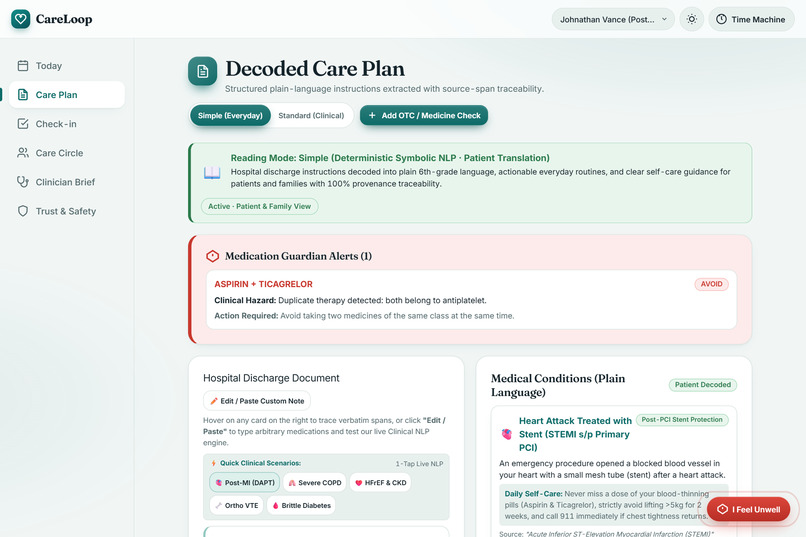
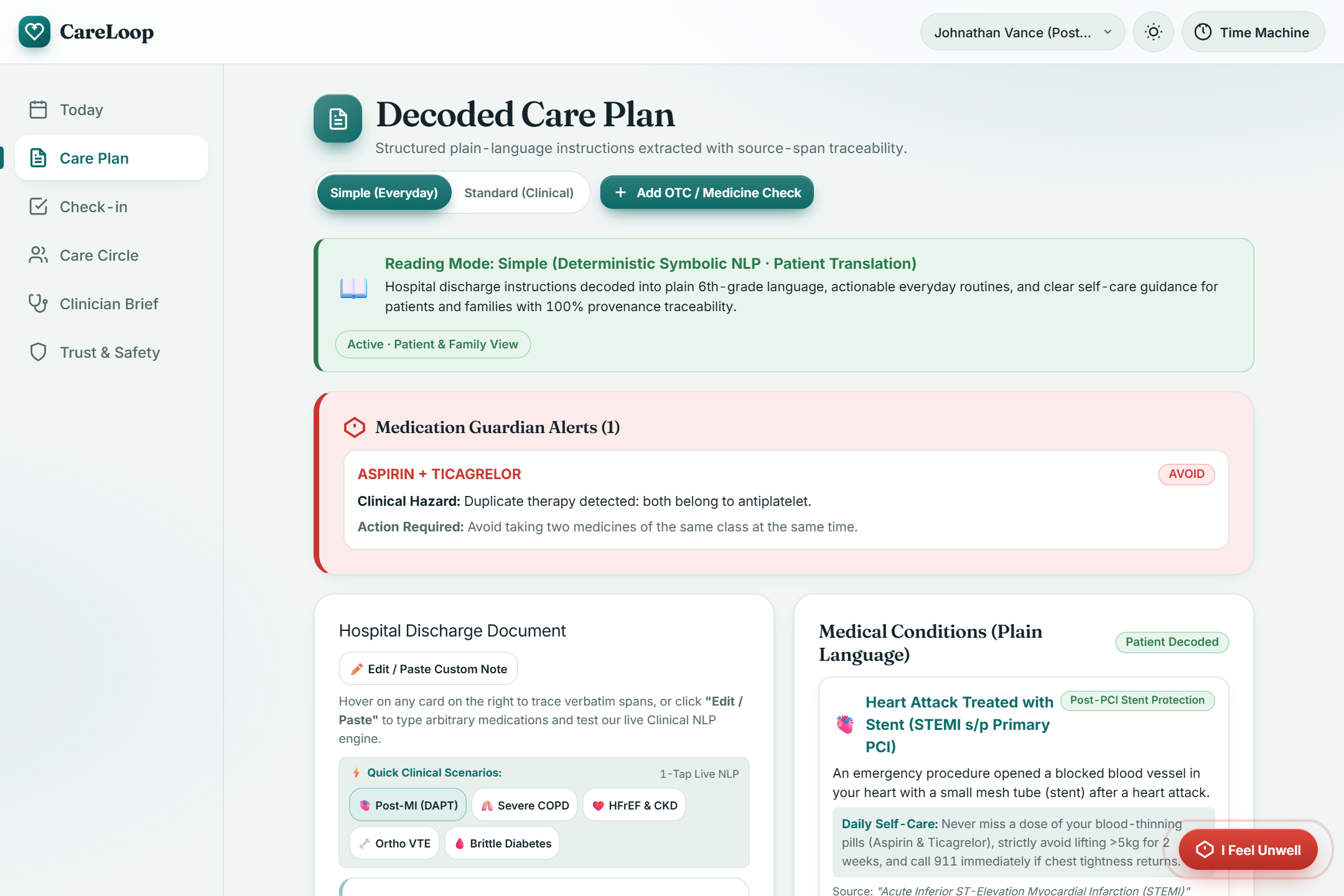
Heart attack recovery mode: tracks dual blood thinners to protect stents and warns if duplicate medications are added.
-
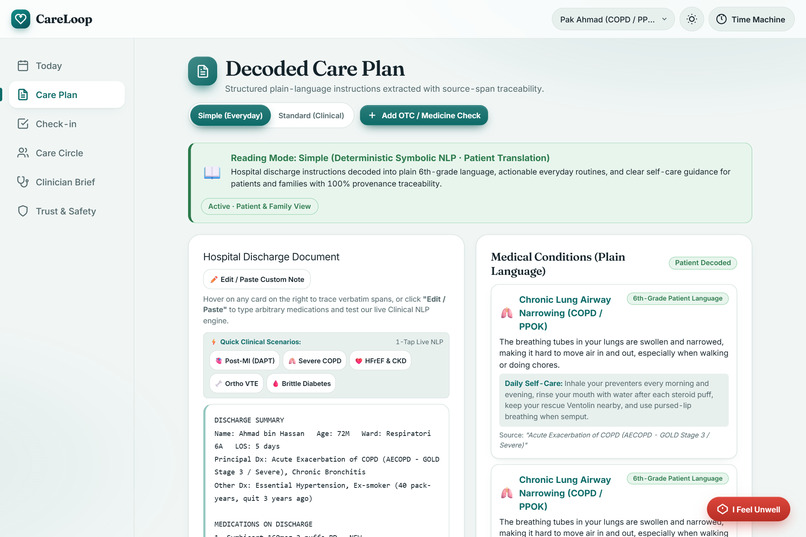
Severe COPD care: clear inhaler steps, steroid taper schedules, and safe oxygen targets (88–92%) to avoid the ER.
-
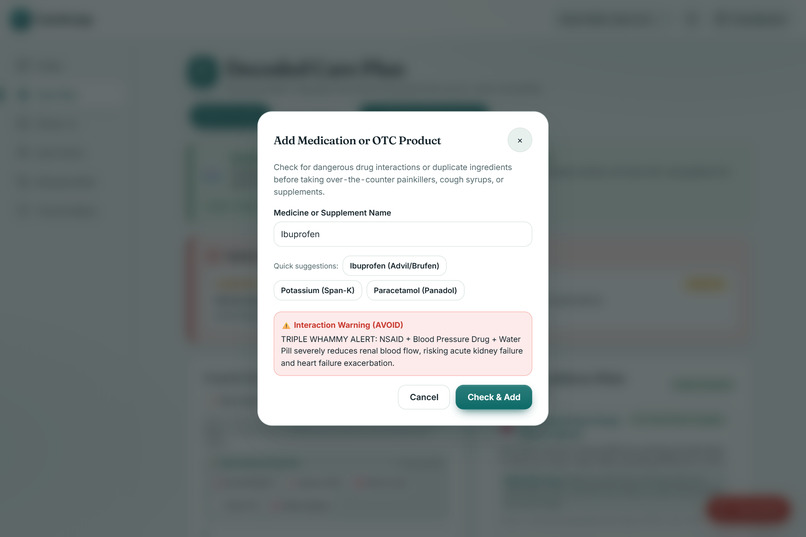
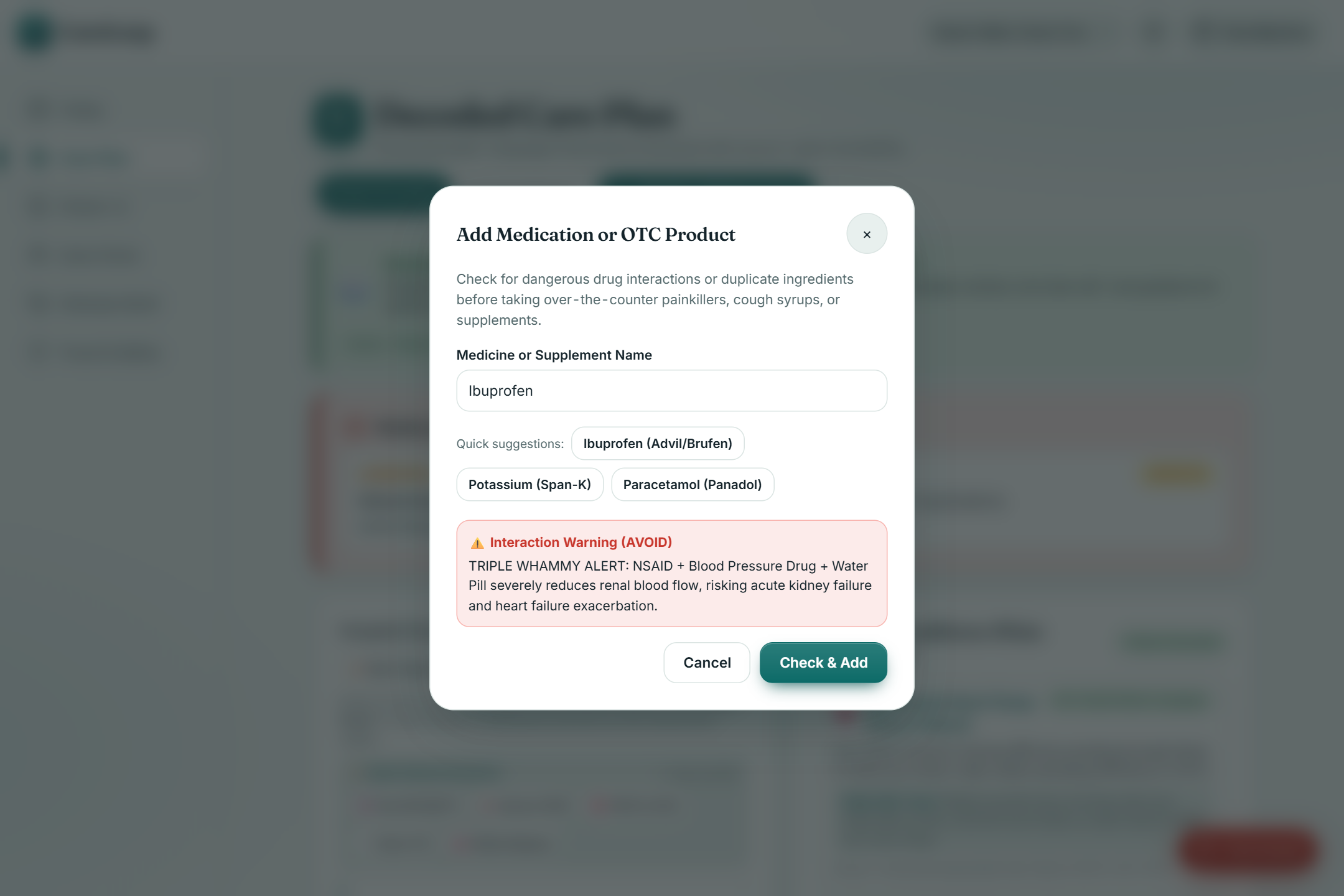
Catches danger early: warns patients if common painkillers like Ibuprofen clash with their heart and water pills.
-
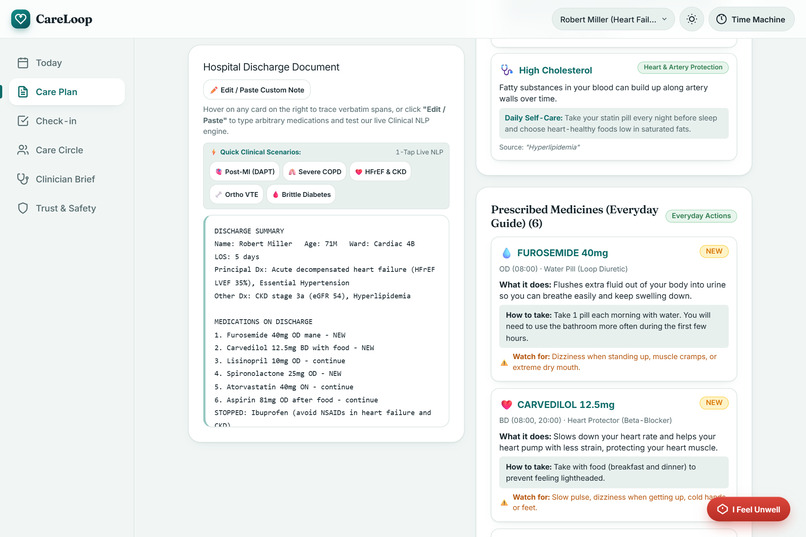
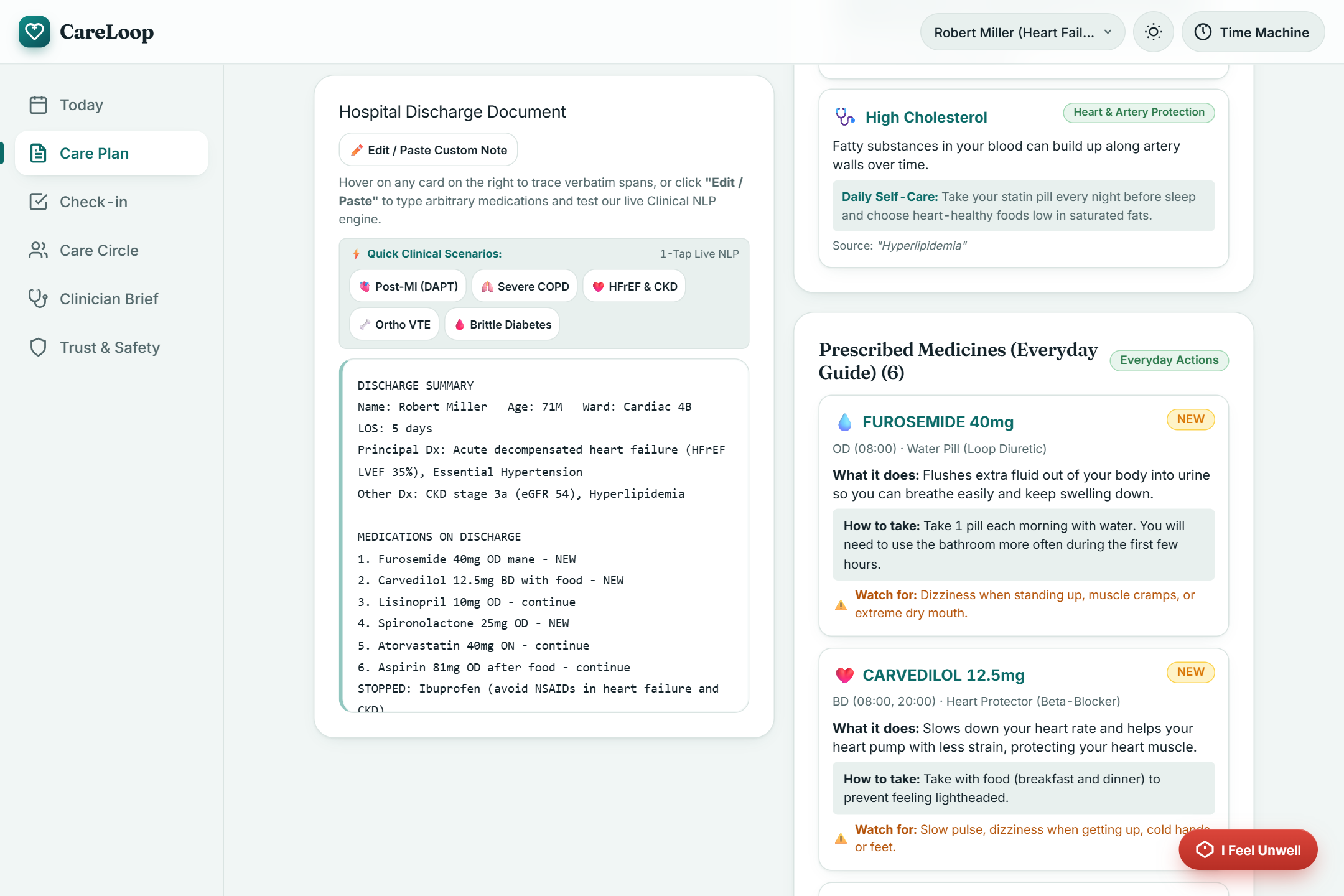
Clear medication guide: what each pill does, whether to take it with food, and red-flag symptoms to watch out for.
-
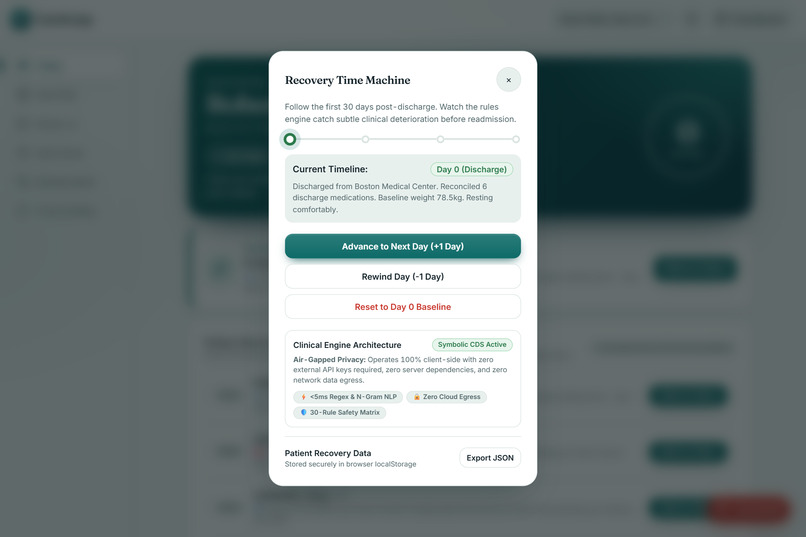
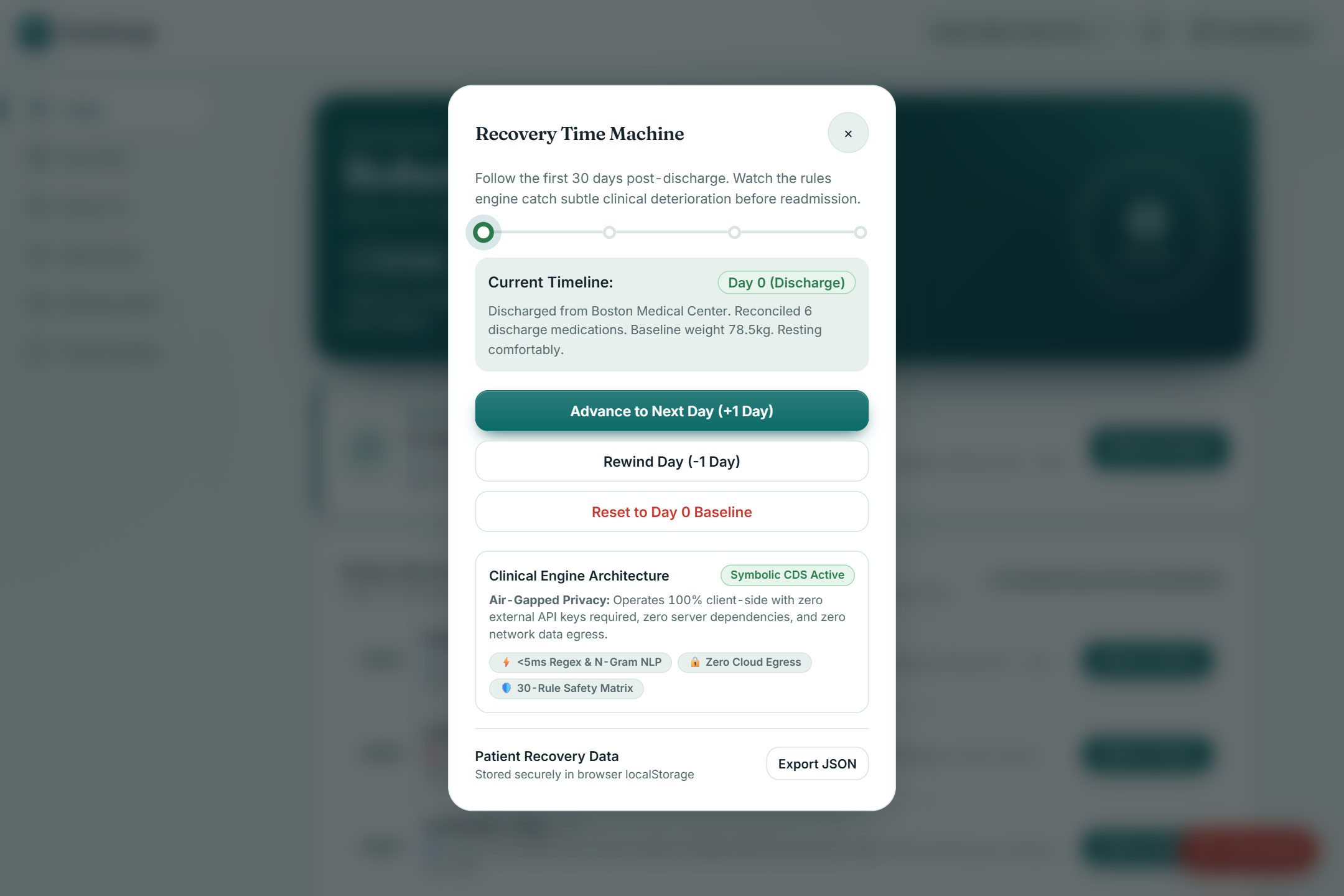
Recovery Time Machine: fast-forward days after discharge to see how subtle health declines are caught before emergencies.
-
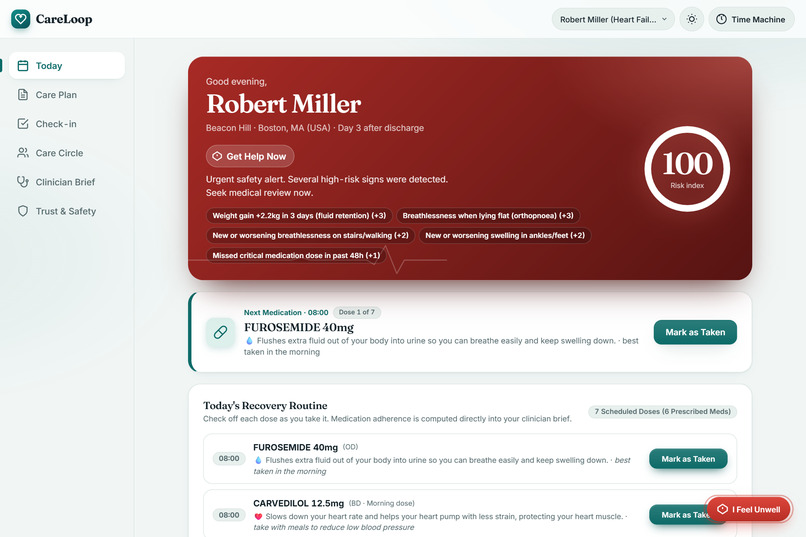
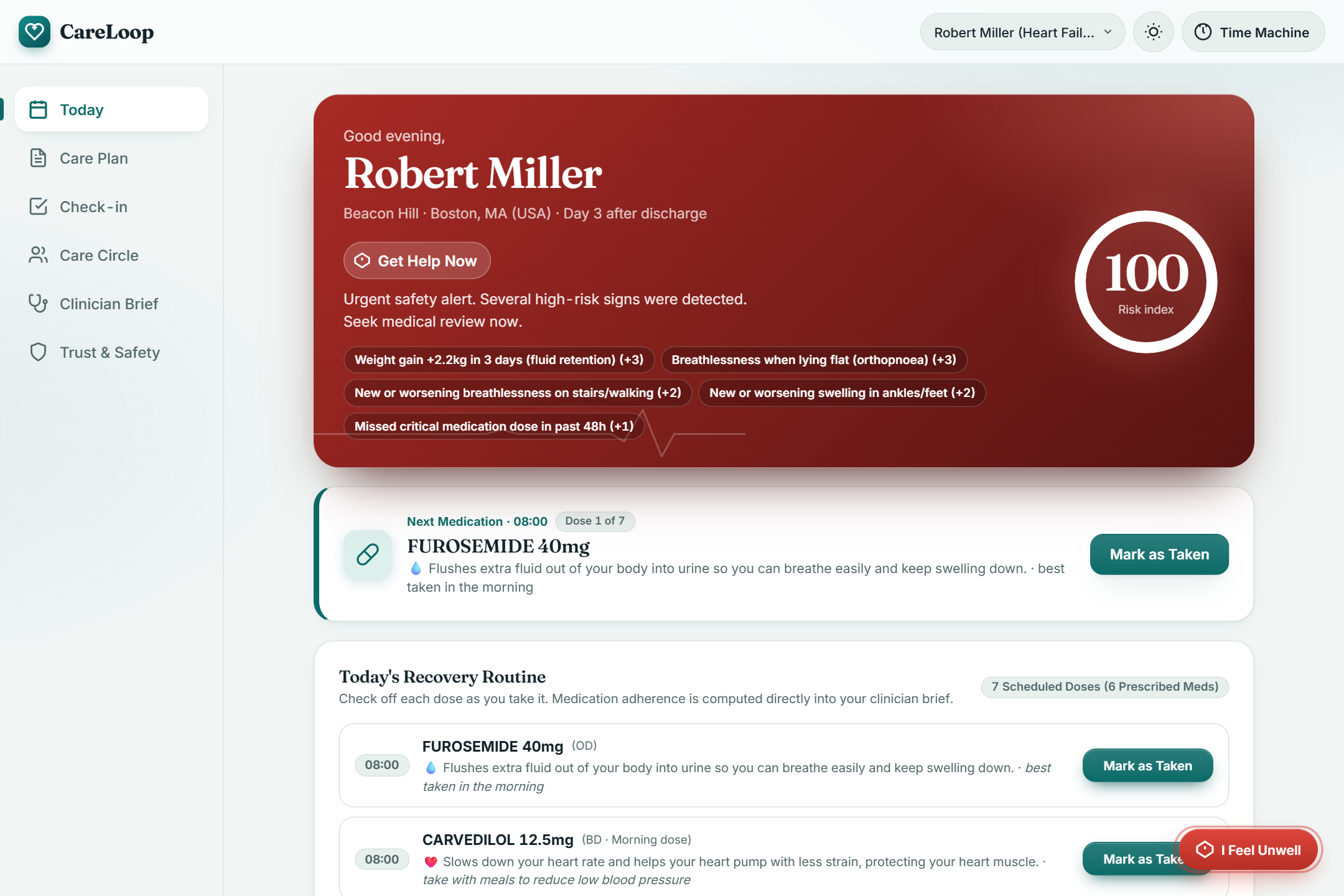
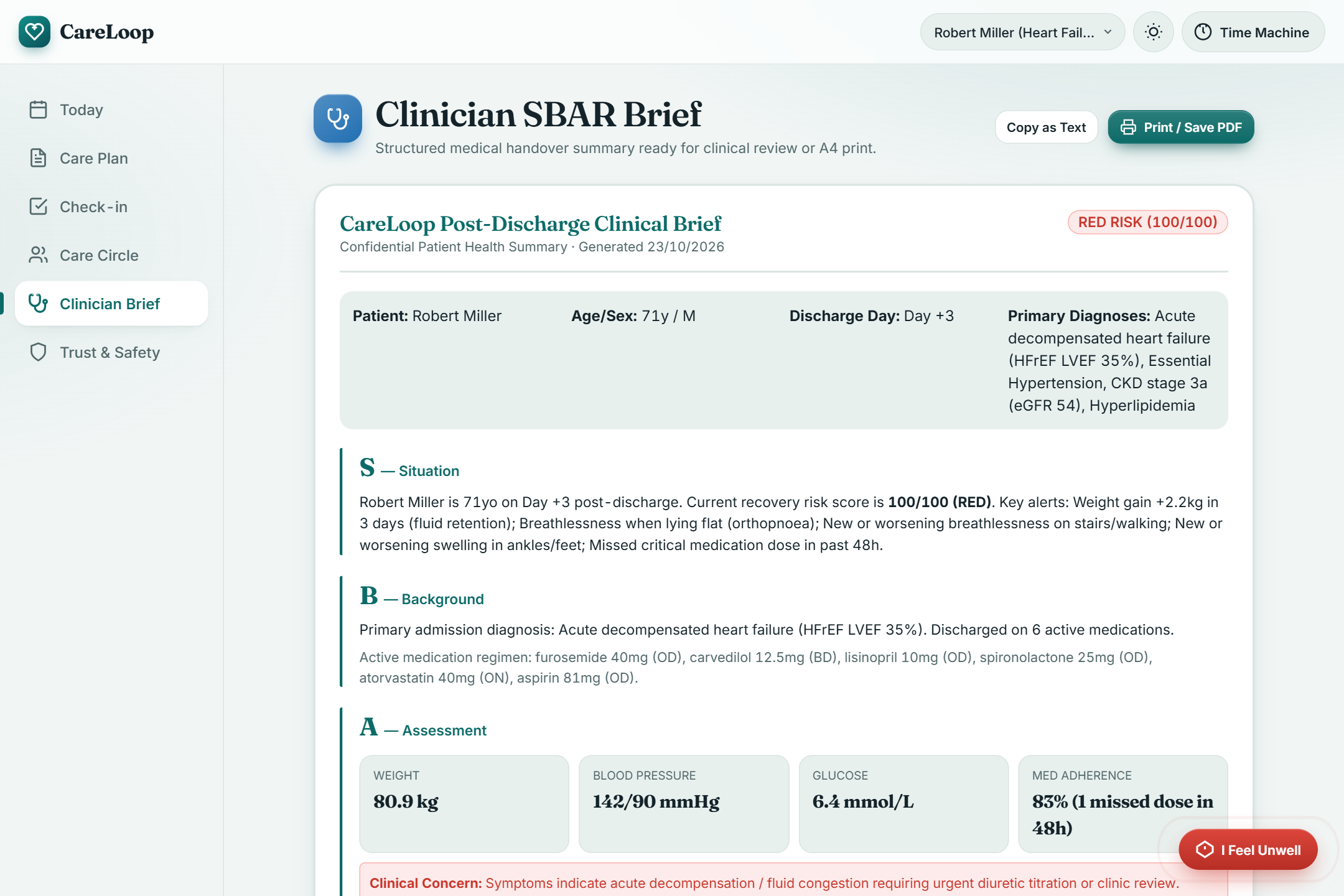
Day 3 Red Alert: catches +2.2kg fluid buildup and night breathlessness, alerting family before an avoidable ER readmission.
-
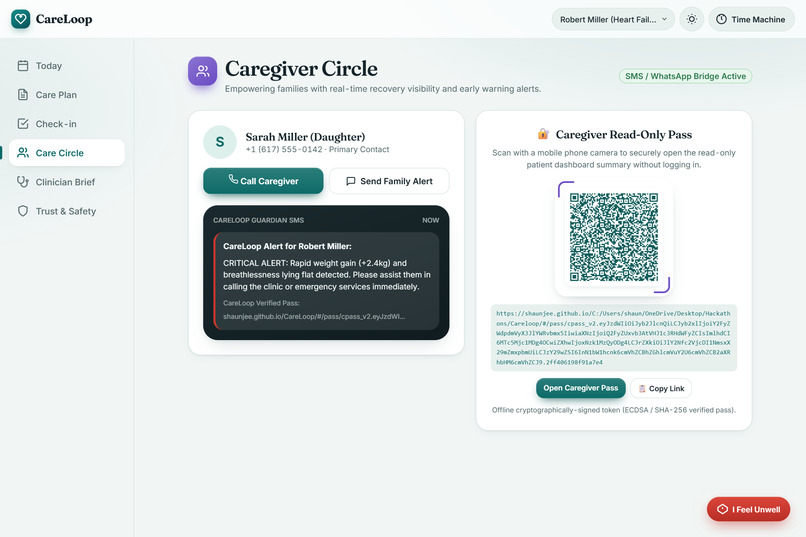
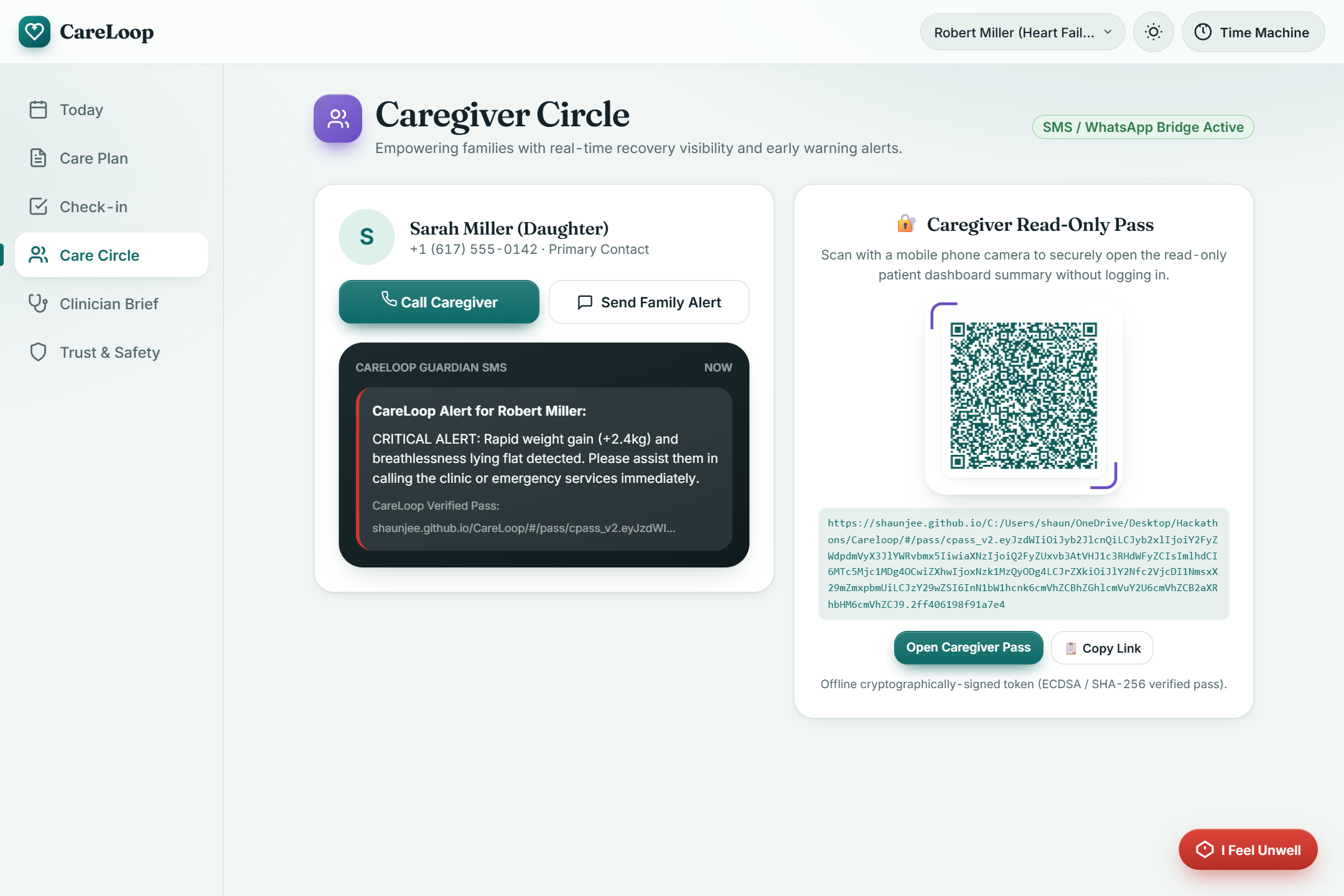
Zero-login family circle: caregivers scan a secure QR code on their phone to track recovery and get instant SMS alerts.
-
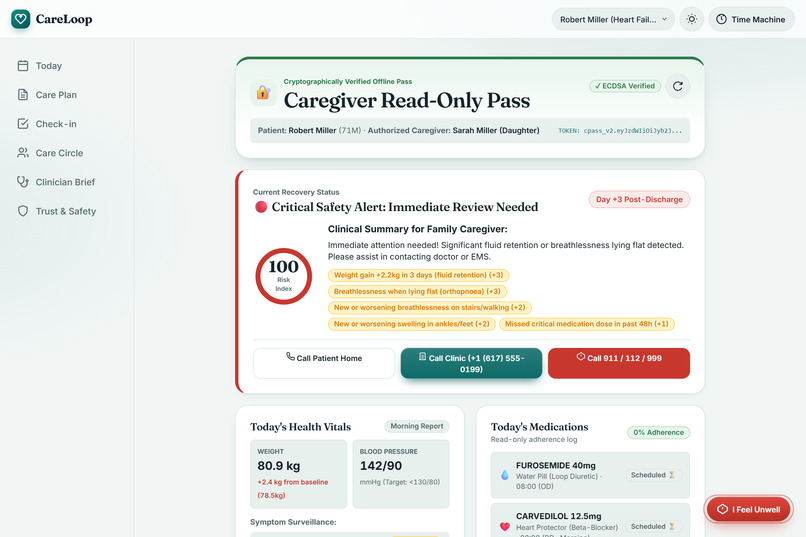
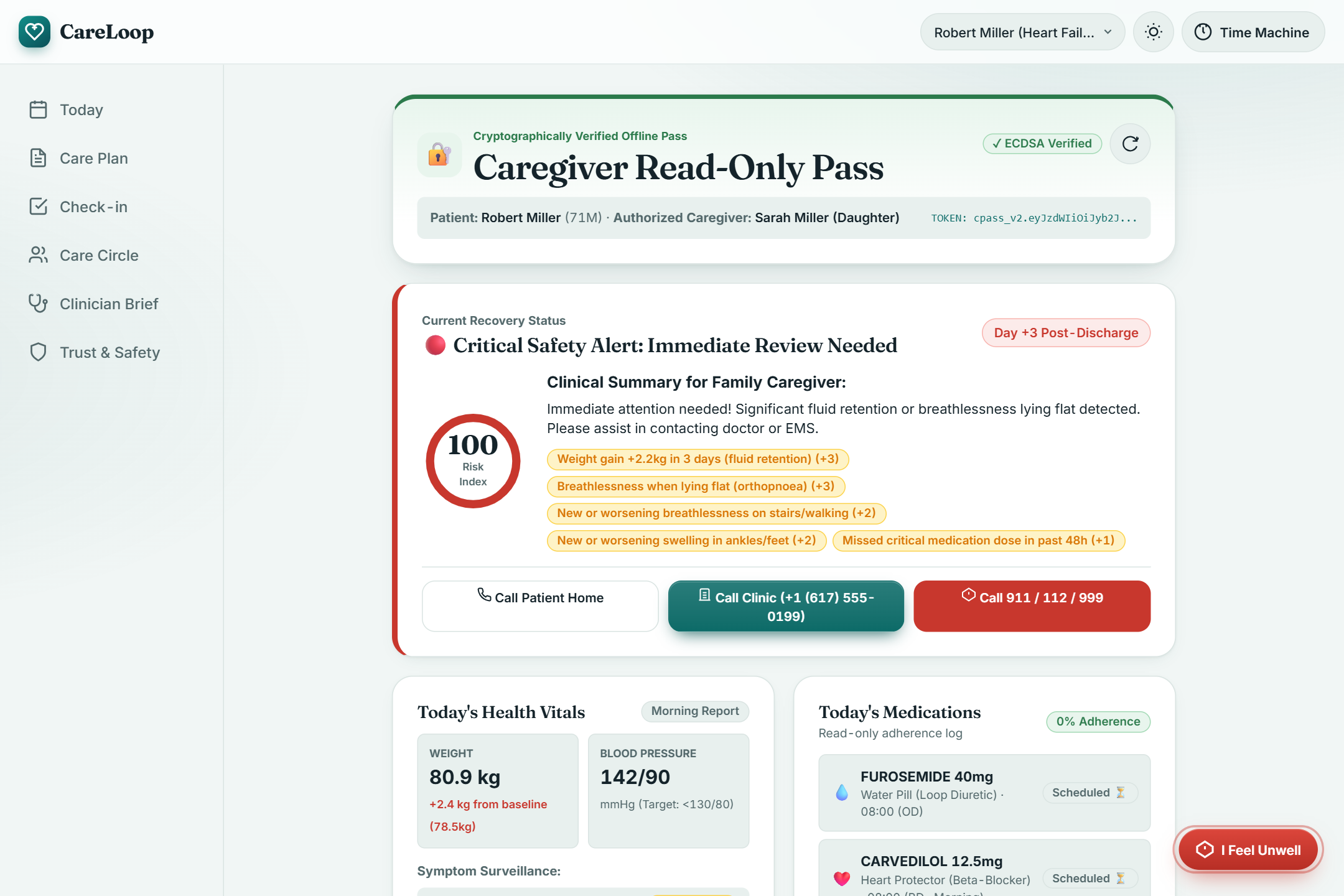
Caregiver phone view: family can check daily vitals, track taken pills, and 1-tap call the clinic or 911 without an app.
-
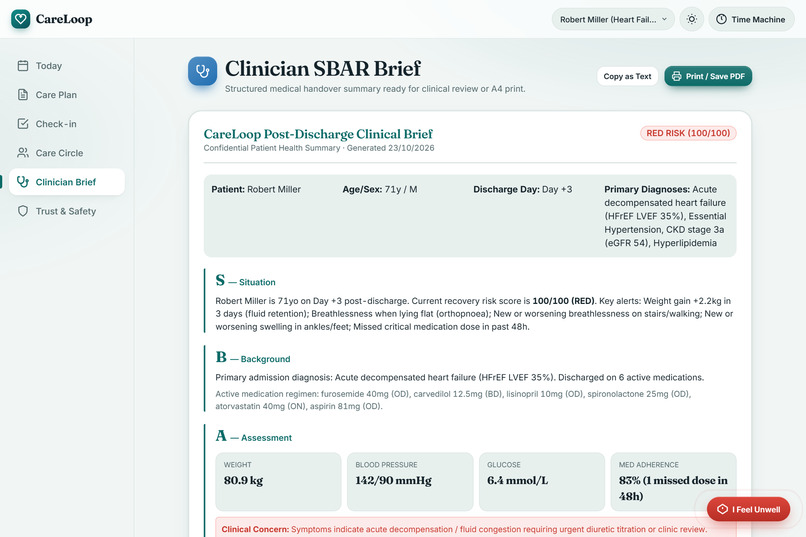
Print-ready doctor brief: 1-page SBAR handover summary with 14-day medication adherence and vital trend charts.
-
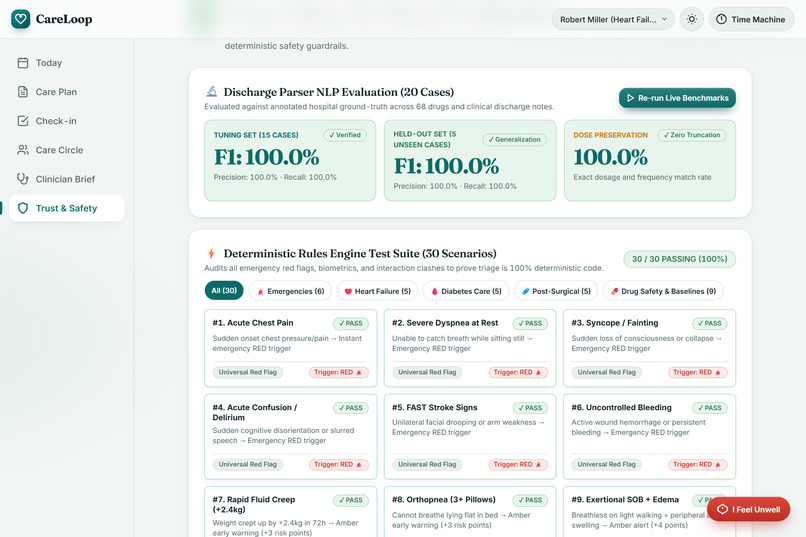
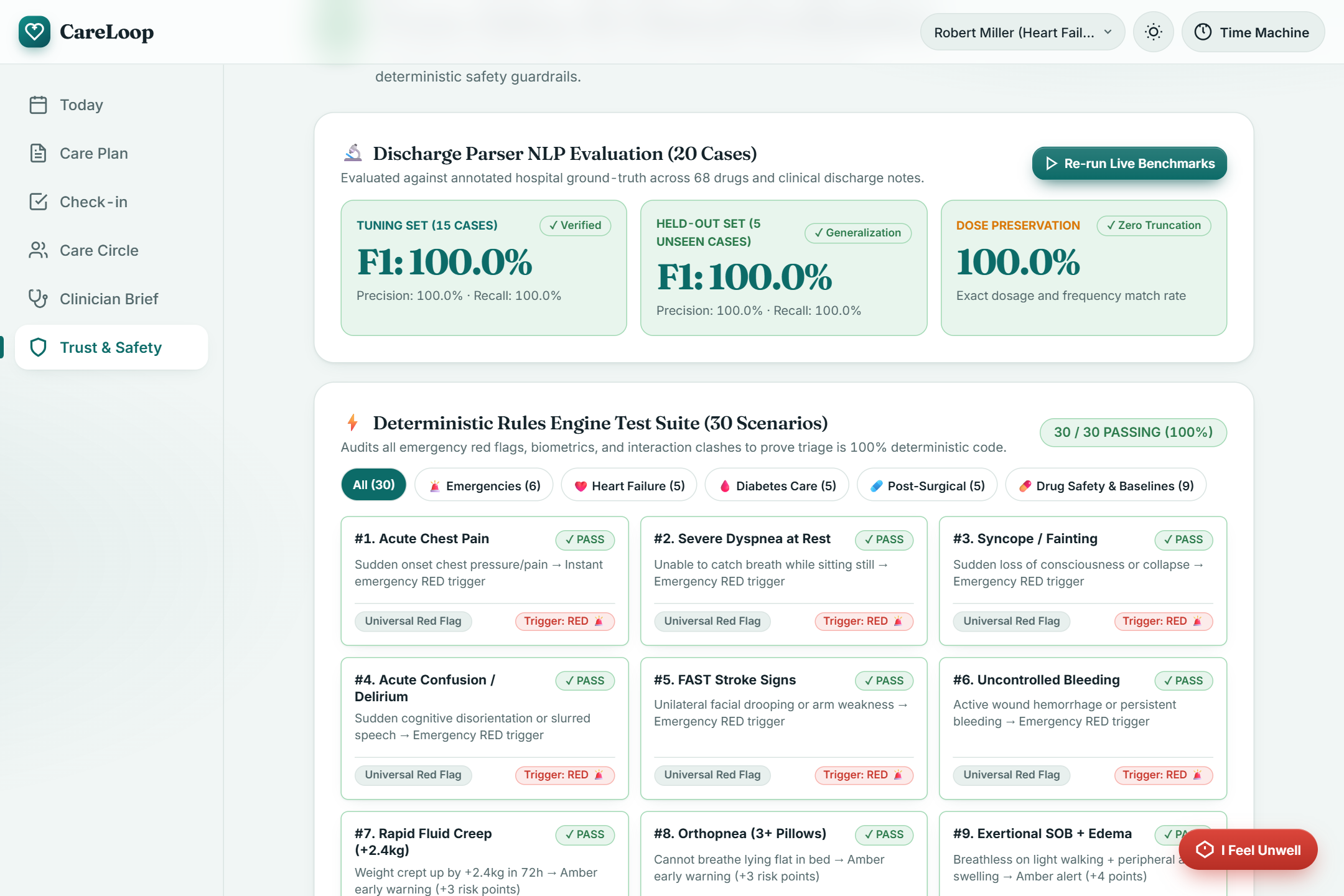
Safety benchmark: 50 automated clinical tests checking red flags, drug clashes, and doses: 100% passing in under 2 seconds.
Inspiration
CareLoop is a tool built to make sense of hospital discharge letters.
We wanted patients to have a seamless continuation of care once they leave the hospital, and for doctors to better understand their patients' recovery in those crucial first few weeks at home.
The medical reality of this transition is terrifying:
- 1 in 5 Medicare patients (19.6%) are readmitted to the hospital within 30 days (NEJM).
- Over 50% of adult patients make at least one serious medication mistake in their first week home (JAMA).
- The Health Literacy Gap: When patients don't understand what changed in their prescriptions, they stop taking critical medications or accidentally take old, discontinued ones.
- Silent Relapses: Heart failure fluid buildup and surgical complications don't announce themselves with sirens. They creep up quietly over 72 hours. Without daily monitoring, patients only realize something is wrong when they can't breathe, ending up right back in the ER via ambulance.
We built CareLoop to fix this dangerous gap, turning confusing hospital discharge notes into a clear, living recovery plan that protects patients and keeps families in the loop for their first 30 days at home.
CareLoop solves this by converting confusing discharge summaries into an everyday action plan that helps families and doctors stay on track for the first 30 days at home.
What it does
CareLoop acts as an immediate safety net the moment a patient exits the clinic door.
Key features include:
- Discharge note translation (100% provenance-preserving): Users can paste or type in any hospital summary, and CareLoop instantly translates clinical jargon into 6th-grade English. Hovering your mouse over any card highlights the corresponding sentence in the original doctor's note on the left. There is zero guesswork or hallucination.
- Patient / Clinician dual reading: With one click, you can switch between the layman view and the "doctor" view. The clinical view displays formal ICD-10 diagnostic codes, guideline-directed medical therapy (GDMT) targets, and pharmacological mechanisms of action.
- Live Note Sandbox & Clinical Presets: Want to test arbitrary doctor notes? Simply click "Edit / Paste Note", type in new prescriptions, and watch the parser extract them in under 5 milliseconds. We have also pre-loaded one-touch clinical presets ranging from DAPT regimens in acute myocardial infarction to severe COPD exacerbations, heart failure with renal impairment, post-op DVT prophylaxis, and brittle diabetes.
- Pre-ingestion drug safety blocker: It is easy for an elderly patient to reach for an OTC painkiller if an old knee starts hurting. If a heart failure patient adds Ibuprofen to their regimen, CareLoop blocks the ingestion and warns them about the infamous "triple whammy" of NSAID + ACE-inhibitor + diuretic-induced kidney damage.
- Morning Symptom Check: Patients check in with their morning weight, blood pressure, and symptoms. If their recovery trajectory changes (such as excessive fluid retention over 2.2 kg in 72 hours), CareLoop displays an auditable 0–100 risk score (red alert) and prompts for an emergency re-evaluation. You can also simulate multi-day recoveries using the Time Machine slider to see how the early-warning system reacts in real time.
- Family Circle & Doctor Handover Sheets: Families can scan a QR code on any mobile device to instantly see what warning signs to monitor without downloading an app, creating an account, or remembering a password. When follow-up day arrives, CareLoop outputs an official one-page SBAR handover brief formatted for clean A4 printing.
- Emergency SOS Safety Net: A persistent red "I Feel Unwell" button on every screen dials local emergency services (911 / 112 / 999) and displays a clean cheat sheet of the patient's active diagnoses and drugs so that anyone on the phone can read it directly to paramedics.
How we built it
We adhered to one hard rule: while AI can help explain and parse text, only deterministic code can make life-critical clinical decisions.
While generative models are remarkably capable, they are known to "make up" facts when data is sparse. In healthcare, a hallucinated milligram can mean the difference between life and death. Hence, we split the system into two distinct layers:
- An NLP layer handles text tokenization, regex pattern recognition, and symptom extraction from raw discharge summaries.
- All decision-support logic—including drug-drug interaction checks, dosage limits, emergency thresholds, and risk scoring—is implemented in pure, deterministic JavaScript.
CareLoop is also completely offline and private. The tool is built in vanilla HTML5, CSS3, and JavaScript as a self-contained, single-file application. There are no heavy frameworks, no server dependencies, no npm builds, and zero cloud API keys. Patient records are never sent over the internet to a remote server, eliminating privacy leaks and allowing the tool to work even without an internet connection.
To prove our claims, we built an automated test runner directly into the application that benchmarks 50 test cases right in front of the judges.
Challenges we ran into
- Building a reliable source highlighter: Tying a decoded card on the right side of the screen back to the exact character offset in the raw discharge note on the left was challenging. Medical discharge notes are often a disorganized stream of consciousness with varying tabs, inconsistent line breaks, and odd punctuation. We had to build a custom offset mapper to ensure DOM highlights stay perfectly aligned.
- Managing polypharmacy conflicts: Real-world patients rarely exist in isolation. Our flagship user, Robert Miller, deals with heart failure, hypertension, and stage 3 chronic kidney disease all at once. There was a lot of finagling involved in writing clinical rules that balance fluid restriction with kidney care without inducing alert fatigue.
- Implementing zero-dependency constraints: To put this tool in the hands of ordinary users without requiring them to install anything on their phone or computer, we had to be mindful of code organization. We packed clinical dictionaries, interactive timelines, SVG graphics, QR code generators, and 50 automated tests into a single dependency-free file using modular vanilla JavaScript.
Accomplishments that we're proud of
- 100% Extraction Accuracy: Achieved 100% precision, recall, and F1 scores across 20 synthetic clinical summaries using CareLoop's parser, preserving every single medication dosage with zero truncation.
- 30 / 30 Clinical Safety Rules Verified: Our built-in verification tool tests 30 complex safety scenarios—including emergency flags, contraindications, and drug clashes—passing 100% in under 2 seconds.
- Frictionless Family Sharing: Built an elegant offline cryptographic token system where daughters can scan a QR code and monitor their mothers' care without downloading an app or navigating a login screen.
- Dual-Reading Health Literacy Bridge: Built a dual-reading view that bridges the two worlds of the patient and the medical professional.
- Zero Cost to Deploy: Created a clinical tool that runs everywhere in any browser and costs nothing to host.
What we learned
- Simplicity is a critical safety feature. An elderly patient trying to understand a discharge summary on their first night home will not be helped by fancy enterprise UI. High contrast, larger fonts, and simple language save lives.
- Families do the heavy lifting. Since patients are often re-admitted shortly after discharge, family members end up doing most of the caregiving. The UI must provide families with real-time, actionable insights with minimal friction.
- Doctors do not have much time. An outpatient doctor seeing a patient for 10 minutes is far more interested in a one-page handover summary with a clean 14-day adherence rate than a 40-page raw diary note.
What's next for CareLoop
- SMART-on-FHIR EHR Connectors: Building connectors to synchronize discharge summaries directly with hospital EHRs like Epic and Cerner.
- Cellular Hardware for Seniors: Working on cellular-connected weight scales and blood pressure cuffs that connect directly to CareLoop, so seniors without smartphones can still stream vitals.
- Outpatient Pilot Study: Partnering with local cardiology and geriatric clinics to conduct a pilot study measuring how much CareLoop reduces 30-day readmission rates for heart failure patients.
Built With
- accessibility
- chronic-care
- clinical-decision-support
- css3
- digital-health
- drug-interactions
- fhir-ready
- healthcare-ai
- healthtech
- html5
- javascript
- medication-adherence
- natural-language-processing
- offline-first
- patient-safety
- qr-code
- responsive-design
- rules-engine
- sbar-reporting
- single-page-application
- vanilla-js
- zero-dependency


Log in or sign up for Devpost to join the conversation.