What inspired us
The seed of CareLoop AI was a simple, uncomfortable observation: a doctor's note is not a to-do list, but it should be. A single visit produces a dozen small, consequential commitments — start this medication, order that MRI, refer to neurology, book a follow-up in six weeks. The clinician is diligent when writing them. The system, however, stores them as prose. After the visit ends, completion is tracked by human memory, and memory is exactly the wrong place for a task that someone's health depends on.
Missed clinical follow-up is a well-known failure mode: the test that is ordered but never checked, the referral that is sent but never scheduled, the medication that is started but never reconciled. The work is not hard — it is unowned.
We did not want to build another chatbot that summarizes notes. Summarization adds another wall of text nobody re-reads. We wanted the opposite: extraction into structure, and structure that stays alive. Every actionable sentence should become a real, typed object with a state, an owner, and a lifecycle. From that conviction, CareLoop AI was born: a note goes in, and a living care plan comes out — one that notices its own gaps, flags its own blockers, and closes its own loops as evidence arrives.
And because the plan is a real data structure, it becomes something an AI agent can safely act on. That is where the second inspiration came in: the Model Context Protocol. If the plan is structured, we can hand an agent exactly the tools it needs — and not one database credential more.
How we built it
The pipeline
CareLoop AI is four cooperating services that share one PostgreSQL database.
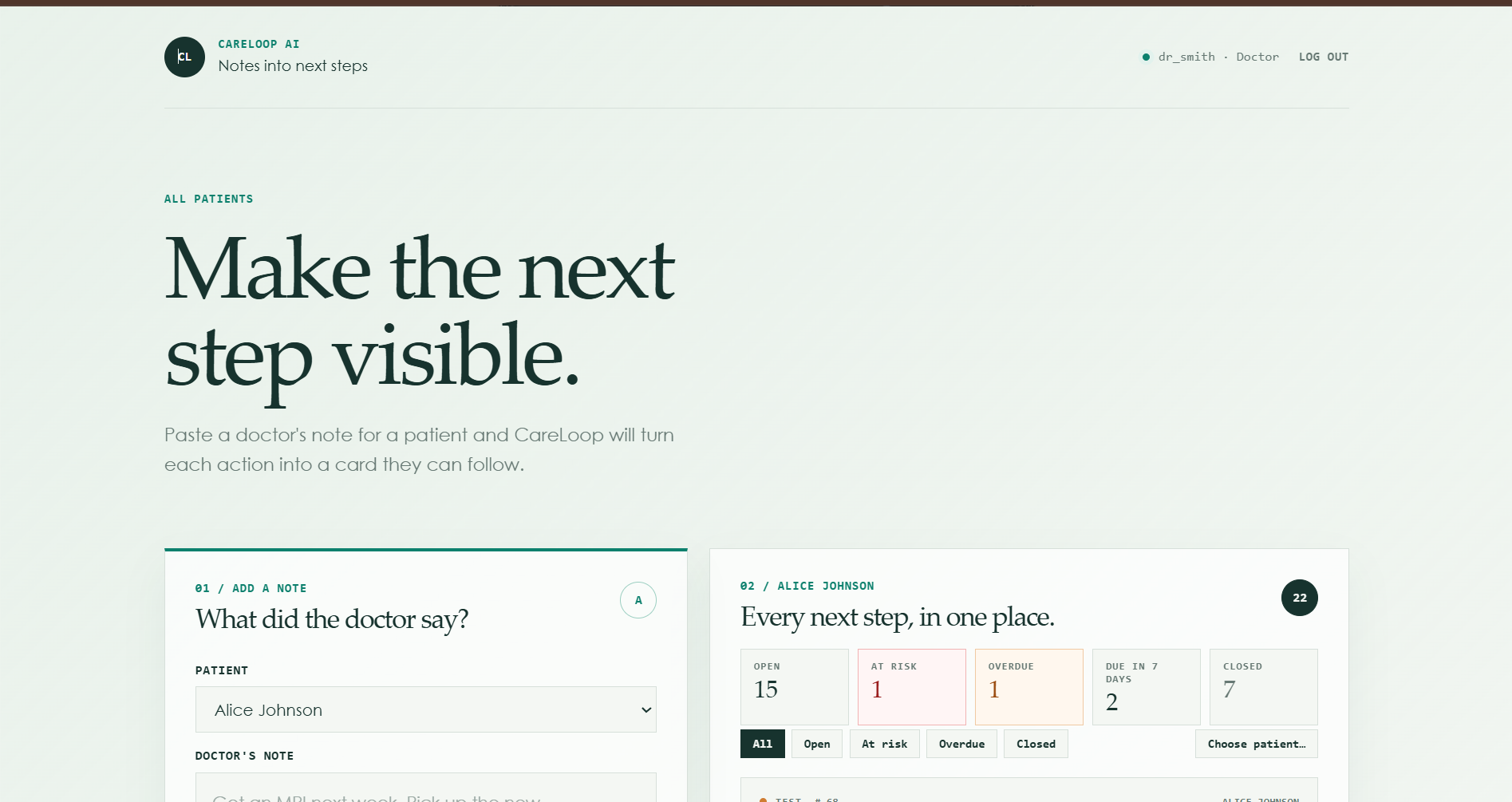
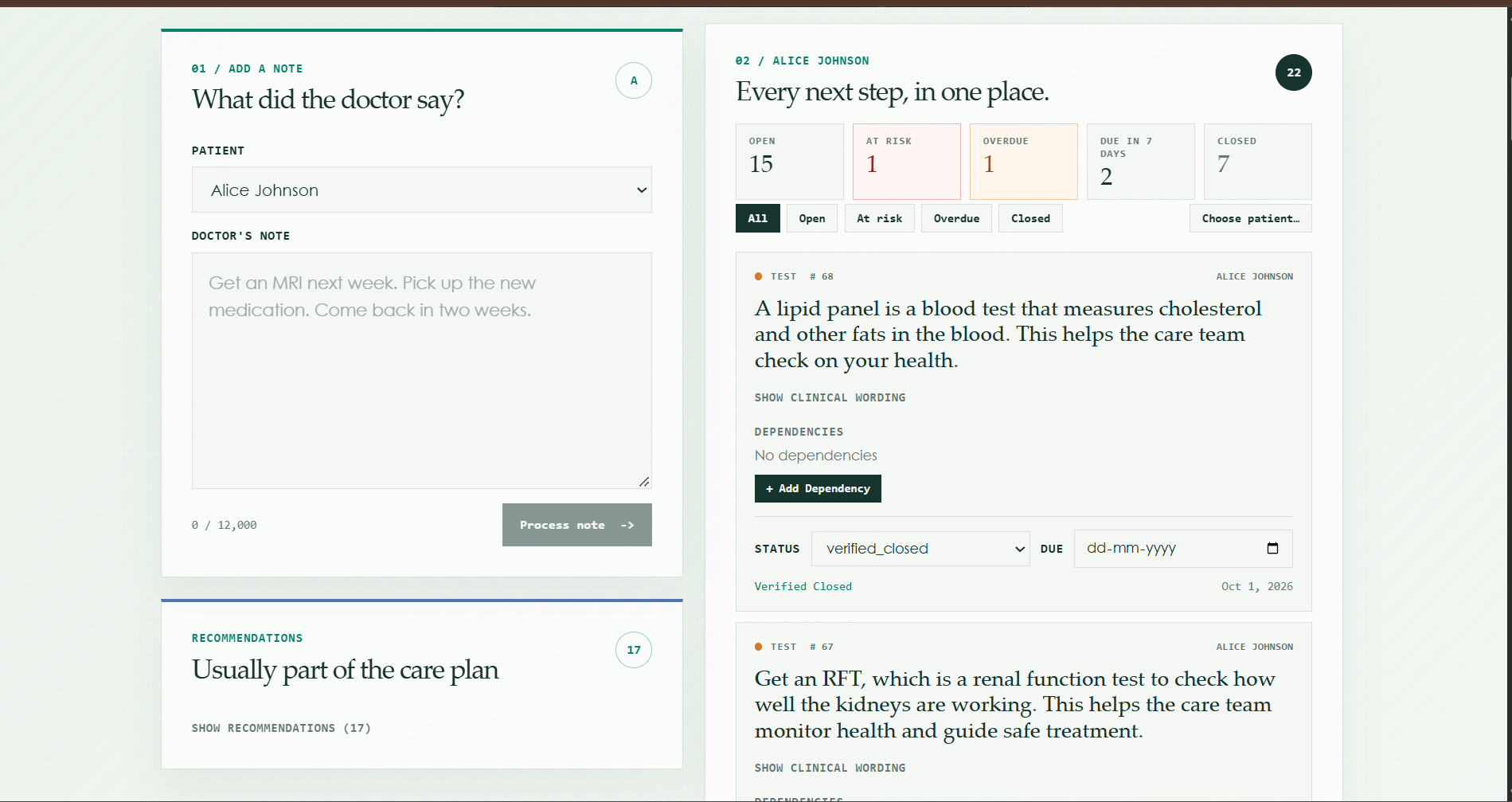
- Intake. A clinician submits a free-text note (up to 12,000 characters)
through the React frontend, or via
POST /api/notes/process. - Extraction. A Gemini tool-calling agent reads the note and calls a
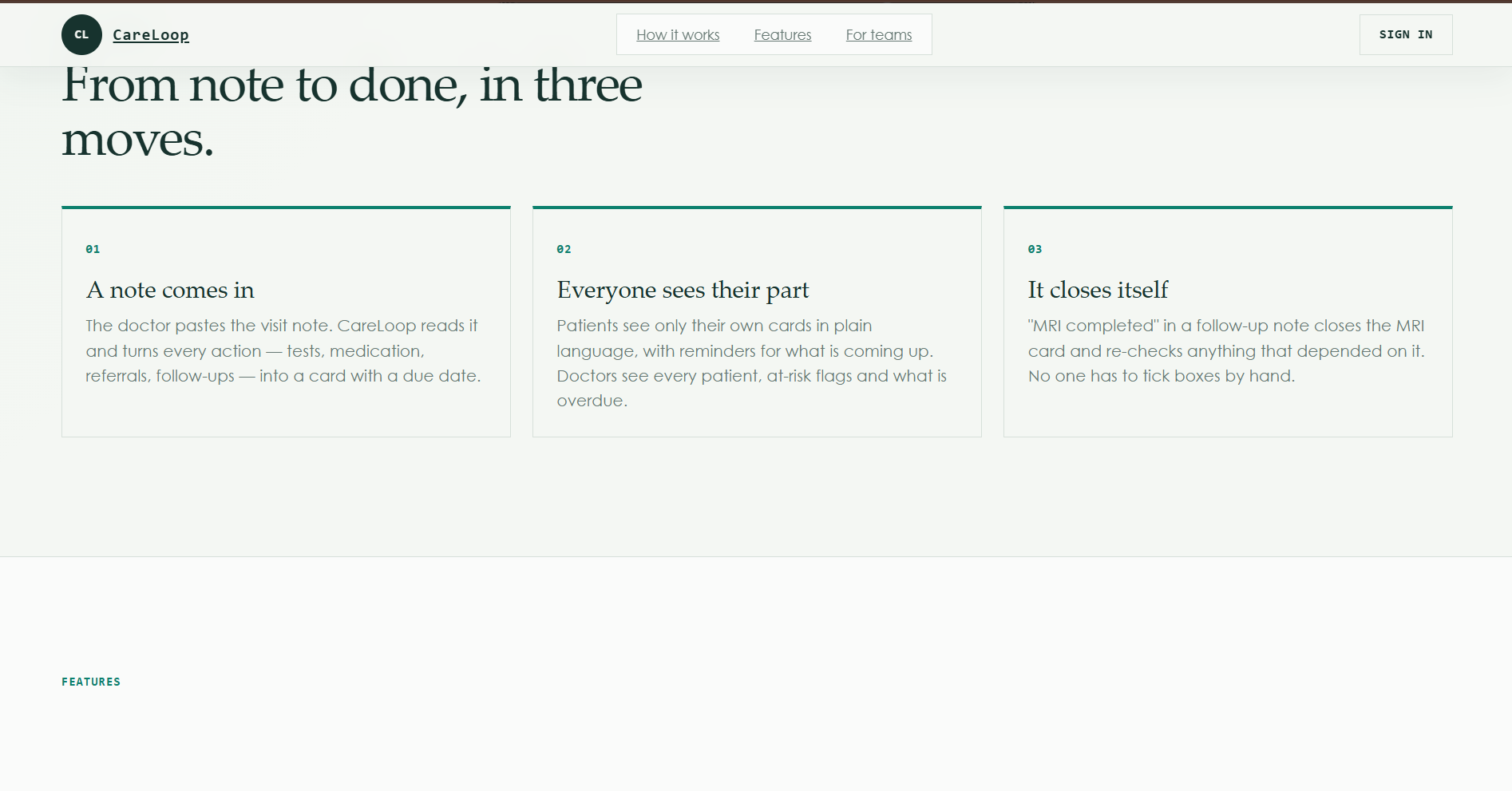
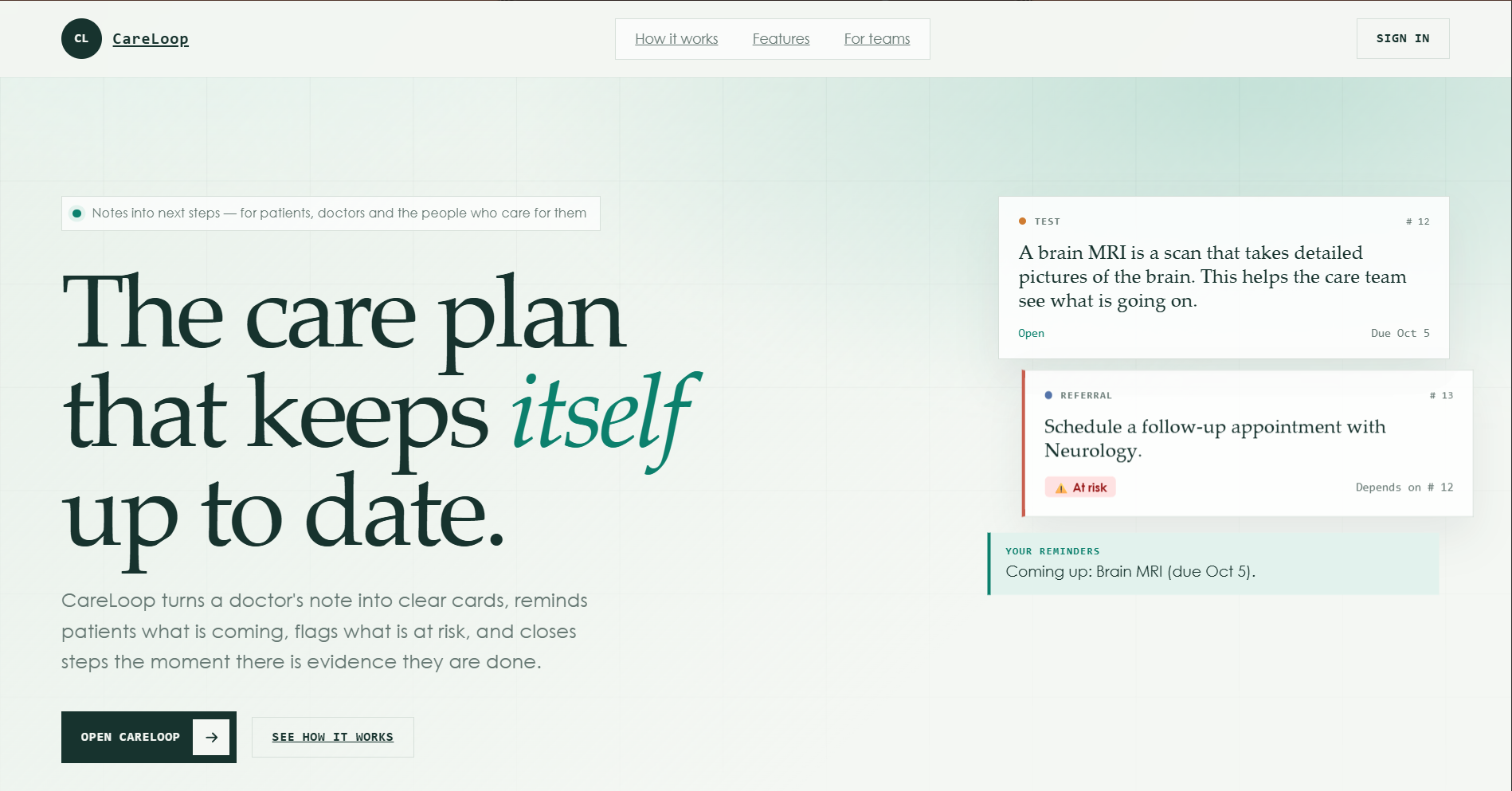
save_cardtool once per actionable item. The agent does not free-form an answer we then have to parse; it emits structured tool calls that map directly onto rows. Each card is typed asmedication,test,referral,next_visit, orgeneral_task, and startsopen. - Interpretation. The backend matches the note's content against a care-gap checklist and proposes anything the clinician likely intended but omitted, and it links cards into a dependency graph so blockers become visible.
- Agency. An MCP server exposes the plan as typed tools so any MCP-capable assistant can read and act on it.
Making the plan self-healing
Three mechanisms make the plan more than a static table.
Care-gap checks. We encoded guidance for 28 conditions — heart failure, type 2 diabetes, COPD, chronic kidney disease, pregnancy, post-operative care, and more — each into a checklist of 5–10 expected items. For a diagnosis $d$ with expected item set $E_d$ and present plan items $P$, coverage is simply
$$ C_d = \frac{\lvert E_d \cap P\rvert}{\lvert E_d\rvert}, \qquad C_d \in [0, 1] $$
and the plan's overall completeness across the diagnoses $D$ present in the note is the mean
$$ \bar{C} = \frac{1}{\lvert D\rvert} \sum_{d \in D} C_d . $$
Anything with a low per-diagnosis $C_d$ becomes a suggestion, never an automatic order: the doctor clicks Add as card or Dismiss. The regression is deliberate — a guideline is a prompt, not a prescription.
Risk propagation. Cards form a directed dependency graph. If card $j$ depends on card $i$, then as long as the upstream card is unresolved the downstream card is not truly "open" — it is blocked. We encode that as
$$ \text{state}(j) = \begin{cases} \texttt{at_risk} & \text{if } \exists\, i \in \mathrm{deps}(j) \text{ with } \text{state}(i) \neq \texttt{closed} \ \texttt{open} & \text{otherwise.} \end{cases} $$
In the demo, a neurology follow-up sits at_risk because it is waiting on the MRI
result first. The blocker is visible, instead of silently overdue.
Auto-closure. When a follow-up note arrives — for example, "MRI completed" —
the system matches it to the open card, closes it as verified_closed with the
supporting evidence attached, and re-evaluates the dependency graph so the
downstream at_risk flag clears on its own. This is what we mean by closing the
loop: the plan heals itself as reality catches up, and completion is recorded
with provenance rather than assumed.
Anything still due within the reminder window (REMINDER_DAYS, default 3) raises
a reminder, so the plan also knows what is about to go wrong.
Handing the plan to agents — safely
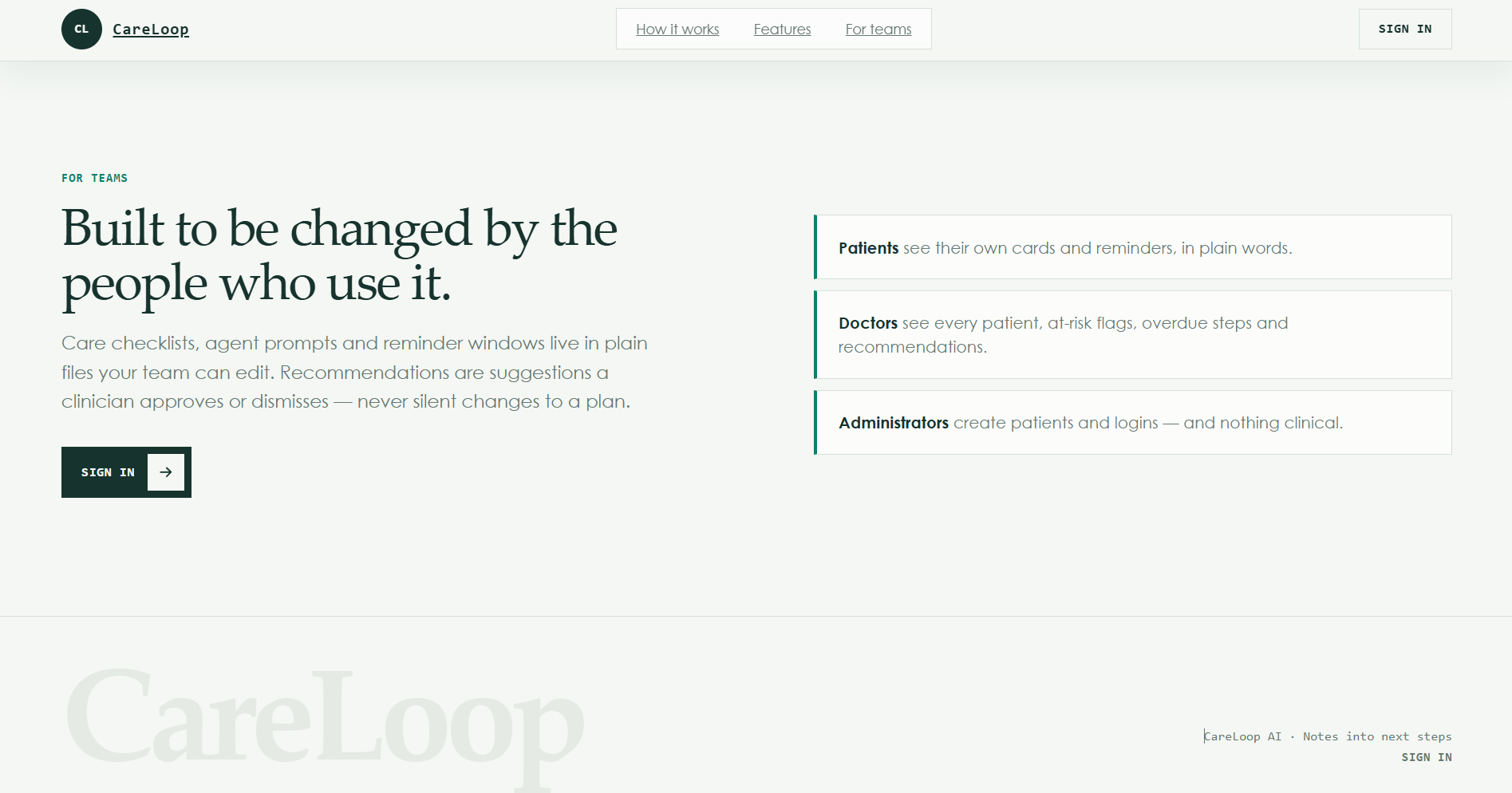
The most deliberate architectural decision was making the MCP server a pure REST client. It holds no database credentials, opens no connection pool, and imports nothing from the backend application. It only ever speaks HTTP to the FastAPI layer, through a small typed tool surface:
careloop_list_patients, careloop_list_cards, careloop_get_card,
careloop_close_card, careloop_flag_card_risk, careloop_list_notes.
That constraint is a feature. An AI agent gets a narrow, auditable, permissioned surface instead of raw SQL, and the backend remains the single place where clinical rules and authorization live. We proved the loop end to end twice: the Gemini MCP client ran seven autonomous tool calls — reading the plan, closing the upstream MRI card with evidence, and watching the dependent risk flag clear.
A second signal: message triage
We also built an urgency watcher. It polls a folder of incoming patient
messages, classifies each one's urgency with the laya router, and stores the
verdict in Postgres. Each message $x$ is routed to the most probable class
$$ \hat{u} = \arg\max_{u \in {\texttt{urgent},\, \texttt{medium},\, \texttt{not_urgent}}} P(u \mid x), $$
and both the decision and its confidence are persisted, so a care team can triage incoming messages by urgency rather than by arrival order. Confidence and the routed model are stored alongside the label, because a triage system that cannot explain itself will not be trusted.
Stack
- Backend: Python, FastAPI, Pydantic,
asyncpg; a Gemini tool-calling agent (default modelgemini-3.8-flash). - Frontend: React 19, TypeScript, Vite.
- Database: PostgreSQL via Docker Compose.
- Agent layer: an HTTP MCP server (pure REST client,
httpx), a Gemini MCP demo client, and a dependency-free MCP demo client. - Triage: the
layarouter for message urgency. - Testing: a
pytestsuite around the Gemini MCP client (5 passing).
What we learned
1. Tool calling beats parsing. The single biggest quality jump came from making the LLM emit structured tool calls instead of prose we then parse. The model's job shrinks to a well-typed function call, and the failure modes shrink with it. Agent reliability is largely a schema-design problem.
2. The hard part of agentic systems is the permission boundary, not the model. The moment we stopped thinking of the agent as "the thing that does the work" and started thinking of it as "the thing that calls a narrow tool surface," the design got simpler and far more defensible. A pure-REST MCP server with no database credentials is a security posture, and it happened to be easier to build, too.
3. State machines are the hidden architecture. open, at_risk,
verified_closed, done — most of the product's intelligence is just a careful
set of legal transitions over a dependency graph. Modeling the graph explicitly
is what let risk propagate instead of merely being stored.
4. Clinical software must be a suggestion engine, not an autopilot. The care-gap checklist was most useful when it proposed and the clinician disposed. We deliberately kept humans in the loop, and that made the tool feel trustworthy rather than threatening.
5. Reproducibility is a feature of the pitch. Getting every service to start in one documented order — database, backend, frontend, MCP server — with a written command reference, mattered as much to a demo as the model quality did.
The challenges we faced
Structured extraction from messy prose. Real notes mix abbreviations,
hedges, and implicit intent ("recheck A1c in 3 months" is a test and a
follow-up). We iterated on the tool schema and the note-to-card prompt until the
agent's tool calls mapped cleanly onto typed cards, then added the care-gap layer
to catch what extraction alone missed.
Making dependencies visible without over-flagging. Early risk propagation was
too eager — everything downstream lit up. We tuned the rule to flag a dependent
card only when its upstream prerequisite is genuinely unresolved, so at_risk
stays a meaningful signal rather than noise.
Closing the loop with evidence. Auto-closing on a follow-up note is only safe
if the match is defensible. We required a closure to record the evidence that
justified it, and we kept verified_closed distinct from done so an automatic
match never masquerades as a human's confirmation.
A narrow, credential-free agent surface. It would have been faster to let the MCP server talk to Postgres directly. Refusing that shortcut forced us to design a typed REST surface, handle auth propagation, and accept the real limitations that come with it (no get-by-id for every object, no free-form risk reason in the response). The constraint made the system both safer and easier to reason about.
Infrastructure friction. A TLS-inspecting proxy on the machine meant every managed Python command needed system certificates, and CPU-only PyTorch had to be pinned to avoid pulling gigabytes of CUDA libraries with no GPU to use them. We lost real time to this and eventually documented it, which is why the project ships a single command reference that just works.
What's next
Closer integration between the urgency watcher and the care plan (triage a message, then open a card directly from it), a first-class closure-evidence field in the API, and richer dependency types beyond simple prerequisites — so the plan can model "this drug before that procedure" as naturally as it models "this result before that referral."
Built With
- ai
- fastapi
- gemini
- langgraph
- laya
- mcp
- ml
- postgresql
- react

