-
-
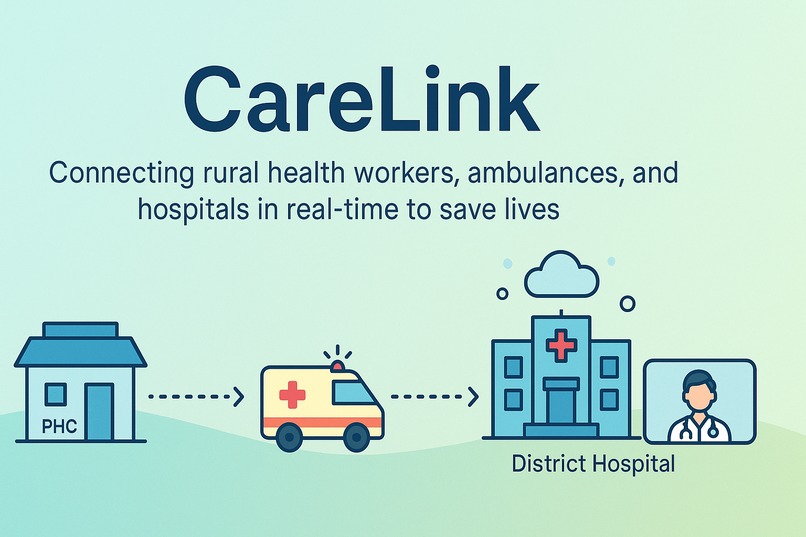
Connecting rural health workers, ambulances, and hospitals in real time to save lives

CareLink – The Rural Health Network Platform
Hackathon Project Story
Inspiration While volunteering in rural clinics, our team noticed a harsh reality: patients needing urgent care often faced hours-long delays just to reach a hospital. Ambulances were scarce, communication was slow, and doctors were overwhelmed. We realized that technology could bridge this gap, but only if it worked offline, was super simple, and suited low-resource environments. That’s when the idea of CareLink was born — a lifeline connecting villages to hospitals in real time.
What It Does CareLink transforms rural healthcare by: Digitally referring patients: Health workers submit patient info, symptoms, and vitals online — the nearest hospital gets instant alerts. Coordinating ambulances: Real-time GPS tracking and automatic ETA updates remove uncertainty during emergencies. Teleconsulting with doctors: PHC staff can consult district hospital doctors via video, avoiding unnecessary transfers. Monitoring health trends: A dashboard aggregates patient data to help government agencies and NGOs plan resources effectively. Working offline: Syncs via SMS and caches data, so even low-network villages stay connected. In short, CareLink doesn’t just speed up referrals — it saves lives.
How We Built It We embraced a lightweight, scalable stack to ensure usability in low-resource areas: Frontend: React.js for web + Flutter for mobile — clean UI for all users, even non-tech-savvy health workers. Backend: Node.js with Express for fast, real-time communication. Database: Firebase + MongoDB to store patient and ambulance data efficiently. APIs: Google Maps for ambulance tracking, Twilio/WebRTC for teleconsultation, and government health APIs for validation. Auth: Role-based Firebase Auth ensures secure access for health workers, hospitals, and admins.
We also implemented offline-first functionality, using local caching and SMS sync, so CareLink works even in areas with patchy network coverage.
Challenges We Ran Into Low connectivity zones: We had to rethink the entire system to work offline and sync automatically when the network is back. User adoption: Health workers were used to paper forms. Making a minimalist, intuitive interface was crucial. Real-time ambulance tracking: Integrating GPS with low-end devices and ensuring updates were accurate was technically tricky. Data privacy: Patient health data is sensitive, so we built role-based access controls and encrypted all data.
Every challenge forced us to think creatively and keep the rural context at the center of our design.
Accomplishments We’re Proud Of Developed a fully functional demo in 48 hours that could handle live referrals and ambulance tracking. Implemented offline-first functionality, ensuring it’s truly usable in remote areas. Designed a simple UI loved by even non-tech-savvy users during our testing. Demonstrated real-time teleconsultation, showing how a doctor miles away can save a life. Our project was recognized as “Most Impactful Solution” by the hackathon jury, emphasizing real-world utility over flashy features.
What We Learned Technology in rural healthcare isn’t about flashy features — it’s about practicality, reliability, and empathy. Building for low-resource environments requires thinking offline first and keeping things extremely simple. Real-world problem-solving often involves iterating quickly under constraints, just like in the hackathon. Collaboration across design, development, and domain knowledge is essential — we learned how to translate healthcare needs into code.
What’s Next for CareLink Pilot programs: Deploy CareLink in select villages to test scalability and impact. AI triage: Integrate symptom analysis to suggest hospital priority automatically. Predictive ambulance routing: Optimize routes using live traffic and road conditions. Government integration: Work with health authorities for broader adoption, aligning with the Ayushman Bharat Digital Mission. Community feedback loops: Make the app adaptive to local dialects, practices, and challenges.
CareLink isn’t just a hackathon project — it’s a movement to digitally empower rural healthcare, saving lives one referral at a time.
Built With
- css
- dart
- express.js
- firebase
- firebasecloudfunctions
- firebasehosting
- flutter
- full-stackdevelopment
- google-maps
- governmensthealthapis
- gpsandambulancetracking
- html
- javascript
- mongodb
- node.js
- offline-firstapps
- react.js
- real-timesystems
- role-basedsuthentication
- twilio
- webrtc

Log in or sign up for Devpost to join the conversation.