-
-

Icon
-
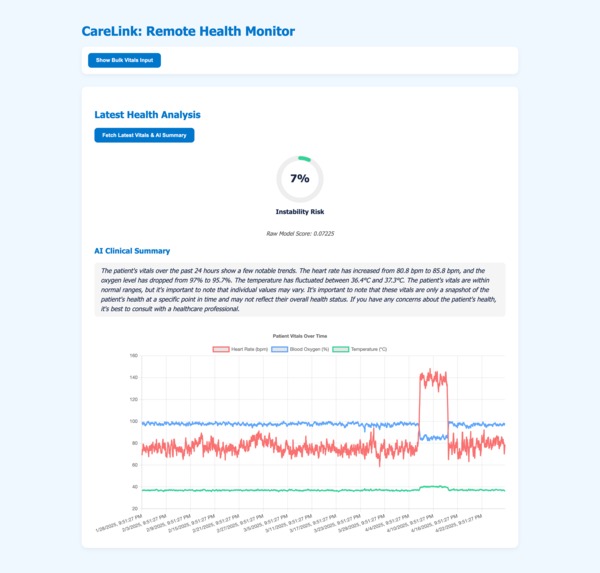
App view

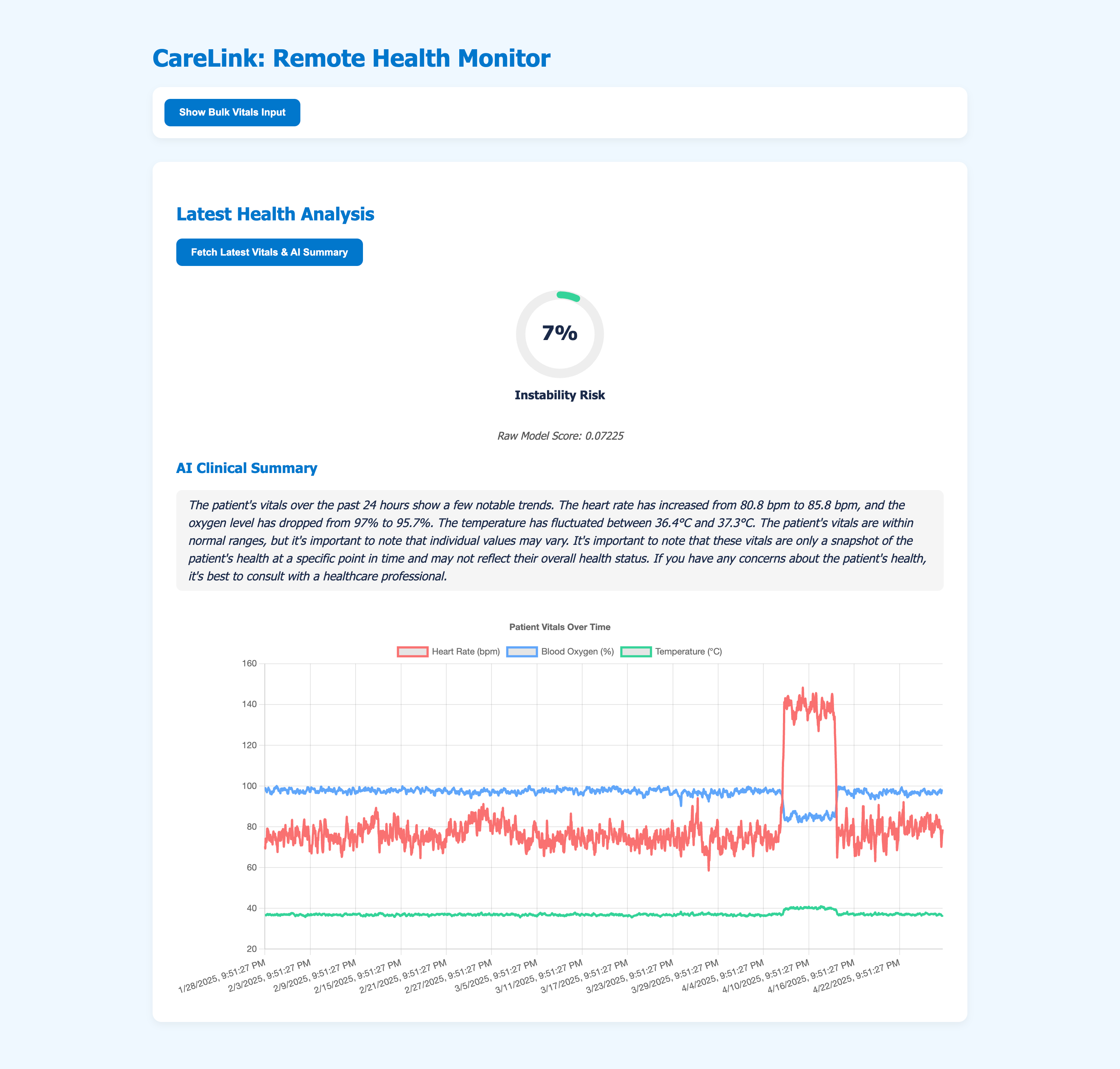
About the Project
✨ Inspiration
We were inspired to build CareLink to address a real-world healthcare challenge:
How can we support remote patients — especially in underserved or isolated areas — without requiring expensive infrastructure, hospital networks, or constant monitoring staff?
We envisioned a lightweight, scalable healthcare monitoring system that could:
- Collect patient vital signs with simple edge devices
- Analyze trends intelligently using AI
- Instantly alert caregivers to potential instability
- Stay affordable, fast, and secure through serverless cloud technologies
🛠️ How We Built It
CareLink collects heart rate, blood oxygen, and temperature readings. It uses:
- AWS IoT Core for secure, real-time transmission of patient vitals.
- AWS Lambda to process and route data instantly without managing servers.
- Amazon DynamoDB to store incoming vital signs over time.
- Amazon SageMaker to predict patient instability risk based on recent vitals.
- Amazon Bedrock (Titan Text G1 Lite) to summarize 3 months of patient history into a clear, clinical-style report.
- Amazon Bedrock (Nova Sonic) to have a human like conversation about the data with an Ai Agent in order to give the user a better more easy to understand experience.
- Amazon SNS to send real-time alerts when dangerous conditions are detected.
- API Gateway and a React.js + Vite frontend to allow caregivers to publish and view AI assessments in real time.
🔄 Why We Pivoted Our Machine Learning Approach
Originally, we planned to predict patient instability based on only the latest single reading (heart rate, blood oxygen, temperature).
However, during testing, we realized:
- One-off readings are too noisy and often misleading in clinical practice.
- Real clinicians always assess trends, not single datapoints.
Our Pivot:
- We pivoted to use the latest 24 hours of vitals for each patient (one reading per hour).
- We collapsed 24 hours of data into one row by serializing them as long feature vectors for SageMaker.
- Example:
Instead of 3 features, our model input became 72 features (24 readings × 3 vitals).
This gave the model "fake memory" — the ability to see and learn trends without needing complex RNN or LSTM architectures.
✅ Much better real-world performance.
✅ Still compatible with SageMaker's managed XGBoost — no heavy PyTorch/TensorFlow deployments needed.
🚧 Challenges We Faced
1. SageMaker Endpoint Design
Latency:
Realized that for rapid API-driven apps, complex large models were too slow.
XGBoost stayed fast (~<500ms per inference).Input Limits:
Had to serialize the 24 hours' worth of vitals carefully to stay under payload size limits.Deployment Region Constraints:
Had to split the architecture (SageMaker/Bedrock inus-east-1, Lambda ineu-north-1) and manage cross-region communication.
2. Clinical Weighting of Vitals
In real life, not all vital sign abnormalities are equally dangerous.
So we engineered clinical weighting logic when building the training dataset:
| Vital Sign | Condition | Weight | Reason |
|---|---|---|---|
| Heart Rate High | HR > 120 bpm | 0.4 | Often compensatory, less critical |
| Heart Rate Low | HR < 50 bpm | 0.5 | Bradycardia can cause fainting, cardiac arrest |
| Blood Oxygen Low | BO < 90% | 0.9 | Hypoxia demands immediate intervention |
| Temperature High | Temp > 39°C | 0.6 | High fever suggests severe infection |
| Temperature Low | Temp < 35°C | 0.8 | Hypothermia is extremely dangerous |
This clinical feature engineering made the model much safer and more realistic.
3. Bedrock Summarization Anchoring
Early on, Bedrock AI sometimes produced summaries that were too optimistic or speculative.
We fixed this by:
- Anchoring Bedrock prompts to the SageMaker risk score.
- Asking for factual reporting based only on the data provided.
4. Data Serialization and Frontend Cleanliness
- DynamoDB JSON storage needed careful serialization (e.g.,
Decimalhandling). - We spent time ensuring the React frontend was:
- Clinically styled (clear fonts, readable graphs)
- Fast and mobile-friendly
- Directly showing both raw AI outputs and readable summaries
🧠 What We Learned
- How to pivot fast when clinical realism shows flaws in early plans.
- How to extend simpler ML models (like XGBoost) with clever data design instead of adding infrastructure burden.
- How to combine SageMaker + Bedrock safely for real-world healthcare apps.
- How AWS serverless tools (IoT Core, Lambda, DynamoDB) enable real-time pipelines without scaling headaches.
📈 Final Solution Architecture
  Device/Simulator
       |
  [ MQTT Publish ]
       |
       v
  AWS IoT Core (carelink/vitals)
       |
  IoT Rule
       |
       v
  AWS Lambda (CareLinkVitalsProcessor)
  - Save raw vitals to DynamoDB
  - Send SNS alerts if critical
       |
       v
  AWS DynamoDB (carelink_alerts)

  (Separately)

  Frontend Dashboard
       |
  ➔ Lambda (Fetch vitals)
       |
  ➔ SageMaker (Predict risk on 24hr window)
       |
  ➔ Bedrock (Summarize last 24hrs of vitals)
       |
  ➔ Bedrock (Nova Sonic) (Have a human like conversation about the data with an Ai Agent)
       |
  ➔ React Frontend (Displays AI results beautifully with latest 3 months of data in a chart)
Built With
- amazon-web-services
- axios
- bedrock
- css3
- html5
- iot
- javascript
- jupyternotebook
- lambda
- python
- react
- sagemaker
- sns
- vite



Log in or sign up for Devpost to join the conversation.