Inspiration
CareLens was inspired by a period in my life when I was balancing multiple responsibilities at once, taking care of my sister while also completing an internship. By the end of each day, I often felt mentally and emotionally drained. I didn’t necessarily need advice or solutions; I just wanted someone to listen without judgment. In those moments, there wasn’t always someone available to talk to, and I realized how many people experience the same quiet overwhelm. That gap, between needing to be heard and not wanting to burden others, became the foundation of CareLens. The project was designed to be a calm, supportive space for reflection. CareLens listens, helps users gently make sense of their day, and mirrors patterns over time without offering diagnoses or clinical advice. It exists for anyone who needs a moment of understanding, simply to feel heard.
What it does
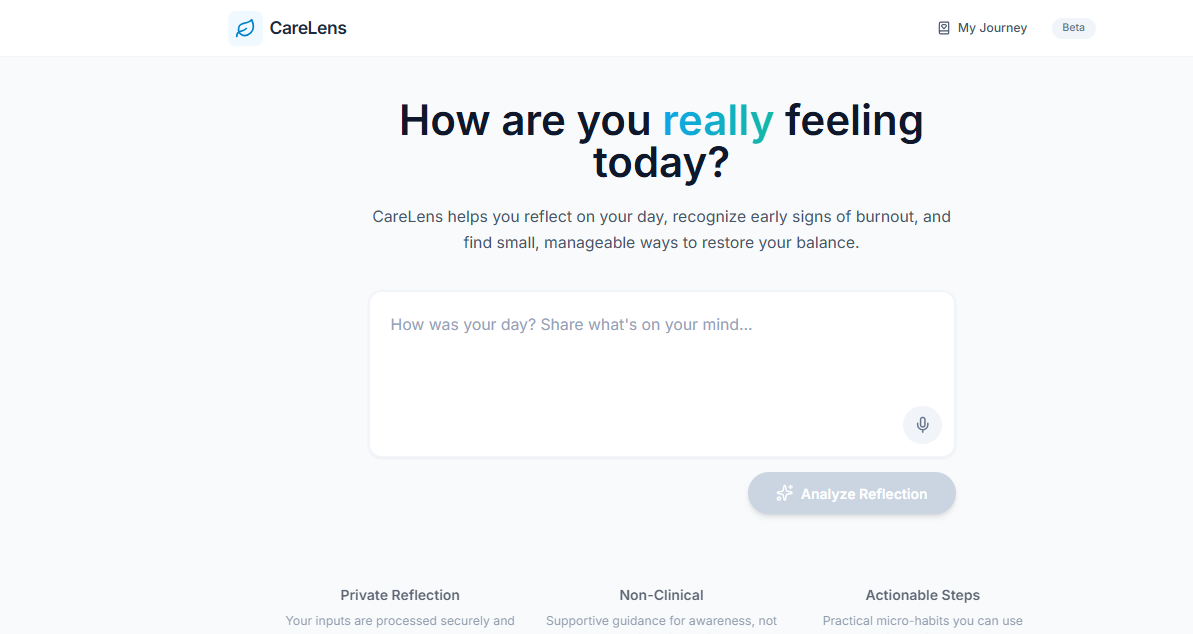
CareLens is a quiet, non-judgmental listening space. It allows users to share their thoughts and feelings about their day freely, without being advised, corrected, or analyzed. CareLens simply listens and reflects back the essence of what the user has shared, helping them feel heard, understood, and emotionally lighter through calm self-reflection.
How we built it
CareLens was built using Google AI Studio with the Gemini API, focusing on intentional prompt orchestration rather than simple question-answering. At the core of the system is a carefully designed system prompt that constrains the model’s behaviour. Instead of giving advice or solutions, the model is instructed to listen, acknowledge emotions, and reflect the user’s day back to them in a calm, non-judgmental way. This ensures CareLens acts as a reflective listener rather than a generic chatbot. The application maintains structured conversation context, allowing it to respond naturally without repeating user input, while keeping each reflection grounded in the current interaction. Special care was taken to control tone, verbosity, and repetition especially across different devices so that responses remain consistent whether accessed on mobile or desktop. The frontend provides a minimal, distraction-free interface where users can safely express their thoughts, while the backend handles prompt orchestration and response filtering to preserve the app’s core principle: listening without judgment. CareLens was deployed as a web application to make it easily accessible, with design decisions centred around emotional safety, simplicity, and intentional AI behaviour.
Challenges we ran into
Voice Input Repetition on Mobile Mobile browsers sometimes produced repeated or overlapping speech transcripts, causing the AI to echo phrases multiple times. We mitigated this by instructing the model to normalize repeated words and focus on the final coherent sentence, though some minor artifacts may still appear on certain devices.
Maintaining a Human-Centered Focus It was important that CareLens listen without giving advice or medical opinions. Balancing technical prompt constraints with empathetic reflection required multiple iterations to ensure responses felt supportive and non-judgmental.
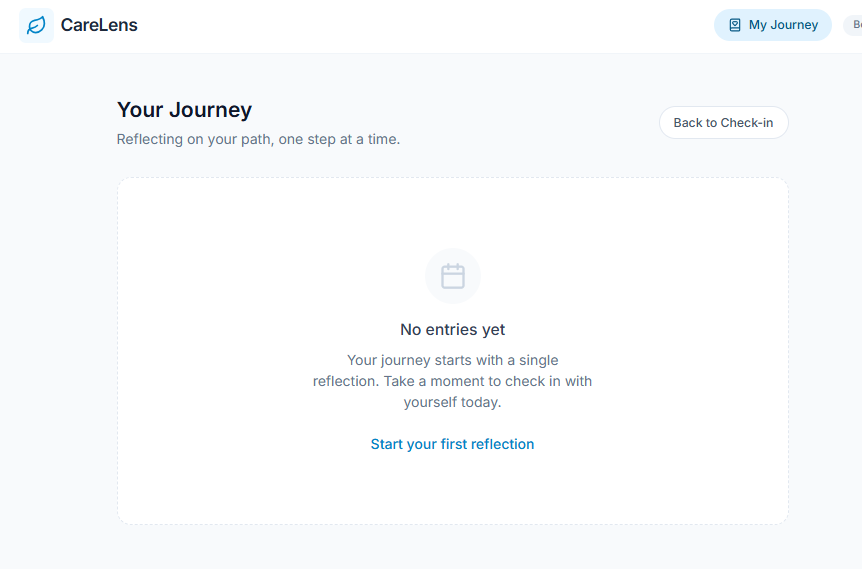
Context and History Management Users’ reflections needed to be remembered over time for meaningful feedback. Structuring the conversation history and ensuring temporal awareness without overwhelming the user posed a challenge. We addressed this by summarizing past entries and reflecting trends rather than showing raw logs.
Accomplishments that we're proud of
I'm proud that CareLens is a fully functional reflection system that genuinely helps users process their day. In testing, it has already provided a meaningful way to get things off one’s chest, notice emotional patterns over time, and feel supported without judgment or advice. Personally, using the app even a few times has made a noticeable difference , during busy or stressful days, it offers a quiet, safe space to reflect, which is exactly the kind of support it was designed to provide. Beyond just working technically, the app demonstrates thoughtful orchestration of Gemini 3’s capabilities in a human-centered, emotionally aware design.
What we learned
Building CareLens taught me the importance of balancing technical capabilities with human-centred design. I learned that creating an AI system that listens without judgment requires careful prompt engineering, context management, and thoughtful handling of user input, especially when dealing with noisy mobile voice data.
I also learned that even simple design choices, like a distraction-free interface and a clear reflection history, can have a big impact on how comfortable users feel sharing their thoughts. On a personal level, this project reinforced how much small, supportive interactions can matter in daily life, and how AI can be used not just to provide answers, but to create spaces for reflection, awareness, and emotional support.
What's next for CareLens
Looking ahead, i plan to expand CareLens beyond the web platform and develop a mobile app, making it more accessible for users on the go. I also envision enhancing the reflection history and trend analysis features, allowing users to better visualize patterns in their emotional wellbeing over time. Additional improvements could include lightweight interactive elements, gentle reminders, and further refinement of voice input handling to ensure a smooth, seamless experience across devices. My ultimate goal is to create a portable, supportive companion that helps people reflect, recognize early signs of burnout, and feel seen and heard wherever they are.
Built With
- ai
- artifact
- cloud
- css
- html
- javascript
- json
- run
- studio

Log in or sign up for Devpost to join the conversation.