
Inspiration
I built CareLedger for my grandma.
She and my aunt handle most of the day-to-day work of looking after my grandfather who had a stroke a few years ago. He is doing better now, but he has been in and out of hospital and still needs a lot of help. The rest of the family steps in for appointments and anything else that comes up.
I hope to work in medicine or biomedical engineering, so I wanted to build something connected to healthcare. I considered glucose tracking for people with diabetes, medication reminders and a few other ideas. But I kept coming back to what happened whenever somebody else needed to step in and help my grandfather.
For one of his appointments, my dad cleared his schedule, got ready to pick him up and planned to stay with him at the hospital. When he called to confirm, he found out that the appointment had been moved to another day and would now be with a different doctor. Nobody had told him but everyone thought he knew.
Because it was a different doctor, we had to dig through WhatsApp and piece together what had happened at the previous appointment so whoever went could bring the doctor up to speed. Then we had to find someone available on the new date.
Nothing terrible happened. My dad lost part of his day, someone else had to rearrange their plans, and the family spent time untangling old messages because everyone remembered the last appointment differently. Everyone was trying to help. They just weren’t working from the same information.
What stayed with me was how much work it took for someone else to step in. They needed to know what had happened last time, what had changed, how my grandfather had been feeling and what still needed doing. Much of that lived in my grandmother and aunt’s heads or somewhere in the family WhatsApp. Without it, the next person started from zero.
I built CareLedger so my grandmother could take a break without first giving someone a full briefing. My dad could see that an appointment had moved before clearing his day. Whoever stepped in could open one place and see what happened last time, what needed doing next and who had agreed to do it.
What it does
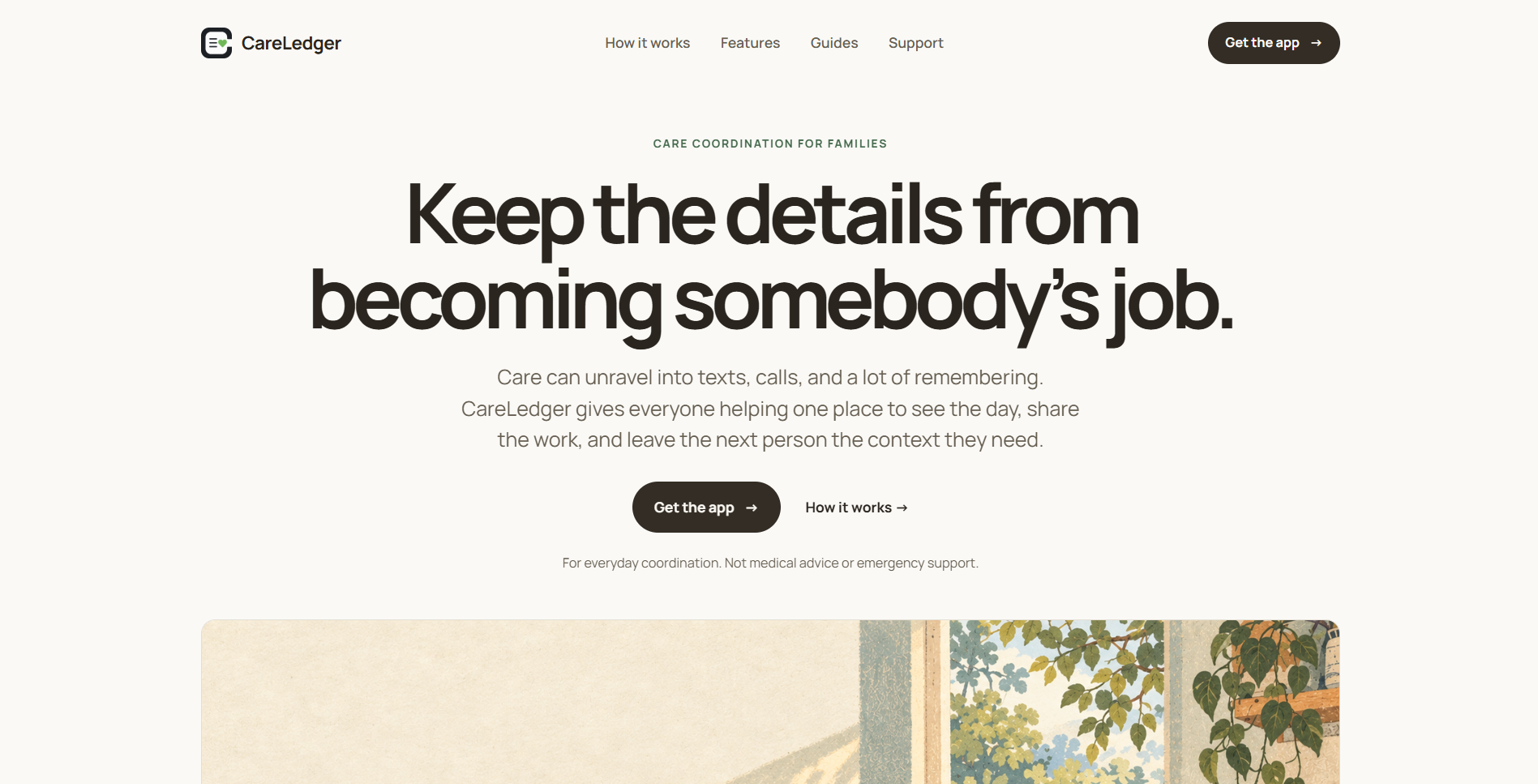
CareLedger is built around a private care circle for the people looking after someone together.
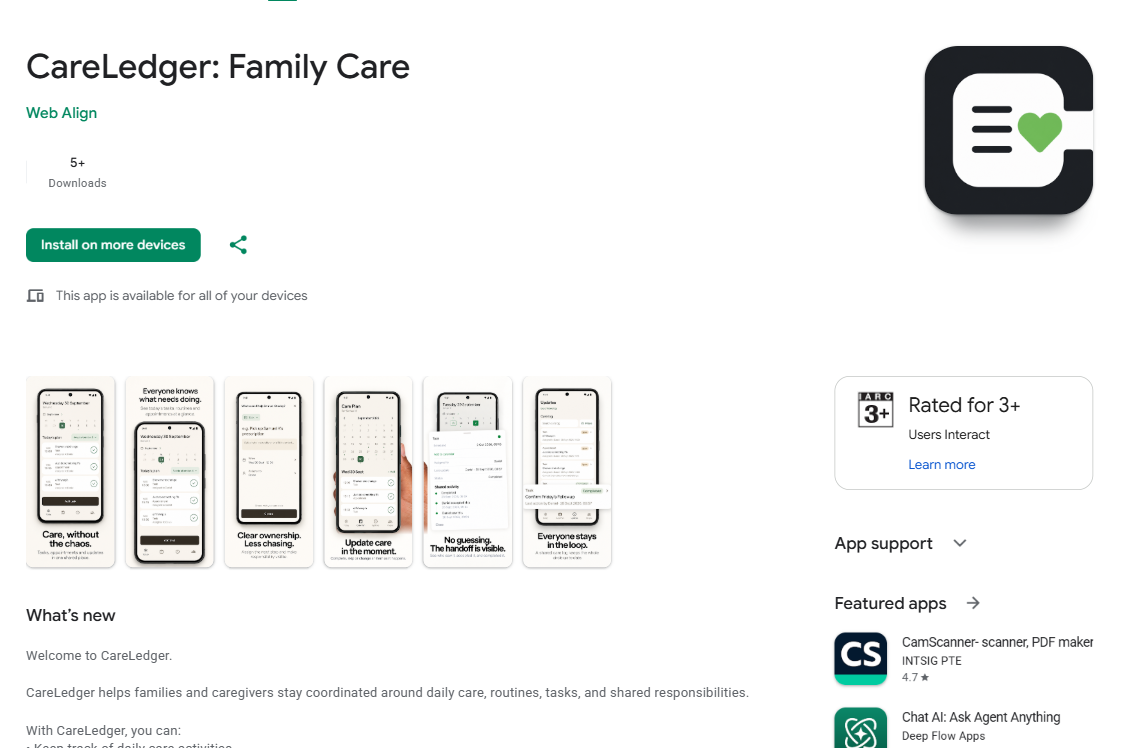
A member can add a task or appointment, include the details someone will need, choose when it should happen and assign it. The assigned person receives a notification. When they open it, CareLedger records that it has been seen and asks them to respond with either “I’ve got it” or “I need help.”
Sending someone an appointment is not the same as them agreeing to handle it. CareLedger keeps those states separate, so the circle can see what still needs attention, what somebody has accepted and what has been completed.
Afterward, the person handling it can record the outcome as done, not done or later. CareLedger keeps the item, the response, what happened and when. If another relative steps in next week, they do not have to call everyone or search through old messages to reconstruct the day.
Supporting features include a Today view, care calendar, phone-calendar integration, shared updates, document notes, searchable history, roles and notification controls. Older items can be archived without losing the history, while the Family plan adds care-log export.
How we built it
Like everyone else building with AI, this was by far my favourite part.
I built CareLedger through Hermes using skills and project instructions I had developed while working on previous apps. Before writing code, I worked through who the product was for, what every screen should do, how the flows connected and what the app should feel like. Those answers became a specification Hermes could keep referring to throughout the build.
I wanted the design to feel clean without looking like another hospital-management app full of clinical blue, dense tables and dashboards. Someone may open CareLedger while tired or already dealing with a stressful day. It needed to feel calm, warm and easy to read. I collected references from Dribbble and Pinterest, then added my preferences for the typography, layout and general feel.
CareLedger is built with React Native and Expo. Supabase handles authentication, the database and shared information between members of a care circle. PostHog handles analytics, while RevenueCat handles subscriptions.
I did not want every family member to need a separate subscription. One person purchases the Family plan, and the benefits apply to the care circle. I also connected scheduled tasks and appointments to the phone’s calendar, so the person handling one can add it to the calendar they already use.
I submitted an early usable version to Google Play instead of waiting for every part to be finished. On a previous app, problems with the paywall stopped me from reaching production properly. I did not want to spend weeks polishing CareLedger only to discover another release problem at the end.
Submitting early started Google Play’s required 14-day testing period and let me test the paywall and release path while I continued improving the calendar, onboarding and other parts of the app.
CareLedger is still a first version. The flow, paid plan and parts of the design will probably change once real families start using it. My development setup makes those changes less expensive, which means I can rebuild what people struggle with instead of defending the version I already made.
Challenges we ran into
My first major challenge was refusing to admit that one of the free models I was using was not capable of doing the job.
I was trying to keep the build cheap, so I experimented with free models through OpenRouter. At one point, I kept sending work to an LFM model with a context window of roughly 65,000 tokens. It struggled to understand the system instructions, the project and the environment it was supposed to work inside.
It could not find the repository properly and eventually tried to download somebody else’s public repository instead of working on CareLedger.
I kept changing the prompts as though I were the problem. Eventually, I got so frustrated that I had to walk away before I did something stupid to the laptop. I came back later, switched to a model that could handle the setup, and the work started moving again.
The more important challenge was finding caregivers willing to try the app.
Before building, I spent time reading caregiver discussions on Reddit. People repeatedly described feeling unsupported, struggling to delegate and having trouble getting reliable help from other family members. That gave me confidence that the problem existed, but speaking directly to those people was harder.
My Reddit posts kept running into moderation problems, and I eventually received a restriction on direct messages even though some people had messaged me first. I also posted on X asking to speak with caregivers. An AI account replied saying it would connect me with one, then never followed through, which felt painfully appropriate for the state of the internet.
The few real responses I received were useful, but I still have not spoken to as many caregivers as I would like. Getting CareLedger into their hands remains one of the main things I need to solve.
Accomplishments that we’re proud of
I am proud that CareLedger made it out of my laptop and onto Google Play as a real product.
Getting the interesting screens working is one thing. Finishing authentication, onboarding, invitations, notifications, subscriptions and the store requirements is less exciting, but it is what turns those screens into an app somebody can use.
A family can create a private circle, invite another person, add and assign something that needs doing, acknowledge responsibility and follow it through to completion. That entire flow works.
I am also happy with the design. I wanted CareLedger to feel warm and calm without losing clarity. It is the first project where I felt comfortable giving an AI system more responsibility for visual implementation without expecting to redo everything afterward.
The speed surprised me. An app like this would previously have taken me around two months. Most of CareLedger’s core functionality came together in roughly two weeks, with the calendar, paywall and release work following afterward.
I am particularly proud of finishing the Shipaton video, even though I did not enjoy making it. I have disliked recording myself since I was a child. This time, I stopped negotiating with myself, turned on the camera, recorded the video, edited it and put my face next to something I had built. That may be normal for other people. It was not normal for me.
CareLedger is also the first product I have shipped that points directly toward the work I hope to do in medicine or biomedical engineering.
What we learned
CareLedger held together because I worked through the product in detail before asking the AI to build it. The specification covered the audience, screens, behaviour, flow and visual direction. That gave the system something stable to return to instead of forcing it to reconstruct the product from whichever prompt I had written most recently.
I also learned to stop treating every AI failure as a prompting problem. Sometimes the model is simply not capable of the work. I wasted hours rewriting instructions for a model that could barely understand the environment. Switching models solved more than another evening of prompt engineering would have.
Speed is useful because it makes changing my mind less expensive. A finished screen can still be the wrong answer. A feature can work exactly as designed and still be annoying in someone’s actual day. If families dislike a flow or ignore half the app, I can replace it rather than protecting it because it took months to build.
Online discussions can tell me that other people recognise the problem. They cannot tell me whether CareLedger fits into somebody’s life. I still need to see what families update, what they forget, what they leave in WhatsApp and whether assigning responsibility feels helpful or like extra administration.
The real test is whether a family will continue using CareLedger after the excitement of trying a new app wears off. That answer can only come from use.
What’s next for CareLedger
The next step is getting CareLedger used by more real families, including my own.
I want to see what people remember to update, what they forget and what still stays in WhatsApp because it is easier. I also need to learn whether assigning someone a task makes responsibility clearer or simply gives the family another thing to maintain.
If families reject the current product, that does not automatically mean the problem is false. It may mean I chose the wrong flow or asked people to do too much. I want to follow what they actually do and rebuild the parts that do not fit.
Family caregiving is the first use case I want to get right. The current pricing, paid plan and paywall are also early tests. I need to learn which parts people genuinely value enough to pay for instead of adding more features and hoping one becomes the reason.
I also want to release CareLedger on the Apple App Store. Many families use a mixture of Android phones and iPhones, and a shared app is not very useful if half the family cannot join.
The next milestone is not another feature. It is a family using CareLedger through an ordinary week and choosing to open it again the next one.
Built With
- expo.io
- hermes
- posthog
- react-native
- supabase

Log in or sign up for Devpost to join the conversation.