-
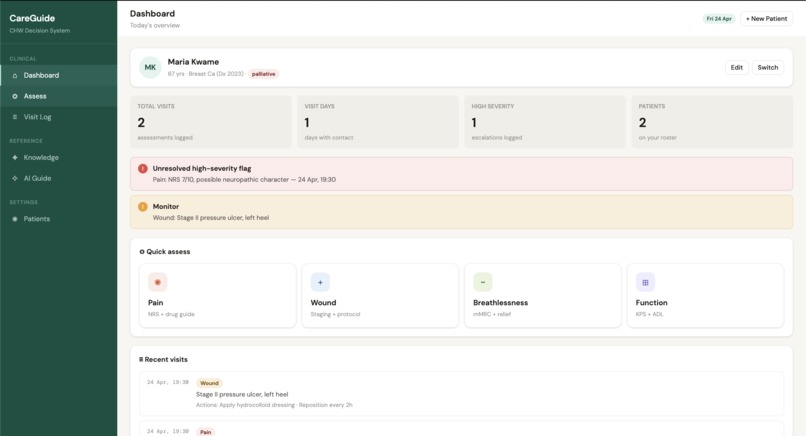
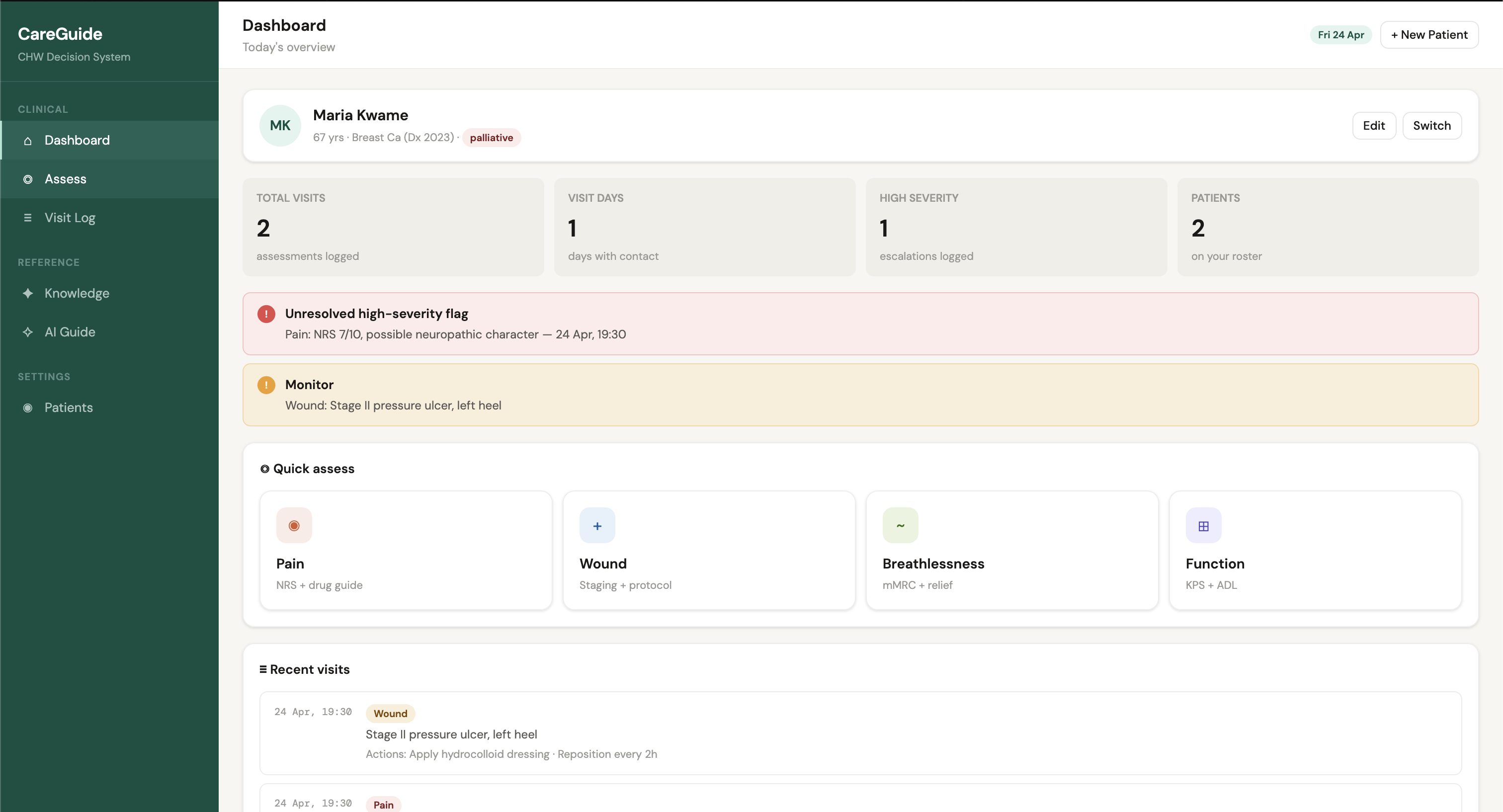
Main page, you can log how your paitent is doing here and this can be used for doctor visits.
-
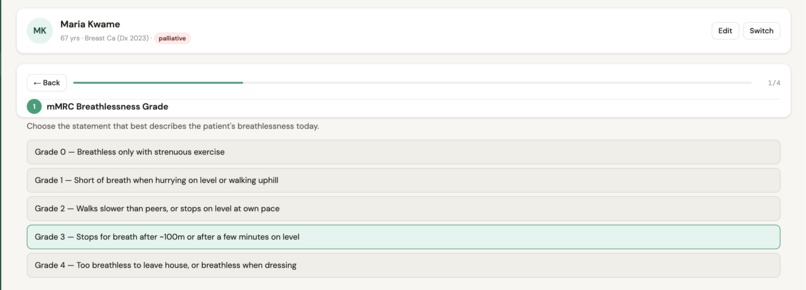
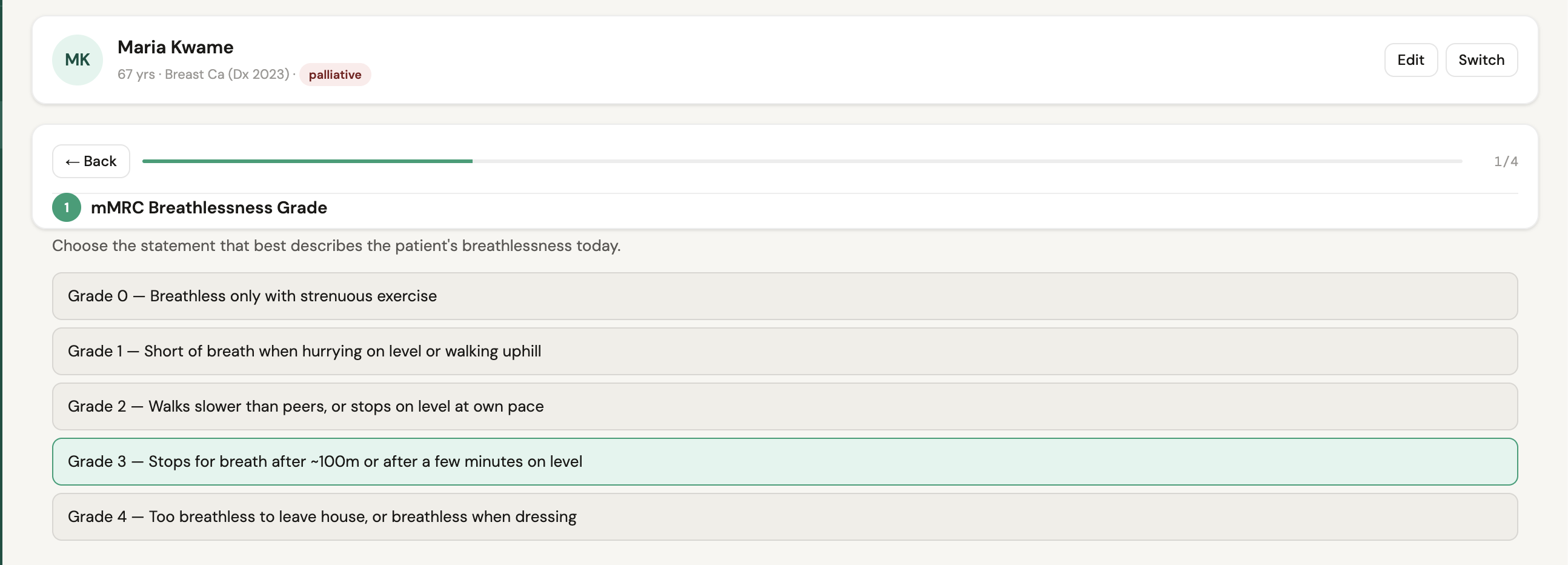
This is how one of the assessments look, with steps describing how it will be.
-
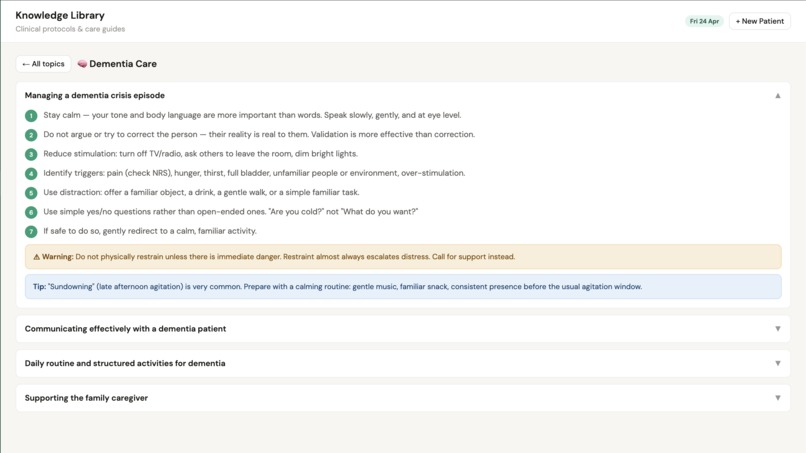
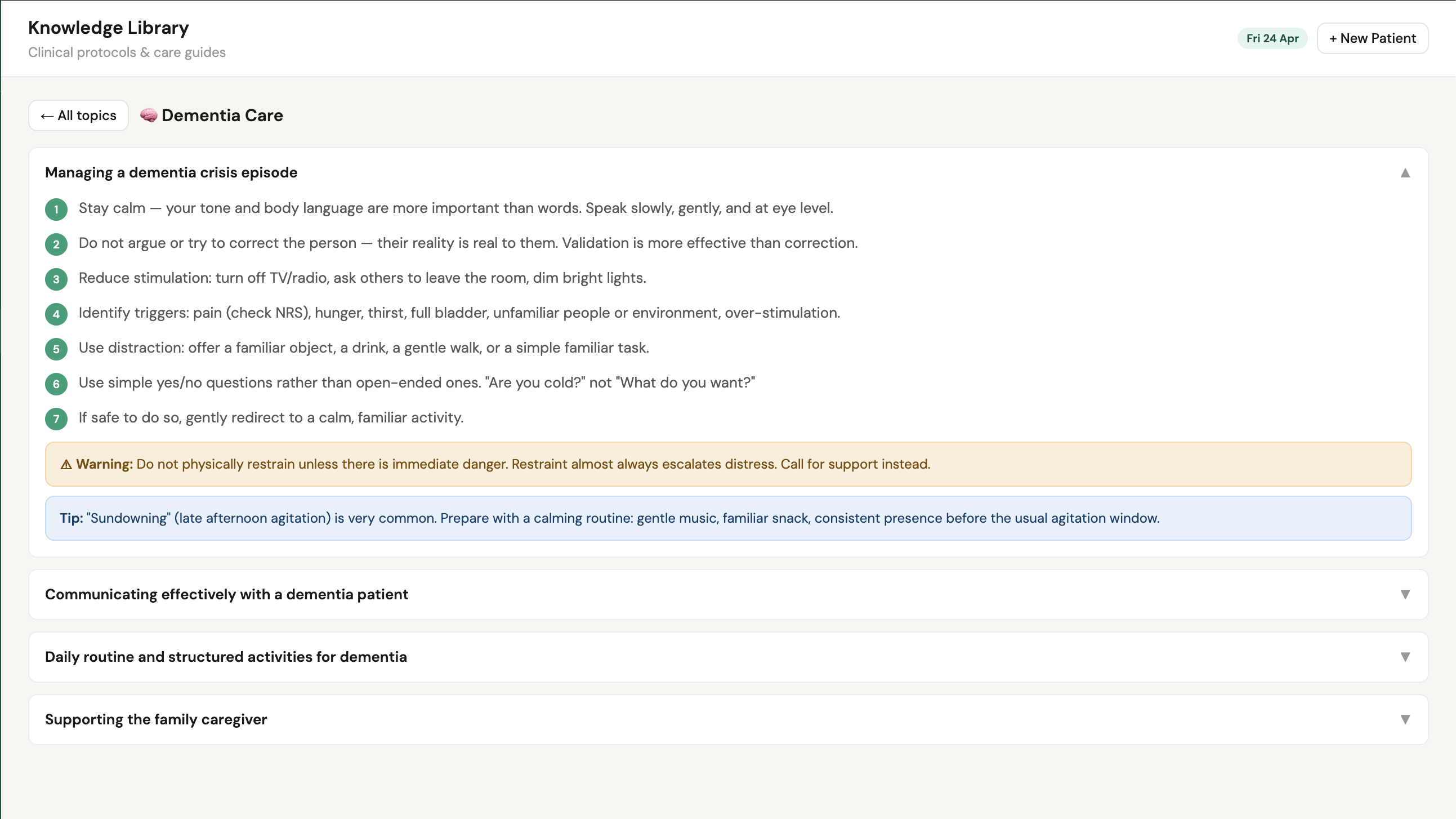
This is how one of the guides will look
Inspiration
The seed for CareGuide was planted during my internship at an old-age home in India as they piloted one of the state's first palliative care programs. I witnessed firsthand that the burden of terminal illness doesn't just rest on the patient—it weighs heavily on the families and caretakers who feel helpless in the face of dementia, mobility issues, and pain. I saw a desperate need for a bridge between complex clinical expertise and the compassionate, everyday care provided at home. I wanted to turn that feeling of helplessness into a sense of agency.
What it does
CareGuide CHW is a fully interactive, offline-first decision support system designed for community health workers (CHWs) and family members. It simplifies complex specialist assessments into four unified clinical modules:
- Pain Management: Uses NRS scoring and the WHO analgesic ladder to detect breakthrough pain and ensure medication adherence.
- Breathlessness: Grades severity via mMRC scales and provides immediate comfort actions like fan therapy or positioning.
- Wound Care: Stages pressure ulcers (NPUAP) and provides protocol-matched dressing guidance with infection alerts.
- Functional Status: Utilizes the Karnofsky scale to trigger Advance Care Plans and daily living support.
How we built it
We developed CareGuide as a robust, full-stack web application designed for low-connectivity environments:
- The Engine: A Node.js and Express backend ensures smooth performance.
- Data Integrity: SQLite manages patient persistence, allowing for detailed visit logs and longitudinal tracking.
- The Frontend: Built with a "Pure HTML/JS" philosophy to ensure the app remains fully functional offline.
- Intelligence: Integrated the Anthropic API to provide a "Knowledge Library" and AI-guided answers for ambiguous cases that fall outside standard protocols.
Challenges we ran into
The biggest hurdle was clinical compression: taking a specialist’s decade of medical training and distilling it into 3–5 sequential steps that a non-clinical worker can execute safely. We had to build strict "Escalation Logic" to ensure that if a patient’s pain hit a 7/10 or if a wound reached Stage III, the app would stop the user and force a referral. Balancing a simple user interface with the life-or-death gravity of palliative care required constant refinement.
Accomplishments that we're proud of
We are incredibly proud of the "Offline-First" architecture. In the rural areas where this care is needed most, the internet is a luxury, not a guarantee. Creating a system that provides "Specialist-level" guidance without needing a constant 5G signal is a major win. Additionally, seeing the "Escalation Cards" function perfectly—moving from green to amber to red—proves that technology can act as a reliable safety net for human caretakers.
What we learned
We learned that in palliative care, action is better than diagnosis. A community health worker doesn't need to know the complex pathophysiology of a disease; they need to know exactly what to do now to make the patient comfortable. We shifted our design from "Clinical Reasoning" to "Executable Tasks," realizing that clarity is the highest form of support we can offer a stressed caretaker.
What's next for CareGuide : A helping hand for family and caretakers
The next step is expanding our Knowledge Library to include more localized content, such as physiotherapy videos and geriatric activity guides tailored to the Indian context. We also plan to refine the AI integration to allow for voice-to-text logging, making it even easier for exhausted caretakers to document patient symptoms on the fly. Our ultimate goal is to move CareGuide from a pilot tool to a standard companion for home-based palliative care across the region.
Built With
- anthropic
- css
- html
- javascript
- react

Log in or sign up for Devpost to join the conversation.