-
-
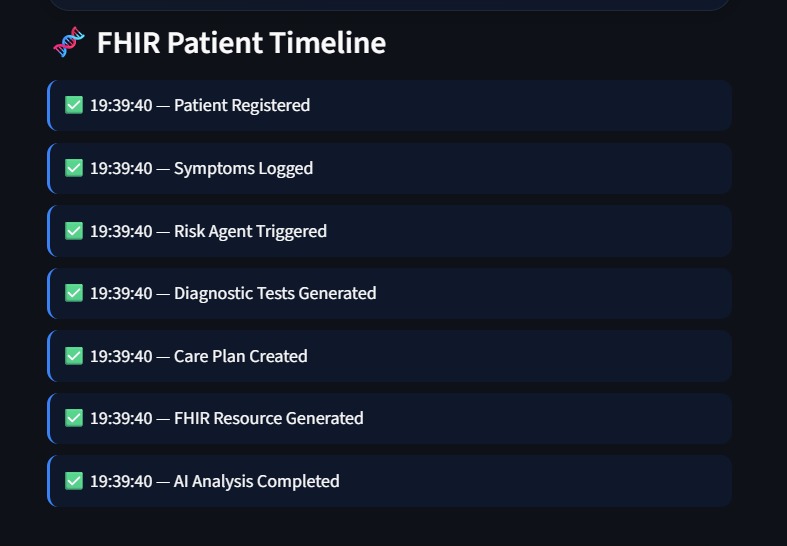
FHIR Patient Timeline
-

Structured PDF Report download feature
-
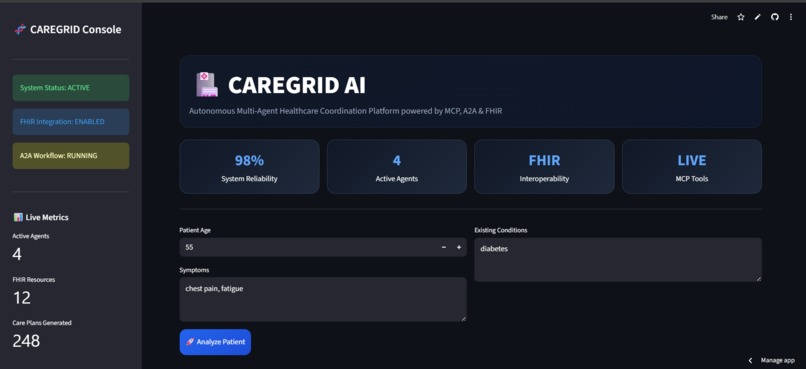
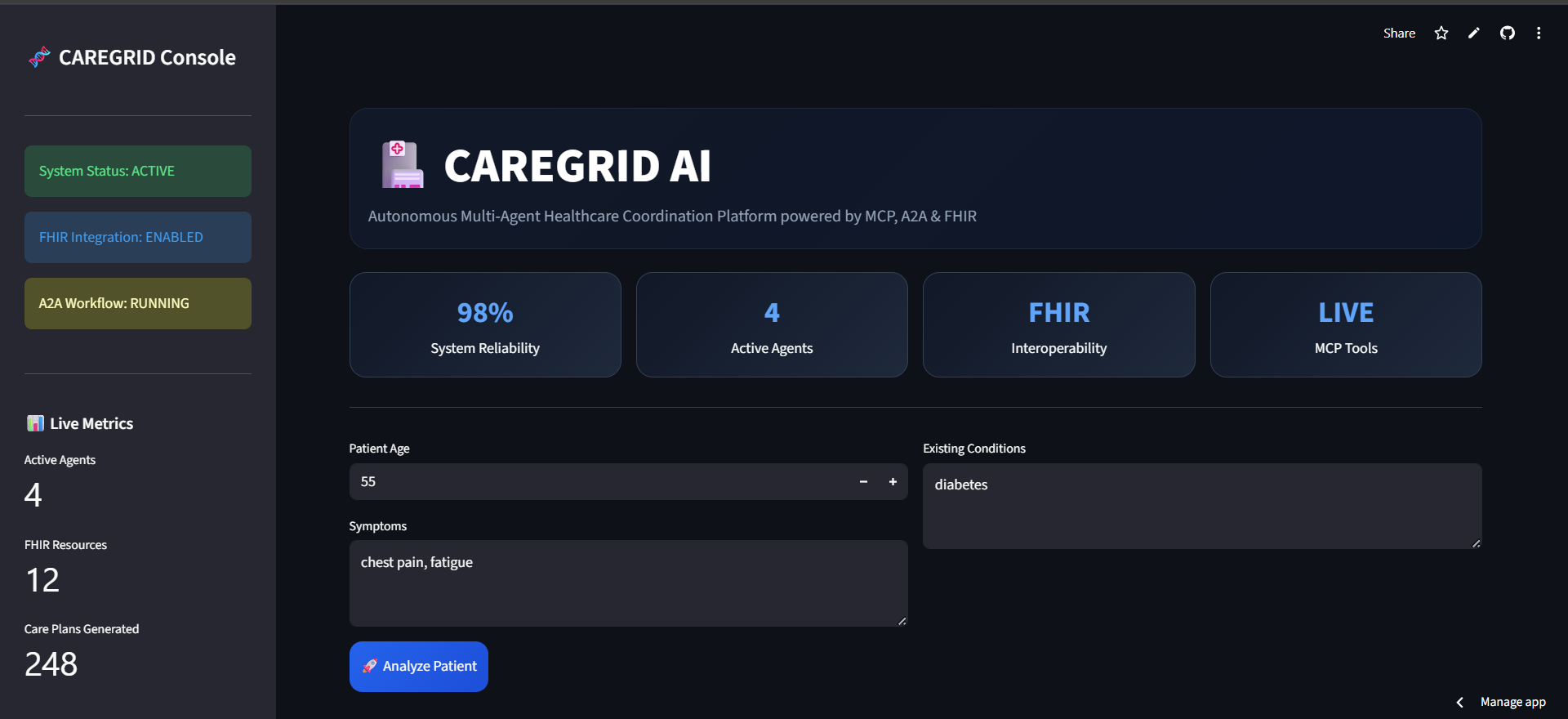
Main dashboard
-
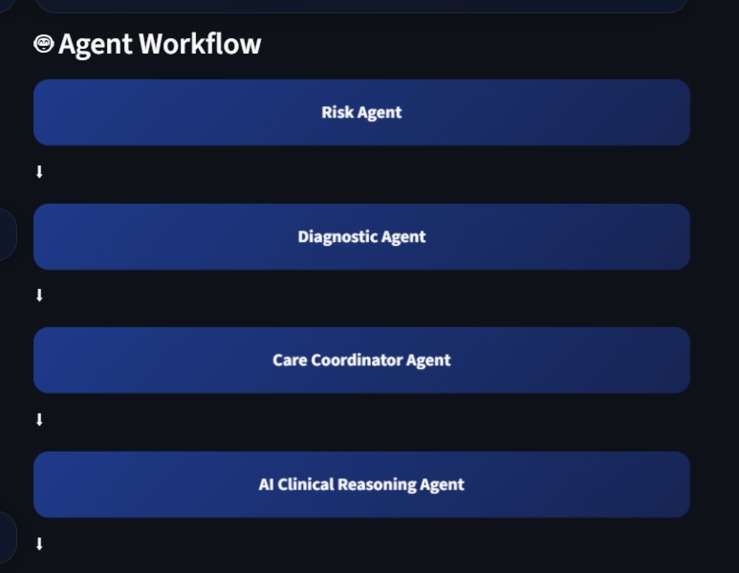
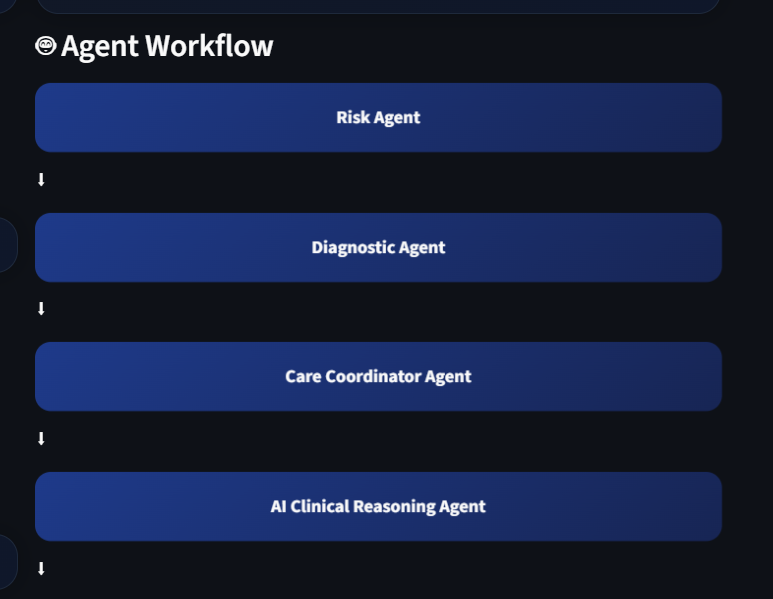
Agents workflow

Inspiration
Healthcare systems today are fragmented, reactive, and overloaded with disconnected workflows. Critical patient information often moves slowly between departments, tools, and professionals, causing delays in diagnosis, treatment, and care coordination.
We wanted to explore how interoperable AI agents could collaborate autonomously in real-time healthcare workflows using MCP, A2A architecture, and FHIR standards.
CAREGRID AI was inspired by the vision of a future healthcare ecosystem where specialized AI agents work together like a digital medical team — assessing risk, generating diagnostics, coordinating care, and structuring interoperable patient records seamlessly.
What it does
CAREGRID AI is an autonomous multi-agent healthcare coordination platform powered by MCP, A2A, and FHIR interoperability.
The platform allows multiple specialized healthcare agents to collaborate in a structured workflow:
- Risk Assessment Agent evaluates patient severity
- Diagnostic Agent recommends medical tests
- Care Coordinator Agent generates immediate care actions
- AI Clinical Reasoning Agent performs contextual healthcare analysis
- FHIR Engine structures interoperable healthcare resources
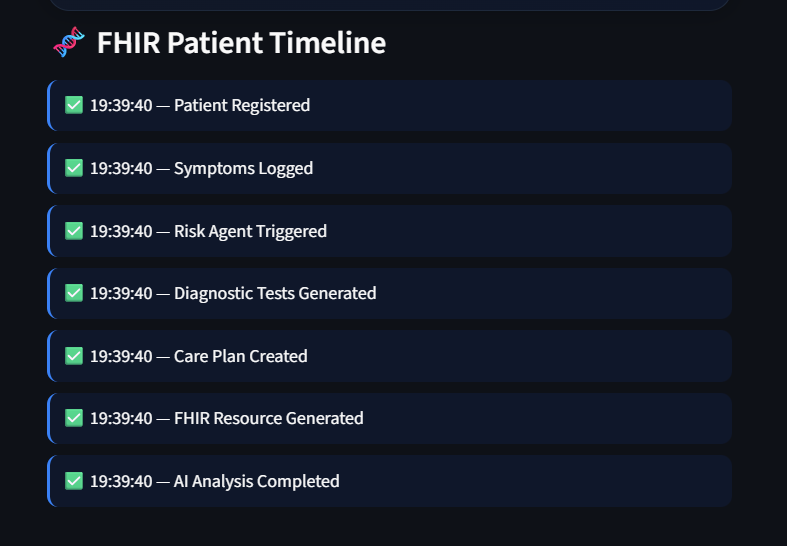
- Timeline Engine tracks the complete patient journey
The platform also includes:
- Emergency escalation detection
- AI-powered clinical reasoning
- Real-time healthcare workflow visualization
- Downloadable clinical PDF reports
- FHIR-compatible patient resources
- Interactive dashboard with live agent orchestration
CAREGRID AI demonstrates how interoperable healthcare agents can coordinate autonomously while maintaining standardized healthcare data exchange.
How we built it
We built CAREGRID AI using a modular multi-agent architecture.
Frontend
- Streamlit
- Custom CSS dashboard
- Interactive healthcare workflow visualization
- Dynamic clinical reporting interface
Backend
- FastAPI
- MCP-compatible API endpoints
- Modular healthcare agent orchestration
AI Layer
- Google Gemini API for clinical reasoning
- Context-aware healthcare analysis generation
Interoperability Layer
- FHIR structured patient resource generation
- Agent-to-Agent workflow simulation
- Timeline-based healthcare event orchestration
Additional Features
- Emergency escalation engine
- PDF clinical report export using ReportLab
- Workflow visualization dashboard
- Real-time patient timeline system
The entire system was designed around interoperability, modularity, and autonomous coordination between healthcare agents.
Challenges we ran into
One of the biggest challenges was designing a system that felt like a real interoperable healthcare platform rather than a simple AI chatbot.
We faced several technical challenges during development:
- Configuring Python virtual environments and dependency management
- Integrating AI reasoning reliably with backend workflows
- Structuring healthcare data into FHIR-compatible resources
- Designing multi-agent orchestration logic
- Creating a professional healthcare dashboard UI
- Managing API integration and environment variables
- Building a workflow visualization system that clearly demonstrated A2A coordination
Another challenge was balancing technical depth with usability and presentation quality within a hackathon timeframe.
Accomplishments that we're proud of
We are proud that CAREGRID AI evolved from a simple healthcare prototype into a polished interoperable healthcare coordination platform.
Key accomplishments include:
- Building a fully functional multi-agent healthcare workflow
- Successfully integrating MCP-style backend services
- Creating a visually polished healthcare operations dashboard
- Implementing AI-powered clinical reasoning
- Generating FHIR-compatible patient resources
- Building emergency escalation logic
- Adding professional downloadable clinical PDF reports
- Demonstrating end-to-end healthcare workflow orchestration
Most importantly, we created a system that clearly demonstrates the future potential of interoperable healthcare AI agents.
What we learned
This project taught us how important interoperability is in healthcare AI systems.
We learned:
- How MCP-based architectures can expose modular healthcare tools
- How agent-to-agent workflows can coordinate specialized AI tasks
- How FHIR standards help structure interoperable healthcare data
- How to design scalable healthcare system workflows
- How frontend storytelling and UX significantly improve technical demos
- How autonomous AI systems can simulate real healthcare coordination pipelines
We also gained valuable experience integrating AI reasoning with structured healthcare workflows in a production-style architecture.
What's next for CAREGRID AI
We plan to expand CAREGRID AI into a more advanced healthcare orchestration platform with:
- Real-time hospital workflow integration
- Advanced FHIR resource support
- Predictive patient deterioration monitoring
- Voice-enabled healthcare agents
- Multi-patient hospital coordination dashboards
- Live EHR integrations
- Secure clinician collaboration systems
- Real-time alert escalation pipelines
- Cloud deployment and marketplace integration
Our long-term vision is to create a scalable interoperable healthcare AI ecosystem where specialized agents collaborate seamlessly to improve patient outcomes and reduce healthcare coordination friction.

Log in or sign up for Devpost to join the conversation.